
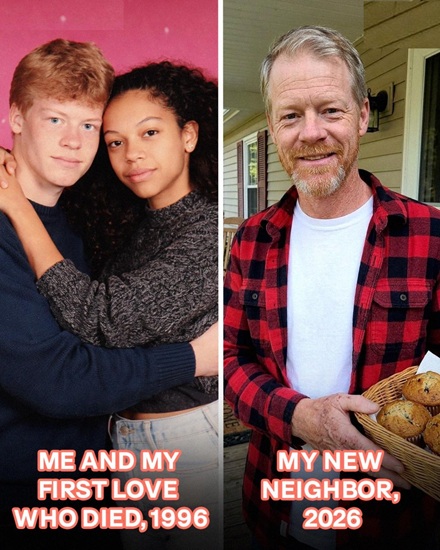
If I had not been stubborn about my hydrangeas that morning, I probably would have missed the moment that changed everything. A moving truck next door seemed ordinary, until the man stepping out looked like someone who had died thirty years earlier.
At first I told myself my eyes were playing tricks on me. Age, grief, and memory can combine in strange ways, especially when you spend decades carrying a ghost in your heart.
But the longer I watched from the edge of my garden, the harder it became to deny what I was seeing. The man unloading boxes next door moved with a familiar rhythm.
He leaned forward slightly when he walked, as if he was always hurrying toward something important. I remembered that posture from years ago, from a time when the world still felt wide and hopeful.
For a moment sunlight caught his face, highlighting the sharp line of his jaw and the calm steadiness in his eyes. My breath caught in my throat.
That face belonged to someone I had buried.
Thirty years earlier, Gabriel Laurent had died in a fire that destroyed his family’s summer house on the edge of town. At least that was the story everyone believed.
I had believed it too.
For decades I carried the memory of that night like a scar no one else could see. The flames, the smoke, the frantic shouting from neighbors who tried to help.

And the terrible phone call the next morning confirming what everyone feared.
Gabriel had not survived.
The moving truck door slammed shut next door, breaking the silence of the street. I realized my hands were trembling so badly that the gardening shears slipped from my fingers.
The metal blades clattered softly against the stone walkway.
The man turned slightly at the sound.
For a fraction of a second our eyes met across the narrow strip of lawn separating our houses. My heart hammered violently against my ribs.
Then I turned and hurried inside.
I closed the door behind me and immediately locked the deadbolt, as if that simple action could somehow protect me from the impossible sight outside.
My phone buzzed in my hand, the screen lighting up with a message from Janet.
Janet had been my closest friend since college. She checked on me constantly, especially during quiet mornings when she knew my thoughts sometimes drifted toward old memories.
But I ignored the message.
Instead I pressed my forehead against the cool wooden door and tried to slow my breathing.
It could not be Gabriel.
People do not return from funerals after three decades. Graves do not open quietly in the middle of suburban neighborhoods.
Still, the image refused to leave my mind.
Three days passed before I dared to look outside again.
During that time I became a stranger in my own home. I kept the curtains closed and moved carefully through the rooms so no one would see me watching from the windows.
Every time a car door slammed or footsteps crossed the driveway next door, my pulse quickened.
On the third night I sat alone at my kitchen table with an old yearbook open in front of me.
The pages had yellowed slightly with age, but the photographs still held the frozen expressions of teenagers who believed life would unfold exactly as they imagined.
My finger traced the image of Gabriel’s face on the page.
He had been smiling in that photograph, his arm draped casually across the back of my chair while we posed together for the camera.
We were inseparable during our final year of high school.
Most people in town expected us to marry someday.
Gabriel came from a wealthy family that owned several pharmaceutical companies across the country. His parents were known for their influence and strict expectations.
My family, on the other hand, owned a small repair shop near the highway.

My father fixed engines for farmers and delivery drivers while my mother handled the paperwork and bookkeeping.
Despite the difference in our backgrounds, Gabriel and I never thought about money or status when we were together.
We thought about music, long drives through the countryside, and the endless plans we made for a future we believed belonged entirely to us.
Sometimes we sat in his parents’ basement late at night talking about what life would look like after graduation.
He planned to study business in another state.
I planned to attend a local college and help expand my father’s repair shop into something bigger.
None of those plans survived the fire.
By the fourth morning after the moving truck arrived, I had almost convinced myself that the man next door was simply a stranger who resembled someone from my past.
That fragile certainty shattered when someone knocked on my front door.
Three slow, deliberate knocks echoed through the hallway.
I stood frozen in the kitchen for several seconds before forcing myself to walk toward the sound.
My hand hovered over the door handle while my heart pounded loudly in my ears.
“Who is it?” I called through the door, trying to keep my voice steady.
A calm male voice answered from the other side.
“It’s Elias. I just moved in next door. Thought I’d introduce myself properly.”
I opened the door only a few inches, keeping the security chain latched.
The man standing on the porch held a small basket in one hand.
Up close, the resemblance felt even stronger.
The same eyes.
The same shape of his mouth.
But the years had added deeper lines around his face, and there were faint marks along his cheek that looked like old scars.
“Hi,” I said carefully.
He smiled politely and lifted the basket slightly.
“I brought muffins,” he explained. “Figured I should make a good first impression before the homeowner association complains about my lawn.”
The attempt at humor sounded friendly and harmless.
Still, my stomach tightened as I studied his face.
Then his sleeve shifted slightly when he adjusted the basket in his hands.
The movement revealed part of his forearm.
The skin there looked different from the rest of his arm.
Some areas were smooth and tight, others slightly uneven, like healed grafts that had replaced something damaged long ago.
Near the inside of his forearm I noticed a faint, distorted scar.

The shape was unmistakable even after all these years.
A figure eight.
An infinity symbol.
Gabriel and I had gotten matching tattoos the summer before graduation. It was a reckless teenage decision, but at the time it felt meaningful.
We believed our relationship would last forever.
The fire had supposedly destroyed his body so badly that the funeral had been closed casket.
Yet the scar on the man’s arm matched the tattoo I remembered.
My throat tightened painfully.
Before I could stop myself, a single word escaped my lips.
“Gabe?”
The smile faded from his face instantly.
For a long moment neither of us spoke.
Then he sighed quietly, the sound heavy with years of exhaustion.
“You weren’t supposed to recognize me, Sammie,” he said softly.
Hearing my old nickname from his voice sent a wave of emotion crashing through me.
“But you deserve the truth,” he added.
My hands began trembling again.
“Gabriel… how are you here?” I whispered.
His eyes glistened slightly.
“That fire thirty years ago,” he said slowly, “wasn’t an accident.”
The words seemed to hang in the air between us.
Without thinking, I reached forward and unlatched the chain on the door.
Then I stepped aside.
“Come in,” I said quietly.
We sat at my kitchen table like strangers who shared a history neither of us fully understood anymore.
Out of habit I poured two cups of coffee, though neither of us drank much of it.
Gabriel kept staring at his hands as if searching for the right place to begin.
“I don’t even know where to start,” he admitted.
“Start with the fire,” I replied.
My voice felt stronger than I expected.
“Start with why we buried you.”
He nodded slowly, his jaw tightening.
“It wasn’t an accident,” he repeated.
The kitchen suddenly felt much smaller.
“What do you mean it wasn’t an accident?” I asked.
“My mother controlled everything after the fire,” he said quietly. “The investigation. The report. Even the dental records they used to identify the body.”

A chill moved through my chest.
“You’re saying your family staged your death?” I asked carefully.
Gabriel met my eyes.
“Yes.”
The word settled heavily between us.
“But there was a body,” I said. “The funeral director said they confirmed it through dental records.”
“There was a fire,” Gabriel admitted. “And someone did die that night. But the identification process can be manipulated if the right people are involved.”
My mind struggled to follow the explanation.
“My parents wanted me far away from you,” he continued. “They believed our relationship would damage the family reputation.”
I leaned back in my chair, trying to process what he was saying.
“That’s not just interference,” I said slowly.
“That’s deception on a massive scale.”
“I know,” Gabriel replied quietly.
“You let me think you were dead for thirty years,” I said.
The pain in my voice surprised both of us.
He lowered his head, unable to answer immediately.
For a long moment the only sound in the kitchen was the quiet ticking of the clock above the refrigerator.
Finally he looked up again.
“There’s a lot you don’t know about what happened after the fire,” he said softly.
And I realized the truth about that night was far more complicated than I had ever imagined.
For a long moment neither of us spoke. The silence between us carried the weight of thirty years—years filled with grief for me and, as I was beginning to understand, years of confusion and control for him.
Gabriel wrapped both hands around the coffee cup, though the coffee had already gone cold. His fingers trembled slightly as if the memories he was about to explain were still difficult to hold.
“After the fire,” he began slowly, “I didn’t understand what had happened. I remember smoke, heat, people shouting my name, and then nothing for a long time.”
He paused, pressing his thumb against the scar on his forearm as if grounding himself.
“The doctors later called it post-traumatic amnesia,” he continued. “Between the burns and the smoke inhalation, my brain simply shut down parts of my memory to survive.”
I listened carefully, trying to match his words with the image I had carried for decades: a boy lost forever in flames.
“My parents took me overseas almost immediately,” he said. “Switzerland. A private rehabilitation clinic that specialized in burn recovery and neurological trauma.”
He looked up briefly, studying my reaction.
“At first, I barely knew who I was,” he admitted. “The doctors said my mind was protecting itself from shock. Whole parts of my life were… blank.”
I folded my hands tightly together.
“You didn’t remember me?” I asked quietly.
“Not at first,” he said.
The honesty in his voice hurt more than I expected, though I knew it was not his fault.
“For months I struggled just to recognize my own reflection,” he continued. “My arms were wrapped in bandages, my lungs hurt whenever I breathed deeply, and everything smelled like antiseptic.”
He glanced down again.
“My mother controlled every visitor and every phone call,” he added. “She told the doctors that keeping me isolated would help me recover faster.”
I felt anger stirring beneath my confusion.
“She erased you from my life,” I said softly.
Gabriel nodded.
“And she erased you from mine,” he replied.
He explained that during the first year of treatment he rarely left the medical facility.
Physical therapy sessions filled most days, followed by psychological evaluations meant to measure how much of his memory had returned.
“At some point I started remembering small things,” he said.
“What kind of things?” I asked.
“Fragments,” he replied. “A laugh. A garage filled with tools. The feeling of riding in an old pickup truck down a country road.”
My chest tightened slightly.
“That was my father’s truck,” I whispered.
Gabriel nodded slowly.
“I know that now,” he said. “Back then I only knew the memories made me feel calm.”
He explained that whenever he mentioned those memories to his parents or doctors, the subject would change quickly.
“They said those images were probably dreams or misinterpretations,” he said. “They encouraged me to focus on building a new life instead of chasing half-remembered pieces of the past.”
The explanation sounded carefully rehearsed, like something he had repeated many times before.
“So you believed them?” I asked.
“For a while,” he admitted.
But as the years passed, pieces of his memory slowly returned.
Certain sounds, certain places, and even certain words would trigger flashes of recognition he could not fully explain.
“One of those memories involved a tattoo,” he said.
My heart skipped.
“The infinity symbol,” he added quietly.
He pulled his sleeve back slightly, revealing the scarred shape again.
“It took years before I understood what it meant,” he said.
I reached across the table instinctively, my fingers hovering above the faded mark.
“We got them together,” I said softly. “In a tiny shop outside town. We were convinced it made us invincible.”
A faint smile touched Gabriel’s lips.
“I think part of me remembered that feeling even before I remembered you,” he said.
But whenever he asked his parents about the tattoo, they dismissed it as a youthful mistake from before the fire.
“They said the symbol had no real significance,” he explained.
I shook my head slowly.
“They were trying to erase the proof that we existed,” I said.
Gabriel’s expression darkened slightly.
“Yes,” he replied.
He went on to describe how his life slowly transformed into something tightly controlled.
After his physical recovery improved, he was moved from the clinic to a private residence owned by his family.
There were always assistants nearby.
Sometimes they were nurses monitoring his health.
Other times they were staff members responsible for scheduling his education and daily routines.
“At first I thought they were helping,” he said.
“But eventually I realized I was being supervised.”
He attempted to leave the property several times during his early twenties.
Each attempt ended the same way.
Someone from his family would find him quickly and convince him to return.
“They told me I wasn’t ready to live independently yet,” he explained.
The frustration in his voice was clear.
“I tried running away twice during the first year after leaving the clinic,” he said.
“What happened?” I asked.
“They found me both times,” he replied. “After that they made sure someone was always nearby.”
My hands tightened around the edge of the table.
“Even as an adult?” I asked.
He nodded.
“Even as an adult.”
Eventually his mother encouraged him to adopt a new identity.
“Elias Laurent,” he said.
The name sounded strange when spoken aloud.
“She told me it would help me move forward without being haunted by the past,” he explained.
Instead, it allowed her to control every part of his future.
For years Gabriel worked within the family’s pharmaceutical business under that new name.
He attended meetings, reviewed company reports, and slowly built a professional reputation separate from the life he had once lived.
But the fragments of his past continued returning.
“A photograph changed everything,” he said quietly.
He reached into his jacket pocket and pulled out a small envelope.
Inside was an old photograph with slightly worn edges.
When he placed it on the table, I felt tears fill my eyes.
It showed two teenagers standing close together in a cluttered basement workshop.
Both of us were laughing at something just outside the frame.
Our arms were wrapped around each other’s shoulders.
And on both forearms, clearly visible, were the matching infinity tattoos.
“I kept this hidden for years,” Gabriel said softly.
“It was the only piece of my past that no one could take away from me.”
I traced the edge of the photograph carefully with my finger.
“You remembered me because of this?” I asked.
“Eventually,” he said.
The memories returned slowly after he found the picture among some of his old belongings that had been stored in a family archive.
“At first I only recognized the tattoo,” he explained.
“Then the garage. Then your laugh.”
My chest tightened again.
“And then you remembered the fire?” I asked.
“Yes,” he replied.
He described waking suddenly one night with the smell of smoke in his memory.
Flames crawling along wooden beams.
Voices shouting in panic.
His father pulling him toward a door while smoke filled the hallway.
But the clearest memory was not the fire itself.
It was his mother standing outside afterward, speaking urgently with a lawyer while ambulances flashed red lights across the lawn.
“She looked relieved,” Gabriel said quietly.
That moment planted the first real doubt in his mind.
Over the following years he began quietly collecting information about the fire and the investigation that followed.
Legal documents.
Medical records.
Insurance reports.
Each discovery revealed small inconsistencies.
“The more I looked, the more obvious it became that the official story had been carefully arranged,” he said.
But it still took decades before he could challenge his mother directly.
“What changed?” I asked.
“My father,” he replied.
Gabriel explained that his father’s health had begun declining several years earlier.
During one late-night conversation, the older man admitted something important.
“He told me the fire had started accidentally,” Gabriel said.
“But the cover-up afterward was deliberate.”
According to his father, Gabriel’s mother had insisted on staging his death because she believed my presence in his life would damage their family reputation.
“She convinced everyone involved that disappearing was the only way to protect the company,” he said.
My stomach twisted painfully.
“So she erased you… just to control your future,” I said.
Gabriel nodded slowly.
“When my father passed away last year, I finally gained access to several legal documents he had hidden,” he explained.
Those documents confirmed the truth.
And they also gave him the authority to access his original identity again.
“That’s when I decided to come back here,” he said.
“To the place where everything started.”
I stared at him for a long moment.
“And you moved in next door to me?” I asked.
He gave a small, embarrassed smile.
“I didn’t know it was your house until the moving truck arrived,” he admitted.
Despite everything, I felt a quiet laugh escape my throat.
After thirty years of silence, fate had placed us on opposite sides of the same driveway.
But the story was far from finished.
Because one person still believed she controlled every piece of Gabriel’s life.
And soon she would learn that the past she buried was no longer willing to stay hidden.
The days after Gabriel told me the truth passed with a strange mixture of excitement and unease. Thirty years of silence had ended, yet the future ahead of us felt uncertain and fragile.
We met quietly most evenings on my back porch where the tall wooden fence shielded us from curious neighbors. The quiet space allowed us to speak freely without worrying who might overhear.
At first our conversations were cautious. Decades of separation had created distance that could not disappear overnight, even though our memories still fit together like pieces of the same puzzle.
We spoke about ordinary things before returning to the difficult subjects. Gabriel described his years working under the name Elias and the strange feeling of living a life that never truly belonged to him.
I told him about my own past, including the marriage that eventually ended after we both realized we had built it on unfinished grief rather than genuine partnership.
My former husband had never known the girl who once laughed in a basement workshop beside Gabriel. That part of me had been buried with the closed casket years earlier.
One evening Gabriel brought another envelope to our meeting on the porch. Inside were copies of legal documents, medical records, and several letters written by his father shortly before his death.
“These prove what really happened,” Gabriel explained quietly. “My father kept them hidden for years. He wanted someone to know the truth eventually.”
I studied the papers carefully. They described the original fire investigation, the unusual identification process used for the body, and the legal arrangements that allowed Gabriel to disappear overseas.
The evidence confirmed everything he had told me.
More importantly, it showed that his father had begun regretting the deception long before his death.
“He tried to protect me while I was recovering,” Gabriel said softly. “But he also knew my mother had gone too far.”
A week passed before the next unexpected development.
I was standing by the curb collecting my mail when Mrs. Harlan, the unofficial leader of our homeowner association, approached with her usual overly cheerful smile.
“Good morning, Sammie,” she said brightly. “Your new neighbor seems… interesting.”
I forced a polite smile in return.
“He’s still settling in,” I replied carefully.
Before our conversation could continue, a sleek black sedan turned slowly into the cul-de-sac.
The polished car immediately drew attention from several neighbors who were watering lawns or walking dogs nearby.
When the passenger door opened, a familiar woman stepped out.
Camille Laurent.
Even after thirty years she carried herself with the same careful elegance that had intimidated half the town when we were teenagers.
Her silver hair was styled perfectly, and her tailored coat suggested she had arrived directly from an important meeting somewhere.
But the moment her eyes landed on Gabriel’s house, the warmth in her expression felt carefully staged.
“Elias,” she called loudly.
The name echoed through the quiet street.
Gabriel stepped out of his front door a few seconds later, his shoulders tense the moment he recognized who had arrived.
Camille’s gaze shifted briefly toward me.
“Sammie, dear,” she said smoothly, as if greeting an old acquaintance at a social event. “It’s been many years.”
Her voice remained polite, but something cold flickered beneath the surface.
“I heard my son moved into the neighborhood,” she continued. “I just wanted to make sure he’s adjusting well.”
Mrs. Harlan’s cheerful curiosity vanished immediately as she sensed the tension forming between us.
Gabriel stepped forward, clearly uncomfortable with the scene unfolding in front of several neighbors.
“I’m fine, Mother,” he said calmly.
Camille ignored the tone of his voice.
“Elias has been recovering from a difficult medical history,” she told the small audience now watching from nearby driveways.
“Sometimes people who have experienced trauma begin confusing memories with reality.”
Her eyes slid toward me again.
“Grief can make people see familiar faces where they don’t truly exist.”
The implication was obvious.
She was suggesting that my recognition of Gabriel was nothing more than emotional confusion.
I felt anger rising slowly in my chest, but Gabriel spoke before I could respond.
“Stop,” he said firmly.
The single word carried more strength than anything he had said since returning to town.
Camille’s expression tightened slightly.
“Stop talking about me like I’m not standing here,” Gabriel continued.
The neighbors pretended to focus on their gardening or mailboxes, but no one actually left.
Everyone sensed that something important was unfolding.
Camille lowered her voice slightly, though the warning inside it remained clear.
“You’re not thinking clearly,” she said quietly to Gabriel. “And certain people around here are encouraging that confusion.”
Her eyes moved toward me again.
“You would be wise to keep your distance,” she added softly.
I stepped forward before Gabriel could respond.
“I know exactly who he is,” I said.
For the first time since arriving, Camille’s carefully maintained smile faltered.
Mrs. Harlan glanced between us, clearly realizing this was no ordinary neighborhood disagreement.
Camille recovered quickly.
“I only want what’s best for my son,” she said calmly.
“But if this situation continues, legal documents may be necessary.”
The threat hung heavily in the air.
Gabriel’s jaw tightened, but he remained silent until Camille finally returned to her car.
The sedan pulled away slowly, leaving an uneasy quiet behind.
Later that evening Gabriel and I met again on the back porch.
Neither of us spoke for several minutes.
“She’s watching,” he finally said.
“I know,” I replied.
The presence of the black sedan returned several times over the following days.
Sometimes it parked briefly at the corner before driving away.
Other times it simply passed through the neighborhood without stopping.
Each appearance reminded us that Camille still believed she controlled the situation.
One evening Gabriel brought out the old photograph again.
The image of our teenage selves smiling confidently at the camera felt almost unreal compared to the complicated lives we had lived since then.
“I kept this picture hidden for years,” he said quietly.
“It reminded me that I had once been someone else.”
I studied the photograph carefully.
“You still are that person,” I told him.
“You just spent a long time living under someone else’s expectations.”
Gabriel looked uncertain.
“My mother has lawyers, influence, and decades of experience controlling every situation,” he said.
I reached across the table and took his hand.
“Then we stop letting her control the story,” I replied.
He studied my face carefully.
“You’re serious,” he said.
“Yes,” I answered.
For the first time since the moving truck arrived next door, determination replaced the confusion inside me.
“We expose the truth,” I continued.
“You reclaim your name, your history, and the life that was taken from you.”
Gabriel took a slow breath.
“And if she fights back?” he asked.
“She will,” I said honestly.
“But this time she won’t be fighting alone.”
At that moment Janet stepped onto my porch carrying a large folder under her arm.
She had always possessed perfect timing when trouble appeared.
“Good,” she said, dropping the folder on the table.
“Because I’ve already started making phone calls.”
Gabriel looked surprised.
Janet opened the folder, revealing several organized documents and notes.
“If Camille Laurent thinks she can keep a thirty-year secret forever,” she said with a confident grin, “she’s about to learn how quickly the truth travels.”
Gabriel glanced at me, uncertainty still lingering in his eyes.
I squeezed his hand gently.
“You’re not alone anymore,” I reminded him.
Janet leaned back in her chair and crossed her arms.
“So,” she said with determination, “are we ready to tell the world what really happened thirty years ago?”
I looked at Gabriel, not the identity his mother had created, but the boy I once loved and the man who had finally returned.
For the first time in decades, the past no longer felt like a prison.
It felt like a story waiting to be corrected.
“Let’s do it,” I said.
And this time, no one would be able to rewrite the truth.
