
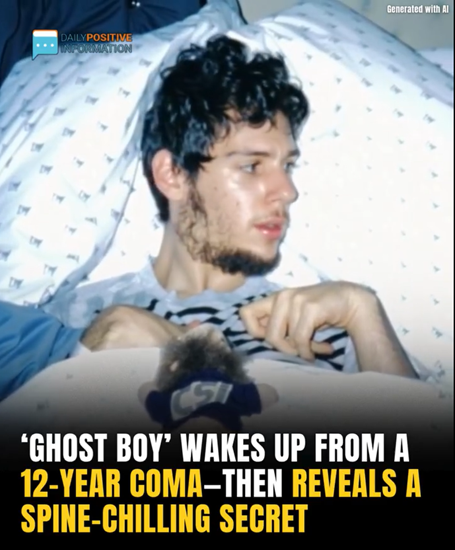
Imagine being fully aware yet unable to move, speak, or make anyone, even yourself, realize your presence. For some, this terrifying scenario is not imagination—it is reality.
Martin Pistorius, a boy from South Africa, faced this unimaginable condition beginning at the age of twelve. A mysterious neurological illness gradually stripped him of speech and motor control.
Initially, doctors, teachers, and family assumed he had entered an unusual coma. Despite appearances, Martin remained fully conscious, observing everything without any ability to communicate.
For years, he existed silently, a mind fully alive within a body that refused to respond. Each passing day deepened his isolation, as he remained trapped yet entirely aware of the world.
The transition from unconsciousness to awareness was gradual. Martin recalls, “It wasn’t like I suddenly woke up; awareness came slowly, leaving me in a strange, in-between state.”

As he became increasingly aware, the frightening truth emerged: he was locked inside his own body, powerless to express thoughts, feelings, or even basic needs.
Family and caregivers assumed he remained unresponsive. This misunderstanding compounded his isolation, creating a sense of invisibility that profoundly affected his emotional state.
Despite immobility, Martin’s mind stayed active. He witnessed family conversations, school events, and daily interactions, fully comprehending but unable to participate or respond.
Psychologically, the experience was torturous. Awareness without agency brought frustration, anxiety, and despair, forcing Martin to confront the limits of patience and resilience at a young age.
Medical professionals eventually began to suspect something more complex than a typical coma. Martin’s condition, however, continued to baffle experts for many years.
Locked-in syndrome, the condition affecting Martin, is rare. Individuals retain full cognitive abilities but cannot move or communicate voluntarily, resulting in extreme isolation and psychological strain.
Martin’s cognitive clarity remained intact despite immobility. His intellect, memory, and emotional depth persisted, underscoring that consciousness is not always externally visible.
He gradually found ways to communicate using adaptive technology. Eye-tracking devices and computer-assisted systems allowed him to express thoughts, bridging the gap between mind and external reality.
The communication system translated minimal movements into speech or text, providing Martin with an essential tool to reconnect with the outside world and regain a degree of independence.
Mobility returned gradually as well. Martin learned to walk, defying medical expectations, although he never regained natural speech. His voice now exists through assistive devices, a testament to technology and perseverance.
Martin’s story resonated globally. His interviews, including one with NBC News, have been viewed by over ten million people, inspiring audiences with his courage and resilience.

He authored Ghost Boy: My Escape from a Life Locked Inside My Own Body, published by Simon & Schuster. The book details his internal experiences and eventual reconnection with the world.
The memoir offers an intimate perspective on life trapped within a body, detailing both psychological struggles and the step-by-step journey toward communication and partial mobility.
His experiences highlight the importance of patience, support, and technological innovation in the lives of those with severe neurological impairments.
Martin emphasizes that early recognition and intervention are critical. Families and caregivers play a vital role in observing subtle signs of awareness in patients presumed unresponsive.
His advocacy extends beyond personal narrative, raising awareness about locked-in syndrome and encouraging medical research and societal understanding.
Adaptive technologies, such as eye-tracking software and voice synthesizers, have revolutionized the lives of those with severe physical limitations, as exemplified by Martin’s journey.
Despite extreme physical constraints, Martin maintains a rich intellectual and emotional life, demonstrating that identity, thought, and consciousness are not bound by physical mobility.
His personal life also flourishes. Living in Essex, UK, he runs his own business from home, showcasing professional independence and entrepreneurial skills.
Martin is married and maintains close personal relationships, proving that meaningful social connections and love are attainable even in the face of significant physical challenges.

The gradual restoration of agency required immense perseverance. Years of small successes—eye movements, selective attention, and adaptive communication—culminated in a regained voice and autonomy.
Martin’s story illuminates the gap between medical assumptions and lived reality. Outward appearances can mislead observers about the true cognitive state of patients with neurological disorders.
His life demonstrates the essential role of emotional support in recovery. Caregivers, family, and therapists provided encouragement and innovative solutions that allowed communication and gradual reconnection.
Martin’s narrative emphasizes resilience. Even years of immobility and inability to speak could not extinguish his sense of self, highlighting the extraordinary strength of the human spirit.
He has become a symbol of hope, illustrating that mental clarity, purpose, and adaptability can persist despite severe physical limitations.
Through his book and public appearances, Martin advocates for awareness, research, and improved adaptive technologies, fostering understanding of rare neurological conditions globally.
He also challenges societal perceptions of disability, demonstrating that the human mind and personality remain active even when the body is unable to express them.
Martin’s achievements, including his professional endeavors and personal relationships, redefine independence and show that capability is not solely determined by physical function.
Psychologically, his journey underscores the importance of coping strategies, patience, and the inner life of individuals facing extreme isolation due to neurological impairments.
His story has prompted further exploration into locked-in syndrome, encouraging medical, technological, and social interventions to support patients with similar conditions.

Martin’s experiences illustrate the delicate balance between cognitive presence and physical absence, showing how the mind navigates awareness without agency.
Even while immobile, he maintained hope, self-reflection, and a sense of connection to the world, highlighting resilience as a key aspect of survival in extreme conditions.
His memoir provides a guide to understanding internal life in paralysis, offering insight into psychological and emotional strategies for coping with long-term immobility.
Martin’s narrative serves as a lesson in human determination, emphasizing that consciousness and identity persist despite severe physical challenges, inspiring countless readers and viewers.
The story of his gradual recovery—learning to communicate and walk—demonstrates the power of persistence, innovation, and patient support in overcoming extreme limitations.
Through technology, determination, and community support, Martin regained a sense of agency, highlighting how adaptive solutions can transform lives in profound ways.
Martin Pistorius remains an enduring example of courage, patience, and innovation. His life underscores that even in extreme adversity, purpose, communication, and fulfillment are achievable.
His journey reminds society that invisible challenges require empathy, awareness, and technological assistance to enable those with severe neurological conditions to participate meaningfully in life.
Ultimately, Martin’s story is a triumph of the human spirit. He overcame extreme isolation, regained independence, and now inspires millions worldwide to appreciate resilience, hope, and determination.
The narrative serves as a beacon for families, patients, and medical professionals, highlighting how consciousness, patience, and technology can create opportunities even in dire circumstances.
Martin’s life proves that identity, intellect, and emotional depth remain intact despite prolonged physical immobility, offering hope to those facing seemingly insurmountable challenges.
His story continues to inspire advocacy, research, and the development of assistive technologies, demonstrating that human resilience combined with innovation can overcome the most extreme limitations.
By sharing his experiences, Martin Pistorius ensures that those trapped in similar conditions are seen, understood, and supported, providing a voice for the voiceless and hope for the invisible.
