
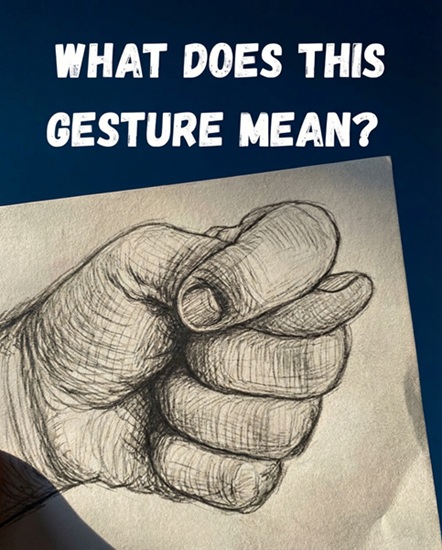
At first glance, a hand held in a fist may seem ordinary, almost unremarkable. Yet, a closer observation reveals a subtle, almost secretive adjustment: the thumb tucked tightly between the index and middle fingers.
This small but deliberate positioning transforms an otherwise simple hand into a gesture that has carried remarkable social and symbolic meaning across cultures, centuries, and generations.
In English, this gesture is commonly referred to as “making a fig,” a phrase that hints at its rich cultural lineage and varied interpretations.
What may appear humorous or trivial today was once a serious and deliberate form of communication. In eras before widespread literacy, instant messaging, or visual media, gestures like the fig provided a discreet way to convey emotion, intention, or defiance.
A single motion could refuse a demand, signal disagreement, express playful resistance, or deliver a quiet “not happening” without a word being spoken. The fig gesture was more than a playful motion; it was a form of nuanced social dialogue, a tool for subtle communication that could navigate the complexities of human relationships.

Origins and Early Cultural Context
The fig gesture has deep historical roots, particularly in European and Mediterranean cultures, though similar expressions have been documented globally. Anthropologists trace its earliest mentions to communities in Italy, Eastern Europe, and parts of the Balkans. Its precise origins are difficult to pinpoint, as the gesture likely developed organically in multiple locales over centuries.
In Italy, the gesture is known as mano in fica, literally “hand in fig.” It was historically employed both as a playful insult and as a protective charm against malevolent forces or bad luck. Folklore suggests that the hidden thumb symbolized a form of mystical power, serving as a safeguard against envy or the “evil eye.”
In Russia, the gesture is referred to as kuvyn’ka, historically used to express refusal, reject bribes, or deliver subtle mockery toward authority figures. Across these regions, the gesture carried layers of social and spiritual meaning, balancing humor, resistance, and protection in a single, easily executed act.
During the 19th century, the English term “the fig” emerged, likely influenced by travel, cross-cultural exchange, and the adoption of Italian and Slavic customs. In European villages, where daily life was tightly woven with communal observation, overt dissent or criticism could carry serious consequences.
The fig gesture allowed individuals to communicate disagreement discreetly, providing a socially acceptable outlet for resistance without endangering personal safety or reputation.
Symbolism Beyond the Gesture
The fig gesture is deceptively simple in its physicality: a closed fist, thumb concealed between fingers. Yet, anthropologists and folklorists emphasize that this simplicity belies its symbolic depth. The closed fist represents hidden strength, control, and resilience.
Hiding the thumb adds a layer of significance, interpreted in some traditions as a protective measure that enhances the hand’s power—both literally and spiritually.
Across folk traditions, the thumb has long been associated with personal power. Concealing it within the fist was believed to shield the individual from harm, ward off misfortune, and assert control over situations in which verbal resistance was impossible. This dual function—social defiance and mystical protection—elevated the fig gesture from mere play to a culturally sanctioned act of empowerment.

By merging physical concealment with symbolic meaning, the gesture allowed people to communicate multiple messages simultaneously. It could signal humor, rejection, resilience, or quiet courage, often all at once.
In a world where social hierarchies were rigid and the repercussions for overt challenge could be severe, the fig gesture offered an elegant solution: resistance wrapped in subtlety, a shielded assertion of agency visible only to those attuned to its code.
The Gesture in Daily Life and Family Settings
Over time, the fig gesture moved from public spaces to intimate social contexts, embedding itself in family life, childhood play, and informal social interactions. Grandparents and older relatives often passed it down as a playful tool, a way to tease children, assert minor authority, or respond to everyday challenges.
In childhood games, the gesture functioned as a secret language. A child could communicate determination, refusal, or solidarity without confrontation or verbal explanation.
Similarly, parents or older siblings might employ the gesture to express reassurance, subtle discipline, or encouragement. Its versatility made it valuable for navigating social boundaries, family hierarchies, and interpersonal play.
For example, in some Italian or Eastern European households, children might use the fig gesture before a sibling challenge, signaling courage or defiance.
Conversely, parents might offer the same gesture to console a child or signal silent understanding during moments of emotional uncertainty. In this way, the fig gesture was both a playful social tool and a symbol of emotional literacy, teaching children that communication could be subtle yet meaningful.
Humor and Defiance in Social Settings
One of the enduring appeals of the fig gesture is its blend of humor and defiance. Unlike overt protest or insult, which could provoke tension or retaliation, the fig allowed individuals to assert themselves while preserving social harmony.
In historical European villages, workers might discreetly perform the gesture to politely reject unreasonable requests from landlords or authority figures.
In marketplaces or local fairs, subtle hand movements could communicate intricate social dynamics without escalating conflict. Siblings, neighbors, and friends could challenge one another or signal disagreement playfully, maintaining relationships even while asserting personal boundaries.
The effectiveness of the gesture lay in its subtlety. It could be executed quickly, hidden easily, and silently understood by those familiar with its meaning. To outsiders, it appeared innocuous, yet for insiders, it conveyed a clear and deliberate message. This duality—publicly discreet, privately communicative—was central to its longevity and social function.

Cultural Variations Across the Globe
While most strongly associated with European traditions, variations of the fig gesture appear in other parts of the world. In Turkey, a similar gesture, known as nah, has historically accompanied playful teasing, signaling gentle refusal or humorous mockery.
In parts of South America, Africa, and Asia, subtle hand movements with hidden or folded fingers have been used to communicate refusal, protest, or minor defiance.
Even within Europe, the gesture’s meaning varies. In Italy, it could carry mildly obscene connotations, while in Eastern Europe, it was primarily humorous or protective. In Russia, it was sometimes used to reject bribes or dishonest propositions. These variations illustrate the gesture’s adaptability: a single physical movement can evolve across regions, acquiring new cultural layers while retaining its core function of subtle, socially intelligent communication.
While the fig gesture thrived for centuries as a subtle, clever, and socially significant form of communication, its presence in modern daily life has diminished. With the rise of mass literacy, instant messaging, social media, and emoji-based communication, gestures like this no longer serve as essential social tools.
The immediacy and visual richness of digital media allow people to convey rejection, humor, and irony with words, images, or animations—making the discreet fig gesture appear quaint, even antiquated.
Yet, the decline of the gesture does not diminish its historical and cultural significance. In fact, its rarity today makes it an important cultural artifact: a window into the ways past societies navigated complex interpersonal, social, and even political landscapes.
For historians, anthropologists, and folklorists, the fig gesture represents the ingenuity of human expression before the dominance of verbal and digital communication. It demonstrates how gestures were used not only to communicate but to maintain relationships, assert agency, and negotiate social boundaries with subtlety and grace.
Lessons in Nonverbal Communication
The fig gesture underscores the enduring power of nonverbal communication. Across centuries and cultures, humans have relied on subtle hand movements, facial expressions, and body language to convey ideas that words alone might inadequately express.

Gestures like the fig can communicate multiple layers of meaning simultaneously: humor, resistance, playfulness, caution, or solidarity.
Modern studies of nonverbal communication highlight several key lessons drawn from gestures like this:
- Nuance Matters: A simple movement can convey complex social meaning without speech. The fig gesture could express defiance toward authority, reassurance to peers, or playful teasing, all depending on context.
- Subtlety is Powerful: Unlike overt confrontation, subtle gestures allow individuals to communicate effectively while avoiding direct conflict. The fig gesture exemplifies how discreet actions can maintain social harmony while asserting personal boundaries.
- Shared Understanding is Essential: Nonverbal gestures rely on cultural codes. Insiders understand the message; outsiders may miss it entirely. The fig gesture’s efficacy depended on collective knowledge and shared social norms.
- Integration with Emotion and Ritual: Beyond mere communication, gestures can carry emotional significance. The fig gesture could comfort children, reinforce familial bonds, or provide a small sense of control in hierarchical settings.
Through these lessons, the gesture demonstrates that effective communication is often as much about how something is expressed as it is about what is expressed.
Humor, Resistance, and Social Intelligence
One of the most remarkable aspects of the fig gesture is its combination of humor and resistance. Humor functions as a social lubricant, softening potentially tense interactions while still allowing a clear statement to be made.
Across generations, the fig gesture allowed individuals—children, workers, or common folk—to push back against authority, reject demands, or assert autonomy without provoking direct conflict.
In households, it served a dual role. Children used it as a playful act of rebellion, while adults occasionally employed it as a gentle corrective signal. Humor made the act socially acceptable, transforming potential tension into a shared understanding of playful defiance.
Historical anecdotes illustrate this point: in 18th- and 19th-century European villages, a peasant might discreetly make the gesture when a landlord made an unreasonable demand, conveying refusal without inviting reprisal.
Similarly, market vendors could reject unfair trade proposals with a subtle fig, maintaining dignity and social cohesion. The gesture became a tool of social intelligence, allowing people to navigate complex hierarchies and relationships skillfully.
The Fig Gesture as a Cultural Artifact
Today, the fig gesture is largely a relic, preserved in memory, folklore, and academic study. Scholars of anthropology, history, and cultural studies often cite it in examinations of nonverbal social tools, childhood play, and traditional methods of interpersonal negotiation.
Its appearance in literature, art, and oral histories further underscores its importance. In Italian folk stories, for example, the hidden thumb often accompanies tales of clever peasants or witty children overcoming minor adversities. In Russian folklore, it signals moral lessons about honesty, cleverness, or social cunning.
Across these narratives, the gesture embodies creativity, resilience, and subtlety—qualities highly valued in communities where overt confrontation could be risky or socially disruptive.
In this sense, the fig gesture represents more than a simple hand motion: it is a historical record of social norms, psychological insight, and cultural ingenuity. Its continued study reminds us that human societies have always relied on rich, nonverbal forms of communication to navigate relationships, enforce social expectations, and maintain cohesion.
Modern Echoes and Symbolic Resonance
While rarely used in contemporary practice, the fig gesture continues to inspire reflection on human behavior, communication, and resilience. Its symbolic resonance remains powerful, particularly in a modern context dominated by speed, visibility, and digital noise.
In an age where words, notifications, and social media dominate expression, the fig gesture teaches enduring lessons about the value of subtlety. Sometimes, the most effective messages are quiet, deliberate, and unspoken. A small thumb tucked between fingers can communicate defiance, solidarity, or humor far more efficiently—and memorably—than a tweet, text, or social post.
Its legacy extends into psychological and sociological understanding as well. The gesture illustrates how humans historically balanced power dynamics, maintained dignity, and expressed autonomy without direct confrontation. In families, communities, and workplaces, the fig gesture offered a discreet yet potent way to navigate social complexities, a lesson that remains relevant even in the age of instant communication.
Creativity, Agency, and Cultural Memory
The fig gesture is also a testament to human creativity. Across centuries, it shows how simple actions can be transformed into culturally significant symbols. From playful childhood teasing to subtle forms of resistance in hierarchical settings, the gesture allowed people to exercise agency while maintaining social cohesion.
Furthermore, it demonstrates the importance of cultural memory. Though seldom seen today, the gesture’s story is preserved in literature, folk narratives, and oral histories. These accounts ensure that the wisdom embedded in seemingly minor actions is not lost, highlighting how small, ordinary behaviors can carry extraordinary social and cultural significance.
By studying and remembering gestures like the fig, we honor the ingenuity of past societies, their nuanced understanding of social interaction, and their ability to communicate complex ideas without words. It reminds us that human expression is multifaceted, adaptive, and endlessly creative.
Conclusion: Subtlety as Strength
In the modern world, dominated by volume, speed, and constant visibility, the fig gesture stands as a reminder of the power of subtlety. Though largely replaced by digital communication, its history offers enduring lessons:
- Strength in Quiet Resistance: The gesture shows that one does not need to be loud or confrontational to assert boundaries or resist pressure.
- Humor as a Social Tool: Playful defiance can coexist with social harmony, maintaining relationships while communicating autonomy.
- Nonverbal Intelligence: Subtle movements, carefully executed, can communicate multiple layers of meaning, enriching human interaction beyond what words alone can achieve.
- Cultural Continuity: Even as practices fade, remembering gestures like the fig connects us to historical ways of thinking, feeling, and interacting.
Ultimately, the fig gesture embodies resilience, creativity, and the clever navigation of social dynamics. Its hidden thumb carries a story centuries in the making: a story of humor, defiance, protection, and human ingenuity.
Though rare in contemporary society, it continues to inspire reflection on communication, relationships, and subtle forms of strength. It reminds us that sometimes, silence can speak louder than speech—and that a small, hidden thumb can convey more than a thousand words.
For scholars, storytellers, and curious minds, the fig gesture is far more than a quaint tradition; it is a lens through which we can view the subtle, ingenious, and deeply human ways people have expressed emotion, asserted autonomy, and navigated social life across generations.
While the fig gesture thrived for centuries as a subtle, clever, and socially significant form of communication, its presence in modern daily life has diminished. With the rise of mass literacy, instant messaging, social media, and emoji-based communication, gestures like this no longer serve as essential social tools.
The immediacy and visual richness of digital media allow people to convey rejection, humor, and irony with words, images, or animations—making the discreet fig gesture appear quaint, even antiquated.
Yet, the decline of the gesture does not diminish its historical and cultural significance. In fact, its rarity today makes it an important cultural artifact: a window into the ways past societies navigated complex interpersonal, social, and even political landscapes.
For historians, anthropologists, and folklorists, the fig gesture represents the ingenuity of human expression before the dominance of verbal and digital communication. It demonstrates how gestures were used not only to communicate but to maintain relationships, assert agency, and negotiate social boundaries with subtlety and grace.
Lessons in Nonverbal Communication
The fig gesture underscores the enduring power of nonverbal communication. Across centuries and cultures, humans have relied on subtle hand movements, facial expressions, and body language to convey ideas that words alone might inadequately express. Gestures like the fig can communicate multiple layers of meaning simultaneously: humor, resistance, playfulness, caution, or solidarity.
Modern studies of nonverbal communication highlight several key lessons drawn from gestures like this:
- Nuance Matters: A simple movement can convey complex social meaning without speech. The fig gesture could express defiance toward authority, reassurance to peers, or playful teasing, all depending on context.
- Subtlety is Powerful: Unlike overt confrontation, subtle gestures allow individuals to communicate effectively while avoiding direct conflict. The fig gesture exemplifies how discreet actions can maintain social harmony while asserting personal boundaries.
- Shared Understanding is Essential: Nonverbal gestures rely on cultural codes. Insiders understand the message; outsiders may miss it entirely. The fig gesture’s efficacy depended on collective knowledge and shared social norms.
- Integration with Emotion and Ritual: Beyond mere communication, gestures can carry emotional significance. The fig gesture could comfort children, reinforce familial bonds, or provide a small sense of control in hierarchical settings.
Through these lessons, the gesture demonstrates that effective communication is often as much about how something is expressed as it is about what is expressed.
Humor, Resistance, and Social Intelligence
One of the most remarkable aspects of the fig gesture is its combination of humor and resistance. Humor functions as a social lubricant, softening potentially tense interactions while still allowing a clear statement to be made.
Across generations, the fig gesture allowed individuals—children, workers, or common folk—to push back against authority, reject demands, or assert autonomy without provoking direct conflict.
In households, it served a dual role. Children used it as a playful act of rebellion, while adults occasionally employed it as a gentle corrective signal. Humor made the act socially acceptable, transforming potential tension into a shared understanding of playful defiance.
Historical anecdotes illustrate this point: in 18th- and 19th-century European villages, a peasant might discreetly make the gesture when a landlord made an unreasonable demand, conveying refusal without inviting reprisal.
Similarly, market vendors could reject unfair trade proposals with a subtle fig, maintaining dignity and social cohesion. The gesture became a tool of social intelligence, allowing people to navigate complex hierarchies and relationships skillfully.
The Fig Gesture as a Cultural Artifact
Today, the fig gesture is largely a relic, preserved in memory, folklore, and academic study. Scholars of anthropology, history, and cultural studies often cite it in examinations of nonverbal social tools, childhood play, and traditional methods of interpersonal negotiation.
Its appearance in literature, art, and oral histories further underscores its importance. In Italian folk stories, for example, the hidden thumb often accompanies tales of clever peasants or witty children overcoming minor adversities.
In Russian folklore, it signals moral lessons about honesty, cleverness, or social cunning. Across these narratives, the gesture embodies creativity, resilience, and subtlety—qualities highly valued in communities where overt confrontation could be risky or socially disruptive.
In this sense, the fig gesture represents more than a simple hand motion: it is a historical record of social norms, psychological insight, and cultural ingenuity. Its continued study reminds us that human societies have always relied on rich, nonverbal forms of communication to navigate relationships, enforce social expectations, and maintain cohesion.
Modern Echoes and Symbolic Resonance
While rarely used in contemporary practice, the fig gesture continues to inspire reflection on human behavior, communication, and resilience. Its symbolic resonance remains powerful, particularly in a modern context dominated by speed, visibility, and digital noise.
In an age where words, notifications, and social media dominate expression, the fig gesture teaches enduring lessons about the value of subtlety.
Sometimes, the most effective messages are quiet, deliberate, and unspoken. A small thumb tucked between fingers can communicate defiance, solidarity, or humor far more efficiently—and memorably—than a tweet, text, or social post.
Its legacy extends into psychological and sociological understanding as well. The gesture illustrates how humans historically balanced power dynamics, maintained dignity, and expressed autonomy without direct confrontation. In families, communities, and workplaces, the fig gesture offered a discreet yet potent way to navigate social complexities, a lesson that remains relevant even in the age of instant communication.
Creativity, Agency, and Cultural Memory
The fig gesture is also a testament to human creativity. Across centuries, it shows how simple actions can be transformed into culturally significant symbols. From playful childhood teasing to subtle forms of resistance in hierarchical settings, the gesture allowed people to exercise agency while maintaining social cohesion.
Furthermore, it demonstrates the importance of cultural memory. Though seldom seen today, the gesture’s story is preserved in literature, folk narratives, and oral histories. These accounts ensure that the wisdom embedded in seemingly minor actions is not lost, highlighting how small, ordinary behaviors can carry extraordinary social and cultural significance.
By studying and remembering gestures like the fig, we honor the ingenuity of past societies, their nuanced understanding of social interaction, and their ability to communicate complex ideas without words. It reminds us that human expression is multifaceted, adaptive, and endlessly creative.
Conclusion: Subtlety as Strength
In the modern world, dominated by volume, speed, and constant visibility, the fig gesture stands as a reminder of the power of subtlety. Though largely replaced by digital communication, its history offers enduring lessons:
- Strength in Quiet Resistance: The gesture shows that one does not need to be loud or confrontational to assert boundaries or resist pressure.
- Humor as a Social Tool: Playful defiance can coexist with social harmony, maintaining relationships while communicating autonomy.
- Nonverbal Intelligence: Subtle movements, carefully executed, can communicate multiple layers of meaning, enriching human interaction beyond what words alone can achieve.
- Cultural Continuity: Even as practices fade, remembering gestures like the fig connects us to historical ways of thinking, feeling, and interacting.
Ultimately, the fig gesture embodies resilience, creativity, and the clever navigation of social dynamics. Its hidden thumb carries a story centuries in the making: a story of humor, defiance, protection, and human ingenuity.
Though rare in contemporary society, it continues to inspire reflection on communication, relationships, and subtle forms of strength. It reminds us that sometimes, silence can speak louder than speech—and that a small, hidden thumb can convey more than a thousand words.
For scholars, storytellers, and curious minds, the fig gesture is far more than a quaint tradition; it is a lens through which we can view the subtle, ingenious, and deeply human ways people have expressed emotion, asserted autonomy, and navigated social life across generations.
