
The modern car interior embodies the pinnacle of digital minimalism. Touchscreens, haptic controls, and acoustic glass create a quiet, sleek environment, replacing the once-familiar physical buttons, levers, and tactile interactions of the past.
For younger drivers born into an era of automation, the center console often appears empty. A rotary dial or small toggle may be the only manual control, with much of the vehicle’s functionality now governed silently by software.
In contrast, drivers from the late twentieth century relied heavily on mechanical interfaces. The gear shifter was a tangible representation of the vehicle’s internal state. Each notch and letter signified a deliberate choice affecting performance and behavior.
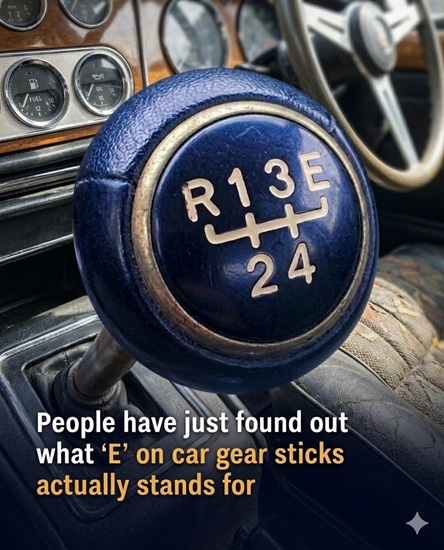
Among the familiar “P” for Park, “R” for Reverse, “N” for Neutral, and “D” for Drive, there existed a letter often forgotten today: “E.” To modern observers, it may appear like an obsolete relic, yet it has a rich historical significance.

During the 1980s and early 1990s, “E” stood for “Economy.” Born from the memory of fuel crises and skyrocketing gasoline prices, it symbolized careful management of fuel consumption without compromising the joy of driving.
Engaging the “E” mode meant altering the car’s mechanical rhythm. Early electronic control units or hydraulic systems modified shift points, encouraging the transmission to reach higher gears earlier for reduced RPMs and maximum fuel efficiency.
Drivers immediately noticed the difference. The engine’s roar softened to a hum, acceleration became measured, and fuel consumption decreased. Every decision was a partnership between human intention and mechanical response.
Economy mode discouraged aggressive driving habits. Sudden kick-downs and rapid overtaking maneuvers were counteracted by a system that encouraged smooth acceleration, cultivating patience and precision in the driver’s handling style.
Some vehicles incorporated throttle modulation. Pressing the accelerator more forcefully produced a gradual increase in power rather than sudden surges, teaching drivers to adjust their input carefully and reinforcing the principle of deliberate energy use.

This hands-on approach allowed drivers to consciously influence their environmental impact. Unlike modern “set-and-forget” strategies, the physical “E” required active participation, turning fuel economy into a mechanical mindfulness exercise.
Not all cars featured an Economy mode, but in those that did, it shaped driving culture. It taught restraint, attention, and mechanical understanding, creating an intimate connection between the driver and the vehicle’s powertrain.
By the 2020s, the physical “E” gear position disappeared almost entirely. Its purpose was absorbed into the automated systems of modern vehicles, making manual selection redundant as computers optimized efficiency continuously.
Today’s vehicles process hundreds of real-time variables: throttle input, weight distribution, road incline, tire pressure, fuel type, and even driver stress patterns, allowing engines and transmissions to operate at peak efficiency automatically.
Modern gearboxes, including multi-speed and continuously variable transmissions, eliminate the need for manual intervention. Cars calculate optimal shift points autonomously, ensuring fuel or energy consumption is minimized without human input.

The disappearance of the “E” reflects a broader philosophical shift. Where once drivers actively managed energy, cars now internalize this responsibility, prioritizing convenience, efficiency, and sustainability seamlessly through integrated systems.
Aerodynamic design, lightweight materials, and low-rolling-resistance tires further reduce the relevance of a dedicated economy gear. Cars are now conceived holistically for efficiency, from design sketches to software programming.
Hybrid vehicles continue this evolution. Internal combustion engines cooperate with electric motors, regenerative braking, and advanced energy storage systems to deliver optimal performance and consumption with minimal driver effort.
Yet the “E” has made a symbolic return in electric vehicles. In modern EVs, “E” represents Electric or e-Pedal mode, reflecting a paradigm shift from conserving liquid fuel to managing electrical energy intelligently.
Selecting “E” in an EV can activate regenerative braking. Drivers may rarely touch the traditional brake pedal, as the car recaptures kinetic energy efficiently, extending battery range and delivering smooth deceleration automatically.
The EV “E” also signals the presence of a silent electric motor, replacing mechanical noise with invisible torque. This subtle shift underscores how far automotive propulsion has evolved while retaining the legacy of efficiency.

The letter has thus completed a full cycle: once a mechanical tool to conserve fuel, it now symbolizes the forefront of clean transportation, sustainability, and intelligent energy management in the modern age.
Looking back at classic vehicles, the “E” serves as a bridge between generations. It connects drivers who understood machines through tactile and auditory cues with a generation relying on digital intelligence and automated efficiency.
The tactile satisfaction of engaging Economy mode cannot be understated. Sliding the lever into “E” communicated intent, awareness, and responsibility, embedding energy-conscious behavior directly into the act of driving.
Although the lever has vanished, its philosophy endures. Modern hybrids and EVs embody the same principle: maximize energy use efficiency while minimizing waste, though guided now by algorithms rather than mechanical feedback.
The evolution of “E” also highlights society’s growing emphasis on sustainability. Early fuel crises taught drivers the importance of conscious energy use, a lesson now embedded in the design of cars from the chassis to software algorithms.
In hybrid and electric systems, energy management is continuous. Acceleration, braking, and power distribution are constantly optimized, echoing the intent of the mechanical “E” without requiring deliberate human intervention.

“E” also reflects the changing nature of driver engagement. Whereas early drivers experienced efficiency physically, modern drivers participate mentally, trusting software to harmonize performance, safety, and energy conservation seamlessly.
Every EV with an “E” mode embodies this philosophy. Energy-efficient driving, silent propulsion, and intelligent regeneration ensure that the principle of responsible mobility continues, maintaining the spirit of the original Economy mode.
Even in fully autonomous vehicles, the legacy of “E” persists. Automated algorithms constantly calculate the most efficient routes, speeds, and regenerative energy use, demonstrating that conscious resource management remains a core design principle.
From a historical perspective, the “E” illustrates how technology transforms interaction. It bridges mechanical understanding, where human touch dictated efficiency, with intelligent automation, where software orchestrates energy conservation invisibly.
The story of “E” also underscores continuity. Across decades, its essence remains: achieving more with less. The methods evolve, but the philosophy—maximizing efficiency while maintaining performance—remains central to automotive engineering.
Classic Mercedes-Benz or Volvo models with “E” levers exemplify this. Each selection required deliberate engagement, teaching patience and attentiveness, creating a tangible awareness of energy expenditure and mechanical behavior.
Conversely, modern electric “E” modes illustrate efficiency at scale. Drivers guide the car, but intelligent systems continuously optimize output, demonstrating the evolution from mechanical action to digital orchestration.
The disappearance of the old “E” lever symbolizes progress that is both invisible and profound. Automation quietly handles efficiency, but the principle—minimizing energy consumption and environmental impact—remains deeply embedded in automotive culture.
Even as cars become smarter, the intent behind “E” is preserved. Hybrid systems, regenerative braking, and electric motors all carry forward the mission of responsible energy use, echoing lessons from decades past.
Ultimately, the “E” represents more than a gear position. It is a narrative of technological evolution, societal change, and the enduring desire to harmonize mobility with energy efficiency and environmental responsibility.
From mechanical economy mode to intelligent electric management, “E” connects the past and present. It reflects a journey in which human action and machine intelligence work together toward sustainable, efficient, and enjoyable driving.
