
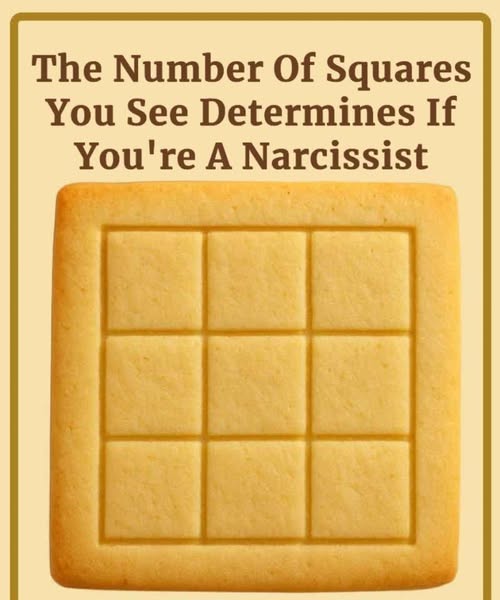
An unassuming grid has taken social media by storm, attracting thousands of curious participants worldwide. Its appeal lies in the way a simple image combines visual challenge with playful self-reflection, drawing users into a surprisingly intricate mental exercise.
The caption, stating “The number of squares you see determines if you’re a narcissist,” instantly transforms the visual from an ordinary pattern into a compelling psychological prompt, encouraging both introspection and social interaction.
At first glance, the puzzle seems trivial, prompting a quick count of visible squares. Yet, this immediate simplicity masks a deeper challenge that tests patience, attention to detail, and individual perception strategies.
Viewers often re-examine the grid multiple times, discovering additional squares hidden in larger combinations. This process encourages focus, persistence, and iterative thinking, turning a casual glance into a more mindful exploration.

Why This Puzzle Grips Attention
The puzzle’s viral nature reflects universal human curiosity. People are naturally drawn to self-assessment, even in playful formats, especially when something as mundane as visual counting promises insight into personal traits.
By blending a counting challenge with a humorous personality label, the image encourages participants to evaluate not only what they see but also how their perception might reflect thought patterns, attention, and cognitive style.
This subtle invitation to reflect often engages participants before they even begin counting, as viewers wonder whether their results will reveal something meaningful about their own mindset and decision-making tendencies.
The Counting Challenge
Most participants initially identify nine small squares. These obvious units are immediately visible and provide a sense of achievement, creating initial engagement while drawing attention to the simpler elements of the structure.
Upon closer inspection, additional squares emerge as smaller sections combine to form medium and larger shapes. Detecting these requires concentration and patience, revealing the cognitive benefits of sustained focus.
Eventually, the entire grid forms a single large square. Including all possibilities, the total number of squares reaches fourteen, challenging participants to expand their perception beyond first impressions and initial assumptions.
Interpretations of Your Count
Playful interpretations accompany different counting ranges. Seeing six to eight squares suggests an easy-going, relaxed observer who prioritizes simplicity and immediate impressions rather than exhaustive detail.

Counting nine to eleven squares is linked to analytical tendencies. These individuals scrutinize patterns carefully, balancing intuition and logic, reflecting a structured approach to problem-solving in both visual and real-world contexts.
Identifying twelve to fourteen squares often signals strong attention to detail. Humorously, it is associated with perfectionism or self-centered tendencies, demonstrating the puzzle’s use of playful exaggeration to encourage sharing and discussion.
The Role of Humor in Engagement
The reference to narcissism is intended to amuse rather than judge. By framing the challenge with a humorous label, the puzzle becomes a social conversation starter and encourages participants to share results across platforms.
Humor lowers barriers to participation. It allows viewers to engage freely without fear of criticism while simultaneously making the activity memorable, relatable, and enjoyable for a wide audience across age groups.
Emotional and Cognitive Dynamics
Participants’ reactions reveal as much as the counts themselves. Satisfaction, frustration, curiosity, or amusement each reflect unique cognitive and emotional styles, highlighting patience, resilience, and attention to process over mere outcome.
Some experience pride upon identifying all fourteen squares, while others may feel momentary frustration when hidden squares are overlooked. Humor often diffuses this tension, keeping engagement light and enjoyable.
The puzzle demonstrates how people navigate challenges, revealing differences in approach and cognitive flexibility, whether detail-oriented, globally focused, or somewhere in between.

Perception Styles Illustrated
The exercise exemplifies contrasts between global and detail-oriented thinking. Global observers see overarching structures quickly, while detail-focused participants analyze components methodically to understand the complete pattern.
Neither approach is superior; both offer valuable insights into human cognition. Many participants naturally combine these strategies, switching between big-picture and granular perspectives to solve the puzzle effectively.
This dynamic illustrates how perception is not fixed. Changing focus, perspective, and attention can reveal previously unnoticed details, emphasizing the fluidity and adaptability of human cognition.
Symbolic Depth of the Grid
Beyond counting, the grid can symbolize life organization. Each square may represent personal priorities such as career, relationships, health, or hobbies, reflecting whether one focuses on parts individually or on holistic connections.
Detail-oriented individuals may emphasize single areas, while global thinkers notice interactions among components. This metaphor adds depth, transforming the puzzle into a tool for self-awareness and contemplation of life balance.
By blending cognitive challenge with symbolic reflection, the puzzle encourages viewers to consider how they structure attention, manage priorities, and approach complex problems in daily life.
Curiosity Drives Engagement
The puzzle’s viral appeal is fueled by curiosity. Individuals are compelled to explore beyond first impressions, testing their observation skills and engaging in iterative problem-solving to uncover hidden elements.

This engagement reflects a broader learning mindset: openness to exploration, active observation, and a desire to question assumptions. Such curiosity promotes mental agility, creativity, and sustained cognitive focus.
The open-ended nature of the challenge ensures a unique experience for each participant, making the puzzle feel personal and encouraging repeated attempts to improve perception skills and analytical ability.
Social Dynamics and Sharing
Social sharing amplifies engagement. Users compare results, debate interpretations, and discuss personality implications online, creating dynamic communal interactions that extend far beyond the initial image.
Its inclusivity allows participation without prior expertise or preparation. Anyone can count squares and engage in conversation, making the puzzle accessible and appealing to diverse audiences across generations.
Shared results and discussions strengthen community bonds while reinforcing the puzzle’s virality. The combination of simple mechanics and social interaction exemplifies how minimalistic content can achieve widespread appeal.
Cognitive Exercise Hidden in Play
Although presented as entertainment, the puzzle is a subtle cognitive exercise. It trains observation, pattern recognition, iterative thinking, and awareness of perceptual strategies in an engaging, low-pressure environment.
Combining visual elements with playful psychological insight encourages critical thinking and reflective cognition, providing benefits beyond entertainment while remaining approachable and enjoyable for all participants.
Continuous Conversation
The puzzle endures because answers vary across individuals. The central question—how many squares do you see?—generates ongoing dialogue, comparisons, and reinterpretations that maintain participant interest over time.

Its combination of challenge, reflection, and humor ensures participants return to test perception and compare results, keeping social media discussions lively, engaging, and repeatedly shareable.
Conclusion: Insight Through Engagement
Ultimately, the square puzzle demonstrates that simple visuals can yield profound cognitive and social insights. Observation, patience, and reflection combine with humor to make the challenge enjoyable, thought-provoking, and widely shareable.
It emphasizes curiosity and flexibility in perception. Each participant learns not only about visual patterns but also about how their mind approaches tasks, highlighting the interplay between cognition, emotion, and social interaction.
By blending entertainment with subtle self-reflection, the puzzle becomes more than a counting exercise. It is an engaging exploration of attention, perception, and personality, providing insight and amusement simultaneously.
As the puzzle continues to circulate, participants are reminded that even the most minimalistic visual can foster discussion, reflection, and cognitive engagement, creating a uniquely interactive and enjoyable experience.
