

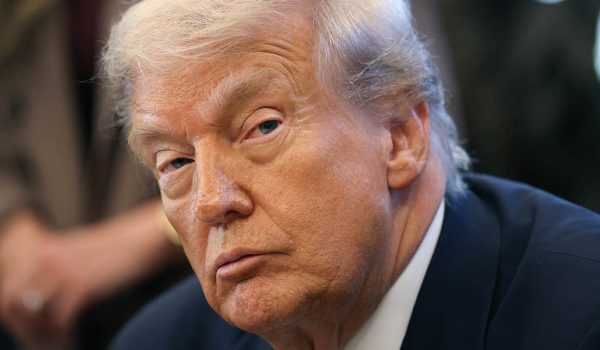
President Donald Trump’s health has repeatedly attracted public and media attention — partly because he often insists he is vigorous and energetic, and partly because he is the oldest person ever elected to the U.S. presidency.
Trump will be 80 years old in June 2026, and questions occasionally arise about what would transpire if a sitting U.S. president were to die in office. Hypothetical scenarios are frequently discussed in political commentary.
While speculation can be sensational, the reality is that the U.S. Constitution and federal law contain very clear, well‑established procedures for presidential death, incapacity, removal, or resignation.
If a president dies while serving, the vice president automatically becomes president according to the U.S. Constitution and the Twenty‑fifth Amendment.
The relevant constitutional text states that “in case of the removal of the President from office, or of his death, resignation, or inability to discharge the powers and duties of the said office, the same shall devolve on the Vice President.”
The Twenty‑fifth Amendment, ratified in 1967, codified this line of succession and clarified long‑standing presidential transition practices.
Under Section 1 of the Amendment, if the president dies, the vice president immediately becomes president with full constitutional authority, rather than merely acting president.
That means—in the unlikely event Trump died while serving—the first official action would be Vice President J.D. Vance taking the oath of office as president, assuming he were still the vice president at that time.
The transition is designed to occur quickly and seamlessly so that there is no gap in leadership or authority, a crucial factor for national security and governmental continuity.
Once sworn in, the new president gains full powers and responsibilities of the office and can make policy decisions, issue executive orders, and lead both domestic and foreign affairs.
One of the immediate responsibilities of a new president is appointing a new vice president if the office is vacant, subject to confirmation by both the House of Representatives and the Senate.
This confirmation process ensures that the new vice president has the support of Congress before assuming the vice presidency.
Another important consideration after succession is the presidential term limits under the Twenty‑second Amendment.
According to that amendment, a vice president‑turned‑president may be elected to two full terms, but only if they served less than two years of their predecessor’s term before taking office.
If the new president serves more than two years of the original term, they can be elected only once more under the constitutional term limits.
The formal constitutional succession plan extends beyond the vice president. If both the president and vice president were unable to serve simultaneously, the Presidential Succession Act designates the next officials in line.
After vice president, the line includes the Speaker of the House, the President pro tempore of the Senate, followed by cabinet secretaries in a specific order.
These protocols ensure continuity even in extremely unlikely scenarios where multiple leaders become incapacitated or die.
Historically, it is uncommon for a U.S. president to die in office, but it has happened eight times in American history.
Four presidents—Abraham Lincoln, James A. Garfield, William McKinley, and John F. Kennedy—were assassinated while serving.
Other presidents such as William Henry Harrison, Zachary Taylor, Warren G. Harding, and Franklin D. Roosevelt died from illness or natural causes while in office.
When President John F. Kennedy was assassinated in 1963, Vice President Lyndon B. Johnson was sworn in as president aboard Air Force One within hours, setting a modern example for orderly succession.
Although modern medical care and presidential health protocols have reduced the frequency of such events, the constitutional mechanisms remain ready for any emergency.
In addition to death, the Twenty‑fifth Amendment also provides procedures if a president becomes incapacitated but not deceased, allowing for temporary transfer of authority to the vice president.
Section 3 of the Amendment allows a president to voluntarily transfer power—such as during medical procedures—by informing Congress in writing.
Section 4 allows the vice president and a majority of the Cabinet to declare a president unable to discharge duties if necessary.
These provisions were added to ensure stability and continuity during any period of presidential vulnerability.
Criticism, speculation, or predictions about any president’s personal health—even when amplified online—do not alter these constitutional procedures.
For his part, Trump and his physicians have publicly stated he remains physically and cognitively capable of fulfilling his duties, with recent checkups indicating overall fitness and monitoring of specific conditions.
The White House has also acknowledged common age‑related conditions such as chronic venous insufficiency, while affirming that Trump continues to carry out his presidential responsibilities.
Despite age‑related discussion and occasional speculative commentary from pundits or critics, the constitutional succession plan is straightforward, comprehensive, and designed to avoid confusion.
Public discourse about a president’s health is longstanding in American politics, seen in debates over transparency and norms for sharing medical information.
But what matters legally is not speculation, but the clear constitutional framework that governs presidential continuity.
The transition process is not only ceremonial; it ensures that one individual is always vested with the full authority to lead the United States.
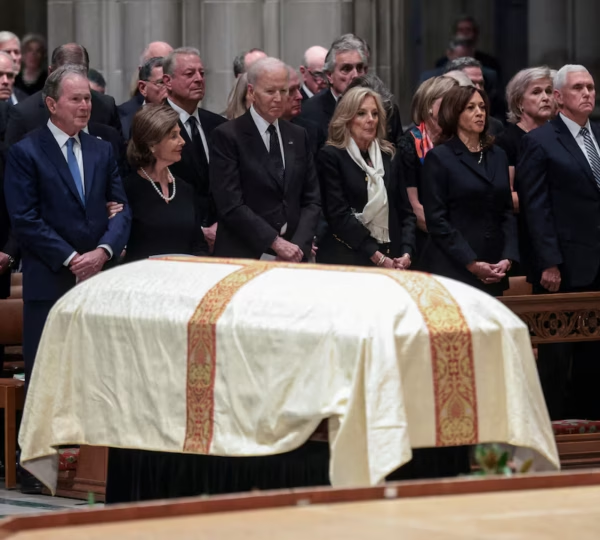
A president’s death would be met with ceremonial honors, public mourning, and national reflection, but it would also trigger an automatic and structured transfer of power to preserve governance.
This framework underscores the resilience of American constitutional design, preventing power vacuums and instability even in moments of crisis.
Ultimately, while Trump’s age and health may remain subjects of public curiosity, the constitutional process for succession is clear, robust, and time‑tested.
Whether in times of everyday governance or sudden transitions, the system is built to ensure continuity of leadership and uphold the rule of law.

