
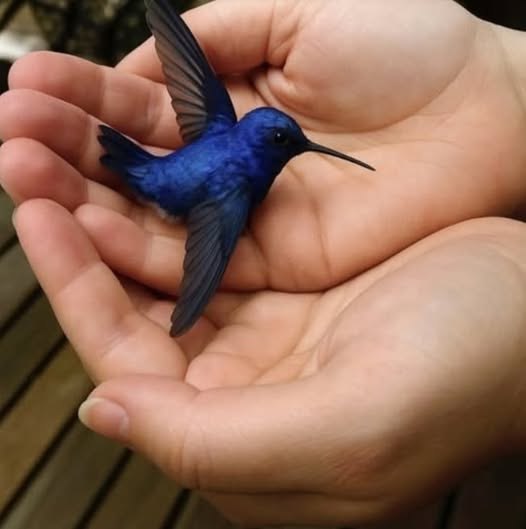
Across many cultures and historical periods, the hummingbird has been admired not only for its dazzling appearance but also for the subtle way its presence can transform a moment.
These small birds—some species measuring only 7–8 centimeters (about 3 inches) in length—embody an extraordinary combination of speed, precision, endurance, and delicacy.
Their feathers shimmer with iridescent color, flashing emerald, ruby, sapphire, or violet depending on the angle of the light. This optical brilliance does not come primarily from pigment but from microscopic structures in the feathers that refract and reflect light, producing colors that shift as the bird moves. The effect is so striking that even a brief glimpse can feel like a pause in time.
Hummingbirds belong to the family Trochilidae and are found exclusively in the Americas, from southern Alaska to Tierra del Fuego in Chile and Argentina. There are more than 300 recognized species, with the greatest diversity occurring in tropical regions of Central and South America.
Despite their tiny size—some species weigh less than a nickel—hummingbirds possess biological capabilities that are unmatched in the avian world. They can hover in midair, fly backward, and even upside down for short moments. Their wings beat at astonishing speeds: depending on the species, between roughly 10 and 80 beats per second. During courtship displays, some species can beat their wings even faster.
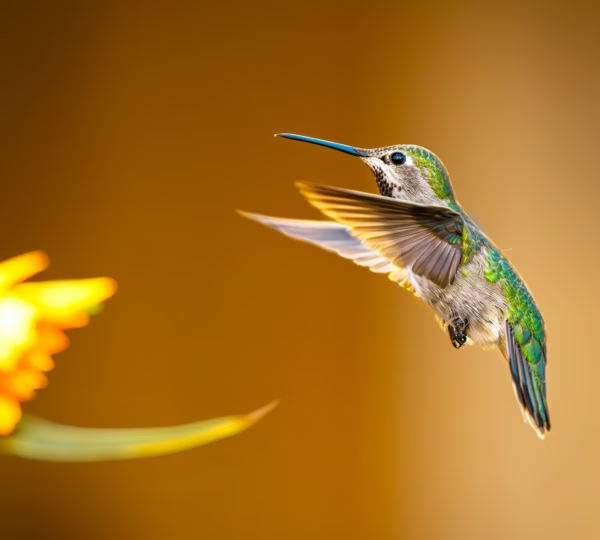
Yet it is not only their speed that captures attention. It is the paradox they represent: intense motion paired with apparent stillness. When a hummingbird hovers before a flower, its wings blur into invisibility, but its body remains suspended with remarkable precision.
This visual contradiction—frenetic movement enabling perfect balance—has inspired symbolic interpretations across generations. Observers often describe a sense of wonder or calm while watching one feed. Even in busy urban environments, a hummingbird’s arrival can shift perception, drawing focus away from distractions and toward a single, luminous point of life.
Scientific Foundations of a Natural Marvel
From a biological perspective, hummingbirds are among the most specialized birds on Earth. Their ability to hover is made possible by a unique ball-and-socket shoulder joint that allows the wings to rotate in a full circle. Unlike most birds, which generate lift primarily on the downstroke, hummingbirds create lift on both the downstroke and the upstroke. This figure-eight wing motion is similar in some respects to that of certain insects, though hummingbirds are fully avian in anatomy and evolution.
Their metabolism is equally remarkable. Hummingbirds have the highest mass-specific metabolic rate of any warm-blooded animal. To sustain this energy demand, they consume nectar frequently throughout the day, often visiting hundreds of flowers.
Nectar provides quick-access sugars, while small insects and spiders supply essential protein and nutrients. Because their energy expenditure is so high, hummingbirds may enter a state known as torpor at night—a temporary reduction in metabolic rate and body temperature that conserves energy while they rest.
Migration further demonstrates their resilience. The Ruby-throated Hummingbird (Archilochus colubris), for example, breeds in eastern North America and migrates to Central America for the winter. Many individuals cross the Gulf of Mexico in a nonstop flight of up to 500 miles (800 kilometers). This journey is particularly striking given the bird’s small size and delicate appearance. Before migration, they accumulate fat reserves that can nearly double their body weight, providing fuel for the crossing.
These scientifically documented facts reinforce a central truth: the hummingbird’s symbolic power rests upon genuine biological wonder. Its abilities are not exaggerations of folklore but measurable features of anatomy and physiology. The intersection of scientific precision and poetic beauty gives the hummingbird a rare dual significance—grounded in fact yet open to reflection.

Cultural Meanings in the Americas
Long before modern ornithology described wing-beat frequencies and metabolic rates, Indigenous peoples of the Americas recognized the hummingbird’s distinctive qualities. In many traditions, the bird was associated with vitality, renewal, and spiritual movement between realms.
Among several Andean cultures, including communities historically linked to the Inca civilization, the hummingbird has been regarded as a symbol of resilience and life force. The Nazca Lines of Peru include a large geoglyph in the shape of a hummingbird, etched into the desert more than a thousand years ago. While scholars debate the precise meanings of these designs, the presence of the hummingbird figure indicates the bird’s longstanding symbolic importance in the region.
In parts of Mesoamerica, hummingbirds were associated with divine energy. The Aztec deity Huitzilopochtli—whose name is often translated as “Hummingbird of the Left” or “Left-Handed Hummingbird”—was a solar and war god. In Aztec belief, fallen warriors were sometimes symbolically linked to hummingbirds, thought to accompany the sun in its daily journey. While interpretations vary among historians, the association reflects the bird’s perceived courage, intensity, and luminous presence.
Many Native American tribes of North America also incorporated hummingbirds into stories and teachings. In some Southwestern traditions, hummingbirds are linked to rain, fertility, and agricultural abundance. In others, they symbolize joy or endurance. These meanings differ by tribe and region, and it is important to avoid oversimplifying diverse traditions. However, a recurring theme emerges: the hummingbird represents vitality, persistence, and the capacity to thrive despite fragility.
Across the Caribbean and parts of Central America, hummingbirds appear in folklore as symbols of love or messengers of affection. While interpretations vary widely, the bird’s gentle hovering and close interaction with flowers have often been associated with tenderness and attraction. These associations are cultural narratives rather than scientific claims, yet they demonstrate how consistently human communities have drawn meaning from the bird’s observable behavior.
The Psychology of a Brief Encounter
Modern research in environmental psychology helps explain why hummingbirds leave such strong impressions. Studies show that brief exposure to nature—including watching birds—can reduce stress levels, improve mood, and enhance attention. The human brain is wired to respond positively to patterns of movement, color, and novelty found in natural environments.
Hummingbirds intensify this effect because they combine unpredictability with visual brilliance. They appear suddenly, hover in a way that seems almost suspended in time, and vanish within seconds. This unpredictability creates what psychologists call a “micro-moment” of awe—a brief interruption of routine perception. Awe has been linked to increased feelings of connectedness, reduced rumination, and heightened awareness of the present moment.

Importantly, these psychological responses do not require spiritual interpretation. They arise from measurable cognitive processes. However, individuals may interpret the experience in personal or symbolic ways. For someone grieving or navigating emotional difficulty, the sudden appearance of a hummingbird may feel meaningful because it coincides with an inner state of reflection. The bird itself is not delivering a supernatural message; rather, its presence becomes a focal point for memory, hope, or emotional renewal.
This distinction matters in responsible writing. It is possible to honor cultural symbolism and personal meaning without presenting unverifiable claims as fact. The hummingbird’s power lies not in magical intervention but in the genuine human capacity to experience beauty as reassurance.
Light, Motion, and Mindfulness
The hummingbird’s flight pattern offers a compelling metaphor grounded in observable reality. Its wings beat rapidly—so rapidly that they become invisible to the naked eye—yet its body may remain perfectly still. In a world characterized by constant motion, digital distraction, and accelerated schedules, this image resonates deeply.
Watching a hummingbird feed can induce a moment of focused attention similar to mindfulness practice. The observer’s gaze narrows. Peripheral concerns fade. Breath may slow unconsciously. Even a few seconds of attentive observation can interrupt stress cycles. While this effect varies by individual, it aligns with research showing that nature-based attention can restore cognitive balance.
The hummingbird does not teach a lesson in any literal sense. Yet its visible behavior can inspire reflection. It demonstrates that stillness does not require the absence of motion; rather, it can coexist with activity. Balance emerges not from stopping entirely but from harmonizing energy and control.
Ecological Significance
Beyond symbolism and psychology, hummingbirds play a critical ecological role as pollinators. Many flowering plants in the Americas have evolved tubular shapes and bright colors that attract hummingbirds specifically. As the birds feed on nectar, pollen adheres to their bills and heads, transferring between flowers and facilitating plant reproduction.
This relationship illustrates coevolution: plants and pollinators adapting in response to each other over long periods. In certain ecosystems, hummingbirds are key contributors to biodiversity. Their presence can indicate the health of native plant communities. Habitat loss, climate change, and pesticide use can threaten both hummingbirds and the plants that depend on them.
Understanding this ecological dimension deepens appreciation. The hummingbird is not merely a symbol of beauty; it is an active participant in sustaining life systems. Protecting habitats, planting native flowering species, and reducing harmful chemicals can support hummingbird populations and broader environmental health.
A Living Intersection of Fact and Meaning
The enduring fascination with hummingbirds arises from the intersection of measurable reality and human interpretation. Scientifically, they are marvels of biomechanics and metabolic efficiency. Culturally, they are woven into stories of renewal, endurance, and light. Psychologically, they evoke awe and presence. Ecologically, they sustain plant life and biodiversity.
Their appearances are brief, yet memorable. They are fragile in size, yet powerful in capacity. They are intensely active, yet able to hover in poised suspension. This convergence of contrasts gives the hummingbird a rare symbolic richness grounded firmly in fact.

In the next section, we will explore in greater depth how hummingbirds have influenced literature, art, and contemporary spiritual reflection—while continuing to anchor every insight in verifiable biology and responsible cultural context.
While the hummingbird’s biology alone is enough to inspire admiration, its presence in literature, art, and reflective thought reveals how deeply this small bird has entered the human imagination. Across centuries, writers, poets, painters, naturalists, and contemporary thinkers have drawn upon the hummingbird as a symbol of vitality, impermanence, devotion, and resilience. Importantly, these interpretations are rooted in observable traits: its precision in flight, its intense energy demands, its shimmering colors, and its fleeting yet unforgettable appearances.
The Hummingbird in Natural History Writing
One of the most influential figures to document hummingbirds in detail was John James Audubon. In the early 19th century, Audubon’s meticulous illustrations and field observations brought North American birds to broader public awareness. His descriptions of hummingbirds emphasized both their delicacy and their fierce territorial behavior. Contrary to their gentle appearance, hummingbirds can be highly assertive, defending feeding territories with determination. This duality—beauty combined with boldness—contributed to their symbolic association with inner strength masked by small stature.
Audubon and other early ornithologists did not romanticize hummingbirds as mystical beings. Instead, they recorded precise behavioral details: how males perform aerial courtship dives, how nests are constructed from plant fibers and spider silk, and how females alone are responsible for incubation and raising chicks. These factual observations enriched cultural understanding by grounding admiration in careful study rather than exaggeration.
Later naturalists continued this tradition. Contemporary ornithologists have documented how certain species, such as the Anna’s Hummingbird, have adapted to urban environments, expanding their range northward in part due to the availability of ornamental plants and backyard feeders. These findings demonstrate that hummingbirds are not static symbols from the past but living species capable of adjusting to human-altered landscapes.
Poetry and the Language of Lightness
Poets have long been drawn to the hummingbird’s paradoxical nature. In American literature, Emily Dickinson famously referred to a hummingbird as “a route of evanescence,” capturing in a single phrase the sense that the bird seems less like a creature of flesh and more like a flash of motion itself. Dickinson’s description is grounded in perceptual reality: the hummingbird’s rapid wingbeats make it appear almost disembodied, as though composed of movement rather than matter.
Similarly, Pablo Neruda wrote of birds and nature with reverence for their luminous qualities. While Neruda did not center his work exclusively on hummingbirds, his broader poetic engagement with Latin American landscapes echoes the bird’s symbolic association with vibrancy and life force.
In these literary contexts, the hummingbird often becomes shorthand for fleeting beauty. Yet this symbolism is never entirely abstract. The bird’s measurable characteristics—its size, speed, and iridescence—anchor the metaphor. Writers do not invent the hummingbird’s delicacy; they observe it. They do not fabricate its energy; they witness it in motion.
Visual Art and Cultural Representation
Hummingbirds have appeared in visual art for centuries. Pre-Columbian ceramics and textiles from Andean cultures depict stylized hummingbirds, sometimes abstracted into geometric patterns. The Nazca geoglyph mentioned earlier remains one of the most striking large-scale artistic representations in the world. Though its exact meaning remains debated among archaeologists, its presence testifies to the bird’s longstanding cultural visibility.

In Mesoamerican art, hummingbirds were sometimes incorporated into symbolic motifs associated with solar energy and vitality. The Aztec god Huitzilopochtli, whose name references the hummingbird, was often depicted with hummingbird feathers. While interpretations vary among historians, the consistent theme is power expressed through radiant movement.
In modern art, hummingbirds frequently appear in watercolor, mural painting, tattoo design, and digital illustration. Artists are drawn to the challenge of capturing motion in still form—an attempt to freeze the almost unfreezable. The iridescent quality of hummingbird feathers presents a technical challenge, requiring careful layering of color and light. This technical difficulty mirrors the bird’s symbolic elusiveness: it resists simplification.
Contemporary Spiritual Reflection
In contemporary spiritual discourse—particularly within mindfulness and personal growth communities—the hummingbird is often invoked as a reminder to remain present and attentive. It is sometimes described as a symbol of joy, adaptability, or perseverance. While these interpretations vary widely, they generally align with observable behavior rather than unfounded claims.
For example, hummingbirds must feed frequently to sustain their metabolism. This biological necessity has inspired reflections about nourishment—not only physical nourishment, but emotional and spiritual sustenance. The metaphor suggests that vitality requires consistent care and attention. However, it is essential to clarify that such interpretations are symbolic frameworks created by humans; they are not inherent properties of the bird itself.
Responsible writing distinguishes between cultural meaning and empirical fact. There is no scientific evidence that hummingbirds function as supernatural messengers. Yet there is ample evidence that humans derive comfort and insight from encounters with nature. When someone experiencing grief notices a hummingbird, the emotional significance arises from the human mind’s capacity to associate beauty with memory and continuity. The bird becomes a catalyst for reflection, not a mystical agent.
Hummingbirds and Emotional Resilience
The hummingbird’s physiology also contributes to its symbolic association with resilience. Its heart rate can exceed 1,000 beats per minute during intense activity. Its body temperature fluctuates dramatically during torpor, sometimes dropping close to ambient temperature at night to conserve energy. These extremes illustrate a finely tuned system of balance between expenditure and recovery.
This biological rhythm—intense action followed by deep rest—parallels principles recognized in human health science. Sustainable performance requires cycles of effort and restoration. While humans do not enter torpor, we rely on sleep and periods of reduced stimulation to maintain cognitive and emotional stability. Observing hummingbirds can therefore serve as a reminder of natural rhythms without implying direct behavioral imitation.
Migration offers another dimension of resilience. Species such as the Ruby-throated Hummingbird complete long-distance journeys that demand precise timing and environmental awareness. Climate shifts can affect nectar availability, requiring flexibility in route and timing. The bird’s success depends not on brute strength but on efficient adaptation. This adaptability reinforces its reputation as a symbol of perseverance through changing conditions.
The Role of Attention in Meaning-Making
One reason hummingbirds hold such symbolic weight is that they are difficult to ignore once noticed. Their rapid motion captures attention through contrast. In a still garden, the sudden hum of wings acts as an auditory cue. Visually, the flash of iridescence breaks monotony. Neurologically, novelty activates reward pathways in the brain, increasing alertness and memory encoding.
Environmental psychologists have found that small, positive encounters with wildlife can accumulate into broader well-being benefits. Even brief birdwatching sessions correlate with reduced anxiety and improved mood in some studies. Hummingbirds amplify this effect because their appearances are brief and unpredictable, encouraging focused observation.
Importantly, this effect does not depend on belief systems. A person may interpret the encounter spiritually, artistically, or scientifically. In all cases, the psychological mechanism remains consistent: attention narrows, sensory awareness increases, and routine thought patterns are momentarily interrupted.
Ethical Awareness and Conservation
As appreciation for hummingbirds grows, so does awareness of the challenges they face. Habitat fragmentation, climate change, and pesticide exposure can reduce food sources and nesting sites. Conservation organizations encourage planting native flowering species, maintaining pesticide-free gardens, and keeping feeders clean to prevent disease transmission.
The hummingbird’s popularity in backyard gardening has had measurable ecological impact. In many regions, feeders supplement natural nectar sources, particularly during migration. However, experts emphasize that feeders should be maintained with proper hygiene—regular cleaning and a simple solution of sugar and water without artificial coloring.
Understanding these practical details grounds admiration in responsibility. If hummingbirds symbolize renewal and vitality, protecting their habitats transforms symbolism into action. Appreciation becomes stewardship.
The Hummingbird as a Lens on Impermanence
Perhaps the most enduring aspect of hummingbird symbolism is its connection to impermanence. The bird’s visits are short. Its movements are swift. It appears, hovers, and disappears. This rhythm mirrors the transient nature of many human experiences: joy, sorrow, change, growth.
Philosophical traditions across cultures emphasize the importance of acknowledging impermanence without fear. The hummingbird’s life cycle—brief compared to many larger birds—underscores this truth. Yet within that brevity lies intensity. Every moment of hovering is precise. Every migration is purposeful.
This dynamic invites reflection on how meaning is constructed. A moment need not be long to be significant. A presence need not be permanent to be impactful. The hummingbird’s fleeting visits become reminders that value is not measured by duration alone.
Bridging Science and Reflection
Throughout literature, art, and contemporary thought, the hummingbird remains a bridge between empirical knowledge and human interpretation. Its measurable biology provides credibility. Its visual brilliance invites metaphor. Its ecological role connects it to broader systems of life.
When viewed responsibly—without exaggeration or misinformation—the hummingbird stands as an example of how nature can inspire without distortion. It does not require mystical embellishment to be extraordinary. Its wings already beat faster than most can imagine. Its migrations already span oceans. Its feathers already refract light into shifting rainbows.
In the final section, we will explore the hummingbird’s role in modern environmental awareness, its influence on contemporary design and media, and the broader lessons it offers about coexistence, sustainability, and the human search for meaning in a rapidly changing world.
As we move further into the 21st century, the hummingbird continues to occupy a unique space at the intersection of science, culture, environmental awareness, and personal reflection. What began as observation—an iridescent flash in a forest clearing or a brief hover near a flowering plant—has evolved into a broader appreciation that links biology with responsibility. In this final section, we will explore how hummingbirds shape ecological understanding, influence modern design and media, and offer grounded lessons about sustainability and coexistence in a rapidly changing world.
Hummingbirds and Ecosystem Health
Hummingbirds are not merely decorative presences in the landscape; they are active participants in ecological systems. As nectar feeders, they serve as pollinators for a wide variety of flowering plants. Many plant species in the Americas have evolved tubular blossoms, bright red or orange coloration, and specific nectar compositions that attract hummingbirds. This evolutionary partnership illustrates a principle known as coevolution, in which two groups of organisms influence each other’s development over long periods.
For example, in parts of North America, the Ruby-throated Hummingbird (Archilochus colubris) pollinates plants such as trumpet creeper and cardinal flower. In the Andes, sword-billed hummingbirds possess extraordinarily long bills adapted to equally long, tubular flowers. These relationships are not random; they reflect mutual adaptation that supports biodiversity.
Because hummingbirds depend on consistent nectar sources, their presence can serve as an informal indicator of habitat quality. A garden rich in native flowering plants is more likely to attract and sustain hummingbirds than one dominated by non-native ornamentals with limited nectar value. In this way, the hummingbird becomes a living signal of ecological balance.
However, habitat fragmentation, pesticide use, and climate change pose real challenges. Shifts in temperature and precipitation patterns can alter flowering times, potentially disrupting synchronization between migration and nectar availability. Researchers continue to study how hummingbirds adjust their migratory timing and routes in response to these environmental changes. Evidence suggests some species are expanding their ranges northward, partially due to warmer winters and increased availability of feeders in urban areas.
These shifts underscore an important reality: hummingbirds are adaptable, but adaptation has limits. Protecting native habitats, planting nectar-rich species, and reducing chemical pesticide use are practical steps that support their survival. Conservation transforms admiration into action.
Urban Landscapes and Human Connection
One of the most fascinating developments in recent decades is the hummingbird’s growing presence in urban and suburban spaces. Species such as the Anna’s Hummingbird (Calypte anna) have become year-round residents in parts of the western United States, including cities that once supported them only seasonally. This adaptation is linked to ornamental gardens, backyard feeders, and warmer urban microclimates.
Urban birdwatching has expanded significantly, and hummingbirds are often among the most sought-after sightings. Their accessibility bridges the gap between wilderness and city life. A balcony planter or small yard can become a microhabitat that supports pollinators. This accessibility democratizes nature appreciation; one does not need to travel to remote forests to witness something extraordinary.
At the same time, responsible practices are essential. Experts recommend that hummingbird feeders contain a simple solution of four parts water to one part white sugar, without red dye. Feeders should be cleaned regularly—typically every few days in warm weather—to prevent fermentation or mold growth that could harm birds. These guidelines are supported by ornithological research and wildlife health organizations.
This balance between access and responsibility illustrates a broader principle: meaningful connection with nature requires informed care. The hummingbird invites attention, but it also demands stewardship.
Design, Media, and the Modern Imagination
Beyond ecology, the hummingbird has become a powerful motif in contemporary design, branding, and media. Its image appears in logos, jewelry, textile patterns, and digital graphics. The bird’s association with lightness, precision, and vitality makes it an appealing symbol for businesses and organizations that wish to convey energy and elegance.
In literature and memoir, hummingbirds continue to serve as metaphors for fleeting insight or personal transformation. Unlike mythical creatures, however, the hummingbird carries symbolic weight precisely because it is real. Its measurable characteristics—rapid wingbeats, iridescent feathers, high metabolism—provide a factual foundation that strengthens metaphor rather than weakening it.
Documentaries and wildlife photography have further expanded public appreciation. High-speed cameras now allow viewers to see details of wing rotation and feeding behavior that were once invisible to the naked eye. Slow-motion footage reveals the intricate mechanics of hovering, deepening understanding of biomechanics. This technological lens reinforces the idea that scientific knowledge enhances, rather than diminishes, wonder.
Lessons in Energy and Balance
The hummingbird’s physiology offers grounded insights into energy management. With heart rates that can exceed 1,000 beats per minute during flight and a daily need to consume nectar frequently, hummingbirds operate near the limits of metabolic intensity. Yet they balance this intensity with nightly torpor, lowering their body temperature and conserving energy.
This cycle of exertion and restoration reflects a universal biological principle: sustainability requires rhythm. While humans do not enter torpor, we rely on sleep, rest, and recovery to maintain cognitive and emotional health. The hummingbird’s life demonstrates that high performance is not constant acceleration but calibrated fluctuation between effort and renewal.
Importantly, this observation is not prescriptive; it does not suggest humans should emulate hummingbird behavior literally. Instead, it highlights a broader ecological truth: energy systems in nature operate through balance. Recognizing this can inform conversations about work-life balance, sustainable productivity, and long-term well-being.
Impermanence and Presence in Contemporary Life
In an era defined by digital distraction and rapid information flow, the hummingbird’s fleeting presence acquires renewed significance. Its visits are brief, often lasting only seconds. Yet those seconds can command full attention. The hum of wings, the flash of color, the delicate insertion of a bill into a flower—these details draw the observer into immediate awareness.
Psychological research on attention restoration theory suggests that natural stimuli can replenish cognitive resources depleted by sustained focus on demanding tasks. Hummingbirds, with their vivid motion and unpredictability, exemplify what researchers call “soft fascination”—an engaging yet not overwhelming stimulus that allows the mind to reset.
For individuals navigating grief or emotional transitions, such encounters can feel especially meaningful. Again, the meaning arises from human interpretation, not supernatural agency. The bird does not intend to comfort; rather, the observer finds comfort in the act of noticing life continuing in delicate form. This distinction preserves factual integrity while honoring authentic human experience.
Climate Change and the Future of Hummingbirds
Scientific monitoring of hummingbird populations provides insight into broader environmental trends. Some species face localized declines due to habitat destruction, while others show range shifts linked to warming temperatures. Citizen science initiatives, such as bird-count programs and migration tracking, play an important role in gathering data.
Climate change poses complex challenges. Altered flowering schedules may create mismatches between migration timing and nectar availability. Extreme weather events can impact breeding success. Researchers continue to investigate adaptive capacity and resilience among different species.
Addressing these challenges requires coordinated conservation efforts: preserving migratory corridors, protecting high-altitude habitats, and supporting biodiversity-rich landscapes. The hummingbird’s migratory journeys remind us that ecosystems transcend political boundaries; international cooperation is essential.
A Symbol Grounded in Reality
Throughout history, humans have projected meaning onto animals. What distinguishes the hummingbird is how seamlessly its symbolism aligns with verified fact. It represents resilience because it truly migrates vast distances. It symbolizes balance because it genuinely hovers through precise biomechanics. It evokes lightness because its feathers refract light in shifting brilliance.
This alignment between perception and reality strengthens its cultural role. The hummingbird does not rely on exaggeration to inspire awe. Its measurable traits are sufficient.
Coexistence and Shared Responsibility
Ultimately, the hummingbird’s significance extends beyond admiration. It challenges us to consider how human activity shapes the natural world. Urban expansion, agricultural practices, and climate dynamics all influence hummingbird habitats. By cultivating pollinator-friendly gardens, supporting conservation policies, and staying informed about ecological research, individuals contribute to sustaining these birds.
Education plays a key role. Teaching children about hummingbird biology fosters curiosity and respect for biodiversity. Observing a hummingbird at a feeder can spark questions about migration, metabolism, and plant ecology. In this way, the bird becomes an entry point into broader scientific literacy.
The Enduring Gift of Attention
In conclusion, the hummingbird stands as a living convergence of science, culture, psychology, and ecology. Its beauty is not an illusion; it is the result of precise feather structures interacting with light. Its endurance is not myth; it is documented in migration data and physiological research. Its symbolic resonance emerges naturally from these realities.
Across gardens, forests, deserts, and city balconies, the hummingbird continues to appear and disappear in flashes of color and motion. It asks nothing of us directly. Yet its presence invites a response: attention, appreciation, and responsibility.
Transformation does not always arrive in sweeping change. Sometimes it comes as a brief hover at a window, a shimmer of green in sunlight, a soft hum that interrupts a busy afternoon. In noticing such moments, we reconnect with the rhythms of the natural world. And in protecting the habitats that sustain hummingbirds, we affirm that beauty and biodiversity are not luxuries—they are essential threads in the fabric of life.
The hummingbird’s blessing is not mystical. It is tangible, ecological, and profoundly real. Through science we understand it; through culture we interpret it; through care we ensure its future.
