
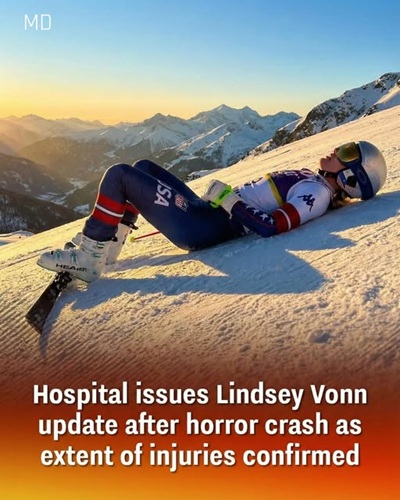
The 2026 Winter Olympics in Milan‑Cortina d’Ampezzo, Italy, were poised to be a celebration of speed, skill, and global athletic excellence, drawing spectators from around the world to witness moments that would define a generation of winter sports.
Yet, amid the breathtaking alpine scenery, towering peaks, and meticulously groomed courses, one event—meant to exemplify triumph—quickly became a stark reminder of the fragility inherent in elite athletic competition.
That event was the women’s downhill final, and at its center was American skiing legend Lindsey Vonn, whose career has long been defined by unmatched determination, resilience, and fearless pursuit of excellence.
Vonn, 41 years old, is widely regarded as one of the greatest alpine skiers in history. Her return to the Olympic slopes, six years after retiring from competitive skiing, was a story of extraordinary courage and dedication.

She had not simply come to participate—she had come to compete at the highest level, in what many anticipated would be her final Olympic appearance.
The expectations of fans, commentators, and fellow athletes were immense, yet so was the challenge she faced: Vonn was still recovering from a recent, severe injury, a complete tear of her left anterior cruciate ligament (ACL) sustained during a World Cup race in Switzerland just days before the Olympic downhill event.
Alpine skiing, particularly at the Olympic level, is inherently perilous. Downhill courses such as the famed Olimpia delle Tofane in Cortina are meticulously designed to test the limits of an athlete’s skill, speed, and physical endurance.
Skiers routinely exceed 80 miles per hour as they navigate sharp turns, steep descents, and variable snow conditions.
The course itself was freshly groomed that morning, with icy patches interspersed with soft snow and narrow gates spaced to challenge precision and control. Vonn, aware of the risks, stepped to the start gate with a knee brace secured over her injured leg, her focus unwavering, her mindset resolute.
As she launched down the slope, her technique—perfectly honed over decades—was evident. She attacked the course with an aggressive stance, edging her skis precisely while maintaining aerodynamic form.
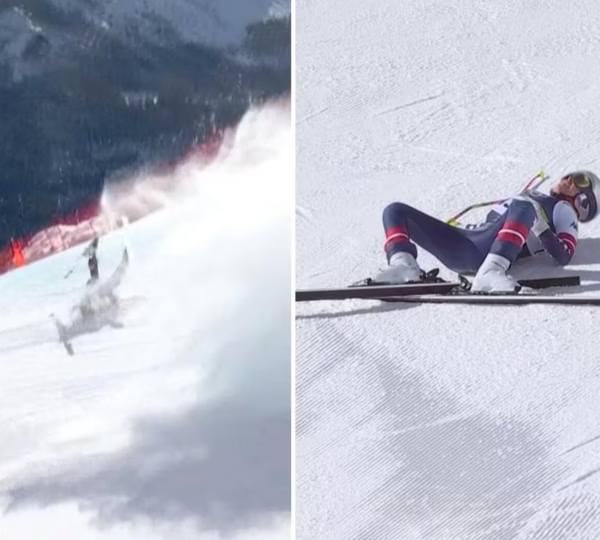
Yet, even the smallest error at such velocity can have dramatic consequences. Just seconds into her run—well before reaching the midpoint of the descent—Vonn clipped a course marker.
The contact destabilized her, causing an immediate loss of balance. Her body spun violently, skis skidding unpredictably over the icy terrain, before colliding with the snow in a series of jolting impacts.

The crowd, which moments before had erupted in cheers, fell silent. For those watching on-site, the shock was palpable; for millions watching around the globe, the footage was heart-stopping.
Television cameras captured the harrowing sequence from multiple angles: Vonn’s rapid tumble, the flurry of snow kicked into the air, and the tense seconds in which she remained motionless while on-course medical teams rushed toward her.
The emergency response was swift—trained alpine medics navigated the slope with skill, assessing her condition and stabilizing her for evacuation.
Within minutes, a medical helicopter had landed on the slope, lifting her to safety as spectators and fellow athletes observed in a combination of fear, admiration, and sorrow.
Her transport to Ca’ Foncello Hospital in Treviso, Italy, was conducted with all due urgency. The hospital, renowned for orthopedic and sports trauma expertise, had been prepared for her arrival.
Medical personnel confirmed that Vonn had sustained a significant fracture in her left leg, requiring surgical intervention to stabilize the injury.
The decision to operate locally was deliberate: Treviso’s multidisciplinary orthopedic teams offered both immediate care and specialized post-operative rehabilitation services tailored to elite athletes.
While specific medical details were withheld to respect her privacy, doctors indicated that the injury would prevent her from further competition in the Games.
What made the incident so poignant was not merely the physical severity of the crash, but the context in which it occurred. Vonn’s presence on the Olympic slopes was itself a testament to human resilience.
After retiring nearly six years earlier, she had pursued a comeback to fulfill a personal and athletic dream. Her career record is extraordinary: 84 World Cup victories, multiple Olympic medals, and numerous historic achievements that have cemented her place in the annals of alpine skiing history.

Yet she returned to competition with her body already taxed by prior injuries—knee reconstructions, ligament tears, and fractures that would sideline most athletes permanently.
For her, the challenge was never solely about medals or accolades; it was about testing limits, embracing passion, and inspiring a generation of athletes who watched her compete with admiration and awe.
The skiing community reacted immediately. Messages of concern, support, and solidarity poured in across social media, television broadcasts, and official channels.
Breezy Johnson, Vonn’s teammate and eventual gold medalist in the downhill, reflected publicly on the emotional weight of the moment: “It’s heartbreaking to see Lindsey go down like that.
She’s not just a competitor—she’s an inspiration, and her courage pushes all of us to be better, even when the sport demands everything from our bodies.”
Fellow Olympians from various nations echoed similar sentiments, praising her bravery and resilience while acknowledging the inherent danger in every high-speed run down such a treacherous course.
Analysts and commentators also weighed in, emphasizing the technical factors that contributed to the crash. The Tofane course is renowned for its challenging terrain: sharp compressions, steep pitches, and icy transitions that test both the athlete’s equipment and reaction time.
Even the slightest misalignment, a ski edge catching the snow at the wrong angle, or a fractionally delayed pole plant can precipitate a fall at incredible speeds.
In Vonn’s case, multiple observers noted that the minor contact with the gate—seemingly trivial in slower races—was catastrophic due to the velocity and terrain conditions.
Her crash served as a sobering reminder of the risks elite athletes face every day. Alpine skiing is a sport defined by precision, physical endurance, and split-second decision-making.

Even for someone with Vonn’s experience, the margin for error is virtually nonexistent. Her willingness to compete despite the known injury reflects not recklessness, but a profound understanding of her body, a deep respect for her sport, and an unwavering determination to challenge her own limits.
As the race resumed without her, the mood of the Olympic event had shifted. Spectators, commentators, and fellow competitors experienced a collective pause—a moment of reflection on the precarious balance between triumph and disaster, between courage and vulnerability.
Breeze Johnson ultimately completed the course under pristine conditions, securing gold for Team USA. Yet for many, the race’s memory was indelibly marked by Vonn’s courage, the dramatic crash, and the reminder that even the most celebrated athletes are subject to the sport’s unforgiving nature.
Off the slopes, discussions regarding Vonn’s future intensified. Her father, Alan Kildow, himself a former competitive skier, expressed concern publicly, noting that her cumulative injuries and the recent fracture might signify the end of her competitive career.
Yet, no immediate announcement was made by Vonn herself. Analysts speculated on her intentions: Would she attempt another comeback after recovery?
Would she shift focus entirely to coaching, mentoring, or commentary? What remained indisputable was that her legacy—as a fearless competitor, a leader in the sport, and a source of inspiration—was firmly secured.
In the hours and days following Lindsey Vonn’s crash, the world of alpine skiing and the wider Olympic community was left in a state of heightened concern and reflection.
For athletes and spectators alike, the image of Vonn tumbling down the Tofane slope was unforgettable—not merely because of the physical impact, but because it represented the razor-thin line separating peak performance from disaster in elite sports. Analysts immediately began reviewing the footage, replay by replay, scrutinizing every angle to understand what happened.
Was it a technical misjudgment, an unfortunate edge catch, or simply the unavoidable reality of racing at 80 miles per hour on an icy course? The consensus was clear: Vonn’s crash was not due to recklessness but to the inherent unpredictability of high-speed alpine racing.
At Ca’ Foncello Hospital, she received immediate, specialized care. A multidisciplinary team of orthopedic surgeons, sports physiotherapists, and pain management specialists collaborated to ensure her stability, manage swelling, and prepare her for surgery.
Reports from medical staff emphasized that her condition was stable and carefully monitored. The fracture, though significant, had been successfully stabilized with surgical intervention, and Vonn’s medical team expressed confidence that, with proper rehabilitation, she could regain full mobility.
The surgery was technically complex, not only because of the injury itself but because her prior knee and ligament injuries added layers of difficulty. Surgeons had to ensure that the procedure reinforced structural stability without compromising future athletic capability.
Recovery planning began immediately. Alpine skiing at the highest level requires not only physical strength but also balance, reflexive precision, and mental confidence in one’s body.
Vonn’s rehabilitation regimen included a combination of physiotherapy, strength and conditioning exercises, and neuromuscular training.
Early sessions focused on maintaining circulation, reducing swelling, and ensuring joint mobility, while later stages would incorporate controlled skiing drills, agility exercises, and gradual return to full-speed training.
Her long experience with previous injuries gave her a unique advantage: she understood how to approach rehabilitation without rushing, balancing patience with the mental drive to return to the sport she loved.
Social media erupted in support of Vonn, with fans around the world sharing messages of encouragement, admiration, and solidarity.
Twitter, Instagram, and X were filled with hashtags celebrating her courage, while news outlets highlighted not only the crash itself but the decades of dedication that had brought her to this point.
Stories ranged from personal anecdotes of how young athletes were inspired by her victories to discussions of the risks and rewards of elite alpine skiing.
Many fans emphasized that Vonn’s legacy was already cemented, regardless of whether she completed another competitive season: she had redefined what it meant to persevere through injury and maintain excellence over a career spanning three decades.
Vonn’s fellow athletes spoke candidly about the psychological impact of witnessing her crash. Breezy Johnson, who had secured the Olympic gold medal, reflected on the delicate balance between competition and camaraderie: “Seeing Lindsey go down like that—it reminds you why we do this, but also why we respect the sport so much.
She’s fearless, but she’s also incredibly smart. I hope the world sees what we’ve all known for years: that she inspires everyone who skis, competes, or even watches.”
Other international competitors echoed this sentiment, emphasizing both the competitive loss and the emotional resonance of the moment.
Many noted that Vonn’s determination to race despite a recent ACL tear and the inherent dangers of the course exemplified not only skill but a psychological resilience rarely seen in sport.
The media, too, explored the broader implications of the crash. Sports scientists and physiologists detailed the mechanics behind the fall: the role of ski edge angles, the impact of centrifugal force on high-speed turns, and the cumulative strain on joints and ligaments.
Interviews with experts highlighted how elite skiers often push the boundaries of physics, understanding that the risk of injury is a constant variable.
Vonn’s career provided a perfect case study: her history of injuries, from knee reconstructions to torn ligaments, underscored both the dangers of alpine racing and the remarkable capacity of the human body to recover with proper care and determination.
For Lindsey Vonn personally, the experience was deeply introspective. Despite the trauma of the crash, she expressed gratitude for the medical care, the safety protocols of the Olympics, and the outpouring of global support.
In post-incident interviews, she reflected on the nature of competitive sport, noting that the thrill of skiing at speed comes with inherent risks: “Every time you step onto the start gate, you know there’s a chance something could go wrong.
That’s the reality of downhill skiing. But it’s also why we do it—it’s about pushing ourselves, respecting the sport, and embracing the challenge. I don’t regret racing for a second.”
Her statements resonated deeply with athletes across disciplines. Coaches, physiotherapists, and sports psychologists cited Vonn’s mindset as a model for resilience, illustrating how mental toughness, preparation, and experience can guide athletes through both triumph and adversity.
Her approach became a talking point in sports education programs, seminars, and workshops aimed at nurturing future generations of athletes while highlighting the importance of safety, preparation, and realistic assessment of risk.
Beyond personal and professional reflections, the crash prompted discussions about the culture of competitive sports. Commentators explored the tension between pushing the limits of human performance and ensuring athlete safety.
Vonn’s story illustrated how elite athletes often operate in a paradoxical space: their skills inspire millions, yet the pursuit of excellence inevitably involves physical peril.
Her decision to compete despite recent injury symbolized the delicate balance between ambition and prudence, a lesson relevant not only in skiing but across all high-risk sports.
The emotional aftermath also extended to fans and the broader public. Social media forums became spaces for collective reflection, blending admiration, fear, and empathy.
Some parents of young skiers noted the importance of teaching risk awareness alongside athletic training, citing Vonn’s career as an example of both resilience and the necessity of structured rehabilitation.
Meanwhile, young athletes wrote messages of thanks and inspiration, expressing how Vonn’s courage motivated them to pursue their passions, even in the face of obstacles.
Amid the global conversation, the Olympic community itself reinforced safety protocols, revisiting course design, medical readiness, and athlete support systems.
The crash underscored the need for immediate access to medical teams, rapid evacuation procedures, and ongoing monitoring of athlete well-being, particularly for competitors returning from injury.
Organizers praised the effectiveness of these measures during Vonn’s incident, noting that swift action had minimized risk and ensured her stable condition.
