
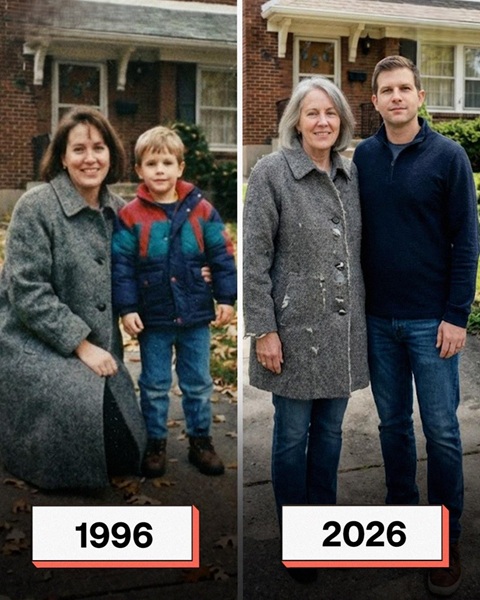
My name is Jimmy, and I am thirty-six years old. For most of my life, I carried a quiet embarrassment—one rooted not in something I had done, but in something my mother wore.
It was a coat. Charcoal gray, wool, heavy, and outdated, with fabric thinning at the elbows and cuffs, so worn that tiny, stubborn pills clung to it as if refusing to let go.
Two mismatched buttons lined the front—one a dark, dull black, the other a washed-out gray, sewn on at different times, a patchwork attempt to preserve what was slowly unraveling. The lining had faded unevenly, showing ghostly streaks of a once-bright interior. The pockets sagged under the weight of years and winter layers, flopping in a way that suggested tiredness, not slouch, as if the coat itself had grown old along with her. To a fourteen-year-old obsessed with appearances and social perception, it looked like a relic from another era. It looked… embarrassing.
I remember the mornings vividly. The wind would whip through our narrow suburban streets, a harsh bite cutting through the thin layers of my teenage wardrobe, and there she was, standing on the curb, coat wrapped snugly around her, hair tucked beneath a wool scarf that smelled faintly of lilacs from the shop she worked at.
The image of her waiting there made me ache with both love and mortification. I wanted to disappear, to make her disappear with me—somehow remove the evidence that my mother, my quiet, patient, unassuming mother, was part of my daily commute to a world obsessed with status and image.

So I would have her drop me off a block away from the school gates. No one would see her. I convinced myself it was for her dignity, though in truth it was for mine. My friends, my peers, the judgmental eyes scanning for anything outdated, anything unworthy—I could not bear the thought of them seeing her there, in that coat, that gray, heavy, ragged coat that smelled faintly of rosewater and mothballs. She never argued with my requests. Never scolded. Just a gentle smile, as though she had foreseen my shame and chosen patience anyway.
“It keeps the cold out, baby. That’s all that matters,” she said once, smoothing a crease in the sleeve, oblivious to the self-conscious heat rising in my cheeks. At the time, I thought she didn’t understand—couldn’t understand—how cruel the world could be when one’s image did not align with the image everyone else demanded. The thought that she might actually be proud, or even happy, in that coat, never occurred to me.
She had worked at the same flower shop in the mall for as long as I could remember. The shop was small, tucked between a newsstand and a faded arcade, but it smelled like a secret garden: damp soil, the subtle sweetness of lilies, the metallic tang of floral foam. She would cradle bouquets like sacred objects, adjusting petals with the care of someone who treated life itself as delicate.
“Flowers are the only things that are beautiful without trying,” she used to say, her voice soft and reverent. “They don’t compete. They just bloom.” She carried that philosophy into her every action, and I had no understanding of it then. I only saw the long hours, the fatigue etched into the delicate lines of her face, the way she slept sitting up with her elbows resting on the counter, hands folded over her chest. We never had much money. Every purchase was calculated, every bill carefully managed. Yet she always ensured I had what I needed, even if it meant skipping meals herself.
Every winter, that coat emerged, a constant in a life of uncertainty. She would brush lint from the sleeves, tug at the collar, adjust the hem so it fell just so. She wore it with a grace that seemed to erase its age, but I only saw its flaws. I remember glaring at the sagging pockets, the tiny holes at the cuffs, the uneven buttons, and wishing for something better.

Not just better—a coat that would announce success and prosperity in the language of teenagers. I would imagine myself, years in the future, wealthier, more capable, able to rewrite the story we were living with a single purchase, a single gesture. I promised myself that I would buy her a coat that finally reflected the life I hoped to create, one that would remove the embarrassment that shadowed her presence like a persistent, uninvited guest.
Years passed. I went through the awkward stretch of adolescence, clinging to social validation and peer approval like a lifeline. I often thought of that coat during moments of acute embarrassment—like when classmates whispered, glanced, or laughed at my choice of lunch or my poorly ironed shirt. I hated it, yet in my heart, I loved her more than I could admit. My mother’s devotion was quiet, unobtrusive, but it was absolute. She worked two jobs most of the week: the flower shop during the day, bookkeeping for a small grocery store at night. I didn’t understand then how little time she had, how rarely she rested, how every ounce of energy she gave was for us, yet she always seemed calm, present, smiling, steady.
When I was twenty-six, I got my first job as an architect. The pay was modest but steady, and for the first time in my life, I had disposable income—not much, but enough to make a small, meaningful change. I began to save for months, determined to fulfill the promise I had made to myself. Finally, I bought her a cashmere trench coat: deep navy, tailored to perfection, soft and warm, with subtle stitching that spoke of craftsmanship rather than ostentation. It was elegant without being flashy, a coat that quietly suggested success, sophistication, and care. The day I handed it to her, Christmas morning, she gasped. I still remember the way her hands trembled as she unfolded the tissue, her eyes glistening with tears. She hugged me so tightly that I could barely breathe, whispering, “It’s beautiful.”
But the next morning, she walked out wearing the old coat.
We argued about it for years. “Mom, we’re not that poor family anymore. Please, just throw it away,” I would insist, frustration in my voice. But she never did. Her eyes, sometimes glimmering with amusement, sometimes wet with quiet sorrow, never revealed the full story. “I know, baby. I know. But I can’t,” she would reply. She never explained why. That coat, to me, was just fabric, worn and outdated. To her, it carried a history I could not yet understand.
The day my mother died, the world seemed to pause. I woke to the phone ringing before dawn, the sound harsh and insistent, slicing through sleep like a blade. The voice on the line was calm but carried the weight of irreversible truth: my mother had passed. A sudden medical emergency, the doctor said, something that could have been caught with regular checkups.
But words like “could have” and “should have” were hollow when they arrived wrapped in the sterile tones of professionals. I packed a bag with trembling hands, leaving behind the life I had built for myself—the apartment, the quiet routines, the endless schedules—and drove the familiar road to her house. Each mile felt like a countdown, a measure of the distance between me and the finality of loss.

Arriving at her apartment, the absence of her presence was almost physical. The small space felt tighter, shadows deeper. Her floral curtains fluttered faintly in the cold breeze coming through the crack in the window. The ticking of the kitchen clock was louder than ever, a slow metronome of inevitability. I moved room to room, touching surfaces she had touched, inhaling faint traces of her—lavender soap, the lingering sweetness of roses from the shop, the faint musk of her perfume. And then I saw it.
The coat.
Hanging from the same hook by the door. Same position. Same quiet dignity it had held for decades. The sight of it, suspended like a silent sentinel, made my chest tighten. It was more than fabric; it was memory, a history stitched into threads worn thin with time. Grief is a shapeless weight, but that coat was something different. Heavy. Dense. Personal. Tangible. Anger, at least, had edges. Grief was sprawling, formless, and this coat carried both.
I grabbed it, intending to toss it into a donation bag. But the weight surprised me. Heavier than it should have been. I ran my fingers along the lining, smooth and familiar. That’s when I noticed the subtle seam—newer stitching hidden beneath the original lining, precise, deliberate. I felt a thrill of curiosity pierce the fog of sorrow. My hand dove deeper, and there it was: pockets, large and reinforced, sewn meticulously, nearly invisible unless you knew where to look.
Inside the pockets were envelopes—thirty of them in total—held together by a brittle rubber band, yellowed with age. No stamps. No addresses. Only my mother’s handwriting, neat and looping, each envelope numbered sequentially. My heart thumped with a mixture of fear and anticipation. I sank to the floor, the coat pooled around me, and carefully opened the first envelope.
“Dear Jimmy,” it began. “When you find these, I’ll be gone. Please don’t judge me until you’ve read them all.”
The words struck me with the force of revelation. My mother had prepared this for me, for a time when she would no longer be here. She had anticipated my grief, my confusion, my anger. And in these letters lay her story—our story—from before I was born, through my childhood, and even into my adulthood.
Her first letter introduced me to a man I had never truly known: Robin, my father. She wrote of their first meeting, a serendipitous encounter in the town square. She had been carrying too many grocery bags when one split open, oranges rolling across the pavement. He had knelt beside her, helping to gather them, laughter in his voice, warmth in his hands. A simple act, yet one that changed everything. They walked home together that day, talking and laughing, oblivious to the world around them. Their lives intertwined instantly, effortlessly, yet with a tenderness that spoke of unspoken promises.

For two years, they were inseparable. She described evenings spent in small, cluttered apartments, sharing cheap meals and cheap wines, yet rich in laughter and intimacy. He dreamt of building something meaningful, crafting tangible proof of his effort and skill. She dreamt of a family, of a life filled with love and connection. The letters described ordinary moments with extraordinary clarity: a first shared cup of coffee, a rainy day spent reading together under a thin blanket, the quiet thrill of first kisses that lingered long after lips parted.
Then, the opportunity came—a job overseas. A chance for him to earn a stable income, real prospects, a life that could be secure, predictable, and respected. He promised to return. The day he left, he removed his own coat—the charcoal gray one I had spent my adolescence hating—and wrapped it around her shoulders. “Just to keep you warm while I’m gone,” he said, laughing lightly, brushing snow from her hair. She wrote about the moment with aching detail, about the way his fingers lingered at the collar, how his eyes held both promise and sorrow.
Weeks later, she discovered she was pregnant. She wrote him letters, one after another, filled with joy, fear, hope, and uncertainty. She never received a reply. None. Years passed in silence, and she believed she had been abandoned. Alone, she raised me while working two jobs, navigating a world that demanded more than it often gave.
As I read each envelope, her words painted a portrait of resilience. She celebrated every milestone, chronicled my achievements, and mourned every setback. In her letters, I saw the mother I had always known—the unwavering presence, the quiet strength—but also the young woman who had loved, waited, and hoped against impossible odds.
Then, midway through the bundle, one letter shifted the course of everything. She had discovered a small newspaper clipping from the region where he had gone to work. A worksite accident. Robin had died six months after leaving, before he ever knew she was pregnant. Before he ever held me. The guilt and anger she had carried toward him for decades, believing abandonment, melted into grief, sorrow, and regret. He had never abandoned us. He had simply run out of time.
Her letters after that revelation were filled with apology and tenderness. She spoke to him as if he were still there, describing every achievement of my life with a mixture of pride and longing. She shared high school victories, college acceptances, internships, and quiet personal triumphs, linking my growth to the love she had once shared with a man who would never see it.

The final envelope contained a photograph—my mother with a young man I had never met, both laughing in a park, the sunlight glinting off their hair, their eyes bright with joy and hope. There was also a letter explaining that Robin had a sister, Jane, who was still alive not far from where I had grown up. She instructed me, gently, to seek her out, to reconnect with the part of my family that had been hidden from me for decades.
I sat there for hours, the coat draped around my shoulders like a shroud and a shield. My mother’s story, once invisible beneath worn fabric, was now laid bare. The weight of the coat, once a symbol of embarrassment and frustration, had transformed into something else entirely: history, memory, love, endurance.
Three days later, I found myself standing before a small cottage on the edge of town. Snow fell steadily, soft and thick, blanketing the world in muted white. It clung to the roof, the windowsills, and the garden gate, muffling the usual hum of traffic and life. The wind bit through the layers of clothing I wore, yet the coat—my mother’s coat, Robin’s coat in spirit—wrapped around me like a second skin. Heavy, warm, familiar, it carried decades of history with it.
I rang the bell. The sound echoed faintly through the quiet house, then a few seconds later, the door opened. An elderly woman, shoulders stooped slightly with age, peered out at me. Her hair was silver, neatly pinned back, her eyes sharp and wary.
“Can I help you?” she asked evenly. There was no warmth yet, only the cautious politeness of someone used to protecting herself from the unknown.
“I think you’re Robin’s sister. Jane,” I said, my voice trembling slightly, betraying my nerves.
Her eyes narrowed, and a faint crease formed between her brows. “My brother died decades ago,” she said. Her tone carried the kind of finality that people use to discourage further questioning.
“I know,” I replied. “But I’m his son.”
There was a pause, long enough for the cold to seep through me, for my fingers to tighten around the edges of the coat. Jane studied me carefully, the skepticism in her eyes slowly softening, replaced by cautious curiosity. Finally, she stepped back and gestured for me to enter.
The cottage smelled faintly of baking and pine. The furniture was modest but well-kept, each item placed with care. I placed the letters and the photograph on the kitchen table, arranging them with reverence, as if their positioning could somehow honor my mother’s memory and the years of longing captured in ink and paper.
Jane looked at the photograph first. Then she looked at the coat draped across my shoulders. Her eyes fell on the collar, and her fingers traced a small repair near the seam—uneven stitching in a thread slightly different from the rest.
“Robin repaired this himself,” she whispered, her voice trembling. “He was terrible at sewing.”
It was as if the years between us collapsed in that moment. I realized, with a sudden, sharp clarity, that the coat was more than fabric. It was love, endurance, and memory stitched together. It was proof that my mother’s devotion to a man she had lost, and to a life she had raised alone, had not been in vain.
We sat by the fire, the room glowing with warmth that was both literal and symbolic. Steam rose from our cups of tea, curling like tiny ghosts around the flickering flames. We said little at first, letting silence hold the weight of everything unspoken.
After a long pause, she picked up the photograph again. Her eyes softened as she studied it. “He has your eyes,” she said quietly, almost as if confirming the truth she had only recently begun to accept. “It will take time.”
“I know,” I replied. “But I suppose you had better start from the beginning.”
And so she did. Jane spoke of Robin as if he were still there, a living presence in the room. She described his quiet kindness, his penchant for tinkering with mechanical things, the way he could laugh with his whole body, the warmth in his eyes when he thought no one was looking. With each detail, I felt closer to the father I had never known, the man my mother had loved, the man who had shaped my existence even in absence.
I spoke too, of my mother, of the life she had built, of the winter mornings and the flower shop, of the way she had loved me, protected me, and carried both of us through years that were difficult, lonely, and uncertain. We shared stories, laughter, and tears, building a bridge across decades of silence.
At one point, Jane reached out, her hand brushing against the coat’s fabric. “She kept it for you,” she said softly. “Even all these years. She wore it because of him, not because of anything else.”
It hit me, finally and fully, why my mother had refused the new coat I had given her. It wasn’t pride, or stubbornness, or poor taste. It was memory. History. A testament to the only love that had shaped her in the deepest way. The coat had kept her warm physically, yes, but it had also kept her connected to the past—the moments she cherished, the man she had loved, the life she had built in spite of heartbreak.
I realized then that the embarrassment I had carried for so many years was misplaced. The coat had never been a symbol of shame. It was a vessel of devotion, a repository of love and resilience. Every worn cuff, every faded patch, every mismatched button told a story—of laughter, of grief, of perseverance. It carried the essence of my parents’ love and my mother’s enduring hope.
We talked long into the evening. The snow continued to fall outside, a soft curtain of white that muffled the world and wrapped the cottage in quiet intimacy. I learned more about Robin from Jane: his dreams, his struggles, his generosity, and the simple, profound way he had loved my mother. I began to understand the rhythm of my own life—the inherited traits, the quiet persistence, the need to build and create—that had come from him.
When it was finally time to leave, I draped the coat carefully over my shoulders. Jane watched silently, the faintest trace of a smile playing on her lips. I stepped into the snow, feeling its cold bite, yet warmed by a realization that had taken decades to unfold. The coat was no longer a burden, no longer a source of embarrassment. It was history, memory, and love. Heavy, yes, but not in the way I had once thought. Heavy with life, with connection, with proof that love had existed, even if circumstances had kept it apart for too long.
Before I walked away, I hung the coat on the hook by Jane’s door. She did not ask me to take it back, and I did not. It would remain there, a bridge between past and present, between what had been lost and what could now be discovered.
That night, as I drove home through streets softened by snow, I reflected on the journey. For years, I had misunderstood the weight of the coat, the significance of the fabric and thread. I had thought it was just clothing, just old wool, just something worn. But some things are not worn-out fabric. Some things are memory. Some things are history. And some things—some of the heaviest things we carry—are evidence. Evidence that love exists, and endures, in ways both visible and invisible, in the quietest acts, in the smallest gestures, in the coats we wear, in the letters we leave behind, and in the hearts of those who never forget.
