
The American heartland and Great Lakes region are struggling under the weight of unprecedented grief, as residents confront destruction unlike anything they have experienced before.
Over several days, violent tornadoes tore through Oklahoma and Michigan, leaving at least eight confirmed fatalities and countless homes flattened or reduced to rubble.
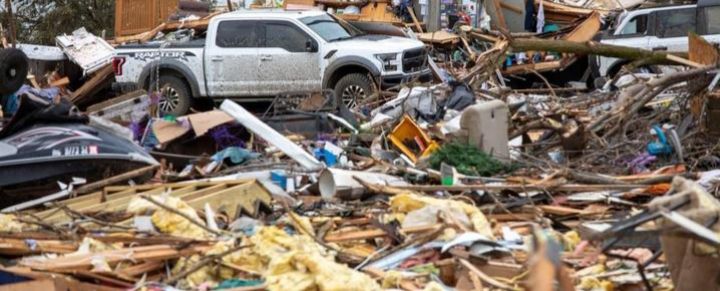
Entire neighborhoods were transformed into chaotic debris fields, stretching for miles, leaving emergency responders stunned by the scale of destruction and sheer unpredictability of the storms.
In southern Michigan, volunteers and authorities are using chainsaws and heavy machinery to sift through shattered timber, twisted metal, and belongings buried beneath mud and debris.
Many residents of Michigan were unprepared for such destruction, as the state experiences a fraction of tornadoes compared to the traditional Tornado Alley in the central United States.
Texas averages 155 tornadoes per year, Kansas sees 96, while Michigan typically records only 15, making this meteorological event exceptionally rare and unexpectedly violent.
The storms on Friday turned the sky an ominous green, creating a surreal and terrifying atmosphere, catching residents off guard despite months of seasonal weather awareness campaigns.
Eyewitnesses described the tornadoes’ approach as a low, guttural roar, akin to a freight train, leaving families seconds to seek shelter in basements or interior hallways.
In many cases, the seconds available were not enough, resulting in homes stripped to their foundations and personal property destroyed beyond recognition.
The psychological shock of seeing long-established neighborhoods destroyed compounds the material losses, leaving survivors in a state of disbelief and emotional trauma.
Oklahoma, although more accustomed to severe weather, also suffered devastating impacts, demonstrating that even storm-hardened communities cannot fully anticipate the destructive potential of EF-4 and EF-5 tornadoes.
Fatalities in Oklahoma highlight the cruel randomness of tornadoes, as preparedness and experience sometimes fail against nature’s overwhelming force and sudden, catastrophic shifts.
Search and recovery operations are now a race against time, with first responders employing thermal imaging, K-9 units, and drones to locate survivors among dangerous debris fields.
Fallen power lines, ruptured gas mains, and unstable structures complicate rescue efforts, forcing teams to balance urgency with safety while navigating treacherous terrain.
Families of the missing endure the silent torment of waiting, as familiar streets and landmarks are erased, leaving even lifelong residents disoriented amid piles of shattered homes.
Emergency shelters in local gyms and community centers have become hubs for displaced families, offering temporary refuge but little relief from the overwhelming sense of loss and upheaval.
Volunteers and neighbors are providing critical support, distributing food, water, and essential supplies while also helping with emotional stabilization and shared grieving.
Meteorologists are investigating the unusual severity of these storms, analyzing atmospheric conditions that allowed such destructive tornadoes to form far north of traditional tornado-prone areas.
The events in Michigan challenge historical assumptions, showing that Tornado Alley’s boundaries are shifting or expanding, making rare but severe storms a growing concern for the northern United States.
Preparedness strategies may need reevaluation, as conventional infrastructure—like limited storm shelters—cannot reliably protect populations facing unprecedented tornado intensity and frequency.
Stories of heroism are emerging alongside devastation, with parents shielding children, neighbors rescuing one another from collapsed structures, and volunteers traveling hours to deliver aid.
These acts of courage and solidarity serve as a counterpoint to the overwhelming destruction, highlighting humanity’s capacity to respond with selflessness and determination in the face of disaster.
Economic consequences are expected to be long-term, as homes, businesses, and infrastructure require extensive rebuilding, potentially altering local demographics if residents relocate permanently.
Insurance companies have begun assessing damages, yet the reconstruction of entire communities will require years of planning, funding, and coordinated effort between state and federal authorities.
Rebuilding efforts involve not only physical structures but also restoring community cohesion, trust, and a sense of security lost in an instant, critical for emotional recovery and neighborhood resilience.
Local governments are coordinating with state agencies and federal disaster relief teams to prioritize immediate needs: safe housing, clean water, and medical care for affected residents.
In addition to physical reconstruction, attention must focus on mental health, as survivors cope with trauma, grief, and the anxiety of potential future storms in regions historically considered low-risk.
As cameras capture the devastation, residents continue the painstaking work of recovery, removing debris, documenting losses, and searching for missing persons amid unstable ruins.
The events in March 2026 will remain a historical benchmark, demonstrating nature’s power and the urgent need for enhanced preparedness even in regions considered outside traditional tornado zones.
In the immediate aftermath, local authorities and first responders are navigating a maze of destruction, coordinating search efforts amid scattered debris and hazardous conditions.
Emergency teams are using drones equipped with thermal imaging to scan for survivors, while K-9 units tirelessly sniff through collapsed structures for any sign of life.
Downed power lines and ruptured gas mains have turned already treacherous areas into high-risk zones, forcing crews to carefully strategize every movement during recovery operations.
The sheer scale of displacement has created urgent needs for temporary shelters, with hundreds of families relying on gymnasiums, schools, and community centers for basic necessities.
Volunteers from neighboring towns have mobilized to deliver food, water, clothing, and blankets, creating informal networks of support that supplement government relief efforts.
Local medical personnel are stretched thin, treating injuries from debris and psychological trauma alike, highlighting the multifaceted impact of such sudden, violent storms.
Counseling services are being deployed to address emotional and mental health needs, acknowledging that the shock of losing a home and personal belongings can have long-lasting effects.
Residents describe a surreal landscape, where familiar streets are blocked by fallen century-old trees, and houses are reduced to slabs and twisted metal, making orientation nearly impossible.
Cleanup crews coordinate with utility companies to restore power, water, and gas, while engineers assess structural integrity to prevent further accidents during rebuilding.
The national guard has been called in to assist with debris removal, security, and logistical support, ensuring safe access to critical areas for rescue and recovery personnel.
Transportation routes are a critical concern, as fallen trees, flooded roads, and scattered debris impede the movement of emergency vehicles and essential supply deliveries.
The storm’s unprecedented severity in Michigan and Oklahoma has drawn attention to the limits of existing disaster preparedness infrastructure in regions historically considered low-risk.
Local governments are reassessing emergency protocols, including siren coverage, evacuation routes, and public communication strategies, to adapt to shifting weather patterns.
Meteorologists are analyzing atmospheric data, considering how warmer temperatures, moisture levels, and jet stream variations contributed to tornado formation in unexpected locations.
Insurance adjusters face a monumental task, evaluating property damage, business losses, and infrastructure destruction to determine compensation for families and municipalities.
Small businesses that served as community hubs are now lost, threatening local economies and potentially leading to population decline if residents choose not to return.
Nonprofits and charitable organizations are coordinating with local authorities to provide supplemental aid, including mobile medical units, temporary housing, and emergency food distribution.
Volunteers are also offering emotional support, helping survivors process the trauma while providing companionship during long nights of uncertainty and fear.
Communication remains a logistical challenge, as cell towers, internet infrastructure, and power lines have been compromised, hindering coordination and information sharing.
Public safety announcements are being delivered via radio, community bulletin boards, and mobile loudspeakers to ensure timely alerts despite technological disruptions.
Long-term planning is beginning even as immediate recovery continues, with architects and city planners assessing how to rebuild stronger, more storm-resilient structures.
Community leaders are holding meetings with residents to discuss rebuilding strategies, including reinforced basements, safe rooms, and improved storm shelter access for future preparedness.
Educational institutions are also playing a role, hosting temporary classrooms and organizing support networks for children traumatized by the storms, maintaining continuity of learning.
Emergency management officials emphasize that recovery is a marathon, not a sprint, highlighting the need for sustained funding, mental health resources, and public engagement in reconstruction efforts.
Psychologists note that children are particularly vulnerable, as sudden loss of home and familiar routines can lead to long-term anxiety, depression, or post-traumatic stress symptoms.
Neighborly cooperation has become vital, with community members sharing tools, food, and labor to assist those unable to rebuild alone, reinforcing social cohesion in the face of adversity.
Meteorologists warn that events like these could become more frequent due to climate change, necessitating broader public awareness campaigns and infrastructural investment in historically low-risk areas.
The unfolding recovery highlights both the fragility and resilience of communities, showing how collective effort, planning, and human empathy are essential to overcoming natural disasters.
As recovery continues, attention is turning toward long-term consequences for Michigan and Oklahoma, where infrastructure, housing, and local economies face years of rebuilding.
Reconstruction requires careful planning, balancing speed with safety, ensuring homes and public buildings are more resilient against future extreme weather events.
Engineers are assessing soil stability, flood risk, and wind patterns to design structures capable of withstanding stronger and more unpredictable tornadoes.
Local governments are evaluating investments in reinforced shelters, early-warning sirens, and emergency communication networks to improve preparedness for low-probability but high-impact events.
Economic recovery is a daunting challenge, particularly for small towns reliant on local businesses that were destroyed or severely damaged by the storms.
Insurance claims are expected to surge, with adjusters meticulously documenting structural damage, lost inventory, and personal property destruction for compensation purposes.
State and federal agencies are coordinating aid packages, grants, and low-interest loans to support families and businesses, though the bureaucratic process may slow immediate relief.
The storms underscore the need for disaster-resilient infrastructure in regions previously considered low-risk, highlighting the evolving nature of extreme weather in a changing climate.
Meteorologists emphasize that climate change is contributing to altered tornado patterns, with warmer temperatures and shifting jet streams creating conditions conducive to northern tornado outbreaks.
Recent studies indicate that moisture-laden air from the Gulf of Mexico can now penetrate further north, increasing the likelihood of severe convective storms in states like Michigan.
This expansion challenges historical assumptions about Tornado Alley and necessitates a reevaluation of regional preparedness strategies, public education, and emergency response protocols.
Urban planners are considering integrating storm-resistant design features into reconstruction, including reinforced roofs, basement safe rooms, and storm shutters to mitigate future risks.
Community organizations are central to the recovery process, coordinating volunteers, fundraising efforts, and relief distribution to ensure no family is left without basic necessities.
Long-term mental health support is a priority, as the trauma of sudden loss, displacement, and witnessing fatalities can have lasting psychological effects on both adults and children.
Schools are implementing counseling programs and peer support groups to help students navigate anxiety, grief, and disruption of their routines caused by the storms.
Neighborhood networks are strengthening social bonds, fostering resilience through shared labor, collective rebuilding efforts, and mutual emotional support.
Stories of heroism continue to emerge, including neighbors rescuing trapped individuals, first responders risking their lives, and volunteers delivering aid across flooded and obstructed roads.
The environmental aftermath includes increased awareness of debris management, soil erosion, and contamination from chemical spills or ruptured fuel tanks in storm-affected areas.
Local ecosystems have been affected, with uprooted trees, destroyed habitats, and soil displacement requiring ecological restoration alongside human-focused reconstruction.
National policymakers are evaluating disaster relief funding, recognizing the need for proactive investment in infrastructure to reduce future costs and casualties from extreme weather events.
Emergency management agencies are reassessing logistics, supply chains, and staffing for rapid deployment in areas where tornadoes are historically rare but increasingly possible.
Insurance companies may need to revise policies, premiums, and coverage strategies to account for evolving tornado risks beyond traditional Tornado Alley boundaries.
Public awareness campaigns are expanding, educating residents about tornado preparedness, evacuation plans, and the importance of safe shelters in both urban and rural settings.
Volunteers and nonprofit organizations are working to bridge gaps in aid delivery, particularly in remote or heavily obstructed areas where government response may be delayed.
Climate scientists are monitoring the broader trend of shifting tornado patterns, exploring correlations with atmospheric warming, jet stream anomalies, and increased moisture transport northward.
The human cost remains profound, with families mourning lives lost, homes destroyed, and the psychological burden of sudden displacement now becoming a central challenge.
Yet the resilience demonstrated by communities—through mutual aid, volunteering, and emotional support—illustrates the capacity of human solidarity to withstand even unprecedented natural disasters.
The March 2026 tornado outbreak will remain a pivotal moment in American meteorological history, highlighting both the destructive power of nature and the critical importance of preparedness and community cohesion.
As rebuilding progresses, residents will not only restore physical structures but also reaffirm a sense of security, identity, and communal strength, ensuring that the heartland can endure future storms.
Ultimately, this disaster serves as a reminder that climate unpredictability is real, preparation is vital, and the courage and empathy of ordinary citizens define the recovery process.
The tragedy has reshaped priorities, driving innovation in urban planning, emergency response, and climate adaptation to prevent similar destruction in the future.
Through persistent effort, careful planning, and social cooperation, Michigan and Oklahoma communities are slowly regaining stability, determined to rebuild stronger and safer than before.
Even as national attention moves on, the daily work of recovery will continue, ensuring that families can eventually reclaim their homes, livelihoods, and peace of mind.
The tornadoes of March 2026 have etched themselves into memory, leaving lessons of human vulnerability, resilience, and the need for foresight in the face of increasingly unpredictable natural forces.
Communities are embracing both the practical and emotional aspects of rebuilding, recognizing that recovery encompasses mental health, environmental repair, and long-term economic sustainability.
In this effort, local, state, and federal agencies, alongside volunteers and residents, are working in concert to create a blueprint for future resilience against severe weather.
Ultimately, the story of this disaster is not only one of destruction but also of courage, solidarity, and the enduring capacity of communities to rise from the wreckage and adapt to a changing climate.
