
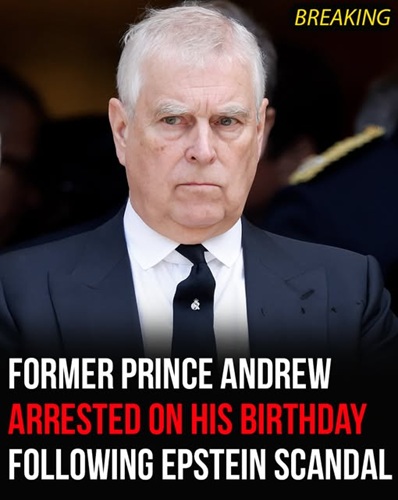
On Thursday, 19 February 2026, British police took the extraordinary step of arresting Andrew Mountbatten‑Windsor, the former Duke of York and once‑senior member of the British royal family.
On suspicion of misconduct in public office — a rare legal and constitutional development that has captivated domestic and international audiences.
The arrest took place at his residence on the Sandringham estate in Norfolk, England, on the morning of his 66th birthday, and marked the first time in modern British history that someone directly connected with the immediate royal family has been detained on criminal suspicion.
A Cautious Police Operation and Public Confirmation
Shortly before 8 a.m. local time, officers from Thames Valley Police — a force responsible for parts of southern England — arrived at Mountbatten‑Windsor’s home in unmarked vehicles as part of a planned operation. Law enforcement sources later confirmed that the decision to arrest was made after a “thorough assessment” of evidence suggesting potential misconduct during his tenure as a UK trade envoy.

In an official statement, the force said it had “arrested a man in his sixties from Norfolk on suspicion of misconduct in public office and are carrying out searches at addresses in Berkshire and Norfolk.” Under UK policing practice, authorities did not initially name the individual — in line with rules that protect ongoing investigations and the fairness of future legal proceedings.
Release Under Investigation
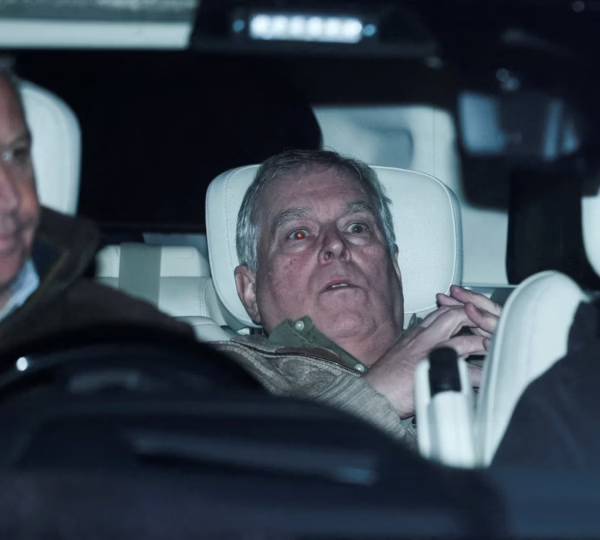
After nearly 12 hours in police custody, Mountbatten‑Windsor was released later that same evening under investigation. This status means he has not been formally charged with any offence, but police inquiries will continue and could ultimately inform prosecutorial decisions by the Crown Prosecution Service (CPS).
An image captured by a Reuters photographer showing the former royal leaving Aylsham Police Station in Norfolk became one of the defining visuals of the day, emphasizing the unprecedented nature of the case.
Why the Arrest Happened — Allegations Being Investigated
The arrest is officially linked to allegations that Mountbatten‑Windsor may have committed misconduct in public office during his time as the United Kingdom’s Special Representative for International Trade and Investment between 2001 and 2011. Police have stated that the inquiry is connected to documents — sometimes referred to in reporting as part of the Epstein files — which are millions of pages of material released by the U.S. Department of Justice relating to late financier Jeffrey Epstein and his global network.
According to reporting based on these records, some emails and correspondences appearing in the released files show Mountbatten‑Windsor possibly forwarding government commercial and diplomatic material to parties connected with Epstein — or at least discussing such information with individuals in Epstein’s orbit.
At this stage, authorities are investigating whether sharing or disclosing such material, especially if confidential or sensitive, could amount to an abuse of public trust that would qualify as misconduct in public office — a common law offence in England and Wales that can carry a maximum sentence of life imprisonment, though convictions are rare and depend on proof of intent.
The Legal Test: Misconduct in Public Office
Under UK law, the offence of misconduct in public office is not codified in statute but established through common law. To secure a conviction, prosecutors would need to show that:
- The individual held a public office and had a duty to act with integrity and in the public interest;
- There was wilful neglect or misconduct of those duties; and
- The conduct was serious enough to constitute an abuse of the public’s trust without reasonable excuse.
Legal experts quoted in coverage note that proving misconduct in public office at this level — especially years after the fact and involving high‑profile figures — is complex, requiring clear evidence of intent and a demonstrable breach of duty.

Searches and Broader Investigative Activity
In addition to the arrest, police confirmed searches were conducted at Mountbatten‑Windsor’s Norfolk address and a property in Berkshire formerly associated with him. The Norfolk searches were declared concluded by police, but the investigation in Berkshire continued at the time of reporting, focusing on gathering potential evidence and documents relevant to the inquiry.
A Landmark Moment in Modern British History
Mountbatten‑Windsor’s detention has been described by commentators and analysts as one of the most significant legal events involving the British monarchy in decades. As noted by some commentators, he is the first senior royal to be arrested in modern times — the closest historical analogue being the detention of King Charles I during the English Civil War in the 17th century.
While he no longer holds royal titles — which were formally removed previously due to controversies over his past associations — Mountbatten‑Windsor remains eighth in the line of succession to the British throne, making the legal inquiry both symbolically and constitutionally notable.
Andrew Mountbatten‑Windsor, the second son of the late Queen Elizabeth II and younger brother of King Charles III, was born on 19 February 1960 at Buckingham Palace. Known historically as Prince Andrew, Duke of York, he spent his early life in the spotlight, performing royal duties while receiving education at prestigious institutions such as Heatherdown School and Gordonstoun School. He later embarked on a military career, joining the Royal Navy in the late 1970s and eventually serving as a helicopter pilot and commander during the Falklands War in 1982.
Following his naval career, Mountbatten‑Windsor was appointed in 2001 as the United Kingdom’s Special Representative for International Trade and Investment, a position that lasted nearly a decade. In this role, he was tasked with promoting British businesses abroad, fostering trade relationships, and representing the UK at international trade forums. The appointment was partly ceremonial but carried real responsibilities, as he engaged with governments, business leaders, and international organizations across Europe, North America, and Asia.
During his tenure, Mountbatten‑Windsor became a frequent visitor to high‑profile financial events, often appearing alongside prominent figures in global finance. While initially praised for his efforts to open markets and foster investment, his role increasingly attracted scrutiny due to associations with controversial individuals, most notably the late financier Jeffrey Epstein. These relationships would later form the context for investigations into potential misconduct in public office.
The Epstein Connection and Alleged Misconduct
The arrest in February 2026 is closely linked to Epstein-related disclosures that surfaced in recent years. Epstein, who died in 2019, was a convicted sex offender whose networks included a range of influential global figures. After his death, the U.S. Department of Justice released millions of documents, including flight logs, emails, and financial records, some of which reportedly referenced Mountbatten‑Windsor.
Investigators have focused on whether he improperly shared confidential government communications while serving as a UK trade envoy, potentially including commercial and diplomatic information, with Epstein or intermediaries connected to him. UK legal experts emphasize that even indirect transmission of official material to third parties outside government channels can constitute a breach of duty if done intentionally and without proper authorization.

The Crown Prosecution Service would have to demonstrate that any actions constituted wilful misconduct in public office. This would include proving that Mountbatten‑Windsor knowingly acted in a way that violated the trust of the public and the expectations of his office, without justification. As misconduct in public office is a common law offense, legal precedent is complex, and cases involving senior officials or royals are exceptionally rare, making the investigation unprecedented.
Royal Family Response
The arrest prompted a rapid but carefully calibrated response from the royal household. King Charles III, Mountbatten‑Windsor’s elder brother, issued a statement emphasizing that the rule of law must take its course and that the royal family was fully cooperating with authorities. The statement reflected the monarchy’s longstanding position of neutrality in legal matters while acknowledging public concern over such high-profile scrutiny.
Other senior royals, including Queen Camilla and Princess Anne, reportedly continued with pre-scheduled official engagements. Sources indicated that the palace aimed to project continuity and stability amid the unprecedented legal and media attention, while also managing the potential reputational damage to the monarchy.
Importantly, Mountbatten‑Windsor had previously stepped back from public duties in 2019, following intense scrutiny over his past associations with Epstein. In October 2025, Buckingham Palace formally removed his royal titles and requested he vacate Royal Lodge in Windsor Great Park, relocating to a more modest residence at Wood Farm on Sandringham estate. This context highlighted the royal family’s ongoing efforts to distance itself from controversies surrounding him, while acknowledging his continued presence in the line of succession.
Government and Legal Reactions
UK political leaders also reacted promptly to the arrest. Prime Minister Keir Starmer emphasized that “no one is above the law,” reinforcing the government’s support for independent police investigations and judicial process. Parliamentary discussions emerged about the potential removal of Mountbatten‑Windsor from the line of succession, a move that would be symbolic yet legally complex. Buckingham Palace stated it would not oppose legislative action if proposed, demonstrating a willingness to cooperate with constitutional processes.
Legal scholars noted that removing a senior royal from the line of succession requires an act of Parliament under current laws governing succession and titles, and while historically unprecedented in modern times, the arrest intensified debate over potential constitutional reforms and the monarchy’s public accountability.
Public and Civil Society Reactions
The arrest drew divided responses from the British public and advocacy groups. Survivors linked to Epstein’s crimes, including family members of Virginia Giuffre, a prominent victim who had publicly accused Mountbatten‑Windsor, praised the police action as an affirmation that legal accountability applies to all, even former royals. Giuffre had passed away in 2025, but her siblings and supporters issued statements welcoming the development.

Civil society organizations advocating greater transparency and accountability in public office also described the arrest as a historic step toward ensuring that individuals in high office, royal or otherwise, cannot act without scrutiny. Campaigners highlighted that misconduct in public office, if proven, undermines public trust in institutions and that holding figures accountable is essential for democratic governance.
Conversely, monarchists and royal supporters expressed concern that the arrest could damage the monarchy’s reputation and weaken public confidence in the royal institution. International media coverage noted that while Mountbatten‑Windsor had already relinquished official duties, the symbolic significance of a royal facing police investigation remained highly sensitive.
Media Coverage and Public Discourse
The arrest became one of the most widely reported news events in the United Kingdom in decades. Coverage spanned television, print, and online outlets, with detailed analyses of both the legal framework and historical context. Media discussions often highlighted:
- The unprecedented nature of arresting a senior royal;
- Historical comparisons, such as King Charles I’s detention during the 17th century;
- The broader implications for the monarchy’s accountability and public trust;
- Potential reforms in royal oversight, succession, and public office duties.
Public discourse reflected a combination of legal curiosity, constitutional debate, and emotional responses, with social media amplifying both criticism and support. Analysts emphasized the delicate balance between legal due process, freedom of press coverage, and respect for the privacy of all parties involved.
Following his release under investigation, Andrew Mountbatten‑Windsor remains subject to a comprehensive inquiry by Thames Valley Police, who are examining both Norfolk and Berkshire properties associated with him. Officers are reviewing thousands of pages of documents, emails, and correspondence connected to his tenure as the UK’s Special Representative for International Trade and Investment between 2001 and 2011.
Investigators are also seeking to interview potential witnesses, including former government colleagues, business associates, and international contacts who may provide insight into Mountbatten‑Windsor’s conduct during official visits and communications. The inquiry extends to examining whether any confidential government information may have been shared inappropriately and whether such actions could constitute a breach of trust under the common law offence of misconduct in public office.
Police have emphasized that the arrest is part of an ongoing process, and that further public statements will be made only when appropriate to protect the fairness of potential legal proceedings. The inquiry is expected to extend over several months, reflecting the complexity of the evidence and the historical nature of the allegations.
Potential Legal Outcomes
While Mountbatten‑Windsor has not been charged, the legal framework in the UK allows prosecutors to bring formal charges if there is sufficient evidence. Misconduct in public office is punishable by life imprisonment, although sentences for comparable cases in modern times have typically ranged based on the severity, intent, and consequences of the misconduct.
Legal analysts note that, due to the high-profile nature of the case, any prosecution would face unprecedented scrutiny, requiring clear documentation of wrongdoing, precise evidence of intent, and careful attention to procedural fairness. In addition, the historical lapse of time between the alleged conduct (2001–2011) and the investigation in 2026 introduces challenges regarding record preservation, witness recollection, and contextual interpretation of duties.
Should charges be filed and a trial proceed, courts would consider Mountbatten‑Windsor’s former status as a public office holder, the seriousness of any improper disclosures, and the impact on public trust. The case could also establish new precedents for accountability of individuals holding high-profile positions, including members of the royal family engaged in quasi-governmental roles.
Historical Significance
The arrest is historically remarkable for several reasons:
- Modern Royal Accountability: This is the first known arrest of a senior British royal in the 21st century on allegations of criminal misconduct, with prior historical parallels dating back more than three centuries to the detention of King Charles I during the English Civil Wars.
- Constitutional Implications: Mountbatten‑Windsor remains eighth in the line of succession, making the investigation constitutionally sensitive. While he no longer holds royal titles following the 2025 palace decision, any legal developments could prompt debate about succession, oversight, and the monarchy’s public role.
- Impact on Public Perception: Analysts suggest the case could influence public trust in both the monarchy and government institutions, highlighting the tension between historical privilege and modern accountability standards. The proceedings may also affect international perceptions of the UK’s commitment to rule of law and transparency in public office.
- Precedent for High-Level Investigations: Legal experts emphasize that this case may set important precedents for future inquiries involving senior public officials or royals, particularly regarding the limits of discretionary power, access to sensitive information, and the intersection of public duties with personal associations.
Broader Political and Social Implications
In the wake of the arrest, UK political leaders, lawmakers, and constitutional scholars have debated potential reforms:
- Succession Legislation: Some members of Parliament have discussed introducing laws to formally remove Mountbatten‑Windsor from the line of succession. While legally complex, such measures are being considered in light of public concern over the monarchy’s integrity. Buckingham Palace has confirmed it would not oppose such legislative proposals, signaling alignment with constitutional processes if pursued.
- Public Office Oversight: The case has renewed debates about oversight mechanisms for individuals in government or semi-official roles, including the need for clearer guidance, auditing, and reporting requirements for confidential information, particularly when the individual also holds symbolic or ceremonial authority.
- Civil Society Advocacy: Advocacy groups, especially those focused on victims of sexual abuse, financial crimes, and public integrity, have emphasized the arrest as a milestone for justice and transparency, underscoring that no individual — regardless of wealth, influence, or royal status — is exempt from scrutiny.
Public Reactions and Media Coverage
The arrest generated a wave of media coverage both within the UK and internationally. Analysts observed several key themes in public discourse:
- Constitutional Debate: Experts and commentators highlighted the tension between royal privilege, legal accountability, and public perception, sparking discussions on whether further constitutional reforms are warranted.
- Historical Comparison: Social commentators frequently compared the situation to historical precedents, including the English Civil Wars, to contextualize the rarity of a senior royal facing legal scrutiny.
- Social Media Engagement: Platforms such as Twitter, Threads, and Instagram saw widespread discussion, with users debating ethics, law, monarchy, and the implications for British national identity.
- Global Attention: International news outlets emphasized the case as a test of the UK’s judicial system and transparency, noting that scrutiny is magnified by the global prominence of the British royal family.
Looking Ahead: What to Expect
As the investigation continues, the public and media can expect several developments:
- Ongoing police reviews of documents, correspondences, and other potential evidence;
- Interviews with former colleagues, business contacts, and officials;
- Potential CPS decision on whether to proceed with charges, which could occur months after thorough evidence review;
- Legislative or parliamentary debates regarding succession and public office accountability;
- Further official statements from the palace, police, or government at key milestones in the investigation.
Legal observers caution that due to the complexity and high-profile nature of the case, any proceedings will unfold over an extended period, likely generating sustained media attention and public discourse.
Conclusion
The arrest of Andrew Mountbatten‑Windsor on suspicion of misconduct in public office represents a defining moment in modern British history, intersecting the monarchy, law, governance, and public accountability. The event underscores that even former royals with ceremonial roles and historical privilege are subject to the scrutiny of law enforcement when their conduct is called into question.
While Mountbatten‑Windsor has been released under investigation and no charges have yet been filed, the inquiry carries profound legal, constitutional, and social implications. From ongoing investigations into document sharing and public duty, to potential reforms in royal succession and accountability, the case is poised to influence British public life, institutional trust, and constitutional debate for years to come.
The unfolding situation remains closely monitored by the UK public, international observers, and media, reflecting both the exceptional nature of the arrest and the broader questions it raises about the intersection of power, privilege, and accountability in contemporary society.
