
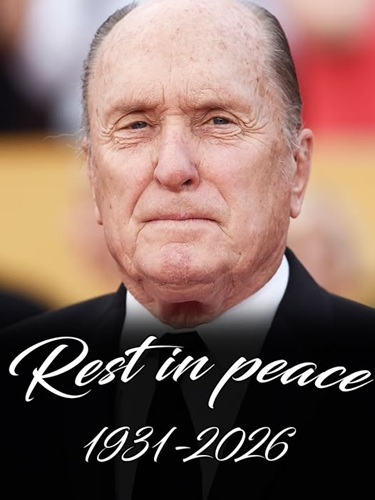
The world of cinema is mourning the loss of Robert Selden Duvall, an actor whose career spanned more than six decades and whose performances helped define modern American film.
Born on January 5, 1931, in San Diego, California, Duvall grew up in a family steeped in discipline, tradition, and a strong sense of duty.
His father, Robert Sr., was a career officer in the United States Navy, a position that demanded structure, mobility, and resilience. His mother, Mildred Virginia, maintained the household and instilled in her children a respect for education, culture, and the arts.
From an early age, Duvall exhibited a quiet intensity and curiosity about the human experience — traits that would become hallmarks of his acting style. Although raised in a disciplined environment shaped by naval precision and the constraints of military life, he showed a natural inclination toward storytelling, literature, and performance. He spent much of his youth observing people, absorbing mannerisms, and cultivating a keen understanding of human behavior — skills that would later allow him to embody characters with depth and authenticity.

Education and Early Artistic Influences
After completing high school, Duvall pursued higher education in the arts, enrolling at Principia College in Elsah, Illinois, where he studied drama. He sought an intellectual and practical grounding in performance, theater history, and the mechanics of storytelling. Even as a young student, he was drawn to roles that explored moral ambiguity, complex psychology, and the nuances of human relationships.
His formal training was further refined when he moved to New York City, determined to immerse himself in the epicenter of American theater. There, Duvall studied under Sanford Meisner at the Neighborhood Playhouse School of the Theatre, one of the country’s most influential acting coaches. Meisner’s method emphasized emotional truth, active listening, and the cultivation of spontaneous and authentic reactions — principles that Duvall internalized and would carry throughout his career. Meisner reportedly recognized Duvall’s exceptional ability to inhabit a character fully, noting his capacity for subtlety, observation, and emotional resonance.
Military Service and Discipline
Amidst his artistic pursuits, Duvall served briefly in the U.S. Army during the Korean War era. While he did not see extended combat, his military experience reinforced a sense of discipline, commitment, and responsibility that later informed the rigor with which he approached acting. The structure and intensity of military life contributed to his ability to understand hierarchical relationships, authority, and leadership — elements that would appear in several of his most memorable roles, including military figures and authoritative characters.
Early Career and Stage Work
Upon completing his training, Duvall began navigating the competitive world of theater and film in New York. He quickly became associated with a cohort of emerging talents, including Dustin Hoffman, Gene Hackman, Jon Voight, and Al Pacino. These friendships and professional connections became formative, allowing him to exchange ideas, experiment with roles, and engage in collaborative creative processes.
Duvall’s stage work during the late 1950s and early 1960s included both classical and contemporary productions. He honed his craft in Shakespearean roles, experimental plays, and off-Broadway productions, mastering the subtleties of timing, voice, and physicality. Critics later noted that his early theater experience was instrumental in cultivating the depth, patience, and attention to detail that would characterize his film performances.

Breakthrough in Film: From Supporting Roles to Iconic Characters
Duvall’s film debut came in 1962 with To Kill a Mockingbird, directed by Robert Mulligan and based on Harper Lee’s Pulitzer Prize-winning novel. Portraying the reclusive and enigmatic Boo Radley, Duvall conveyed a quiet, simmering presence that hinted at profound emotional and psychological depth. Though his screen time was limited, critics recognized the precision and restraint of his performance, noting his ability to convey vulnerability, mystery, and humanity simultaneously.
Throughout the 1960s, Duvall worked steadily in theater, television, and film, gradually building a reputation as a character actor capable of remarkable range. He appeared in episodes of The Twilight Zone and made-for-TV movies, each role serving as a laboratory for exploring the subtleties of human emotion and behavior. He became known for his meticulous preparation, studying scripts in detail, understanding every line, and finding authentic motivations for even minor characters.
This period of steady work laid the foundation for the breakthrough that would propel Duvall into Hollywood’s cinematic canon. By the late 1960s and early 1970s, American cinema was undergoing a renaissance — a time characterized by new realism, complex narratives, and morally ambiguous characters. Duvall’s commitment to truth in performance positioned him perfectly for this era, allowing him to seize opportunities that demanded subtlety, psychological insight, and layered portrayals.
Collaboration with Cinematic Visionaries
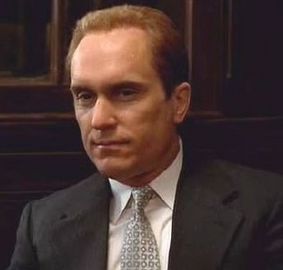
Duvall’s collaboration with Francis Ford Coppola marked one of the most significant partnerships of his career. In The Godfather (1972) and The Godfather Part II (1974), Duvall portrayed Tom Hagen, the calm, intelligent, and morally grounded consigliere of the Corleone family. Though not Italian himself, Duvall immersed himself in the cultural nuances, speech patterns, and ethical dilemmas of the character, crafting a performance that was both understated and essential to the narrative’s tension.
Coppola later described Duvall as “one of the finest actors of our generation,” praising his capacity to convey complex emotion with minimal dialogue and subtle physical expression. The role of Tom Hagen became emblematic of Duvall’s style: measured, authentic, and always grounded in psychological truth. His work on The Godfather demonstrated an ability to elevate supporting roles into unforgettable contributions that shaped the emotional and ethical fabric of the story.
Character Depth and Range
The early 1970s also included Duvall’s acclaimed work in The Conversation (1974) and Network (1976), where he explored themes of power, human vulnerability, and societal pressure. Each role revealed his capacity to inhabit diverse personas — from the quietly observant to the morally conflicted — while maintaining a consistent authenticity that earned him the respect of both audiences and peers.

His approach was methodical: Duvall immersed himself in the lives of his characters, understanding their histories, motivations, and ethical frameworks. He often spent months preparing for a single role, researching professions, dialects, and emotional responses, ensuring that every gesture and line resonated with credibility.
As the 1970s unfolded, Robert Duvall transitioned from a respected character actor to one of the most commanding presences in Hollywood. His performances during this period exemplified the convergence of preparation, psychological insight, and a profound understanding of human complexity. These years marked a watershed in his career, solidifying his reputation not merely as a performer but as a master storyteller in his own right.
Apocalypse Now: Immortalizing the Myth of War
In 1979, Duvall delivered one of his most iconic performances in Francis Ford Coppola’s Apocalypse Now, portraying Lieutenant Colonel Bill Kilgore, the larger-than-life Air Cavalry officer whose obsession with surfing amid the chaos of the Vietnam War became a symbol of cinematic audacity. Kilgore’s memorable line, “I love the smell of napalm in the morning,” instantly entered popular culture, representing the paradoxical blend of bravado and existential absurdity inherent in combat.
Duvall approached Kilgore with the same meticulous attention to detail that had defined his earlier work. He immersed himself in military procedures, studied pilot behavior, and consulted extensively with advisors to ensure authenticity. Despite the film’s surreal and hallucinatory tone, Duvall’s grounded, authoritative performance provided a psychological anchor for audiences navigating the story’s moral ambiguities.
Critics lauded the performance for its fearless engagement with the dark humor and tragedy of war. Kilgore’s swagger, eccentricities, and unexpected humanity became a blueprint for future portrayals of complex antagonists and morally ambiguous figures. Duvall’s work here demonstrated his capacity to balance charisma, menace, and subtle vulnerability within a single, unforgettable role.
The Great Santini: Exploring Family and Authority
Also in 1979, Duvall starred in The Great Santini, directed by Lewis John Carlino and adapted from Pat Conroy’s novel. His portrayal of Marine Corps fighter pilot Lieutenant Colonel Bull Meecham earned critical acclaim and an Academy Award nomination for Best Actor. Meecham is a man of discipline, intensity, and fierce devotion to his family, yet he struggles with personal rigidity, emotional repression, and the consequences of authority imposed without empathy.
Duvall’s performance was widely regarded as a masterclass in subtle emotional layering. He conveyed Meecham’s internal contradictions with gestures, glances, and tonal modulation, showing a commanding exterior juxtaposed against a fragile interior. Critics noted that Duvall did not merely act; he inhabited Meecham entirely, bringing a lived-in authenticity that resonated with audiences familiar with the challenges of familial dynamics, authoritarian structures, and the nuanced pressures of military life.
The Great Santini reinforced Duvall’s ability to command both leading and ensemble roles, highlighting his knack for grounding even larger-than-life characters in believability.
Tender Mercies: The Pinnacle of Craft
In 1983, Duvall achieved a defining moment in his career with Tender Mercies, directed by Bruce Beresford. He portrayed Mac Sledge, a washed-up country singer seeking redemption and human connection after a lifetime of personal failures and alcoholism. The film is a quiet, contemplative exploration of resilience, love, and self-discovery — a sharp contrast to the grandeur of Duvall’s prior epics.
For this role, Duvall undertook rigorous preparation, including learning to sing country songs convincingly, studying the emotional cadence of rural Texan life, and inhabiting the psychological landscape of a man burdened by past mistakes yet yearning for dignity. His performance radiated subtlety, vulnerability, and emotional power, capturing the attention of both critics and the Academy.
At the 56th Academy Awards in 1984, Duvall won the Oscar for Best Actor for his portrayal of Mac Sledge, cementing his status as one of the greatest performers of his generation. Beyond the award itself, the role exemplified Duvall’s philosophy: to embody the character’s humanity so fully that audiences see not the actor, but a person living, breathing, and grappling with life’s complexities.
Lonesome Dove: Expanding into Television Excellence
While Duvall’s work in cinema continued to flourish, he also made landmark contributions to television. In 1989, he starred in Lonesome Dove, the four-part Western miniseries based on Larry McMurtry’s Pulitzer Prize-winning novel. Portraying Augustus “Gus” McCrae, a retired Texas Ranger with wit, charm, and moral complexity, Duvall brought warmth, humor, and gravitas to a character that would become one of television’s most enduring heroes.
The series was a ratings phenomenon and won numerous Emmy Awards, with Duvall’s performance widely celebrated as the emotional heart of the story. Critics emphasized his ability to convey deep friendship, love, and loss with a natural ease that never felt performative. Lonesome Dove also showcased his skill in ensemble storytelling, highlighting how he elevated not just his own performance, but those around him through collaborative artistry.
Continued Versatility and Mastery
The 1980s and early 1990s saw Duvall consistently alternating between character-driven dramas and epic narratives. He appeared in The Natural (1984), a sports drama highlighting idealism, failure, and redemption; Days of Thunder (1990), demonstrating his aptitude for mentoring characters in mainstream Hollywood; and The Apostle (1997), a personal passion project he directed and starred in, which examined faith, sin, and the human longing for redemption.
His versatility became a hallmark: military officers, con artists, fathers, lawmen, musicians, and everyday men were all rendered with precision, authenticity, and emotional intelligence. Duvall approached each role as a full-life study, seeking to understand not just what a character did, but why, and how their personal history, environment, and moral compass shaped every choice.
Industry Recognition and Peer Admiration
By this point in his career, Duvall had earned seven Academy Award nominations, multiple Golden Globes, Emmy Awards, and a reputation as one of the most reliable, intelligent, and profoundly skilled actors of his era. Colleagues consistently praised his generosity on set, patience with co-actors, and unrelenting pursuit of authenticity. He was known for helping younger actors discover depth in their craft while simultaneously pushing seasoned veterans to reach new heights.

Directors and peers often cited Duvall’s humility, meticulous preparation, and emotional honesty as central to his enduring appeal. His approach to acting combined a respect for the text, the director’s vision, and the collaborative process, making him both a singular talent and an irreplaceable ensemble member.
Throughout the 1990s, Robert Duvall continued to demonstrate unparalleled range and dedication to craft. He alternated between leading and supporting roles with equal authority, embodying characters that spanned military officers, fathers, priests, lawmen, and ordinary men caught in extraordinary circumstances. In The Apostle (1997), a project he not only starred in but also directed, Duvall explored the intricate dynamics of faith, redemption, and personal accountability. The film received critical acclaim for its deeply nuanced storytelling and authenticity, reflecting Duvall’s continued commitment to examining the human condition in all its complexity.
During this period, Duvall also delivered memorable performances in The Hunt for Red October (1990), Falling Down (1993), Phenomenon (1996), and Deep Impact (1998), showcasing his capacity to navigate both blockbuster narratives and intimate character studies. Critics praised his ability to infuse even supporting roles with gravitas, creating characters whose presence remained indelible long after the credits rolled.
The 2000s: Recognition, Reinvention, and Exploration
In the new millennium, Duvall embraced roles that both reflected his own maturity and challenged audience expectations. In A Civil Action (1998), he played a senior attorney grappling with corporate malfeasance, portraying both authority and ethical reflection. In Secondhand Lions (2003), he captured the whimsical and tender side of his artistry, a testament to his versatility and enduring charm.
Duvall’s work in this era earned continued critical recognition, including nominations and awards that reinforced his status as one of the most respected actors of his generation. His career became a blueprint for artistic integrity: pursuing roles that resonated personally, contributing creatively beyond acting, and choosing projects with both cultural relevance and human resonance.
Mentorship and Influence
Beyond his performances, Duvall’s influence extended through mentorship. Young actors frequently credited him with guidance on emotional authenticity, professional discipline, and approaching roles with humility and intellectual curiosity. Whether on set or in private, he fostered collaboration, encouraged risk-taking, and shared the importance of understanding a character’s life history and motivations.
Colleagues often emphasized his patience and willingness to engage in detailed discussions about a scene, always prioritizing the narrative and emotional truth over personal recognition. Many noted that Duvall’s mentorship was not formalized in schools or workshops but existed organically, through everyday interactions on sets across decades, leaving an indelible mark on multiple generations of actors.
Personal Life: Grounded and Authentic
While his professional life was highly public, Duvall cultivated a personal life marked by privacy, reflection, and connection to the natural world. His longtime residence in Middleburg, Virginia, provided a sanctuary away from Hollywood, where he could pursue his love of horses, outdoor sports, and contemplative living.
Duvall’s marriage to Luciana Pedraza in 2005 reflected a profound personal partnership. Luciana often spoke of Duvall’s deep curiosity, his joy in conversation, and his ability to find meaning in both work and life. Friends describe Duvall as a man who valued authenticity, modesty, and emotional honesty — traits that were inseparable from his approach to acting.
He maintained close friendships with collaborators across decades, including directors like Francis Ford Coppola, Martin Scorsese, and Sam Peckinpah, as well as actors such as Gene Hackman and Dustin Hoffman. These relationships were characterized by mutual respect, loyalty, and a shared dedication to artistic excellence.
Later Career: 2010s–2020s
Even in his later years, Duvall’s artistic output remained vibrant. He appeared in critically acclaimed films like Jackie Brown (1997), Get Low (2009), The Judge (2014), and Widows (2018), demonstrating that age had only deepened his skill and presence. His performances continued to exhibit a remarkable balance of authority, subtlety, and vulnerability — a hallmark that defined his career from the earliest days of To Kill a Mockingbird to his final projects.
Duvall’s ability to inhabit roles with authenticity and emotional resonance continued to captivate audiences worldwide. Directors consistently sought him for projects requiring a blend of experience, insight, and on-screen credibility, recognizing that his presence elevated every ensemble.
Awards, Accolades, and Industry Recognition
Over the course of his career, Duvall amassed seven Academy Award nominations and one win for Tender Mercies. His accolades also included multiple Golden Globes, Emmy Awards, Screen Actors Guild recognitions, and honors from international film festivals. Yet perhaps more importantly, his peers and collaborators consistently praised him not just for accolades, but for his artistry, generosity, and dedication to the craft.
Industry figures often highlighted Duvall’s rare combination of humility and mastery. He was regarded as an actor who could make any role believable, elevate fellow performers, and navigate complex characters without overshadowing the story itself. This respect made him not only a performer but also a pillar of cinematic integrity.
Cultural Impact and Influence
Robert Duvall’s influence extends beyond individual roles and awards. His work contributed significantly to the evolution of American cinema, particularly in the realm of character-driven storytelling. From The Godfather to Apocalypse Now, Tender Mercies, and Lonesome Dove, Duvall consistently portrayed characters whose humanity, flaws, and resilience reflected broader social, cultural, and moral truths.
His performances shaped audience expectations for realism and depth, challenging Hollywood norms and elevating the art form. In portraying lawmen, military officers, musicians, and everyday men, Duvall demonstrated that authenticity, subtlety, and psychological insight could anchor even the most grandiose narratives.
Moreover, Duvall’s work inspired countless performers who followed, showing that a career defined by integrity, curiosity, and emotional honesty could achieve both critical acclaim and enduring cultural resonance.
Reflections on Legacy
Robert Duvall’s legacy is multidimensional. He leaves behind a body of work that spans more than six decades, a testament to endurance, versatility, and an unwavering commitment to craft. His influence as a mentor and collaborator ensures that his principles of preparation, empathy, and authenticity will resonate for generations.
Beyond the screen, Duvall’s life exemplified the importance of grounding oneself amidst fame, pursuing passions outside one’s career, and maintaining integrity in both art and personal relationships. His work reminds audiences and performers alike that great acting requires not only talent, but curiosity, observation, and a deep engagement with the human condition.
The Enduring Presence of Robert Duvall
As tributes poured in from Hollywood and beyond, a consistent theme emerged: Robert Duvall was not merely a remarkable actor but a model of artistic dedication and human authenticity. Directors, colleagues, critics, and fans celebrated his life as one in which every performance reflected deep preparation, emotional truth, and a profound respect for storytelling.
Even as Hollywood continues to evolve, Duvall’s work serves as a benchmark for quality, sincerity, and creative integrity. His characters, whether legendary figures like Tom Hagen, Kilgore, or Mac Sledge, continue to resonate because they are grounded in universal human experience.
In the final analysis, Robert Duvall’s passing marks the conclusion of a storied chapter in cinematic history — but his work, influence, and example remain timeless. Every aspiring actor, filmmaker, and viewer can find in his career lessons on the power of patience, preparation, and profound empathy.
Rest in peace, Robert Duvall — an actor of extraordinary depth, a mentor, a storyteller, and a true icon of American cinema. Your work will continue to inspire, educate, and move audiences for generations to come.
