
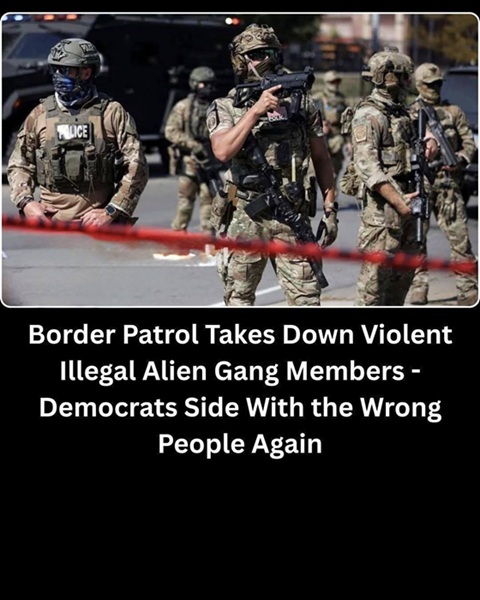
Blood hit the pavement before the facts could ever reach the microphones. In the early hours of a federal law enforcement operation in Portland, Oregon.
A violent confrontation unfolded that would immediately ignite outrage on social media and dominate cable news cycles.
The incident involved the discharge of firearms by federal agents, a detail that, in any other circumstance, would have prompted measured reporting and cautious public commentary. Instead, the response was instantaneous, visceral, and often misleading.
Within hours, politicians, activists, and journalists were already condemning U.S. Immigration and Customs Enforcement (ICE), accusing the Trump administration of conducting “militarized” immigration raids, and painting the federal presence in Portland as an existential threat to civil liberties.
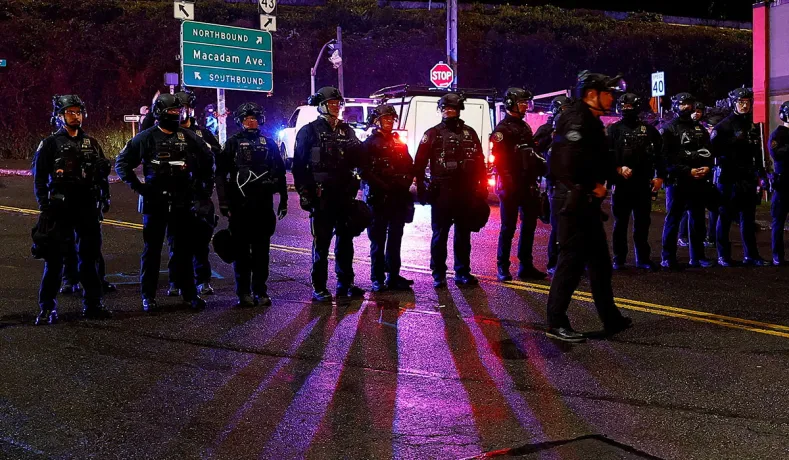
The narrative formed faster than investigators could confirm even the most basic details: who had fired the weapons, under what circumstances, and which federal agency was actually responsible.
This rapid escalation of outrage highlights a broader pattern in American civic discourse, particularly around immigration enforcement. Portland, a self-declared sanctuary city with a history of tense interactions between local authorities and federal immigration officers, became the perfect flashpoint.
The city has long prided itself on progressive policies aimed at limiting cooperation with federal immigration authorities. These policies are rooted in a belief that local law enforcement should not participate in federal immigration enforcement, especially when it involves detaining or deporting individuals who may be undocumented.
However, this stance, while popular among certain political constituencies, also creates a highly charged environment in which any incident involving federal officers can quickly become a symbol of a larger political struggle, regardless of the actual facts on the ground.
On the morning of the incident, early reports—often unverified—identified the agents involved as ICE personnel, a misattribution that would shape public perception for days.
Social media posts labeled the operation as a deliberate, militarized raid targeting immigrant communities, while cable news segments echoed these claims, often without citing concrete sources.
Public anger escalated before investigators could determine that the agents in question were actually from U.S. Customs and Border Protection (CBP), not ICE. The distinction is significant: while both agencies fall under the Department of Homeland Security, ICE and CBP have different operational mandates, protocols, and chains of command.
ICE is responsible primarily for identifying, arresting, and deporting undocumented immigrants already within the United States. CBP, by contrast, focuses largely on border enforcement and protecting ports of entry. Misidentifying the agency not only skewed public understanding but also fueled a politically charged narrative that bore little resemblance to the operational reality.
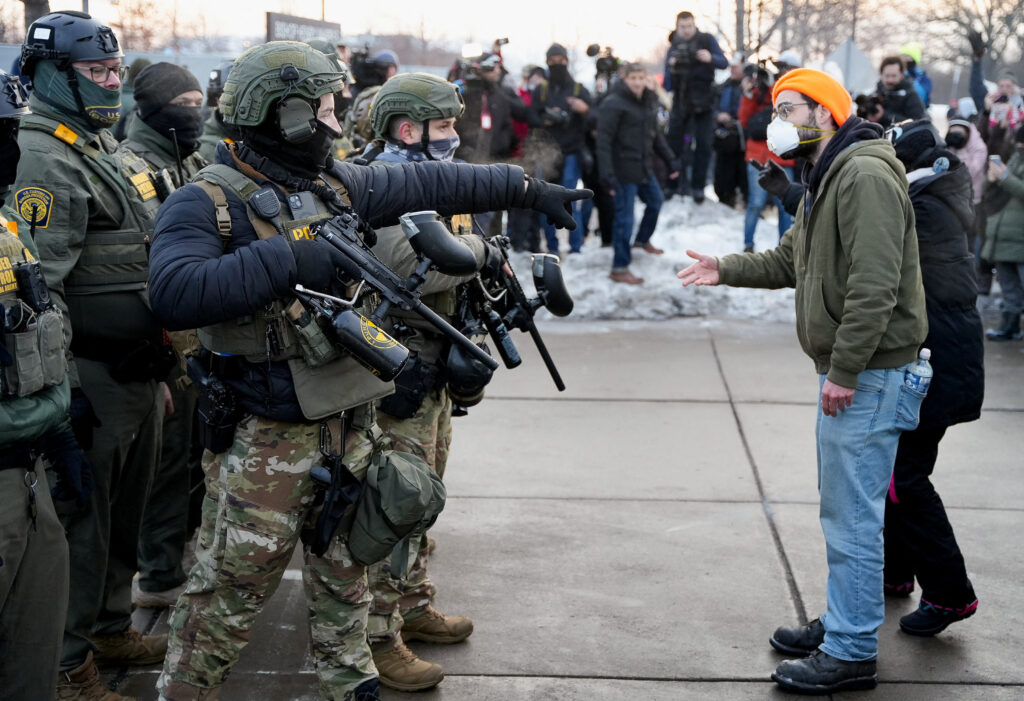
Portland’s political leaders quickly joined the chorus of condemnation. The mayor invoked the notion of federal “militarization” on city streets, threatened legal action, and tied the shooting to national immigration policies—all before the agency responsible was clearly identified or before investigators could ascertain whether the agents faced a legitimate, immediate threat.
Local police, operating in a city that has often expressed skepticism toward federal enforcement actions, were cautious to distance themselves from the incident, wary of public backlash in a community that views sanctuary policies as essential protections.
Meanwhile, federal officials urged restraint, calling for thorough reviews of body-camera footage, forensic evidence, and operational reports before reaching any conclusions. By the time these facts were verified, the initial narrative had already taken root in public consciousness, illustrating how quickly outrage can outpace reasoned analysis.
This was not an isolated misstep. Earlier incidents, including the shooting of Winston Smith in Minneapolis, demonstrated a similar pattern: initial claims were amplified by media and political actors, only to be contradicted by video evidence or official investigation later.
In Portland, the misidentification of CBP as ICE revealed a broader societal phenomenon. Immigration enforcement has become a highly symbolic issue, where perception often eclipses reality. Federal officers are quickly cast as villains in a political narrative long before the facts are established, eroding public trust and shaping debates in ways that complicate objective understanding.
In this environment, the line between factual reporting and political commentary blurs, leaving the public with impressions that are difficult to correct even after accurate information emerges.
The Portland incident also underscores the complex dynamics between local and federal law enforcement in cities with progressive immigration policies. CBP agents, tasked with executing lawful operations, operate under strict rules of engagement.
These include assessments of immediate threats to life, protocols for use of force, and procedural obligations to document every interaction.
Yet, when these protocols are enacted in highly visible urban areas, they are often interpreted through a political lens rather than an operational one. For the citizens of Portland, any show of armed federal authority can appear as an aggressive encroachment on local autonomy, regardless of the legality or necessity of the action.
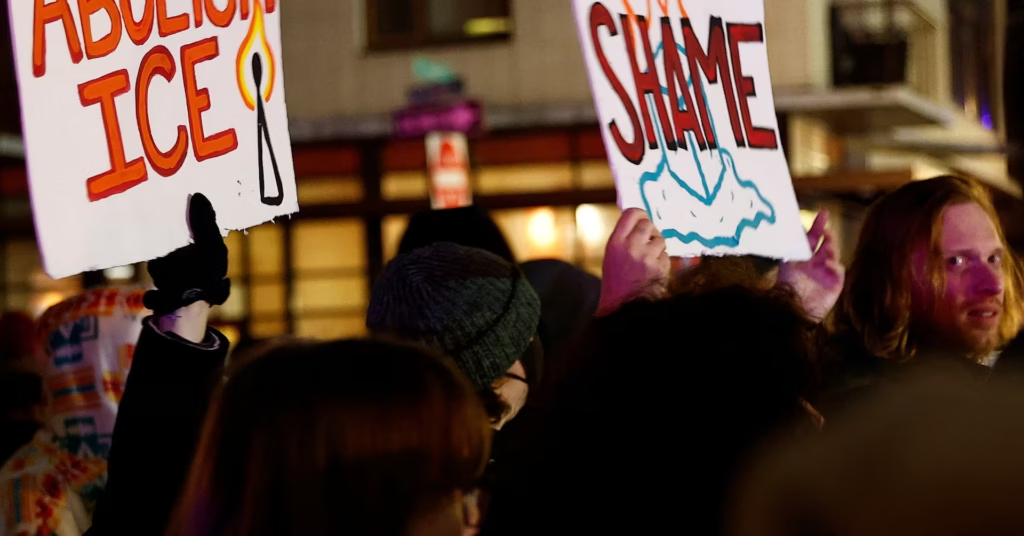
The result is a continuous tension between enforcing federal law and maintaining community trust, a balance made even more precarious when media narratives and social media amplification take precedence over investigative verification.
Even after investigators confirmed that CBP, not ICE, had conducted the operation, the correction had little impact. The initial framing—one of “federal militarization” targeting immigrants—had already cemented itself in public discourse.
Cable news panels continued to debate the implications of federal authority in sanctuary cities, activists organized protests based on the earlier misinformation, and social media posts continued to circulate inaccurate characterizations of the event.
The persistence of the initial narrative illustrates a broader psychological phenomenon: first impressions often outweigh later corrections, especially in emotionally charged situations. Once outrage has been activated, subsequent facts may be acknowledged but rarely alter the core perception that has formed.
The long-term implications of the Portland incident extend beyond a single day of social media frenzy. The misidentification of federal agencies, the premature condemnation, and the rapid spread of unverified narratives highlight the fragility of public trust in both law enforcement and journalism.
In an era where news cycles are compressed to minutes and information travels instantly via smartphones and social media platforms, the consequences of hasty conclusions are magnified.
Public officials, journalists, and activists all operate under intense pressure to respond quickly, but when speed overtakes accuracy, the resulting narratives can have lasting consequences for both communities and agencies tasked with enforcing the law.
In Portland, the incident also revealed tensions inherent in the intersection of federal authority and local governance. Sanctuary cities, like Portland, were designed to protect immigrant communities by limiting cooperation with federal immigration enforcement.
This often includes restricting local law enforcement from assisting ICE or CBP in arrests related to immigration status. While these policies aim to foster trust between immigrant communities and local authorities, they also create a volatile environment in which any federal operation can be perceived as an aggressive intrusion.
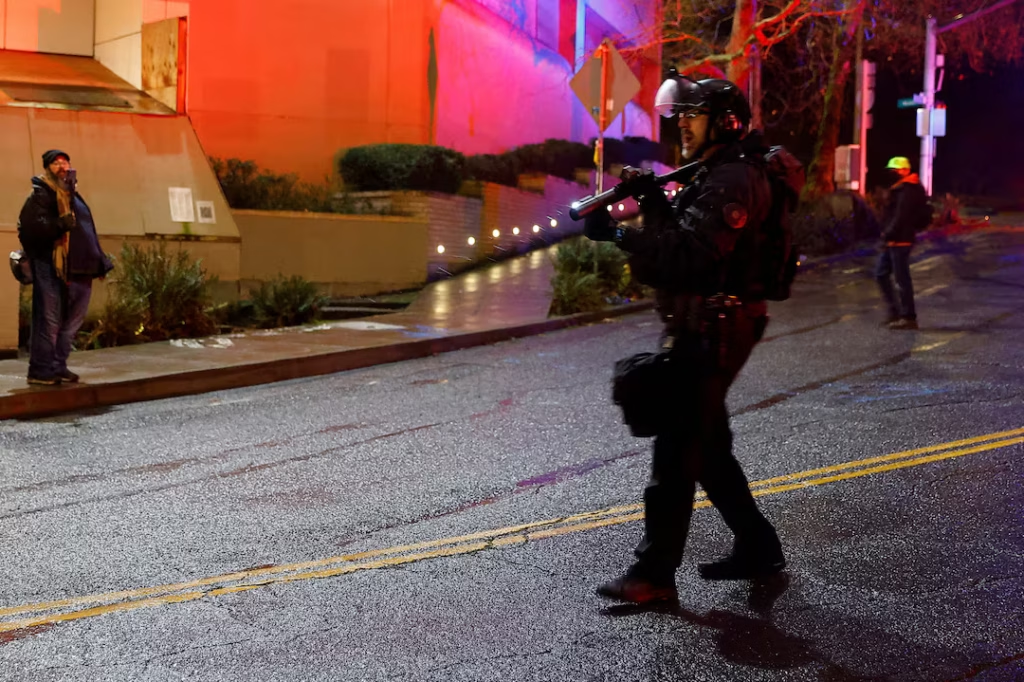
Citizens may assume that armed federal agents are acting outside the bounds of law, even when the operation is conducted legally and in accordance with established protocols. This perception becomes even more potent when amplified by social media posts or political commentary framing the incident as a deliberate attack on immigrant rights.
Federal agencies, meanwhile, face operational and public relations challenges that are often misunderstood by the public. CBP, in particular, operates under strict legal mandates that dictate when and how force may be used.
Agents receive training in threat assessment, de-escalation techniques, and proper use of firearms. They are required to document incidents meticulously, including video footage and detailed reports.
Yet these safeguards are often invisible to the public, and any use of force is quickly scrutinized, interpreted through the lens of local political climates rather than operational necessity.
In Portland, this dynamic created a situation in which agents acted in accordance with their training and federal law, but the resulting narrative framed them as aggressors before any investigation had concluded.
The media environment amplifies this effect. In fast-moving stories, especially those involving contentious topics like immigration enforcement, there is an inherent tension between speed and accuracy.
Social media platforms reward immediacy, often favoring headlines and posts that provoke strong emotional responses. Traditional news outlets, aware of the competition for attention and ratings, frequently echo these narratives without independent verification.
The result is a feedback loop in which assumptions become facts in the public imagination, further complicating the task of law enforcement and local officials trying to provide accurate information.
In Portland, once the operation was misattributed to ICE, the narrative hardened so quickly that corrections from official sources—though accurate—struggled to penetrate the established perception.
Legal and procedural questions also emerged from the incident. Portland’s city officials explored the potential for civil litigation, questioning whether federal agents had violated local ordinances or constitutional protections.
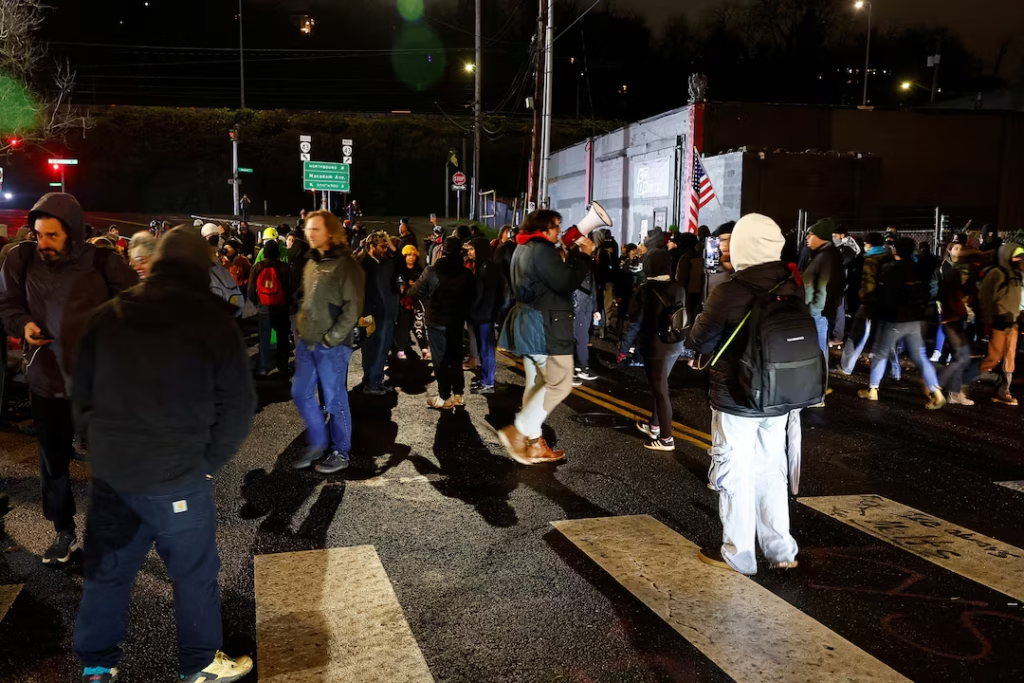
While federal law generally grants agencies like CBP authority to operate in domestic jurisdictions, these actions still exist in a delicate balance with local legal frameworks and the rights of residents.
Civil rights organizations monitored the situation closely, advocating for transparency, accountability, and independent reviews of the evidence.
These efforts reflect the broader challenge of ensuring that law enforcement operations, particularly those involving immigration, respect both federal mandates and local community standards.
At the societal level, the incident highlighted a deepening polarization in how Americans perceive immigration enforcement. For some, the presence of armed federal agents represents a necessary component of national security and the enforcement of immigration law.
For others, it is seen as an overreach of government power and an attack on vulnerable populations. Portland, with its progressive political identity and strong activist community, exemplifies the latter perspective. Yet the facts of the situation—CBP acting under lawful authority, the agents responding to immediate threats, and the careful review of evidence by federal officials—paint a more nuanced picture.
This tension between perception and reality underscores the broader challenge facing the United States as it grapples with highly politicized debates over immigration, law enforcement, and civil liberties.
The Portland case also serves as a cautionary tale for policymakers, media organizations, and social media platforms. It demonstrates the need for responsible reporting, critical evaluation of sources, and public patience before forming conclusions.
Outrage, while emotionally compelling, is not a substitute for evidence. The incident reinforces the principle that investigations should precede judgment and that even well-intentioned responses can perpetuate misinformation if based on incomplete or inaccurate data.
Educating the public about procedural protocols, agency distinctions, and the realities of federal operations could help mitigate the effects of misperceptions in the future.
In conclusion, the Portland federal shooting incident exemplifies the challenges of contemporary information dynamics in the United States.
Rapid social media dissemination, politically charged interpretations, and the misattribution of responsibility combined to create a narrative that outpaced the truth.
By the time facts emerged confirming that CBP—not ICE—conducted the operation, the initial story had already shaped public opinion, influenced political rhetoric, and catalyzed civic action.
The event underscores the importance of careful verification, the complexities of federal-local relationships in sanctuary cities, and the enduring tension between perception and reality in public discourse.
It also highlights a critical lesson: in an age of instantaneous communication, truth must not only be discovered but actively disseminated and defended against the initial surge of misinformation. Only then can trust between law enforcement, government, and the public be preserved, even amidst the most politically and emotionally charged incidents.
