
In early April 2026, the United States and Iran agreed to a conditional two‑week ceasefire, bringing a temporary halt to a dangerous conflict that had been unfolding for more than a month.
The agreement came just hours before a U.S. deadline set by President Donald Trump, who had warned that military action could escalate dramatically if Iran did not meet U.S. demands.
Under the terms of the ceasefire, Iran agreed to reopen the critical Strait of Hormuz for safe maritime traffic, a strategic requirement that had been central to Washington’s position throughout the hostilities.
The Strait of Hormuz is one of the world’s most vital oil‑shipping routes, handling a significant share of global petroleum flows; its closure had exacerbated market uncertainty before the ceasefire.

President Trump described the deal as a “total and complete victory,” asserting that U.S. objectives had been met and that the truce offered a foundation for extended negotiations.
Trump said Iran submitted a “workable” 10‑point proposal that could help facilitate broader peace talks, though major disputes over nuclear issues and military activities remain unresolved.
The ceasefire was mediated in part by Pakistani officials, whose diplomatic intervention in Islamabad helped defuse tensions just before Trump’s deadline for military escalation.
Before the ceasefire emerged, Trump had issued extremely strong rhetoric, warning that if Iran did not comply, its infrastructure and society faced sweeping military consequences.
In a widely reported social media post, Trump wrote that “a whole civilization” could perish unless Iran opened the Strait of Hormuz by a specific deadline — language that drew international concern.
This dramatic threat alarmed global leaders and legal experts, who cautioned that targeting civilian infrastructure could violate international law and raise serious humanitarian issues.

Iran’s state media rejected the initial U.S. plan for a temporary ceasefire and countered with its own proposal for a permanent end to the conflict, highlighting deep differences over terms.
Iran also warned that attacks on power plants, bridges, and other non‑military infrastructure would provoke “devastating and widespread” retaliation, underscoring the risks of further escalation.
The conflict intensified after U.S. and Israeli forces launched a military campaign against Iran in late February 2026, marking a significant escalation in a region already marked by longstanding tensions.
Trump and some U.S. allies framed the campaign as necessary to counter perceived nuclear and missile threats, but critics argued that the war had no clear endpoint and was drawing in more nations.
International reaction to the President’s earlier threats was swift and broad. Major world figures, religious leaders, and politicians expressed deep concern over the rhetoric and its possible consequences.
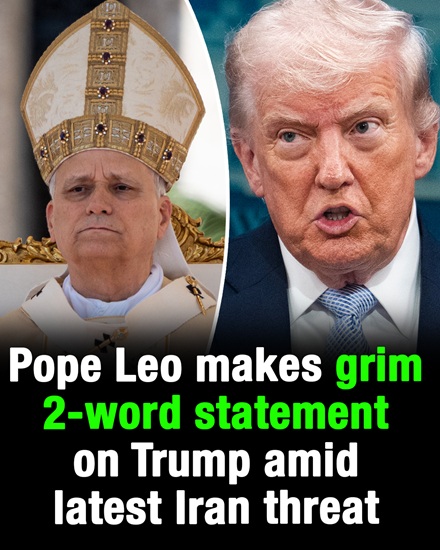
One of the strongest critiques came from Pope Leo, the sitting leader of the Roman Catholic Church, who condemned Trump’s language as “truly unacceptable” and urged restraint.

Speaking to reporters outside his residence in Castel Gandolfo, the Pope emphasized that threats against an entire people raise profound moral questions beyond legal considerations.
The Pope said that any language suggesting the destruction of civilian populations violates both moral norms and international law, urging leaders to pursue peace rather than escalation.
In his remarks, he called on people “of good will” around the world to encourage political leaders to reject war and seek diplomatic solutions where possible.
The Pope’s comments reflected his broader Easter appeal for peace, in which he called on nations to abandon conflict and embrace dialogue to solve disputes.
He also cited concerns for innocent civilians — children, the elderly, and vulnerable populations — who suffer disproportionately in modern conflicts and urged protection for non‑combatants.
The Vatican’s public rebuke of Trump marked one of the most pointed critiques by a major religious figure in recent memory regarding U.S. policy in the Middle East.

Around the world, other global leaders and institutions also responded critically, warning that aggressive language risks destabilizing broader diplomatic efforts.
Within the United States, politicians from across the political spectrum expressed alarm over the rhetoric, with some Republican voices and many Democrats rejecting threats of massive destruction.
Some U.S. lawmakers called for increased oversight of war powers, arguing that decisions to engage in large‑scale attacks on another country should be subject to constitutional checks.
Others expressed concern that such rhetoric could undermine U.S. credibility and moral authority on the world stage, especially when linked to threats against civilian infrastructure.
Legal experts highlighted that under international humanitarian law, attacks must distinguish between military targets and civilians, and deliberately threatening infrastructure vital to civilian life would be unlawful.
Even U.S. bishops’ leaders rebuked the threats, echoing the Pope’s earlier appeal for peace and calling on the President to seek negotiated settlements rather than expanded warfare.
Archbishop Paul S. Coakley, president of the U.S. Conference of Catholic Bishops, warned that language suggesting destruction of civilian populations is morally indefensible and urged peace efforts.
The broader war context included diplomatic efforts by regional actors like Pakistan, Oman, and Turkey, each playing roles in attempting to mediate between Tehran and Washington.
Energy markets responded to the ceasefire announcement with prices dropping after weeks of volatility caused by fears of supply disruptions through the Strait of Hormuz.

Despite the ceasefire, analysts caution that fundamental disagreements — especially over nuclear activities and regional alliances — may challenge efforts to reach a permanent resolution.
Iran’s confirmation of a preliminary agreement included reopening parts of the strait, although full resumption of tanker traffic remains uncertain amid lingering distrust.
The situation is further complicated by internal and external pressures on both governments, which seek to portray the ceasefire as a form of success while preserving national pride.
Some critics argue that the truce may be temporary, serving as a diplomatic pause rather than a definitive end to conflicts that have deep historical roots in U.S.–Iran relations.
Others see the ceasefire as a necessary interval that could create space for meaningful negotiation, although trust between parties remains fragile and contentious.
The international community continues to watch closely, urging de‑escalation and appealing for renewed emphasis on peaceful engagement and mutual understanding.
For now, the ceasefire stands as a short window of calm amid a broader regional crisis, offering a chance — however uncertain — for diplomacy and peace to take hold.
Whether this temporary cessation leads to lasting peace or simply sets the stage for future conflict will depend on continued negotiations, international pressure, and a shared commitment to resolving differences through dialogue.
