
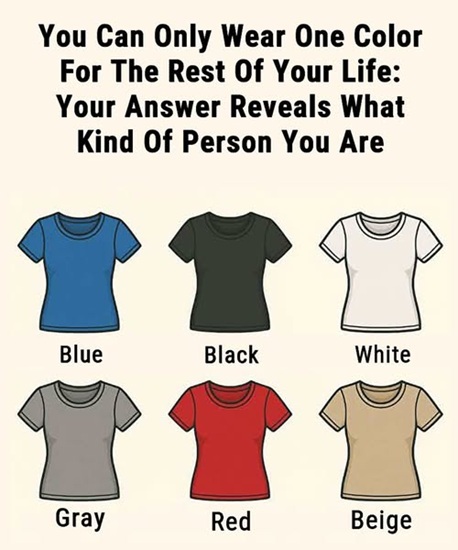
Imagine waking up tomorrow to a rule that changes everything subtly yet profoundly: every piece of clothing you will ever wear must be the same color.
No exceptions, no variations, just one color repeated forever. At first, it feels limiting. Humans are used to choice, variety, and spontaneity, so restricting oneself to a single hue is disorienting.
That unease, however, is the beginning of self-reflection, not mere frustration. The color you select cannot be arbitrary. It becomes a statement of identity, a reflection of your personality, emotional tendencies, and how you wish to present yourself to the world.
This thought experiment forces you to consider qualities you might otherwise overlook: emotional resonance, social signaling, personal comfort, and even long-term habits related to self-expression and perception.

Let’s explore six classic colors—blue, black, white, gray, red, and beige—and the subtle psychological, emotional, and social nuances each represents, along with the lifestyle implications of wearing it consistently.
Blue often symbolizes stability, calmness, and trustworthiness. Individuals drawn to blue may prioritize reflection over chaos, valuing patience, introspection, and a steady presence in both professional and personal contexts.
People who gravitate toward blue are often sought after for guidance. Their calm demeanor conveys reliability and emotional balance, which reassures others and fosters trust in social interactions and collaborative environments.
Blue wearers may prefer thoughtful problem-solving and measured responses to stress. Their color choice reflects a desire for emotional equilibrium, consistency, and a meaningful approach to relationships, career, and everyday decisions.
Black carries a distinct energy of authority, independence, and self-confidence. People who choose black often value boundaries, clarity, and maintaining control over their space, presence, and interactions without needing validation.

Black’s strength is quiet yet unmistakable. It communicates sophistication, decisiveness, and self-assurance. Those who embrace it are often resilient, disciplined, and willing to assert themselves when necessary, without overt dramatics or attention-seeking behavior.
Black can also influence lifestyle choices. Its wearers may prefer minimalist surroundings, efficient routines, and a focused approach to goals, aligning outer appearance with inner priorities for simplicity and control.
White symbolizes clarity, intention, and simplicity. Individuals drawn to white often seek emotional transparency, organization, and environments that feel calm, purposeful, and unencumbered by clutter or distraction.
White encourages mindfulness and reflection. Its wearers may approach challenges with careful deliberation, valuing honesty and clear communication. The color choice emphasizes a desire for openness, ethical consistency, and structured thinking in life and work.
Gray represents neutrality, balance, and emotional composure. People who favor gray often resist extremes, preferring reasoned observation, measured response, and practical decision-making over impulsivity or dramatics.
Gray wearers often excel at managing conflict and maintaining perspective. Their neutral presence provides stability in social and professional settings, allowing them to remain composed under pressure while guiding others calmly.

Gray communicates subtle resilience and groundedness. The color reflects adaptability, discretion, and thoughtful moderation, encouraging its wearers to act decisively while maintaining emotional equilibrium and minimizing unnecessary tension.
Red conveys intensity, passion, and energy. People who choose red often embrace boldness, emotional expressiveness, and engagement with life’s experiences, accepting both the rewards and risks of being fully alive.
Red wearers may have high emotional intelligence and a willingness to act decisively. Their choice signals vitality, presence, and courage, emphasizing an active, dynamic approach to relationships, creativity, and challenges.
Red also carries cultural and psychological weight. It draws attention without demanding it and can enhance confidence, motivation, and assertiveness. Those who embrace it often value aliveness over passivity or caution.
Beige suggests quiet confidence, warmth, and grounded stability. Individuals drawn to beige may prioritize comfort, emotional security, and authenticity over outward display, finding satisfaction in reliability and subtle presence rather than recognition.
Beige wearers often exude reassurance, calm, and dependability. Their lifestyle choices may emphasize sustainable habits, balanced routines, and environments that feel safe and harmonious, reflecting contentment with simplicity.

The color you choose shapes practical decisions too. Repeatedly wearing one color influences wardrobe composition, daily coordination, shopping habits, and even lifestyle choices, streamlining decision-making while subtly reinforcing identity.
Color functions as communication without words. It influences perception, mood, and interaction. Blue invites trust, black commands authority, white conveys clarity, gray suggests balance, red emphasizes passion, and beige radiates calm reassurance.
This experiment also highlights conscious decision-making. Wearing a single color requires reflection on texture, material, and fit, fostering aesthetic mindfulness. Each garment becomes a deliberate choice aligned with personal values and identity.
Over time, the color becomes a signal to others and a reminder to oneself. It creates subtle consistency, demonstrating reliability, self-awareness, and emotional coherence across diverse social contexts and environments.
Selecting one color forever forces reflection on authenticity. Trends, brands, and external expectations fade, leaving only what resonates personally. This clarity can increase confidence, reduce anxiety, and deepen self-understanding.
Psychologically, immersion in one color may affect mood and behavior. Blue enhances calm and analytical thinking, red energizes, black reinforces control, white promotes clarity, gray stabilizes, and beige encourages comfort and groundedness.
Culturally, color carries associations beyond personal preference. Red is linked to energy and courage, black to sophistication, white to purity, blue to calm, gray to neutrality, and beige to understated stability, subtly influencing perception worldwide.
Choosing a lifelong color also has practical benefits. Decision fatigue decreases, coordination becomes effortless, and wardrobe maintenance simplifies. Daily dressing transforms into a conscious ritual reinforcing identity, values, and personal style.

Socially, a consistent color creates cohesion in perception. Others may intuitively interpret the chosen color as signaling personality traits, enhancing communication without words and reinforcing reputation in personal and professional spheres.
Identity becomes intertwined with color choice. It is no longer external decoration but an extension of thought patterns, emotional tendencies, and habitual behavior, subtly shaping interactions, habits, and self-perception over time.
The exercise reveals priorities. Which qualities matter most—trust, authority, clarity, balance, passion, or calm? The decision highlights the emotional and psychological traits one wishes to express continuously to oneself and others.
Clothing becomes a medium of intentionality. Each outfit is not merely aesthetic but a reflection of values, emotional style, and cognitive tendencies, creating a consistent personal brand grounded in authenticity rather than performance.
Reflection on color also encourages mindfulness in broader life decisions. It fosters awareness of choice, consequences, and alignment between internal values and external presentation, prompting intentional living across relationships, work, and personal habits.
Over the long term, repeated immersion in a single color enhances self-concept. The color becomes associated with emotional stability, social behavior, and personal identity, subtly influencing confidence, perception, and lifestyle alignment.
The simplicity of a single-color wardrobe magnifies the psychological and emotional significance of each garment, transforming daily decisions into opportunities for self-expression, self-reflection, and alignment with personal priorities.
Color also interacts with environmental perception. Consistency enhances visual coherence, reduces cognitive load, and reinforces the wearer’s sense of personal space and stability, contributing to both mental clarity and social interpretation.
Ultimately, the exercise is less about fashion and more about identity, intentionality, and awareness. It strips away superficial concerns, highlighting deeper questions about presence, self-expression, and the traits one values most.
A single-color wardrobe challenges assumptions about variety, aesthetic preference, and social signaling, demonstrating that simplicity can reveal profound truths about personality, emotional priorities, and self-perception in daily life.
It also encourages reflection on long-term habits. How do we communicate values consistently? How do repeated small choices reflect larger priorities? Color becomes both symbolic and practical, bridging personal identity and daily routine.
The thought experiment is transformative because it connects visual presence to internal consistency. It demonstrates how subtle external choices mirror internal states, fostering awareness, mindfulness, and intentional expression across life domains.
So, if you had to choose a single color for life, what would it say about you? What traits, priorities, and emotional qualities would you communicate silently every day, without needing words or explanation?
