
On February 8, 2026, Bad Bunny delivered what many are already calling one of the most visually stunning, culturally resonant, and technically ambitious Super Bowl halftime shows in recent memory.
Performing at Levi’s Stadium in Santa Clara, California, the Puerto Rican superstar captivated an audience of millions with a meticulously choreographed, 14-minute spectacle that celebrated his heritage, embraced Latin culture, and highlighted the power of unity, love, and inclusivity through music and performance art.
From the very first beat of “Tití Me Preguntó,” audiences were transported into the vibrant life of Puerto Rico. Unlike any traditional halftime show that might rely solely on flashy visuals or celebrity appearances, Bad Bunny approached this performance with a holistic artistic vision.
He wanted the Super Bowl stage—one of the most watched live events in the world—to act as a window into the everyday experiences, traditions, and collective spirit of Puerto Rican life. This ambitious approach involved combining high-energy choreography, intricate staging, live musical performances, guest appearances, and an innovative concept that literally redefined the notion of a “stage.”

The performance began with a carefully designed entrance sequence that recreated the bustling atmosphere of Puerto Rican streets. Fans were greeted with scenes reminiscent of town squares filled with domino games, open-air markets, and bustling nail salons—spaces that are central to everyday community life on the island.
Rooftop weddings were recreated in miniature, giving the stage a sense of vertical depth and connecting the spectacle to intimate cultural traditions. Every element, from the set design to costume choice, was infused with authenticity.
Flags representing Puerto Rico and various Latin American nations waved proudly in the stands, symbolizing both pride and inclusion, and reinforcing Bad Bunny’s message that this halftime show was not just for Puerto Rico but for Latin America and its diasporas around the world.
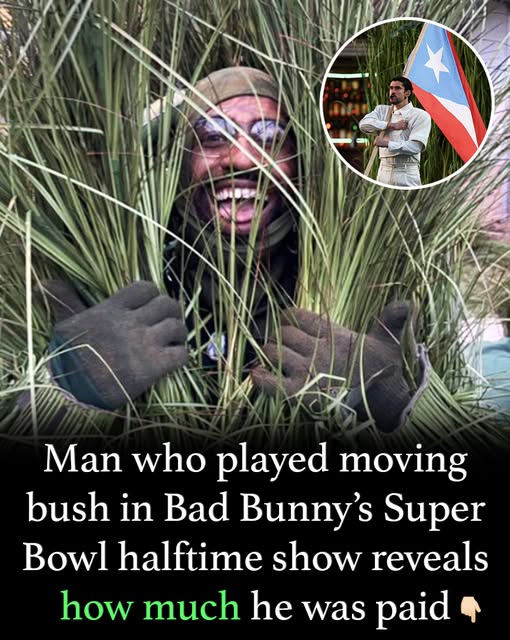
Perhaps the most talked-about element of the performance was the “grass” covering the stage. At first glance, viewers assumed it was a prop or special effect. In reality, it was composed of 500 live performers dressed as plants, moving in precise synchronization to create the illusion of a living, breathing Puerto Rican sugarcane field.
Andrew Athias, one of the performers and a social media personality known as “The Reese’s Guy,” revealed the hidden labor behind the spectacle. He flew in from Philadelphia weeks before the event to participate in rigorous rehearsals, which included hours of standing still under hot stadium lights, coordinating with camera operators, and practicing precise, limited movements.
Only individuals who met strict physical requirements were selected: participants had to be between 5’7” and 6’0”, possess athletic endurance, and have the ability to carry heavy costumes for extended periods. “It was more physically demanding than it looked,” Athias said. “You’re holding still for long stretches, sometimes in direct sunlight or under the glare of stadium lights. And you have to stay perfectly in character—completely still, like you are part of the grass itself. It sounds simple, but it’s deceptively hard when millions are watching.”
The secrecy surrounding the show added another layer of difficulty. All 500 “grass” performers signed strict non-disclosure agreements (NDAs), preventing them from posting images, videos, or any behind-the-scenes details for two weeks. Athias described this as “torture,” knowing the scale of the performance and the surprises involved but being unable to share any details.
Despite the modest compensation—$18.70 per hour, including rehearsal time—performers expressed that the experience itself was priceless. “I would have done it for free,” Athias said, reflecting the once-in-a-lifetime nature of participating in a Super Bowl halftime show of such scale and cultural significance.

Adding to the spectacle, Bad Bunny invited superstar guests Lady Gaga and Ricky Martin, both of whom contributed unique musical and visual elements. Lady Gaga performed a salsa-infused rendition of “Die With a Smile,” blending her signature vocals with complex choreography alongside Bad Bunny. Ricky Martin joined for a medley of his classic hits, further enriching the Latin musical experience while bridging generational appeal.
The collaboration wasn’t just about star power—it was a deliberate attempt to highlight the diversity, vibrancy, and history of Latin music. Visuals throughout the show were breathtaking, featuring dynamic lighting, giant moving platforms, and multi-layered sets that created a sense of depth and immersion. The synergy between music, movement, and design exemplified a rare level of planning and precision for a live performance broadcasted globally.
The symbolic choice of a living sugarcane field was deeply intentional. Sugarcane holds historical and cultural significance in Puerto Rico, representing both the island’s agricultural heritage and the resilience of its people. By having real humans embody the plants rather than using inanimate props, Bad Bunny emphasized themes of community, growth, and life.
This artistic choice required meticulous choreography: performers had to move subtly to simulate the gentle swaying of sugarcane under the wind, all while maintaining synchronization with lighting cues, camera angles, and the larger musical narrative. The resulting effect was a stage that felt alive, dynamic, and distinctly Puerto Rican—a living canvas of culture in motion.
By the end of the show, millions of viewers—estimated at 135.4 million—had tuned in, making it one of the most-watched halftime performances in history. Social media erupted as fans shared clips and reaction videos, celebrating the energy, cultural authenticity, and sheer creativity of the show.
Hashtags referencing the event trended globally, and discussions about the human “grass” performers dominated online conversations, shining a spotlight on the often-invisible labor that makes such spectacles possible.

Even with widespread praise, not everyone was enthusiastic. Former President Donald Trump criticized the performance on Truth Social, calling it “absolutely terrible” and labeling it as a “slap in the face to our country.”
His comments sparked spirited debates across social media, with commentators like Piers Morgan responding publicly: “Couldn’t disagree more, Mr. President. I absolutely loved Bad Bunny’s halftime show … and by the way, Spanish is the first language for over 50 million Americans!” Despite this political commentary, the overwhelming narrative centered on the show’s creative brilliance, cultural importance, and innovative execution.
As the show progressed, it became increasingly clear that Bad Bunny had created a halftime experience that went far beyond music—it was storytelling, visual art, and cultural homage rolled into one seamless performance.
One of the most remarkable aspects of the halftime show was how the audience, both in Levi’s Stadium and at home, became fully immersed in the Puerto Rican narrative. From the very beginning, the staging was designed to feel dynamic and alive, drawing viewers into the rhythms, colors, and textures of the island.
The performance included sequences inspired by everyday Puerto Rican life, from domino games in town squares to bustling nail salons filled with performers acting as customers and staff. The attention to detail was astonishing: the set designers replicated the architectural nuances of Puerto Rican buildings, the color palette reflected the vivid vibrancy of the streets, and props were carefully curated to ensure authenticity.
Even the choreography mirrored gestures, dances, and movements typical of Puerto Rican communities, making each scene feel lived-in and genuine. These elements created an atmosphere where culture was not just represented—it was celebrated and lived in real time.
The “grass” performers remained the unsung heroes behind the show’s visual ingenuity. José Villanueva, another member of the 500-person troupe, described the surreal feeling of being part of such a historic performance: “When the lights hit us, you feel every eye in the stadium on you, and yet you have to maintain stillness and composure.
You become part of the landscape, and it’s simultaneously exhausting and exhilarating. It’s one thing to perform in front of a small crowd, but millions watching live? That’s something else entirely.” The dancers’ ability to hold weighty, immobile positions for extended periods, occasionally shifting only slightly to mimic the natural sway of a sugarcane field, was essential to the illusion of a living, breathing environment. Their contributions, though largely invisible to casual viewers, were critical to the spectacle’s success.
Another standout moment occurred during Lady Gaga’s segment. Her performance of the salsa-infused “Die With a Smile” required precision timing with Bad Bunny and the 500 “grass” performers, as well as a seamless integration with elaborate camera shots. Gaga’s choreography was intricate, including rapid spins, coordinated footwork, and synchronized arm movements with Bad Bunny and a team of backup dancers.

The production team had to coordinate camera angles, lighting cues, and musical transitions to ensure that each visual moment landed perfectly for the live broadcast. This coordination underscored the enormous technical demands of the performance—every dancer, every camera operator, and every musician had to operate like a single, finely tuned instrument.
Ricky Martin’s medley of Latin classics added another layer of depth, connecting the present-day celebration of Latin culture with its rich musical legacy. By performing alongside Bad Bunny, Martin symbolically bridged generations, uniting longtime fans with new audiences and reinforcing the continuity of Latin influence in global music.
The medley included hits such as “Livin’ la Vida Loca” and “La Copa de la Vida,” seamlessly woven into the overarching narrative of Puerto Rican pride and Latin heritage. The stage design cleverly incorporated Martin’s entrance, using moving platforms and multi-level staging to highlight both his presence and the surrounding performers, creating a sense of fluid motion across the entire field.
Perhaps the most emotionally resonant moments of the show were the gestures of connection and inclusion. Bad Bunny reached out to the audience in ways that were both intimate and symbolic. One particularly moving instance occurred when he handed a Grammy Award to a young boy in the crowd, moments that initially sparked speculation about the child’s identity.
Rumors suggested the child was Liam Conejo Ramos, a 5-year-old recently detained by ICE, but TMZ later confirmed the boy was Lincoln Fox Ramadan, a young actor chosen to inspire viewers. Regardless of identity, the gesture became a viral symbol of hope, inclusivity, and the human spirit, resonating widely across social media. Clips of the moment circulated rapidly, with fans praising the sincerity and emotional weight of the interaction.
The reception from audiences worldwide reflected the show’s impact. Social media erupted immediately, with fans sharing both short clips and full reactions from the live broadcast. Platforms such as Twitter, Instagram, TikTok, and X were flooded with comments highlighting various aspects of the performance: the moving sugarcane field, the energy of Lady Gaga’s salsa routine, Ricky Martin’s classic hits, and Bad Bunny’s authentic storytelling.
Fans praised the meticulous coordination, the authenticity of the cultural depictions, and the innovative use of human performers to transform a stadium into a living tableau of Puerto Rican life. Comments like, “The sugarcane field? Genius. The attention to detail is unmatched!” and “This is why representation matters. Puerto Rican culture has never looked this good on a stage this big” became common refrains online.
Even technical observers and media analysts expressed admiration for the show’s production complexity. Synchronizing 500 human performers with live music, intricate camera work, moving platforms, and elaborate lighting was an extraordinary logistical feat. Producers had to ensure that the timing of every beat, movement, and visual effect aligned perfectly with the live broadcast.
The performers’ ability to maintain composure under intense scrutiny, while executing precise movements in heavy costumes, exemplified an often-overlooked form of physical artistry that is just as critical as the musical performance itself. The “grass” performers were particularly remarkable because they demonstrated the power of subtlety: while they moved only slightly, their disciplined presence created an immersive, almost magical experience for millions of viewers.

In contrast, political commentary on the performance highlighted how cultural events can spark broader societal conversations. Former President Donald Trump’s criticism on Truth Social—calling the performance “absolutely terrible” and “one of the worst” halftime shows ever—triggered widespread online discussion. Commentators from various media outlets countered his remarks, emphasizing the show’s artistry and its celebration of Latin heritage.
Many pointed out that more than 50 million Americans speak Spanish as their first language, underscoring the cultural relevance of showcasing Latin music and traditions on a global stage. The debate illustrated that beyond entertainment, the Super Bowl halftime show had become a platform for cultural dialogue and representation.
The combination of creativity, cultural pride, and technical prowess made this halftime show historic. Bad Bunny did not just perform music; he curated an experience that married performance art, community storytelling, and live spectacle in a way rarely seen in mainstream entertainment.
The inclusion of 500 human performers as the sugarcane field, combined with guest appearances, high-energy choreography, and attention to cultural detail, created an immersive performance that engaged audiences both emotionally and aesthetically. For performers like Andrew Athias and José Villanueva, participating in such a massive production was transformative. The experience offered not only exposure to millions of viewers but also an opportunity to contribute to a cultural moment that will be remembered for generations.
As the final notes of Bad Bunny’s Super Bowl LX halftime show reverberated through Levi’s Stadium, it became clear that the performance was more than a fleeting entertainment spectacle—it was a cultural milestone. By integrating elements of Puerto Rican daily life, Latin music heritage, and groundbreaking stagecraft, Bad Bunny had crafted a moment that would be remembered not just as a Super Bowl halftime show, but as a defining instance of representation on one of the world’s largest stages.
The legacy of the show lies in its multidimensional approach. First, there was the music: a carefully curated setlist that blended Bad Bunny’s contemporary hits with collaborative segments featuring global icons like Lady Gaga and Ricky Martin.
Each song was carefully chosen to advance the narrative of the show, highlighting Puerto Rican pride, Latin musical legacy, and the universal power of joy and community. Beyond the notes themselves, the choreography acted as a form of storytelling, portraying cultural rituals, social gatherings, and collective experiences that had previously seldom been depicted on an international platform of this scale.
The inclusion of 500 human performers as the sugarcane field symbolized a deeper, more humanistic approach to art and culture. These performers were not simply background extras—they embodied the land, labor, and vitality of Puerto Rico itself. By having real humans represent the sugarcane, Bad Bunny emphasized the connection between culture, history, and the people who carry it forward.
Performers endured physically demanding conditions: standing or moving subtly for hours in 50-pound costumes, under intense stadium lights, and in synchronization with live music and broadcast camera work. Their dedication and precision were critical in creating the show’s most iconic visual element, and yet, for many viewers, this effort remained invisible until the viral reveal. The revelation that the “grass” was human performers only heightened appreciation for the ingenuity and labor behind the production.
Critically, the performance also highlighted the importance of representation in media. For Latin audiences around the world, seeing Puerto Rican streets, social rituals, and everyday moments portrayed with authenticity on a global stage was deeply validating. Social media reactions reflected this sentiment: fans celebrated not only the music and choreography but also the pride and visibility that the performance offered to Latin communities.
Memorable comments included reflections such as, “I’ve never felt so seen on a stage this big” and “Bad Bunny just made our culture global and glamorous at the same time.” These reactions underscored a broader cultural resonance, beyond mere entertainment value, demonstrating how artistic performances can inspire identity, connection, and pride.
The show’s technical brilliance also contributed to its lasting impact. Coordinating live music, high-energy choreography, 500 human “plants,” dynamic lighting, moving platforms, and complex camera work required months of preparation. Every detail, from costume fittings to rehearsal timing, was meticulously planned.
Choreographers and directors worked closely with performers to ensure movements were both authentic and visually striking from every camera angle. The result was a performance that balanced artistic vision with technical execution, creating a flawless broadcast that captivated millions while maintaining cultural integrity.
Beyond the technical and artistic feats, the halftime show also included heartwarming moments of connection, which resonated widely with viewers. The gesture of Bad Bunny handing a Grammy Award to young Lincoln Fox Ramadan, for example, symbolized hope, inclusion, and encouragement for the next generation.
Even though initial rumors had mistakenly identified the child as a politically symbolic figure, the act was universally celebrated for its emotional resonance and uplifting message. These small, human moments punctuated the grand spectacle, demonstrating that even in large-scale productions, personal connection and empathy can shine through.
Audience reception further solidified the show’s cultural significance. Millions of fans shared clips, reflections, and behind-the-scenes reactions across platforms like Twitter, Instagram, TikTok, and X. Hashtags related to the sugarcane field, Lady Gaga’s salsa performance, and Ricky Martin’s medley trended globally. Media analysts praised the show’s fusion of artistry, cultural storytelling, and technical mastery.
Even critiques from political commentators, including former President Donald Trump, could not overshadow the overwhelmingly positive public response, highlighting the distinction between cultural celebration and partisan critique.
The performers themselves often described the experience as life-changing. Andrew Athias emphasized the rare combination of endurance, focus, and creativity required: “You’re part of something historic. You’re invisible in some ways, yet the show could not exist without you.
It’s physically grueling, but emotionally, it’s unforgettable.” José Villanueva reflected on the emotional weight of the experience: “Being there, being part of a living piece of Puerto Rican culture, you realize that every movement matters. We were contributing to something much bigger than ourselves.”
In conclusion, Bad Bunny’s Super Bowl LX halftime show will be remembered as one of the most innovative, visually spectacular, and culturally impactful halftime performances in Super Bowl history. By combining human creativity, technical excellence, and heartfelt storytelling, the show created an immersive experience that honored Puerto Rican and Latin culture while connecting with a global audience. From the intricate choreography to the 500 dancers portraying a living sugarcane field, every detail was carefully orchestrated to convey pride, resilience, and joy.
More than just a musical performance, the halftime show became a statement about identity, inclusion, and representation. Millions of viewers worldwide were not only entertained but inspired to celebrate their own cultures, traditions, and histories. The performance also demonstrated the invisible labor and dedication behind large-scale productions, highlighting the remarkable contributions of performers who often remain unsung heroes.
Ultimately, Bad Bunny’s halftime show was a triumph of art, culture, and human effort, blending music, storytelling, and visual artistry in a way that will resonate for generations. It redefined expectations for halftime performances, set a new standard for cultural representation, and offered a historic example of how large-scale entertainment can simultaneously educate, inspire, and celebrate humanity.
By centering the people, history, and vibrant life of Puerto Rico, the show transcended the boundaries of a typical sports halftime event, establishing itself as a moment of global cultural significance, one that will be remembered, studied, and celebrated for decades to come.
