
Late one September evening in Deltona, Florida, a shocking incident occurred that would leave an elementary school’s library severely damaged and ignite conversations about youth accountability, community safety, and parental responsibility.
The Volusia County Sheriff’s Office reported that on September 13, two boys, ages just twelve and thirteen, were implicated in an apparent break‑in and extensive vandalism at Friendship Elementary School, a local public school in Volusia County.
According to deputies, the boys first entered the school campus during the day without authorization and then returned later that same night, this time causing significant destruction to the library’s interior.
The school’s library, commonly referred to as the media center, was left in ruin by the time authorities responded to a nighttime alarm triggered at the building that Saturday, prompting a police call.

Responding deputies discovered the glass front door of the media center shattered, evidence of forced entry, and a scene of disorder and destruction that drew gasps from those who viewed the photos shared publicly.
Once inside, law enforcement officers found books strewn across the floor, furniture overturned, materials ripped from shelves, and walls marked with what appeared to be graffiti, creating a chaotic and distressing scene.
Surveillance video released by the Volusia Sheriff’s Office captured clear images of two males inside the library during the day, before the later nighttime break‑in, helping investigators identify persons of interest.
In one portion of the footage, one boy is seen wearing a distinctive Monster Energy cap, and both suspects appear to have attempted to obscure their faces, though their identities were eventually revealed.
At first, authorities shared the video with the public in hopes that tips from community members would assist in identifying the suspects, a step that quickly produced results once the footage spread online.

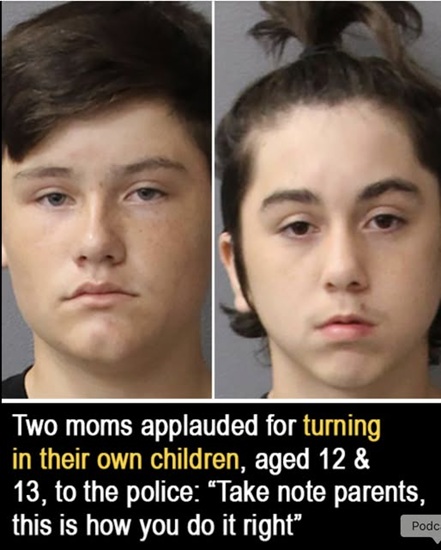
In the wave of online response, tips began pouring in, and notably, the crucial leads came from two unexpected sources: the boys’ own mothers, who recognized their children on the surveillance footage.
The Volusia Sheriff’s Office publicly confirmed that both mothers contacted law enforcement, acknowledged their sons in the video, and reported their involvement to deputies, leading to their surrender.
In a statement on social media, the sheriff’s office said that after being identified, both boys confessed to breaking into the school and vandalizing the media center, a rare moment of parental accountability.
Officials said the pair initially entered the school during daytime hours and later returned at night to “look at the damage and cause more,” exacerbating the destruction already begun earlier in the day.
Local reports estimate that the total cost of damage to the library exceeds $50,000, as furniture, fixtures, media equipment, books, and structural elements require extensive repair or replacement.
Because the library is a vital educational resource for students, the impact extends beyond physical materials, affecting learning, literacy programs, and classroom access to books for all grade levels.

In response to the incident, the sheriff’s office charged each boy with a range of offenses, including multiple counts of burglary, trespassing on school grounds after hours, criminal mischief, and theft, reflecting the seriousness of the wrongdoing.
Burglary charges allege the boys unlawfully entered the property with intent to commit a crime, while trespassing charges reflect unauthorized presence on school property, both of which carry notable consequences under Florida law.
Criminal mischief charges apply because the boys caused property damage beyond simple disarray, demonstrating a level of destruction that legally qualifies as significant vandalism.
The theft charges stem from allegations involving the removal or attempted removal of school property, though it has not been fully detailed which items were taken, if any, pending judicial proceedings.
At present, authorities have not publicly confirmed how the case will advance through the juvenile justice system, where procedures differ greatly from adult courts and focus more on rehabilitation.
In Florida, juvenile cases often include a range of legal considerations such as detention hearings, assessments of risk, and evaluations by professionals trained in adolescent development, all of which influence outcomes.
Juveniles accused of crimes may be subject to probation, counseling programs, restitution requirements, and involvement in structured rehabilitative approaches meant to reduce recidivism and encourage accountability.

Community reaction to the incident was swift and widespread, especially after images and accounts were shared online, where users expressed shock, disbelief, and intense interest in the outcomes.
Many responses praised the boys’ mothers for turning their children in, acknowledging the difficult parental choice of prioritizing accountability over concealment, a sentiment echoed by commenters across platforms.
“Great job moms!!! I’m sure that was incredibly hard, but it was the right thing to do,” one commenter wrote, stressing that confronting consequences is part of responsible parenting.
Another wrote, “Thank you moms for seeing your child needs to see the world doesn’t revolve around them,” emphasizing that actions have repercussions and children must learn this lesson early.
Some commenters observed the boys were very young to face the prospect of criminal records, suggesting concern for their future prospects while still applauding the decision to turn them in.
Others took a more punitive viewpoint, suggesting that part of any consequences should involve hands‑on restitution — such as having the boys help clean and restore the library as part of making amends.
“Assign them the library repair every day to clean up their mess from putting books back on the shelves to cleaning every nook and corner,” wrote one online user, reflecting a restorative justice approach.
“They should have to go clean it up during school hours so everyone can see,” another commenter suggested, implying that public acknowledgment of responsibility could help teach accountability.

Restorative justice programs in juvenile systems sometimes include community service or direct involvement in repairing harm, designed to connect offenders to the consequences of their actions.
Psychologists and juvenile justice experts note that adolescents at ages twelve and thirteen are still developing critical decision‑making skills, and interventions often focus on education, supervision, and support rather than punishment alone.
Many educators and parents in Volusia County expressed sadness over the destruction because school libraries serve as central hubs for learning, reading enrichment, and community engagement for students of all ages.
School leaders noted the emotional toll the vandalism had on staff and students, especially as librarians and teachers had to reorganize resources and repair a space intended to inspire learning.
Friends of students who attended Friendship Elementary shared concern for how the disruption might affect their peers’ access to books, tutoring, and activities that contribute to academic success.
Volusia County School District officials reiterated their commitment to maintaining safe, welcoming environments and said they would explore additional security measures to prevent a future incident like this.
Deterrence strategies in schools can include enhanced surveillance, controlled access to facilities after hours, community awareness programs, and partnerships with law enforcement to monitor campuses.
Though this incident involved remarkably young individuals, it highlights broader issues of youth behavior, access to facilities after hours, and how communities respond to serious misconduct by minors.
School administrators hope the case will prompt discussions among parents and students about respect for learning spaces, personal responsibility, and the value of community resources.
Parents across social media shared stories of difficult conversations they’ve had with their own children about respecting public and shared property, emphasizing that healthy discipline is complex but necessary.
The boys named in the case — Felix Cohen Romero, age 12, and Bentley Ryan Wehrly, age 13 — remain in custody pending further proceedings in the juvenile system, where fines, counseling, or other outcomes may be ordered.
While juvenile records are typically sealed or handled differently from adult records, the families and legal representatives will likely attend hearings to determine appropriate measures tailored to each child’s circumstances.
Regardless of the legal outcome, this case has already sparked important conversations about accountability, forgiveness, rehabilitation, and the role of parents in guiding children through serious mistakes.
Volusia County residents continue to discuss how to balance punishment with support, ensuring young people understand consequences without facing undue lifelong harm for actions at a formative age.
Ultimately, the Friendship Elementary library vandalism serves as a reminder that even actions by youth can have deep consequences for communities, and that addressing such incidents requires cooperation between families, schools, and justice systems.
If you were in a similar situation, would you turn your child in to authorities? What approaches do you think best help children learn from serious mistakes? Let us know your thoughts below.
