
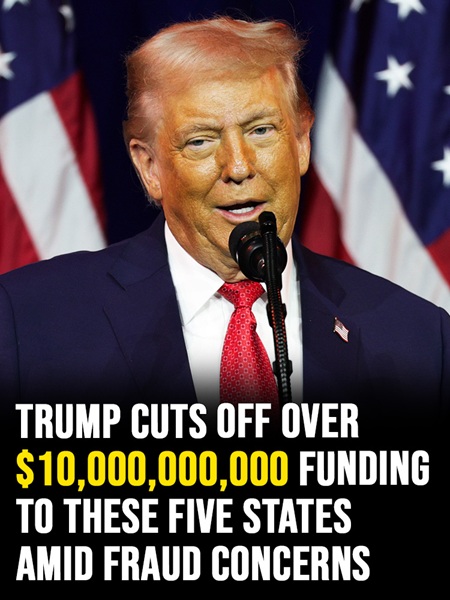
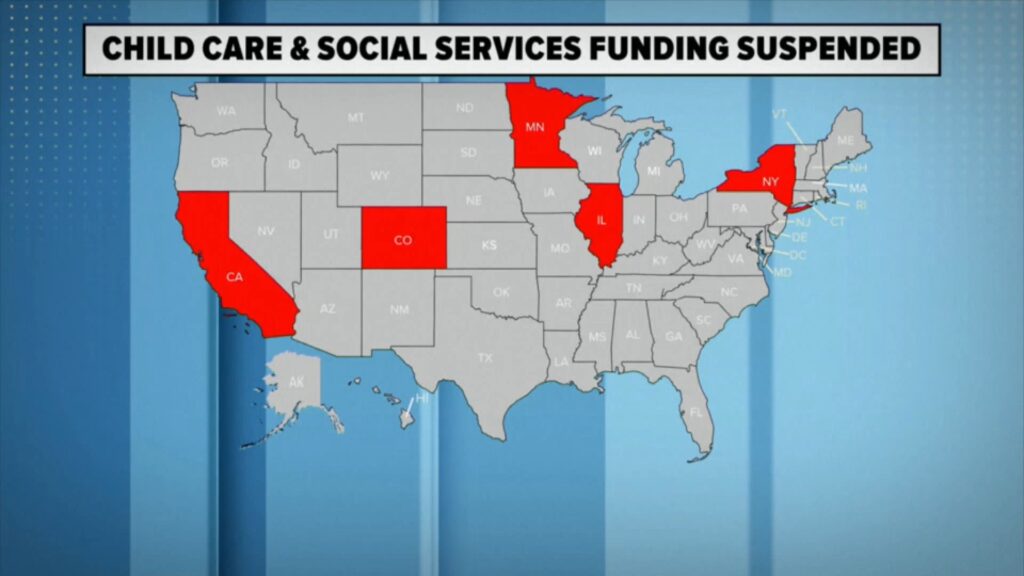
In a move that has sent shockwaves through the U.S. political landscape, the Trump administration has announced it will freeze more than $10 billion.
In federal funding allocated to five states governed by Democrats: California, Colorado, Illinois, Minnesota, and New York. The decision specifically targets major social service programs.
Including the Temporary Assistance for Needy Families (TANF), the Child Care Development Fund (CCDF), and the Social Services Block Grant (SSBG). According to the Department of Health and Human Services (HHS), this action is intended to curb alleged fraud and ensure that federal taxpayer dollars are being used properly and for their intended purposes.
Andrew Nixon, a spokesperson for HHS, stated, “For too long, Democrat-led states and governors have been complicit in allowing massive amounts of fraud to occur under their watch. Under the Trump administration, we are ensuring that federal taxpayer dollars are being used for legitimate purposes. We will ensure these states are following the law and protecting hard-earned taxpayer money.”
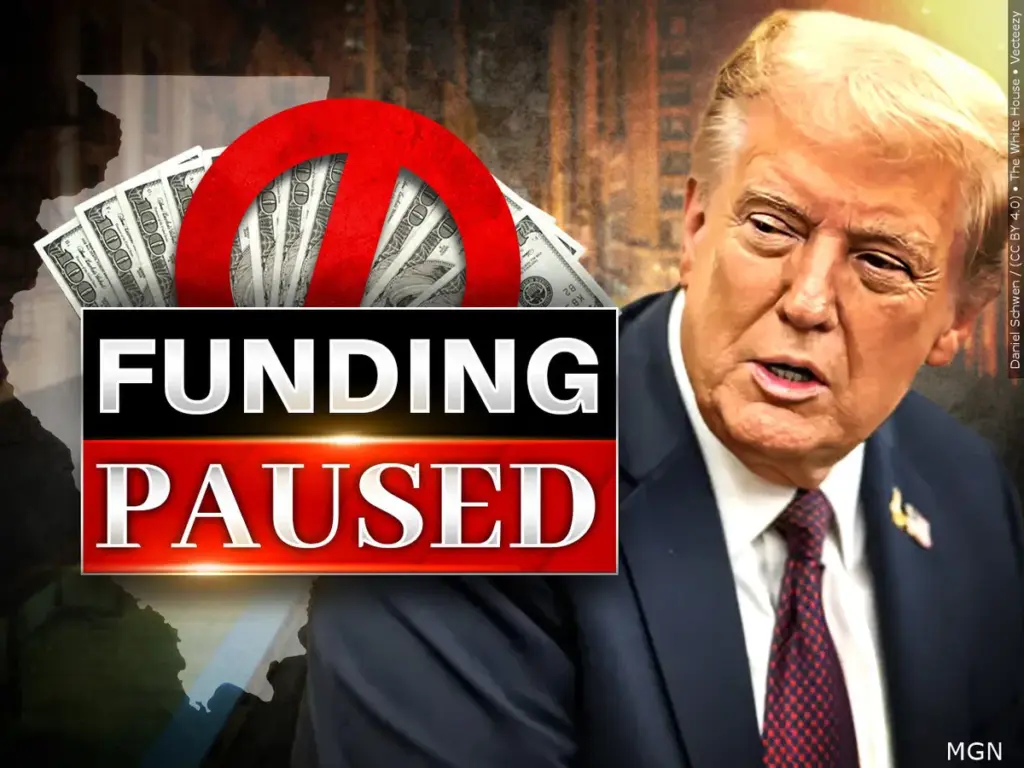
The Scope of the Funding Cuts
The financial impact of these freezes is substantial. TANF, which provides temporary financial assistance to low-income families, is set to lose over $7.3 billion. The Child Care Development Fund, which helps families afford safe and reliable child care, will see $2.4 billion withheld.
In addition, $869 million from the Social Services Block Grant, which supports a broad range of community services, is also at risk.
In total, more than $10 billion in federal support is affected, representing a significant disruption for millions of Americans who rely on these services for essential needs such as child care, housing assistance, food, and other social programs.
ACF Assistant Secretary Alex Adams, in letters sent to the affected governors, cited “recent federal prosecutions and additional allegations that substantial portions of federal resources were fraudulently diverted away from the American families they were intended to assist” as justification for the freeze.
The letters underscore the administration’s stated commitment to investigating and preventing misuse of federal funds.
Programs Directly Impacted
The TANF program provides essential support to millions of low-income families, funding food, housing, job training, education, and other critical services, particularly for single-parent households.
The CCDF ensures that children from low-income families have access to safe, high-quality child care while enabling parents to maintain employment or pursue educational opportunities.
The SSBG allows states flexibility to provide critical social services, including adult protective services, foster care, and mental health support.
Officials from HHS argue that these programs have been susceptible to misuse, such as improper payments to ineligible recipients or mismanagement at the state level.
While the administration has not publicly detailed specific instances for each state, it maintains that the freeze is a preventive measure to protect taxpayers and maintain the integrity of federal programs.
Immediate Political Backlash
The announcement has triggered widespread criticism, particularly from Democratic leaders in the affected states, who argue that the freeze is a form of political retaliation rather than a legitimate fraud-prevention measure.
New York Senator Kirsten Gillibrand has emerged as one of the most vocal opponents. She described the freeze as “immoral and indefensible” and accused the administration of targeting children and low-income families for political reasons.
“Trump is threatening to freeze child care funding in New York and targeting our children for political retribution. It’s immoral and indefensible,” Gillibrand stated in a post on X. She further emphasized, “To use the power of the government to harm the neediest Americans is immoral and indefensible.
This has nothing to do with fraud and everything to do with political retribution that punishes poor children in need of assistance.”
Gillibrand also released a public statement outlining her concerns about the broader impact of these funding cuts. “My faith guides my life and public service,” she said.
“It is our job to serve the people most in need and most at risk, no matter what state they live in or what political party their family or elected representatives belong to. I demand that President Trump unfreeze this funding and stop this brazen attack on our children.”
State-Level Reactions
California Governor Gavin Newsom condemned the freeze, calling it “a direct attack on vulnerable families who rely on federal support for basic needs.” He highlighted that millions of Californians depend on TANF, CCDF, and SSBG funding for access to food, child care, housing assistance, and other critical social services. Newsom criticized the move as politically motivated and morally unacceptable.
In Illinois, Governor J.B. Pritzker described the decision as “reckless and harmful,” emphasizing that it would directly affect children, single parents, and seniors who rely on these programs.
Minnesota Governor Tim Walz warned that the freeze could have “devastating consequences” for the state’s most vulnerable populations.
Colorado Governor Jared Polis also voiced strong opposition, arguing that cutting funding for programs designed to help struggling families is an attack on the very people federal policies are meant to protect. He added that TANF and CCDF programs already have strict oversight mechanisms, making the broad allegations of fraud appear politically motivated rather than evidence-based.
Democratic lawmakers and local officials have consistently framed the freeze as punitive, suggesting it represents an unprecedented use of federal power to exert pressure on states with opposing political leadership. Legal experts and policy analysts indicate that judicial review may be sought, potentially resulting in federal court challenges.
The freeze of more than $10 billion in federal funding has the potential to create immediate and long-term repercussions for families and communities across California, Colorado, Illinois, Minnesota, and New York. TANF, CCDF, and SSBG are foundational programs for low-income households, providing essential support for basic needs, child care, and community-based services.
TANF, in particular, delivers temporary financial assistance to families in need, helping them cover expenses for food, housing, and essential utilities.
The suspension of over $7.3 billion in TANF funding could lead to reduced monthly benefits or delays in assistance, pushing vulnerable families into deeper financial instability.
Many households rely on these funds to stabilize their finances while seeking employment, attending school, or caring for children. Experts warn that any interruption in TANF support may increase poverty rates and widen economic disparities, especially in urban centers where living costs are high.
The Child Care Development Fund (CCDF) plays a critical role in enabling parents to work or pursue education by subsidizing access to affordable, safe, and high-quality child care.
Freezing $2.4 billion in CCDF funds could reduce the number of available child care slots, forcing parents to either reduce working hours or leave the workforce entirely. This, in turn, could lower household income, reduce economic mobility, and hinder children’s social and cognitive development.
Organizations such as the National Association for the Education of Young Children (NAEYC) emphasize that disruptions in child care services disproportionately affect low-income families and rural communities, where access to licensed providers is already limited.
Social Services Block Grants (SSBG), which provide $869 million in support for adult protective services, foster care, mental health programs, and disability services, are also at risk. These programs assist some of the most vulnerable Americans, including seniors, children in foster care, and adults with disabilities.
Cutting this funding could reduce or suspend critical services, forcing families and communities to fill gaps that state agencies may no longer be able to cover. Community-based organizations, which depend on SSBG funds to operate programs for domestic violence survivors, counseling services, and elder care, may face staffing reductions, program cuts, or even closure in extreme cases.
Historical Context and Oversight
The Trump administration cites concerns about fraud as the primary reason for freezing the funds. While fraud can and does occur in large federal programs, independent audits have historically shown that the incidence of fraud is relatively low compared to the total dollars distributed.
For example, a 2022 federal audit of TANF programs across several states identified isolated cases of improper payments and eligibility errors, but found that most states complied with federal regulations and maintained robust oversight mechanisms.
Experts caution that using the threat of widespread fund freezes as a political tool is unusual and potentially harmful. Previous instances of mismanagement or fraud typically result in targeted audits, fines, or program adjustments, rather than blanket freezes affecting millions of families.
By freezing funds in multiple states simultaneously, critics argue, the administration risks conflating isolated incidents with systemic fraud, creating undue hardship for individuals who depend on these programs.
Expert Opinions
Policy analysts and nonprofit organizations have expressed concern about both the short-term and long-term implications of the freeze. The Center for Budget and Policy Priorities (CBPP), a nonpartisan research organization, noted that “freezing funds intended to support families in poverty will have immediate negative effects on children’s health, education, and overall well-being.”
They emphasize that political motivations behind the freeze may undermine public trust in federal social programs, potentially destabilizing services even beyond the states directly affected.
Child advocacy groups, including the NAEYC and First Five California, have warned that the freeze could severely limit access to licensed child care providers.
“Families already struggling to secure affordable, quality child care will have even fewer options,” said a representative from NAEYC. “Children may be placed in unlicensed or unsafe care settings, which can have long-term consequences for their development and safety.”
Legal experts also note that states may challenge the freeze in federal court, arguing that the administration must provide clear evidence of widespread fraud to justify withholding funds.
Courts typically scrutinize federal actions that significantly impact public welfare, particularly when low-income populations are at risk. Previous legal cases suggest that broad, punitive funding cuts without sufficient evidence can be overturned, potentially resulting in lengthy legal disputes.
Broader Implications for Federal-State Relations
The freeze raises broader questions about federal oversight versus state autonomy. Programs like TANF, CCDF, and SSBG are designed to provide critical support while allowing states flexibility to address local needs. Using funding freezes as a tool of political leverage risks undermining this balance, setting a precedent in which states could face retaliation for political differences rather than program noncompliance.
Economists warn that reduced funding for child care and social services could have ripple effects on local economies. Fewer parents in the workforce could lower household incomes, increase reliance on other public assistance programs, and reduce consumer spending.
Community service providers may face budget shortfalls, resulting in layoffs and reduced program availability. These consequences could exacerbate existing economic inequities, particularly in marginalized communities already vulnerable to poverty and systemic barriers.
Political and Public Response
Democratic lawmakers and advocacy groups across the affected states have called for the immediate release of funds. Public demonstrations, media campaigns, and lobbying efforts are expected to intensify as families directly affected by the freeze share their experiences.
Governors have pledged to explore all available avenues to challenge the freeze, including potential legal action to ensure that critical social programs continue uninterrupted.
Meanwhile, the Trump administration maintains that the freeze is necessary to protect taxpayer dollars and prevent fraud. Officials describe the decision as part of a broader effort to ensure accountability in federal programs and to reinforce compliance with federal law.
Supporters argue that safeguarding federal resources is essential for the integrity of social service programs and protecting taxpayer investments.
The Path Forward
The coming weeks are expected to determine whether the freeze remains in effect, is partially lifted, or faces judicial intervention. Regardless of the outcome, the decision has already sparked a national debate about the balance between political authority, federal oversight, and the needs of America’s most vulnerable populations.
Families, advocacy groups, and policymakers will continue to closely monitor the situation, emphasizing the importance of maintaining critical support systems while ensuring accountability and transparency.
The freeze highlights the tension between federal oversight and state autonomy, raising questions about how social service programs can be both secure and responsive to local needs. It also underscores the human impact of political decisions, as millions of children, parents, and seniors face uncertainty about access to essential services.
As legal and political battles unfold, the debate is likely to influence federal social policy and the administration of welfare programs for years to come.
