
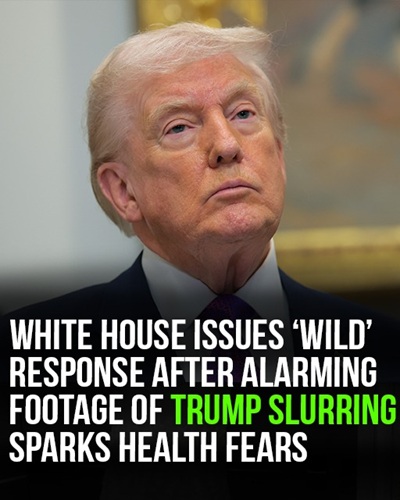
Another week has passed, and with it comes yet another wave of public discussion and media commentary regarding the health and overall well-being of President Donald Trump.
In today’s hyper-connected media ecosystem, even the most minor gestures, fleeting glances, or brief moments of apparent fatigue are instantly noticed, dissected, and amplified by journalists, social media users, and casual observers alike.
The position of President of the United States is inherently one of unparalleled scrutiny. Every word, every facial expression, every movement is subject to near-constant analysis, and this intense examination is magnified exponentially for someone who has spent decades in the public eye and built a personal brand around spectacle, theatricality, and relentless visibility.
Donald Trump, who first entered the national spotlight as a businessman and television personality, has consistently drawn attention not only for his political positions but also for his persona, style, and performative approach to public appearances.
As he approaches the age of 80, public discussions surrounding his health and physical condition have intensified, reflecting both natural curiosity and societal concerns about leadership, age, and stamina. Age inevitably brings questions about physical endurance, cognitive acuity, and overall wellness—especially for an individual tasked with managing the immense responsibilities of leading a nation, overseeing a global military presence, and engaging in high-stakes diplomatic negotiations.

Observers and commentators have, over the years, noted certain aspects of Trump’s public appearances that contribute to ongoing speculation. Minor bruises, visible signs of fatigue, subtle shifts in posture, and occasional lapses in verbal delivery have all been cited in media analysis and social discourse. It is crucial to note, however, that these observations are not definitive medical evidence of any particular condition; they are simply elements that fuel discussion, curiosity, and debate across both mainstream media outlets and digital platforms.
Among the most closely scrutinized events in recent weeks was President Trump’s public appearance at the White House on Wednesday, February 11, during the “Champion of Coal” event. The gathering was organized to honor coal miners and highlight the administration’s energy policies, particularly those supportive of coal production and American energy independence. The event reflected the administration’s longstanding commitment to promoting fossil fuel industries while aligning with a broader economic and political agenda focused on domestic energy dominance.
During the ceremony, President Trump signed an executive order directed at the Department of War—a phrasing that raised eyebrows among observers due to its atypical nature, though it was likely intended as a symbolic emphasis on assertive energy policy. In an unusual but characteristic display of presidential theatrics, Trump was presented with a trophy for signing the executive order, a moment described variously as ceremonial, humorous, or unconventional, depending on individual perspectives. The visual of a sitting president receiving a tangible award for enacting a policy measure reinforced the performative style that has become a hallmark of Trump’s public persona.
In his speech at the event, Trump addressed the assembled miners and audience with a combination of personal acknowledgment, political messaging, and rhetorical flourishes. Opening with the words, “I’m thrilled to welcome to the White House the men and women who light our cities. You know, you do things that people don’t even understand,” he set a tone that aimed to celebrate the workforce while simultaneously reinforcing his administration’s narrative of economic and industrial achievement.
He continued, emphasizing the essential role of coal miners in powering homes, fueling factories, and transforming natural resources into economic opportunity, stating, “You heat our homes, fuel our factories, and turn natural resources into American riches and dreams. Our amazing coal miners.” This phrasing underscored the administration’s framing of coal as integral to national prosperity and energy security.
The speech, while well-received by many attendees, quickly drew attention for aspects of delivery rather than content. Observers noted moments in which the president’s speech appeared fragmented, slurred, or irregular—elements that, in the era of viral video and instant social media reaction, rapidly became points of discussion online.

Platforms such as X (formerly Twitter), Reddit, and various news outlets featured real-time commentary ranging from humorous observations to serious concerns about cognitive and physical wellness. Some users drew parallels between these speech patterns and personal experiences with age-related or medical conditions, while others employed hyperbolic or satirical framing to amplify the moment.
For example, one user commented, “My grandpa [had] dementia, in the early stages he would talk exactly like this and then try to distract,” linking their observation of Trump’s speech to a personal family experience. Another post read, “Trump’s brain completely malfunctions on live TV, as his speech devolves into total gibberish: ‘I’m proud to officially name the…undishpu..the…jshhhh…whendidthiscomeoutechr!’ Stroke?
If this was your grandpa—wouldn’t you call an ambulance?” These reactions exemplified the immediacy and intensity with which moments of perceived anomaly can be magnified in the modern media ecosystem. Conversely, other users downplayed the observations, writing dismissively, “Trump’s slurring his words. Nothing to see here—keep calm and carry on,” reflecting the range of interpretations and polarized perceptions of the president’s public performance.
The viral nature of video clips, GIFs, and excerpts from the February 11 event further amplified attention. Social media facilitated widespread dissemination and enabled both casual viewers and professional commentators to examine and debate even the most fleeting moments of speech or gesture. Some analysts offered contextual explanations, citing environmental factors such as lighting, temperature, room acoustics, or simple momentary fatigue as potential contributors to minor irregularities in verbal delivery.
Others were less charitable in their assessments, suggesting the behaviors might indicate underlying cognitive or neurological conditions. Importantly, no verified medical diagnosis accompanied these observations, emphasizing that such interpretations remain speculative and should not be treated as confirmed health assessments.
Within hours of the viral discussions, the White House responded formally to address the rising speculation. Davis Ingle, a spokesperson for the administration, issued a statement to The Daily Beast asserting: “President Trump is the sharpest, most accessible, and energetic president in American history. While the deranged and failing Daily Beast has their lightweight, glue-sniffing interns push baseless conspiracy theories — President Trump spent the day unleashing energy dominance, lowering costs, and putting the American people first.”
The statement itself, with its colorful language and pointed criticism of media outlets, became a focal point for further public discourse. Many observers highlighted the unusual tone of the message, interpreting it as both defensive and assertive, while supporters lauded it as evidence of transparency and vigor.

Public reactions to the statement were immediate and varied. On Reddit, one user wrote, “It’s insane to me that anyone would read this and think ‘yeah, this country is in the best place it’s ever been,’” reflecting skepticism toward the administration’s framing. Another added a bluntly humorous response: “Is this real???? Holy f**king sh*t,” highlighting the surprise and attention-grabbing nature of the spokesperson’s phrasing. Collectively, these responses illustrate how modern media dynamics amplify and perpetuate discussion around a single event, blending satire, concern, and political commentary.
As the discussion surrounding President Donald Trump’s health continued to circulate following the February 11 “Champion of Coal” event, it became increasingly clear that the conversation was not solely about a single speech or isolated gestures. Rather, it reflected deeper societal concerns about leadership, age, and accountability in the modern political landscape.
The intense scrutiny of a sitting president, particularly one approaching eighty, is neither new nor unique. However, the convergence of Trump’s personal history, his public persona, and the immediacy of social media has created a uniquely magnified environment in which even the smallest physical or verbal irregularities can be observed, analyzed, and debated by millions of people within hours of occurring.
Historically, age and health have always been factors of public interest when it comes to U.S. presidents. Leaders such as Ronald Reagan, George H. W. Bush, and Joe Biden have faced public questions about stamina, cognitive function, and the physical demands of the office. What differentiates Trump’s situation, however, is the unprecedented degree of media saturation and the performative nature of his public life.
Unlike many predecessors who maintained more formal and controlled public appearances, Trump’s style—characterized by rallies, spontaneous remarks, and frequent television appearances—creates a constant stream of content for the public and press to evaluate. Every movement, facial expression, or verbal pause is immediately captured, shared, and often interpreted, creating a feedback loop in which the audience simultaneously consumes and critiques the presidency in real time.
The February 11 event, while ostensibly a celebration of coal miners and American energy, exemplified this dynamic. The spectacle of presenting a trophy to the sitting president for signing an executive order blurred the line between ceremonial formality and performative theater.
For supporters, this was a moment of celebration, a tangible acknowledgment of executive action, and a reflection of the administration’s prioritization of energy independence. For critics, the event highlighted a broader pattern of theatrics over substance, in which visual spectacle and symbolism occasionally overshadow the actual content or impact of policy decisions.
Trump’s delivery during the speech—marked by moments of fragmented phrasing and apparent pauses—triggered widespread commentary. Some media analysts argued that these speech patterns could be influenced by environmental factors, including stage lighting, the acoustics of the room, or the physical demands of speaking at length under public scrutiny.

Others noted that fatigue from travel, schedule intensity, or the demands of preparing for high-profile events could contribute to transient irregularities in speech. These assessments underscore an important principle: human performance, particularly under public observation, is complex and context-dependent. Momentary slurring, repetition, or hesitation is not necessarily indicative of a broader medical issue, yet in the era of instant digital dissemination, such moments can be magnified and interpreted in a variety of ways.
Social media platforms played a particularly significant role in shaping the public narrative. Clips of the February 11 speech circulated rapidly across X, Reddit, TikTok, and other platforms, often accompanied by commentary ranging from analytical observation to satire. The viral nature of these clips illustrates the speed at which perception is formed in the digital age.
Users collectively dissected the president’s gestures, posture, and speech, comparing them to previous appearances and to culturally familiar references. Some commentators used these observations to question cognitive capacity, while others employed humor and exaggeration to entertain or critique, reflecting the dual role of social media as both an information source and a venue for cultural commentary.
This environment amplifies the natural human tendency to seek patterns and explanations. When a highly visible leader exhibits any irregularity, whether in speech, movement, or energy, observers instinctively attempt to contextualize it. However, without verified medical evaluation, these interpretations remain speculative.
Medical professionals outside the political sphere emphasize that cognitive and physical performance are influenced by a range of factors, including stress, fatigue, hydration, medication, and environmental conditions. Any claim of a specific diagnosis based solely on observed speech patterns or gestures is therefore unreliable and should be treated with caution.
The performative elements of Trump’s presidency further complicate the discussion. From the earliest stages of his political career, Trump demonstrated an acute awareness of visual and rhetorical impact. His rallies often incorporate elaborate staging, visual branding, and direct engagement with supporters.
Media-savvy gestures, such as the presentation of awards, trophies, or symbolic props during official events, serve multiple purposes: they reinforce the administration’s messaging, create memorable imagery for media coverage, and sustain the narrative of leadership and energy dominance. While these moments are often criticized as superficial, they also reflect a deliberate communication strategy designed to engage multiple audiences simultaneously: supporters, media observers, and the broader public.
Age-related discussion is inseparable from this performative context. At nearly eighty years old, the president operates in a landscape where stamina, cognitive sharpness, and energy levels are closely observed. The pressures of office are immense: coordinating with executive departments, navigating complex domestic and international policy issues, addressing the media, and maintaining a relentless schedule of public events.
In this environment, even brief pauses, slips, or hesitations—common human experiences—can be magnified into moments of intense scrutiny. The public’s engagement with these observations reflects broader societal anxieties about leadership continuity, generational change, and the interplay between physical presence and perceived competence.
The February 11 event also exemplifies the feedback loop between official communication and public perception. Following the speech, the White House statement issued by Davis Ingle sought to reassure the public while simultaneously attacking media outlets engaged in speculation.
The unusual language—both colorful and combative—reinforced existing narratives: supporters saw transparency and vigor, while critics interpreted defensiveness and performative exaggeration. This dual reading illustrates the challenge of communication in the digital era: a single message can simultaneously affirm and polarize, satisfying no audience entirely while generating extensive discussion.
Moreover, the broader historical context is essential. Trump’s pattern of high-frequency public appearances, blending political messaging with media spectacle, contrasts with the approach of many previous presidents, who often limited exposure to tightly controlled press events.
In doing so, Trump ensures both visibility and vulnerability: every event is an opportunity to connect with supporters, but also a moment in which perception of health, stamina, and cognitive function can be evaluated and debated. The immediacy of social media amplifies this dynamic, ensuring that any minor anomaly—whether a mispronunciation, hand gesture, or fleeting pause—becomes part of the larger narrative surrounding leadership capability.
Finally, it is important to recognize the role of public perception in shaping political discourse. In the digital age, leadership is not only evaluated based on policy outcomes or legislative achievements but also through constant observation, cultural commentary, and social interaction. Memes, commentary threads, and viral clips create shared points of reference that influence collective understanding of political figures. The February 11 event illustrates how a single appearance can become a multi-dimensional narrative, encompassing admiration, concern, satire, and political debate all at once.
The February 11 “Champion of Coal” event ultimately serves as a compelling case study in the modern dynamics of political leadership, public perception, and media scrutiny. Beyond the specifics of a single speech or executive action, the event underscores the complexity of evaluating presidential performance in the age of instantaneous communication, relentless social media coverage, and global visibility. Every gesture, pause, and word uttered by a sitting president is not merely symbolic; it becomes part of a broader narrative, interpreted and reinterpreted across diverse audiences with varying perspectives and motivations.
One of the defining features of Trump’s presidency has been the constant tension between spectacle and policy substance. Events such as the February 11 gathering highlight this duality: on one hand, they present concrete policy actions, such as executive orders supporting domestic energy production; on the other, they showcase the performative elements that have long been a hallmark of Trump’s public persona. The combination of theatricality and policy messaging ensures widespread attention, but it also exposes the president to intensified scrutiny regarding his energy, cognitive clarity, and overall health.
Public discussion about presidential wellness is not merely speculative curiosity—it is a reflection of broader societal anxieties about leadership continuity, generational transitions, and the physical and cognitive demands of the office. Leaders approaching advanced age inevitably face heightened observation, as citizens, journalists, and political analysts seek to understand how stamina, focus, and resilience may impact governance. This is compounded in the modern era, where live broadcasts, high-definition video, and social media platforms allow instantaneous and near-universal dissemination of visual and verbal cues, magnifying even minor signs of fatigue or speech irregularity.
The interplay between perception and reality is particularly pronounced in Trump’s case. While some observers interpret brief pauses or fragmented phrasing as indicators of cognitive decline or physical fatigue, others point to the president’s continued rigorous schedule as evidence of stamina and capability.
Throughout his presidency and post-presidential public life, Trump has maintained an intense pace of travel, rallies, press briefings, and policy meetings, demonstrating a level of energy that supporters argue is remarkable for someone nearing eighty years of age. The contradiction between isolated moments of perceived irregularity and overall performance highlights a central challenge in evaluating leadership: single appearances, even when widely publicized, may not accurately reflect broader patterns of health, focus, or decision-making ability.
Social media, with its rapid feedback loop and algorithmic amplification, plays a critical role in shaping these narratives. Clips from the February 11 event circulated across platforms within minutes, accompanied by commentary ranging from analytical observation to humorous exaggeration.
The viral dissemination of content fosters collective engagement but can also distort context, as isolated moments are interpreted without full consideration of environmental factors, prior behavior, or broader circumstances. Lighting, acoustics, fatigue from prior events, and even the inherent pressures of public speaking can influence delivery, yet the instantaneous nature of online reactions often prioritizes immediacy over nuance.
The White House’s response to the speculation, delivered through Davis Ingle, illustrates the dual objectives of contemporary political communication: reassurance and narrative control. By emphasizing the president’s energy, engagement, and executive accomplishments, the statement sought to counteract concerns while reinforcing a perception of vitality.
Simultaneously, the pointed criticism of media outlets amplified partisan interpretations, reflecting a strategic awareness of how messaging resonates differently with supporters, critics, and the broader public. The public’s reaction to this statement demonstrates the fragmented nature of perception in the digital age: humor, skepticism, affirmation, and critique coexist simultaneously, each influencing how leadership is understood and debated.
The broader implications of these dynamics extend beyond Donald Trump or the specifics of the February 11 event. They illustrate a fundamental shift in how leadership is experienced and evaluated in the 21st century. Citizens now observe leaders not only through formal speeches or policy announcements but also through continuous visual and digital presence, meme culture, social commentary, and the rapid proliferation of viral content. Leadership assessment has evolved from structured reporting and deliberate analysis to a continuous, decentralized, and participatory process in which public perception, media framing, and cultural discourse intersect.
At the intersection of age, performance, and perception lies an important truth: human leaders are subject to both physical and cognitive limitations, yet the evaluation of these traits is inherently mediated by societal, technological, and cultural factors. The February 11 event highlights this reality vividly. While supporters emphasize evidence of resilience, stamina, and capability, critics focus on moments of irregularity, constructing narratives of concern or conjecture. Both perspectives coexist within the same informational ecosystem, illustrating how perception can diverge from objective reality while still influencing public discourse, policy interpretation, and political strategy.
Ultimately, the narrative surrounding President Trump’s health and performance underscores the evolving relationship between leadership and public visibility. The intensity of scrutiny, the immediacy of social media, and the global audience for U.S. presidential actions create an environment in which every gesture, pause, and word can take on symbolic significance far beyond its immediate context.
The February 11 “Champion of Coal” event, with its combination of theatricality, policy enactment, and viral moments, exemplifies this phenomenon. It reflects both the enduring interest in presidential wellness and the broader societal negotiation of trust, perception, and authority in the digital era.
In conclusion, while speculation about physical stamina, cognitive acuity, or health is an understandable aspect of public engagement with a senior political leader, it must be tempered by awareness of context, evidence, and uncertainty. The February 11 event illustrates that a single speech can become a microcosm of broader debates surrounding leadership: the tension between image and substance, the interplay between age and capability, and the power of modern media to amplify and distort perception.
In the digital age, where every public figure is constantly observed, moments of imperfection—however minor—take on amplified significance. Yet alongside these moments, patterns of endurance, engagement, and active leadership provide a fuller, more balanced understanding of capability and performance.
The event, the reactions it provoked, and the subsequent discussions all highlight a central truth about contemporary political life: leadership is no longer evaluated solely on policy achievements or strategic decisions. It is also judged through a continuous interplay of observation, interpretation, and cultural narrative.
The February 11 speech at the White House, both as a celebration of coal miners and a reflection of the broader spectacle of governance, exemplifies this intricate dance between reality, perception, and public discourse. For citizens, media analysts, and political observers alike, it provides a window into the complexities of modern leadership, demonstrating that the evaluation of a president in the digital era involves not only what is said and done, but how it is perceived, interpreted, and shared by millions around the world.
