

On the evening of January 31, 2026, 84-year-old Nancy Guthrie, mother of acclaimed television journalist Savannah Guthrie, was last seen at her residence in the upscale Catalina Foothills community just northeast of Tucson, Arizona, USA.
What began as a worrying absence quickly escalated into a full-scale criminal investigation when law enforcement determined that Nancy’s disappearance bore signs of foul play.
As investigators push deeper into the case, which authorities now describe as a suspected abduction, the mother of one of America’s most recognizable broadcast personalities remains missing.
Law enforcement, family members, and community volunteers have united in an urgent effort to locate her, while the public has followed developments with intense interest and concern.
At the heart of this unfolding story is not only the search for a missing woman, but the emotional toll on her family, the methodological investigation by law enforcement, and the role of public speculation in shaping the conversation around her disappearance.
The Context: Who Is Nancy Guthrie?
Nancy Guthrie was widely known among friends and neighbors as an active, independent woman. Despite being in her eighties, she maintained daily routines, attended community events, and participated in social gatherings in the Catalina Foothills area. Neighbors described her as bright-spirited, socially engaged, and a familiar face within her neighborhood.

While not a public figure in the way her daughter Savannah — co-anchor of NBC’s Today show — is, Nancy nonetheless earned respect and affection within her community. Her disappearance, therefore, not only devastated her family but also sent shockwaves through the local area where she was known.
January 31, 2026: Last Known Movements
According to statements released by the Pima County Sheriff’s Department, the timeline of Nancy’s disappearance begins on the evening of January 31. On that day, she was dropped off at her home by her son-in-law, Tommaso Cioni, who is married to Nancy’s daughter, Annie Cioni.
She was reported to be in her residence that evening, carrying out her usual routines. Based on witness accounts and security analysis, she appeared calm and unharmed when last seen. No indication at that time suggested anything unusual or threatening had occurred.
The following morning, February 1, Nancy did not arrive for a planned breakfast gathering with close friends. Concerned, those friends reached out to her family, who tried to contact her directly. After repeated failed attempts to reach her, and with no responses to calls or messages, friends eventually found her home unattended and made an emergency call to 911.
A Sudden Shift: From Missing Person to Criminal Investigation
Once law enforcement arrived, detectives began a methodical search of Nancy’s home. Initial observations raised immediate concern among investigators. Although the front door did not appear forced open, there were clear signs something was amiss.
Investigators later confirmed that blood evidence found inside the home belonged to Nancy Guthrie, and this discovery marked a turning point: what had begun as a missing-person case rapidly evolved into a criminal investigation.
Sheriff Chris Nanos publicly stated that the presence of blood and the lack of any credible theory suggesting Nancy left of her own volition made it highly unlikely she walked away from her home voluntarily. Given her advanced age and documented reliance on daily medications, she would be unlikely to survive on her own for an extended period without assistance.

The residence was officially declared a crime scene, and specialized units were brought in to conduct a thorough forensic sweep.
Law Enforcement Mobilizes
From the outset, the Pima County Sheriff’s Department coordinated its efforts with multiple federal and local agencies, including the Federal Bureau of Investigation (FBI). Law enforcement sources indicated that they treated the circumstances with the utmost urgency given Nancy’s age and health profile.
Investigators began canvassing the neighborhood, conducting interviews with neighbors, checking surveillance footage from nearby homes and businesses, and documenting any potential evidence. Drones, aerial units, and ground search teams were deployed to comb surrounding areas for clues.
Specialized search-and-rescue dogs were brought in to track possible scents. Forensic teams meticulously collected and cataloged physical traces, working to paint a precise timeline of events that night.
Forensic Evidence and Initial Findings
At the crime scene, investigators documented several critical pieces of physical evidence. Among them were:
- Blood evidence confirmed through DNA testing to belong to Nancy Guthrie.
- A detached glove found near the home, which became a subject of intense forensic scrutiny.
- Changes in electronic activity, including disruptions in the home security cameras and a sudden disconnect between Nancy’s pacemaker and its monitoring system.
- Surveillance footage from neighboring properties, which detectives analyzed to determine movement in the area during the late evening hours.
While these pieces of evidence were significant, authorities were cautious in drawing premature conclusions. No suspect has been publicly named, no arrest has been made, and sheriff’s officials have emphasized that the investigation remains open, fluid, and ongoing.
Investigation Challenges and Law Enforcement Strategy
The Pima County Sheriff’s Department has been transparent about the challenges of this case. In public statements, Sheriff Nanos has acknowledged both the breadth of investigative angles and the absence of definitive leads linking any individual to Nancy’s disappearance.
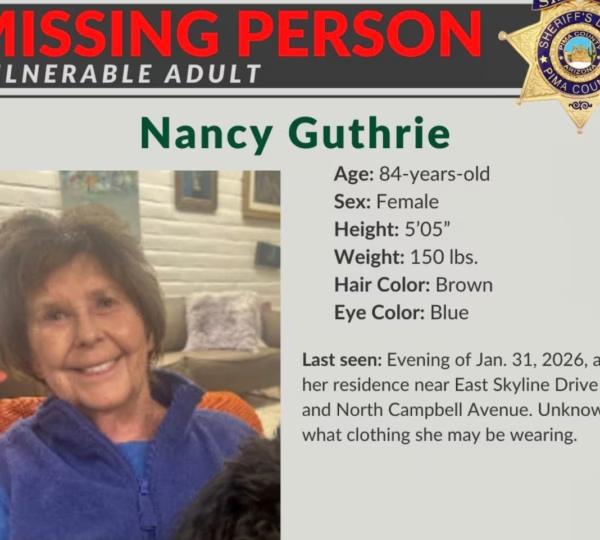
No Public Suspects — But a Wide Net of Leads
Authorities have explicitly stated that no one is currently named as a suspect, including all members of Nancy’s family. In response to rampant speculation on social media, Sheriff Nanos made a point of clarifying that: “No members of the Guthrie family — including all siblings and spouses — are considered suspects in this case.”
He further emphasized that the family has been cooperative with investigators, and that unfounded accusations against family members were harmful, distracting, and counterproductive to the search efforts.
Despite some early investigative detentions and questioning of certain individuals in the neighborhood, most findings so far have not produced clear links to the disappearance. Investigators remain methodical, processing forensic evidence and following every credible lead.
Public Appeals, Rumors, and the Role of Media
Almost immediately after the news of Nancy’s disappearance went public, the case drew widespread attention. Media outlets across the country picked up the story, and viewership on social platforms surged as details emerged.
Family Statements and Emotional Appeals
In the days following her disappearance, the Guthrie family made emotional, heartfelt pleas for help. Savannah, Annie, and other relatives appeared in video messages shared widely on social media and through news broadcasts.
They implored anyone with information to come forward. In several statements, they urged compassion and emphasized their sole focus: bringing Nancy home safely.
Ransom Notes and Hoaxes
Amid genuine public concern, the investigation also encountered a number of unverified claims and false communications. Several alleged ransom notes and extortion demands were forwarded to local media outlets and circulated online.
Law enforcement officials stressed that many of these messages were hoaxes originating from unrelated individuals, and that investigators were working to determine the authenticity of each claim. In some cases, authorities publicly confirmed that certain ransom-style texts had no connection to the main investigation.
The FBI also increased the reward for credible information leading to Nancy’s return from $50,000 to $100,000, emphasizing that even the smallest piece of reliable information could be critical.
Public Reaction and the Balance Between Concern and Speculation
The disappearance of a loved one — particularly under unclear circumstances — naturally invites public interest and inquiry. However, law enforcement and the Guthrie family have repeatedly cautioned against spreading unverified theories.

While some online commenters speculated about motives, individuals, or scenarios, authorities have maintained a clear message: focus on verified facts, credible tips, and cooperative investigation.
Sheriff Nanos urged media, commentators, and the public to avoid sensationalism, noting that unsubstantiated accusations can cause undue harm and distract from the search.
Family Impact: The Human Toll of Uncertainty
Everyone who has followed this case quickly realized that beyond the headlines lies a family enduring profound emotional distress. Savannah Guthrie, an Emmy-award-winning journalist with a national platform, has been candid about stepping back from professional duties to focus on her family and the search for her mother.
The absence of proof — neither confirmation that Nancy is alive nor definitive evidence of her death — has been one of the most wrenching aspects for her family.
Family members have described Nancy as not only independent but mentally sharp; traits that make her sudden disappearance all the more confounding to loved ones.
For now, the family balances hope with heartbreak — a waiting that has no fixed end and a search that continues without pause.
As the disappearance of Nancy Guthrie moved beyond its first critical days, the investigation entered a more complex and sustained phase. Law enforcement agencies intensified their efforts, shifting from an urgent immediate-response search to a structured, evidence-driven criminal probe designed to withstand scrutiny and, ultimately, lead to accountability.
With the case now firmly classified as a suspected abduction, authorities expanded both the geographic scope and technical depth of their work. The goal remained unchanged: locate Nancy and determine exactly what happened inside and around her Catalina Foothills home on the night of January 31, 2026.
The Expanding Investigation: Coordinated Multi-Agency Efforts
The Pima County Sheriff’s Department quickly recognized the scale and sensitivity of the case. Given Nancy’s age, medical needs, and the growing national attention surrounding her disappearance, investigators requested federal assistance. The Federal Bureau of Investigation (FBI) formally joined the case, bringing additional forensic expertise, technical analysis capabilities, and resources for interstate coordination if necessary.
Sheriff Chris Nanos emphasized that collaboration between local and federal agencies was not unusual in complex missing-person cases involving suspected foul play. However, he also made clear that this case demanded particular urgency because of Nancy’s vulnerability.
Joint task forces reviewed evidence daily. Investigative leads were categorized and prioritized based on credibility, proximity to the timeline, and potential for corroboration. Detectives began constructing a minute-by-minute reconstruction of Nancy’s last known hours.
Reconstructing the Timeline: Night of January 31
One of the most critical tasks for investigators has been establishing a precise timeline. Authorities analyzed:
- The time Nancy was dropped off at her residence.
- Security camera activity at and around her property.
- Phone records and digital device data.
- Pacemaker monitoring logs.
- Neighbor reports of unusual activity.
According to officials, Nancy’s home security system showed changes around the time she was last known to be inside. Cameras that typically remained operational reportedly went offline during a key window of time. Investigators have not publicly disclosed whether the outage appeared accidental, mechanical, or deliberate.

Additionally, Nancy’s pacemaker — which was monitored through an external app — disconnected from its tracking system. Medical device monitoring systems typically transmit data at regular intervals. The sudden loss of signal became a critical timestamp in the investigative timeline.
While authorities have not speculated publicly about what caused these interruptions, they confirmed that such digital evidence is being carefully examined by forensic specialists.
Forensic Processing of the Crime Scene
Once Nancy’s residence was officially declared a crime scene, forensic teams conducted a meticulous examination. Crime scene investigators processed the property over multiple days, documenting:
- Blood spatter patterns.
- Entry and exit points.
- Potential signs of struggle.
- Footwear impressions.
- Latent fingerprints.
- DNA samples from various surfaces.
Officials confirmed that blood found inside the home belonged to Nancy. However, authorities have not disclosed the volume or exact location of the blood evidence, citing investigative integrity.
The detached glove discovered near the property also underwent extensive forensic analysis. DNA recovered from the glove did not match Nancy and, according to statements released, did not immediately match profiles in federal databases. That does not eliminate its evidentiary value; it simply means it has not yet been tied to a known individual.
Investigators have noted that forensic investigations often take time, especially when samples require advanced testing or comparison with national databases.
Search Operations: Ground, Air, and Technology
In addition to processing physical evidence at the home, authorities launched an extensive search operation across the Catalina Foothills and surrounding desert terrain near Tucson, Arizona.
Search resources have included:
- Helicopters conducting aerial sweeps.
- Drone units equipped with high-resolution imaging.
- Ground search teams.
- K-9 units trained in scent tracking.
- Volunteers assisting in designated zones.
The terrain northeast of Tucson presents particular challenges. The Catalina Foothills region includes desert vegetation, rocky hillsides, and remote areas that can be difficult to traverse. Law enforcement officials stressed that every accessible area within a defined radius of Nancy’s home was methodically searched.
Search teams also examined nearby roadways for surveillance footage, including traffic cameras and private security systems from neighboring properties. Detectives canvassed businesses and residential communities within a broader radius to gather video recordings from the relevant timeframe.
Digital Forensics and Modern Investigative Tools
Modern criminal investigations rely heavily on digital data. In Nancy’s case, investigators have examined:
- Cell phone pings and tower data.
- Wi-Fi router logs.
- Smart home device activity.
- Vehicle tracking data where applicable.
- Security system timestamps.
Authorities have not publicly released specific findings from these digital investigations, but Sheriff Nanos has confirmed that electronic data is central to the ongoing review.
Digital forensics teams can determine whether devices were moved, powered off, or accessed remotely. Even small irregularities — such as unusual login attempts or power interruptions — can provide clues about the sequence of events.
Investigators have also worked to trace and authenticate communications related to alleged ransom messages. Several ransom-style texts sent to media outlets were confirmed to be hoaxes unrelated to the primary investigation. Authorities warned that false information diverts valuable time and resources from legitimate leads.
Reward Increase and Public Tip Line Expansion
Recognizing the importance of community involvement, the FBI increased the reward for information from $50,000 to $100,000 for credible tips leading to Nancy’s location.
Law enforcement officials reiterated that tips can be submitted anonymously. Investigators encouraged residents to report:
- Suspicious vehicles in the area on January 31.
- Unusual sounds or disturbances that evening.
- Individuals unfamiliar to the neighborhood.
- Abandoned items or evidence discovered later.
Authorities emphasized that even details that seem minor may become significant when combined with other evidence.
Addressing Speculation and Protecting the Integrity of the Case
As national media coverage intensified, so did online speculation. The fact that Nancy’s son-in-law, Tommaso Cioni, was the last known person to see her generated discussion across social platforms. However, Sheriff Nanos issued a direct public statement clarifying that:
- No family member, including Savannah Guthrie or her siblings and spouses, is considered a suspect.
- The family has been fully cooperative with law enforcement.
- Public accusations against relatives are unfounded and harmful.
Officials underscored that investigations rely on evidence, not speculation. Law enforcement also warned that spreading misinformation can complicate witness testimony and discourage credible tips.
Maintaining public trust while protecting investigative confidentiality remains a delicate balance. Authorities have shared verified updates while withholding sensitive details that could compromise the case.
The Emotional Toll on the Guthrie Family
As days turned into weeks, the emotional impact on Nancy’s family deepened. Savannah Guthrie, a co-anchor of NBC’s Today show, stepped away from her professional duties to assist her family and remain present during the search.
In public statements, Savannah expressed gratitude for community support while emphasizing the pain of uncertainty. Not knowing whether Nancy is safe — or what exactly occurred — has created a prolonged emotional strain.
Family members described Nancy as mentally sharp and socially active. She attended gatherings, kept appointments, and maintained independence appropriate for her age. The abrupt nature of her disappearance has left relatives grappling with unanswered questions.
Friends in the Catalina Foothills community organized prayer gatherings and supportive events, demonstrating solidarity with the family.
Community Response and Public Safety
Despite the seriousness of the case, law enforcement has stated there is no indication of a broader threat to public safety. Sheriff Nanos reassured residents that investigators have not identified patterns suggesting ongoing danger to others in the neighborhood.
Nevertheless, the incident has prompted many residents to review their own home security measures, including camera systems and lighting.
Community meetings were held where law enforcement answered questions within the bounds of investigative confidentiality. Residents were encouraged to remain vigilant but calm.
Investigative Challenges: Why Cases Like This Take Time
Criminal investigations involving suspected abduction are inherently complex. Detectives must:
- Verify every tip.
- Process forensic evidence thoroughly.
- Cross-check digital records.
- Interview witnesses multiple times.
- Avoid premature conclusions.
Authorities have emphasized that thoroughness is critical. Mistakes or rushed conclusions can undermine prosecution efforts if a suspect is eventually identified.
Sheriff Nanos has stated that investigations can take weeks, months, or even longer, particularly when forensic results require laboratory analysis or when leads cross jurisdictional boundaries.
The Broader Significance of the Case
While Nancy Guthrie is not a public official, her connection to a nationally recognized journalist has amplified attention. This visibility has both advantages and challenges.
Advantages include:
- Increased public awareness.
- Greater tip submissions.
- National media coverage.
Challenges include:
- Misinformation spread online.
- Hoaxes.
- Public pressure for rapid updates.
Law enforcement has reiterated that they remain focused on evidence and verified information rather than speculation.
Where the Investigation Stands Now
As of the most recent official updates:
- Nancy Guthrie remains missing.
- The case is classified as a criminal investigation.
- Blood evidence confirms she did not leave voluntarily.
- No suspects have been publicly identified.
- The FBI reward stands at $100,000.
- Search and forensic efforts continue.
Investigators continue to urge anyone with credible information to contact the Pima County Sheriff’s Department or the FBI tip line.
By mid-February, law enforcement had extended the search perimeter significantly beyond the Catalina Foothills neighborhood, covering both urban and remote terrain around Tucson, Arizona. Authorities have maintained a multi-layered approach, combining traditional investigation methods with modern technology:
- Ground Units: Teams of deputies, detectives, and volunteers combed accessible desert trails, canyon areas, and surrounding roadways. Each search area was carefully mapped, with search patterns designed to maximize coverage.
- K-9 Units: Specially trained scent-tracking dogs were deployed repeatedly across both the residential neighborhood and nearby wilderness to pick up any trace of Nancy’s movement or the abductor’s path.
- Aerial Surveillance: Helicopters equipped with infrared cameras and drones allowed investigators to scan areas that are difficult to reach on foot, particularly during early morning and evening hours.
- Forensic Specialists: Teams continued to examine and re-examine evidence, including the detached glove, security footage, and traces of blood. Forensic analysis also expanded to include soil and environmental sampling near key locations identified by search teams.
- Technical Investigation: Experts monitored digital activity, including potential interactions with Nancy’s smart devices, pacemaker data, and neighborhood security systems. Analysts cross-referenced logs with cell tower data and motion detector alerts to refine the timeline.
Authorities emphasize that while search operations are visible, a great deal of investigative work occurs behind the scenes in coordination with federal databases, forensic labs, and specialized task forces. This process ensures that every lead is thoroughly vetted before action is taken.
Community Engagement and Public Support
The disappearance of Nancy Guthrie has generated significant community involvement, reflecting both concern for her safety and solidarity with her family. Local residents, neighborhood associations, and volunteer organizations have played an active role in the search:
- Neighborhood Canvassing: Volunteers, coordinated by law enforcement, distributed flyers and conducted door-to-door checks to identify any observations that might have gone unnoticed.
- Online Coordination: Social media platforms and local forums have allowed residents to report potential sightings, share surveillance footage, and discuss unusual activity in the area. Investigators caution that only verifiable tips are actionable, but these platforms have helped amplify outreach.
- Support Events: Community prayer vigils, gatherings, and memorial walks have been organized, providing a space for collective hope and emotional support for the Guthrie family.
The family has consistently expressed gratitude for this support while reminding the public that caution and respect for facts are critical to the investigation.
Family Perspective: Coping with Uncertainty
For the Guthrie family, the search continues to be a deeply emotional journey. Savannah Guthrie has taken a public role in appealing for help, stepping back from her professional commitments, including her NBC Today show responsibilities, to focus on her family and the investigation.
The family has described Nancy as:
- Mentally alert and socially active, regularly participating in community events.
- Independent in daily routines, but reliant on medication and monitoring for health concerns.
- Well-known and well-liked by neighbors and friends.
The emotional strain stems from the uncertainty of not knowing Nancy’s condition or location. Authorities and family members alike stress the importance of hope and patience, as complex investigations can take weeks or months to yield breakthroughs.
Managing Misinformation and Media Narratives
Given the high profile of the Guthrie family, the case has attracted national media attention. While the visibility has been beneficial for public outreach, it has also presented challenges:
- Online Rumors: Social media speculation initially included theories about family involvement or unrelated criminal activity. Law enforcement responded decisively to clarify facts and protect the integrity of the investigation.
- Hoax Communications: Some individuals circulated false ransom notes or unverified claims. FBI and local authorities identified these hoaxes and emphasized that spreading misinformation can delay the investigation.
- Media Statements: Law enforcement has held regular briefings, balancing transparency with the need to withhold sensitive information. Public statements focused on verified facts, urging the public to provide tips rather than speculate.
Sheriff Nanos reiterated that no family member is a suspect and that all information shared publicly should be factual and verifiable.
The Role of Technology in Modern Investigations
The Guthrie case highlights how technology can play a crucial role in missing-person investigations:
- Digital Footprints: Surveillance cameras, smart home devices, and pacemaker monitoring systems provided timestamps that investigators used to reconstruct the timeline of events.
- Data Correlation: Cell tower pings, Wi-Fi activity, and electronic logs were cross-referenced with eyewitness reports to narrow search areas.
- Forensic Analysis: Advanced DNA testing, including mitochondrial and touch DNA, is being applied to evidence such as gloves and household items.
Investigators caution that while technology aids the process, it is only part of a comprehensive investigative strategy that also relies on human observation, witness interviews, and physical search efforts.
National Attention and the Broader Conversation
The disappearance of Nancy Guthrie has sparked national conversations about elder safety, abduction awareness, and the role of community vigilance. News coverage has highlighted:
- The challenges of protecting vulnerable older adults in residential neighborhoods.
- The importance of timely reporting when an elderly family member goes missing.
- How coordinated efforts between law enforcement, family, and the public can increase the chances of recovery.
Public figures, advocacy groups, and ordinary citizens have engaged in discussions about safety measures, neighborhood watch programs, and elder care best practices, demonstrating the wider societal relevance of Nancy’s case.
Law Enforcement Perspective: Patience and Thoroughness
Sheriff Nanos and his team continue to emphasize the need for methodical investigation:
- Every lead is pursued fully before conclusions are drawn.
- Minor details, such as an unfamiliar vehicle in the neighborhood, could be significant.
- Investigators remain cautious not to prematurely categorize events, maintaining flexibility in investigative strategies.
Sheriff Nanos has reiterated that even small, seemingly inconsequential tips can prove pivotal. Authorities continue to encourage anyone with information — no matter how trivial it may seem — to come forward immediately.
Current Status and Continuing Efforts
As of mid-February 2026:
- Nancy Guthrie remains missing, and her location is unknown.
- Criminal investigation is ongoing, with forensic, digital, and field investigations continuing around the clock.
- No public suspects have been identified.
- Reward for credible information stands at $100,000.
- Public cooperation is essential, as law enforcement relies on tips, observations, and community vigilance.
Sheriff Nanos has stated that the timeline for resolution is uncertain. While investigations can be prolonged, the priority remains Nancy’s safe return and the collection of evidence that may lead to an arrest.
The Human Element: Hope, Vigilance, and Patience
At its core, the case is a deeply human story: a family’s love, a community’s concern, and law enforcement’s commitment intersecting in the search for one woman. Each day brings new efforts, renewed searches, and public appeals.
Nancy Guthrie’s family continues to navigate hope and heartbreak, balancing patience with the urgency imposed by her age and medical needs. For investigators, the work continues tirelessly, combining scientific analysis, traditional detective work, and community coordination in pursuit of a single objective: finding Nancy and bringing her home safely.
Conclusion: A Case That Unites a Nation in Vigilance
While Nancy Guthrie’s disappearance remains unresolved, the story underscores:
- The critical importance of community vigilance and cooperation in missing-person cases.
- The complex nature of modern criminal investigations, including forensic science, digital analysis, and search operations.
- The emotional toll on families when a loved one is missing, and the national empathy such situations inspire.
Authorities continue to appeal for public assistance, emphasizing that even the smallest verified detail can be life-saving. Each tip, observation, and report contributes to a larger, methodical effort to resolve a case that has captured national attention and compassion.
Nancy’s safe return remains the paramount goal of all involved — law enforcement, family, friends, and the wider public. Until that moment comes, the search continues, unwavering in its diligence and urgency.
