
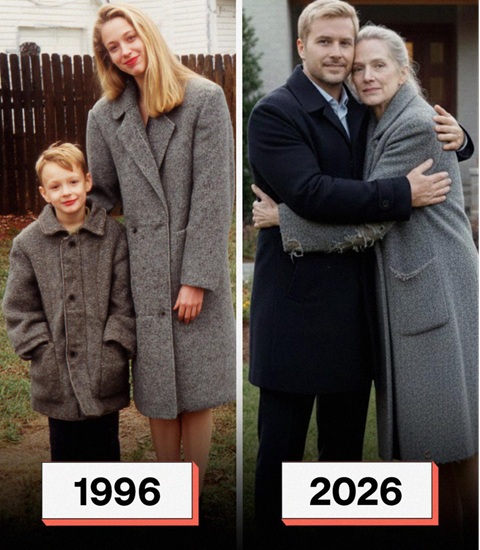
My mother wore the same worn-out coat for decades, thirty winters exactly. I spent much of my childhood embarrassed by it, shrinking under its heavy folds as if its very texture broadcast my family’s struggles.
I was Jimmy, now thirty-six, and I can still remember the ache of walking beside her in that coat, wishing she could wear something different, something that didn’t seem to declare poverty to the world.
The very sight of it made me hyper-aware of classmates’ judgment, of whispers that might follow us down the streets, of eyes that would unfairly measure us by fabric rather than character.
The coat was simple but functional—charcoal gray wool, worn thin at the elbows from repeated wear, fraying at the cuffs, with two mismatched buttons that Mom had sewn on herself over the years.
The buttons didn’t match in size or color, and the stitching was uneven, but each imperfection was a testament to her life and her persistence. She had mended it countless times, patching holes, reinforcing seams, making sure it lasted through every cold winter. As a child, however, I could see only imperfection, only what the world would see, not the history stitched into it, not the quiet proof of her resilience.
I remember vividly the morning I was fourteen, when my embarrassment boiled over. I begged Mom to drop me off a block away from school so that my friends wouldn’t see her patched coat.

I had rehearsed the explanation in my mind, trying to make it sound reasonable, but the truth was simple: I wanted to hide the shame. Mom didn’t scold me, didn’t argue. She looked at me with that patient, understanding smile she had always worn like armor, soft and yet profoundly knowing.
“It keeps the cold out, baby. That’s all that matters,” she said softly, brushing a loose strand of hair from my face. I remember being frustrated that her words didn’t match my feelings, that she didn’t understand why it mattered so much to me. At the time, I didn’t see that she had already understood perfectly, that she was teaching me patience, humility, and the quiet strength to carry on despite appearances.
From that day forward, I promised myself that someday I would buy her something better, something she truly deserved. When I finally embarked on my career as an architect, that promise became a mission.
I found a luxurious cashmere trench coat—soft, elegant, and expensive—the kind of coat that exuded success, a tangible symbol of having “arrived” in the world. I purchased it with pride, imagining her delight, picturing her stepping out into the cold with something that would protect her and make her feel seen in a new way.
When I presented the coat to her, she accepted it with polite gratitude, hanging it carefully in her closet. That was the end of the transaction. The next morning, to my surprise and quiet frustration, she wore her old coat. My gift remained untouched, an elegant specter in the shadows of her wardrobe, beautiful but unnecessary. It was a gentle rebuke I didn’t fully understand at the time, a lesson wrapped in cashmere that I was too young and too impatient to appreciate.
Mom’s life was defined by simplicity and small joys. She worked at a modest flower shop in the local mall, where she was surrounded by blooms of every imaginable color. She adored flowers, often remarking that they were the only things in life beautiful without effort, without pretense. I didn’t understand that perspective then; I only understood the embarrassment of standing beside her, carrying her coat as a banner of perceived inadequacy. I was blind to her philosophy of life, blind to the richness in ordinary, humble things.
We argued about that coat countless times over the years. “Mom, we’re not poor anymore. Please throw it away,” I’d say, as though sheer insistence could erase decades of history, longing, and quiet love stitched into its seams. Her response was always gentle, eyes softening, lips curving into a sad smile. “I know, baby. I know,” she said quietly. “But I can’t throw it away.” Her words lingered with me, unassuming yet profound, though I didn’t realize their weight until much later.
Through winters, summers, and ordinary days, that coat remained her companion. She wore it faithfully, unconcerned with appearance, unbothered by the judgments of others. It became a symbol of consistency, of her determination, and of a life lived quietly yet fully. She continued wearing it until her last breath, unaware that it would one day reveal a story far more extraordinary than I could have imagined, a story that would redefine my understanding of her sacrifices, her love, and her resilience.
Mom died suddenly at sixty, on a bitterly cold February morning. Doctors suggested that regular checkups might have caught her condition earlier, but hindsight offered little comfort. I lived in the city, working long hours, visiting every weekend, and calling her nightly. I told myself it was enough, that I had done my duty, that love was measured in presence and obligation. But in truth, it was convenient for me to believe that.
After the funeral, I drove alone to her small apartment, a place I had visited countless times yet never truly appreciated. I needed to pack her things, to occupy my hands, because grief had hollowed my chest in a way nothing else could fill. I felt unmoored, unprepared for the absence, and yet compelled to act, to gather the remnants of her life into neat boxes, as though order could somehow bring solace.

The coat still hung by the door, same hook, same spot. It looked as if she had stepped out for a moment, and I should expect her return at any minute. The familiarity was both comforting and painful. Grief hit differently this time—intense, raw, unstoppable. Anger surged as I stared at the coat. I resented that we could have afforded better, that she had chosen to wear this old, worn garment, and that I had spent so many years feeling ashamed, blind to the love and history it represented.
I grabbed the coat, intent on discarding it once and for all, but it felt heavier than wool should. My fingers traced the fabric, and I discovered something extraordinary—hidden pockets Mom had sewn herself. They were deep, carefully concealed, and bulging with something mysterious inside. My curiosity overpowered my initial anger. I reached in, expecting nothing more than old receipts or candy wrappers, perhaps a few lost coins.
Instead, my fingers closed around a bundle of envelopes, bound together with a brittle rubber band, fragile yet preserved. There were thirty of them, each numbered meticulously in Mom’s familiar handwriting. None bore stamps or addresses. I sat against the wall, holding the coat in my lap, trembling as I opened the first envelope, marked “1.” The first line of her letter made my eyes well with tears: “Dear Jimmy, when you find these, I’ll be gone. Please read all before judging.”
Hours passed as I read each word, absorbing the depth of her story. Mom wrote about my father, Robin, whom she had loved at twenty-two. They had met in a small town square on a freezing November day. She had stumbled while carrying groceries, and he had helped her pick them up. From that moment, he never truly left her heart.
The first envelope alone was enough to shake me to my core. Mom’s handwriting was familiar, yet each word carried the weight of decades of longing, hope, and unspoken truths. I could almost hear her voice, soft and patient, as she carefully chose each phrase, knowing one day I would read them. “Dear Jimmy,” she wrote, “I know you have grown up believing you were alone. But you were never alone. Let me explain.”
She told me about Robin, the man she had loved in her early twenties. He wasn’t just a fleeting romance or a shadow from her youth; he was the person who had touched her heart so deeply that the memory of him had shaped her every decision for years to come. They had met in the town square on a biting November day, a day sharp and cold, when she had struggled to carry groceries and everything slipped to the ground. He had bent down, lifted her burdens, and laughed with her as they gathered the scattered packages. From that moment, she wrote, she knew life had handed her something extraordinary, though fleeting.
For two years, they were inseparable. She described it in the letters with such warmth that I could almost feel the joy radiating through the paper. They wandered the town’s narrow streets, shared meals in tiny cafes, and dreamed of a life together. But then, an opportunity arose for Robin abroad—a chance to earn more money than they could have imagined, a chance to secure a future. He promised her he would return, promised that he would save, promised that together they would build something lasting, something real.
Mom’s words painted a picture of that final day: the cold pressing against their skin, the quiet fear in her heart, and Robin removing his own coat to wrap around her shoulders. “Just to keep you warm while I’m gone,” he said. She laughed, chiding him, “You’ll freeze!” But he insisted he would be fine. That coat, she wrote, was the first proof she had ever held of love and selflessness, a tangible warmth that lasted far longer than the winter air.

Weeks later, she discovered she was pregnant with me. She described the mixture of joy and fear that gripped her, the uncertainty about what the future would hold. She wrote letters to Robin, sharing everything—her pregnancy, her excitement, her anxieties—but none were ever returned. Years passed, and each unanswered letter became a small wound in her heart, leaving her to carry a sense of abandonment that was never true. Robin had not walked away; he had been taken from her life far too soon.
I traced each word with my fingers, feeling her joy and pain as though it had been inscribed into my own memory. The coat, now in my lap, became more than fabric. It was a repository of silent hope, a tactile reminder that even in absence, love could endure. Mom had worn it through every winter, carrying with her the warmth of a man she believed she had lost, never realizing he had left nothing but love behind.
Mom wrote about my childhood too, every milestone she had quietly documented for Robin: my first steps, my first words, the night I cried endlessly during my first week of kindergarten. She told him about the moments I was scared, the moments I was joyful, the moments I excelled beyond what she had ever imagined. Each letter was a confession, a journal, a bridge across time connecting what was lost with what remained.
Around the ninth or tenth envelope, her tone shifted. She had discovered a small newspaper clipping, an obituary from the region where Robin had gone to work. It was brief, almost unremarkable, yet it contained the truth that changed everything. He had died in a worksite accident six months after leaving, before he could ever know I existed. Mom had spent decades believing he had abandoned her. She had carried resentment, sorrow, and longing for a man who had loved her fiercely but had been taken from her by fate.
Reading her words, I felt my own grief swell—not only for her, but for the man I never knew, and the son he never had the chance to be. The letters following that revelation were strikingly different. Gone was the quiet desperation of unanswered hope; in its place was a deliberate, tender recording of my growth, her gratitude, and the love she continued to carry despite tragedy. She wrote, “He became an architect, Jimmy. He builds things that last. You would have made him proud.” I read that line three times, unable to stop the tears from falling.
Mom’s letters were meticulous, filled with small observations about life, my growth, and the passage of time. She described my successes in school, the friends I had made, and even my failures, each with honesty and care. She recounted quiet family moments, holidays, birthdays, and the little victories that shaped who I had become. With each line, I felt closer to her, and yet further from the world I had assumed existed—a world without Robin, without the warmth of his love.
The final envelope was different. It was newer, written in a pen with fresh ink, and it contained a photograph of Mom with a young man I had never seen. They were laughing, radiant, full of life. The letter explained that Robin had a sister, Jane, who lived quietly not far from where I had grown up. Mom had feared reaching out before, worried that she might be dismissed, or that I might be hurt, but she wanted me to know that I was not alone.
Three days later, I found myself standing in front of a small, snow-covered cottage. The snowfall was thick, settling on the roof and the bare trees, softening the world into white silence. My heart pounded as I knocked on the door. When an elderly woman answered, cautious yet curious, I introduced myself. “I think you might be Robin’s sister, Jane.” Her expression hardened immediately. “My brother died decades ago,” she said. I nodded, steadying myself. “I know. I’m his son, Jimmy.”
After a long pause, she stepped aside and let me in. I laid the letters and photograph on her kitchen table. Jane studied them silently, her face unreadable, refusing to speak at first. Finally, she remarked, “Anyone could find a photograph.” I explained about the coat—how it had been the last thing Robin had ever wrapped around Mom, how it had carried her love, her hope, and her memories through thirty winters. Slowly, her eyes softened, and she whispered, “He has your eyes.”

We sat in silence, the snow falling heavily outside. Her house was warm, filled with the comforting scent of tea and old wood. The fireplace crackled gently in the corner, a subtle heartbeat in the quiet room. Jane poured tea without asking if I wanted any. I hung the coat on a hook near her door, a silent acknowledgment that some things belong exactly where they find warmth.
As I listened to her stories about Robin, I felt a new depth of connection—not just to my father, whom I had never met, but to the entire history of my family’s quiet endurance. Mom’s coat had been more than a garment. It was a vessel of memory, a proof of love and waiting, a tangible bridge across decades of absence, longing, and resilience.
Reading the letters and hearing Jane speak, I understood my mother in a way I never had. Her insistence on wearing that coat wasn’t stubbornness or pride. It was devotion, an outward manifestation of inner strength. Every repair, every stitch, every layer of worn wool carried with it a narrative of love, loss, and hope preserved. What I had once judged as raggedness was, in truth, extraordinary courage.
I thought about all those mornings when I had begged her to wear something different, all the times I had been frustrated by her apparent indifference to appearances. I had mistaken her devotion for denial, her love for weakness. The coat was proof that love can endure in silence, that grief and hope can coexist, and that waiting for someone unseen can be one of the most profound expressions of human strength.
Mom’s letters also contained small lessons hidden between the lines. She wrote about patience, about the necessity of hope even when circumstances seem hopeless, and about the quiet dignity in enduring without complaint. She had raised me alone, teaching me resilience, kindness, and empathy not through grand gestures but through a lifetime of consistent, quiet love. I realized, too, that she had never once allowed bitterness to dominate her heart, even when grief and loss could have consumed her entirely.
As the afternoon wore on, Jane and I spoke more freely. She told me about her brother, about his character, his quirks, and the warmth he had radiated in his short life. Her stories filled in the spaces between my mother’s letters, weaving together a portrait of a man I had never known yet felt connected to through the threads of memory, love, and loss. Each story reinforced what Mom had always silently taught me: love endures, even when unseen, even when unanswered, and even when separated by tragedy.
By the time I left Jane’s cottage, the snow was falling thicker, painting the world in quiet white. I carried with me not just the photograph, not just the knowledge of my father’s sister, but an understanding of the depth of my mother’s life and the sacrifices she had silently borne. Thirty winters of waiting, thirty letters written in hope and love, and a coat that had borne witness to everything.
Walking away, I no longer felt the shame and frustration I had carried for decades. The coat was never a symbol of poverty, or failure, or embarrassment. It was proof—proof of enduring love, of resilience, of unwavering faith in the face of absence and uncertainty. What I had once dismissed as old and worn was, in fact, a tangible testament to strength, devotion, and history carried through fabric.
Walking away from Jane’s cottage that snowy afternoon, I felt the weight of history settle gently on my shoulders, almost like the coat itself had transferred some of its years of endurance and love onto me. The snow swirled around me, heavy and silent, blanketing the world in quiet reflection. I thought of Mom, of the countless mornings she had worn that coat, carrying it through bitter winds and freezing days. What I had once seen as ragged, outdated, and embarrassing now felt sacred. Each thread told a story; each patch preserved decades of memories, hope, and resilience.
As I walked down the narrow path, I could almost hear her voice echoing in my mind. “It keeps the cold out, baby. That’s all that matters.” Those words, so simple and unassuming, had once annoyed me, but now they resonated deeply. It wasn’t just about warmth. It was about protection, care, and the quiet persistence of love. My mother had understood, even without explanation, the enduring nature of small gestures. She had lived those lessons every day, hidden in plain sight within the folds of that coat.

Back in my apartment, I unfolded the cashmere trench coat I had once gifted her. Its elegance, softness, and price all felt irrelevant now, a symbol of achievement meaningless compared to the legacy wrapped inside a worn, patched, charcoal wool garment. I realized that no amount of luxury could replicate the depth of connection that Mom had carried through decades of life. That coat was proof—a physical testament to patience, hope, and undying love.
I began reflecting on my childhood with a new lens, remembering every time I had hidden behind embarrassment, every time I had wished for something more glamorous, more socially acceptable. I had believed that appearances mattered more than truth, that comfort and pride could be measured by fabric rather than by character. My mother had been teaching me a lesson in humility all along, one that I could now fully appreciate. The true measure of worth, she had shown me, was endurance, love, and the quiet commitment to keep believing in people—even those unseen.
The letters Mom had left were more than personal stories—they were a bridge connecting me to a family I had never known. Each word revealed her unwavering devotion to me, her courage in facing abandonment, and her refusal to let grief consume her spirit. They revealed her extraordinary capacity for love, even in the absence of answers, and the strength she derived from memory, patience, and hope. Every line was deliberate, every phrase a thread connecting past, present, and future. Through her letters, she had taught me the most important lessons about life: the value of resilience, the importance of waiting, and the power of unconditional love.
The encounter with Jane, Robin’s sister, was another revelation. I had walked into that small cottage expecting distance, skepticism, or disbelief. Instead, I found understanding, acknowledgment, and warmth. Jane’s eyes softened when I spoke of the coat, and her words—“He has your eyes”—felt like a final link connecting the generations. I realized that my mother’s life had always been about connection, about bridging gaps between the past and the present, between absence and presence, and between sorrow and hope.
I began to imagine the life Mom had lived alone, carrying my father’s memory in every letter, in every stitch of that coat. She had endured loneliness with dignity, never allowing bitterness to dominate her heart. Each winter, each day, each moment she had chosen to wear that coat was a choice to embrace hope, to hold on to the warmth of love, and to preserve a tangible connection to the man she had lost too soon. I felt a profound respect for her now, not just as my mother, but as a woman who had carried decades of unseen devotion.
As I thought about my own life, I realized how much of my early adulthood had been shaped by misperceptions. I had judged Mom’s coat as a symbol of inadequacy, poverty, and embarrassment. I had missed the point entirely. Now, I understood that it was a vessel of resilience, a testament to the power of waiting, and a silent chronicle of love that spanned thirty years. Each patch, each repair, each worn thread was deliberate and intentional, a reflection of her enduring strength and unyielding spirit.
I remembered small, previously forgotten moments with newfound clarity. The way she would hum quietly while sewing a patch, unaware I was watching. The way she lingered by the window in winter, watching the snow fall, perhaps imagining Robin’s return. The way she never complained, never wavered, never allowed despair to overshadow hope. All those tiny gestures, once invisible to me, were now beacons of wisdom. They had shaped my character, my understanding of life, and my conception of love.
Returning to my childhood home in my mind, I pictured the coat hanging by the door, waiting patiently, carrying letters, memories, and warmth. It was a sentinel, a witness to a life defined not by material wealth but by extraordinary emotional richness. It had survived thirty winters, not because of durability or craftsmanship alone, but because of what it represented: unwavering faith, enduring love, and hope sustained across decades.
I thought about the broader implications of what I had learned. So often, the world measures worth by appearances, by wealth, by material success. I had internalized that belief as a child, feeling ashamed of my mother for her humble coat. Yet the reality was clear: the true measure of a person is found in the depths of their character, the strength of their convictions, and the love they carry silently for others. Mom had understood this intuitively, living it every day, and I had only just begun to comprehend the enormity of her wisdom.
The coat itself became a symbol for me—not just of my mother’s life, but of the enduring connections we share with those we love. I realized that objects gain power through the stories attached to them, through the intentions, emotions, and experiences embedded within their fibers. The coat was proof that love could persist, unseen and unacknowledged, and that waiting, patience, and hope are among the most profound forms of courage.
I thought again about Robin. Though I had never met him, his presence was woven into the very fabric of our lives. His love had survived death, transmitted through my mother’s devotion, preserved in letters, and made tangible by that coat. I felt a kinship with him, a gratitude for the brief intersection of our lives, and a recognition that absence does not negate love—it transforms it.
Standing outside, I could almost feel the coat around my shoulders again, the weight of decades, the warmth of love that had traveled through time. I thought of Jane, my father’s sister, and how our meeting had expanded my understanding of family, connection, and legacy. I realized that my mother’s life had been a series of deliberate choices, made with courage and guided by the invisible threads of devotion. Every stitch, every layer of fabric, every letter was a testament to her wisdom and resilience.
That night, I reflected deeply on the lessons Mom had left behind. I thought about my own relationships, my own life, and the ways in which I could embody the principles she had modeled: patience, empathy, unconditional love, and the quiet endurance of hope. I realized that legacy is not measured by wealth, accolades, or recognition, but by the ways we touch others’ lives, often silently, often unseen.
The coat, once a symbol of embarrassment, had become a living history, a bridge between generations. It connected my father, my mother, myself, and now Jane, intertwining our lives with invisible threads of love, sacrifice, and hope. In its folds were thirty winters of devotion, letters chronicling growth and triumph, failures and heartbreak, joys and fears—all stitched into fabric with unwavering care.
I finally understood that the true value of the coat was not in its appearance, nor in any material gift I could provide, but in the stories it held, the love it preserved, and the lives it connected. My mother had carried hope for thirty years, keeping the memory of her lost love alive while nurturing a life for me. That was the coat’s purpose. That was her gift.
Walking through the snow that night, I felt a profound sense of connection and closure. I no longer felt anger, embarrassment, or sorrow. I felt gratitude, understanding, and reverence for a life lived with unwavering courage. I had been given a gift far beyond any coat: insight into the depth of human love, patience, and resilience. My mother’s coat had survived not because it was wool and buttons, but because it was infused with meaning, purpose, and proof of enduring devotion.
I returned home with a renewed sense of self, carrying with me the understanding that life’s greatest treasures are often hidden in plain sight, waiting for the right moment to reveal their significance. The coat had taught me more about love, loss, and human connection than any other experience in my life. It was timeless, not merely a garment but a vessel of history, emotion, and unbreakable bonds.
In the days that followed, I found myself revisiting memories of Mom in vivid detail: the way she tended to her flowers with quiet reverence, the way she laughed softly at small, absurd moments, the way she held hope in her heart even when life offered no guarantees. Each memory, now seen through the lens of understanding, felt richer, fuller, and more profound. The coat, ever-present in my imagination, symbolized all of it.
I realized that the lessons of the coat extended beyond family, beyond grief, beyond even my own life. It was a reminder that strength can be quiet, love can endure in silence, and hope can survive through decades of uncertainty. It was proof that some things are not lost to time; they are preserved, woven into the very fabric of existence, waiting to teach those willing to understand.
Finally, I understood that my mother’s choice to wear that coat, through thirty winters, was not about stubbornness or poverty. It was about love. It was about waiting faithfully, enduring hardship, and preserving memory. It was a testament to resilience, patience, and the quiet power of devotion. And as I thought of her, of Robin, of Jane, and of the life I had been given, I felt a profound connection—not just to my family, but to the enduring capacity of love itself.
Mom’s coat was never old. It was never ragged. It was never a symbol of shame. It was proof—proof of life lived with integrity, proof of love carried faithfully across time, proof that waiting, patience, and quiet endurance are among the most profound human virtues. And in that realization, I finally found peace.
