
My mother raised me alone, and in every sense, she was both architect and scaffolding of my childhood. The rhythm of our days was set by her constant motion, a determined energy that never allowed fatigue to settle for more than a few seconds.
She worked long hours at a diner on the edge of town, where fluorescent lights hummed above the clatter of coffee cups and the low murmur of conversation. Most nights, she’d return home with tired feet, slipping out of worn sneakers, groaning theatrically, “Lord, my feet are suing me.”
I was six years old the first time I heard that, and it made me laugh uncontrollably. To me, it was the funniest sentence ever spoken—a tiny rebellion against the monotony of our little life.
Our home was modest, the walls thin and papered with years of faded beige, the wooden floorboards creaking in protest whenever we walked across them. Money was always tight. I didn’t know how tight, of course, because my mother had a talent for hiding worry behind a smile and the hum of the coffee pot. But winter had a way of revealing the gaps between her smile and reality.
That winter—one of the coldest of my childhood—the wind found every crack in the house. The heating bill soared. I watched her silently, noticing the way she would linger over unopened envelopes, as if willing them to contain warmth instead of bills.
One evening, I wandered into the kitchen and found her sitting cross-legged on the floor, surrounded by a pile of old clothes. Faded shirts, jeans with frayed hems, sweaters with moth holes—each piece bore its own history.

“What are you doing?” I asked, my voice small.
She held up a tiny square of fabric cut from a red sweatshirt, its sleeve threadbare from countless washes. “I’m making us a quilt,” she said, her smile soft and steady.
“Out of old clothes?”
“That’s what makes it good,” she replied, her eyes shining with quiet pride. “Every piece already knows us. Every piece remembers something we’ve lived.”
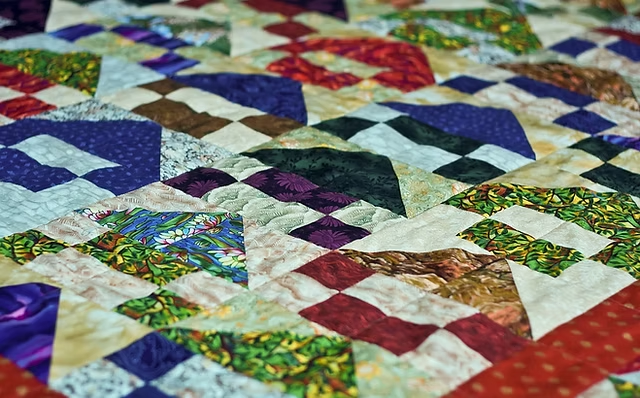
She worked for weeks, her hands moving skillfully over the fabric, threading it together with care and precision. I would sit beside her, watching the quilt grow, fascinated by the patchwork of colors, textures, and memories. There were squares from my baby clothes, pieces of her favorite dresses, and remnants of the t-shirts she had worn on long shifts at the diner. Each stitch seemed to hold a whisper of laughter, a sigh, or a story that had gone unspoken.
When it was finished, that quilt became more than fabric—it became a container for our life. That winter, we wrapped ourselves in it together on the couch, curling up to watch old movies. The chill of the house could not penetrate the warmth stitched into each square, a warmth made of love, sacrifice, and countless nights spent together. For years, that quilt symbolized safety and home. It was her hands, her effort, and her unwavering love manifested into something tangible.
Life slowly improved. Mom’s shifts at the diner became more manageable, and she eventually earned a promotion. I grew older, graduated college, and carved a life that appeared solid from the outside: a decent apartment, a stable job, and routines that carried the illusion of comfort and security. Yet, in my heart, the quilt remained sacred, a reminder of the woman who had built a life for us out of resilience and determination.
Then Colin proposed. He had chosen a small, intimate restaurant downtown for the moment, a place with low, amber lighting, wooden tables polished to a soft gleam, and a quiet hum of conversation that made it feel like a world apart from the busy city outside. Halfway through a shared chocolate tart, he reached into his jacket pocket, and I knew.
“Oh my God,” I gasped.
“I haven’t even asked yet, and that is not a yes,” he said, eyes wide and playful, the tension in his jaw betraying his nervous excitement.
“I know, I know, keep going,” I managed, laughter and tears mingling uncomfortably.
Finally, he got the words out, and of course, I said yes. I called my mother immediately afterward. The sound of her voice brought a rush of warmth and happiness, piercing the grief I had been quietly carrying from the years of struggle.
“Oh, honey,” she screamed with joy, her excitement almost physical, “Oh, I’m so happy for you. I want you next to me the whole day.”
But life, as it often does, has a cruel way of blending joy and heartbreak. Weeks after the engagement, my mother was diagnosed with cancer. At first, the words used by doctors and friends were reassuring: treatable, manageable, early-stage. Colin kept repeating, “We’re going to get through this.” I wanted to believe them. We all did.
But the timeline of life does not always match our hopes. Treatments progressed quickly, hope dwindled, and just as the seasons began to shift from winter to spring, my mother passed away. The weeks that followed were a haze of casseroles, sympathetic phrases, and paperwork, none of which seemed to ease the ache that hollowed me out from the inside.
Through it all, Colin held me. He offered space to grieve, silent support that did not attempt to fix what could not be fixed. His presence was steadfast, grounding me as the world seemed to tilt beneath the weight of absence.
Weeks later, I returned to my mother’s house to begin the painstaking task of packing up her belongings. Every drawer I opened felt like a miniature confrontation with memory; each piece of clothing, each photo, each small item seemed to ask for acknowledgment before being put away. And then I saw it: the quilt. Folded neatly on a shelf behind the couch, a silent witness to our lives. I pulled it down, letting its familiar weight rest against my chest. The smell of old fabric, faintly floral from countless washes, reminded me of her. Tears blurred my vision, and for a moment, I could almost hear her voice, whispering, “What are you doing snooping through my things?”
In that instant, I knew what I wanted.
I told Colin, bracing myself for skepticism. “I want to turn this quilt into my wedding skirt,” I said. My words stumbled over themselves as I anticipated his response.
“Beautiful,” he said instantly, his eyes lighting up. “Really?”
“Yes, really,” I affirmed. “This quilt kept us warm when we had nothing. It’s more than fabric. It’s love stitched into every square. Wearing it on our wedding day honors her.”
And he agreed, without hesitation, fully understanding the depth of the gesture.
The weeks between engagement and wedding were a blur of excitement and sorrow, a peculiar mix that left me suspended between grief and anticipation. Colin and I met with a seamstress who specialized in heirloom garments, someone who could take a quilt—threadbare and delicate—and transform it into a wearable tribute. Her studio smelled of cotton, linen, and the faint tang of ironed fabric. Patterns and swatches covered every surface, pinned to walls like a patchwork gallery of possibility.
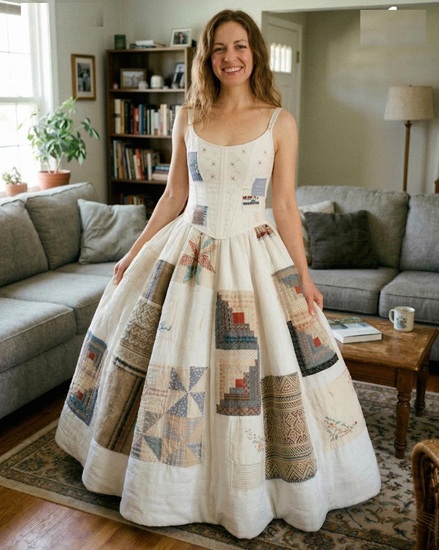
I unfolded the quilt in her light-filled room, the fabric slightly frayed at the edges, the colors softened by time. Each square told a story. There was a patch from the faded green sweater I had worn to my first day of school, one from the soft flannel shirt my mother had insisted I wear on winter mornings, and even a piece of the red sweatshirt she had used to begin the quilt during that cold winter so long ago. The seamstress ran her fingers over the patches, tracing the seams with awe.
“This is more than a quilt,” she said softly. “It’s a lifetime in fabric. And it deserves to be honored properly.”
Over the next few days, we worked carefully, adjusting the cut and flow of the skirt to make it elegant yet retain the integrity of the quilt. The finished skirt was stunning, a soft cascade of color and texture, each square retaining the memory stitched into it. The first time I tried it on, I felt a tangible closeness to my mother, as if she were leaning over my shoulder, smoothing the folds and whispering encouragement. I smiled through tears in the mirror, realizing how much of my childhood, my survival, and my love for her had been sewn into this garment.
Then came Linda. Colin’s mother, a woman whose presence always commanded attention, glided into my fitting room like a perfectly polished shark. Her hair was impeccable, her heels clicking on the wooden floor with a rhythm that made me anxious. She paused at the skirt, eyes narrowing.
“You’re planning to wear that to the wedding?” she asked, her voice sharp and controlled. “Do you realize how many of my business associates will be there?”
I looked directly at her, refusing to be cowed. “It’s my mother’s quilt,” I said firmly. “She made it. It’s special to me. I’m wearing it to honor her.”
Her lips pressed into a thin line. “And now it will embarrass this family.”
Colin stepped forward, protective and calm. “Mom, that’s enough.”
I added, without looking away from her, “I’m wearing it, Linda. We both agree.”
She smiled—coldly, with all the polish of a woman who thought she had won. But she did not back down. That was the first warning sign of the storm that would hit the morning of the wedding.
In the days that followed, the tension built like static in the air. Colin and I focused on the wedding details: flowers, seating, music, and menu. But a part of my mind was always with the skirt, imagining how it would flow as I walked down the aisle, how it would speak of love, resilience, and memory.
The morning of the wedding arrived in a frenzy of controlled chaos. The bridal suite buzzed with activity: hairstylists, makeup artists, and bridesmaids moving with military precision. I went to the closet to check on the skirt, and my heart lifted at the sight of it hanging neatly, as though it were waiting for me, patient and resilient.
Two hours before the ceremony, I went back to the closet to dress. I opened it and froze.
The skirt was destroyed. Long, jagged tears ran across the patchwork. Stains darkened the once-vibrant colors. Pieces of fabric hung loose, dangling, ready to fall. One seam had been ripped almost entirely from the waistband, leaving squares swaying precariously. I sank to the floor, shock and grief converging.
The door clicked softly behind me. I looked up.
Linda stood there, perfectly composed, her arms crossed, a slight, knowing smile on her face. “Oh, dear. Is something wrong with your skirt?”

“You did this,” I whispered, incredulous.
“I saved you from embarrassing yourself,” she said lightly, as if she had performed an act of charity.
I wanted to scream, to throw the fabric across the room, but instead, I let the room absorb my silence. I wiped my face with the heel of my hand, feeling the weight of every memory stitched into the quilt pressing against my chest.
“You might be right,” I said quietly, more to myself than to her. “Maybe it wasn’t appropriate.”
Her smile widened, triumphant, as she straightened her blazer. “I’m glad you finally see sense.”
I gathered the ruined skirt, careful not to let the pieces tear further, and placed it on the table in front of the planner. “We need to make a few changes,” I said calmly. My voice carried the weight of resolve.
The planner looked at me, eyes wide. “Are you sure?”
“Yes. Absolutely,” I said.
When the church doors opened, I stepped out wearing a simple, elegant ivory dress from the planner’s emergency rack. In my arms, I carried the ruined quilt skirt. The torn squares hung loose, the stains visible under the warm lighting of the ceremony space. Gasps traveled through the crowd as I moved down the aisle. The room was silent, all attention fixed on me and the fragile testament to my mother’s love I held.
At the altar, Colin’s expression shifted from confusion to concern. “What happened?” he whispered.
I placed the skirt on the small table beside us, nodding toward the sound booth. The music faded, replaced by a soft piano track. The screen behind the altar flickered to life, showing the first images of my mother in our kitchen, laughing as she worked on the quilt.
A hush fell over the guests. My voice, recorded earlier, began narrating:
“When I was growing up, it was just my mom and me. There were winters when we couldn’t afford heat very often. My mom made us a quilt from old clothes. It kept us warm. It made us feel safe.”
Images transitioned, showing our modest home, the worn fabrics, and the countless hours of stitching. Finally, the screen displayed me at the fitting, wearing the finished wedding skirt, my hand pressed to my mouth, tears streaming down my face.
“When I got engaged, I turned that quilt into my wedding skirt,” my voice continued. “It wasn’t fancy, but it meant everything to me.”
The screen went dark. I turned to the guests and lifted the torn quilt skirt, letting it hang as a symbol of resilience, love, and memory. Whispers passed through the crowd, a ripple of understanding and curiosity.
I looked toward the front row. Toward Linda.
“She destroyed this skirt herself,” I said calmly, holding her gaze. “She claimed she was saving this wedding from embarrassment.”
Linda’s lips pressed into a hard line, her eyes narrowing. I held the room’s attention, letting the weight of the moment settle.
“My mother worked two jobs to raise me,” I continued. “Nothing she ever made for me could embarrass me.”
I turned to Colin. “Before we do this, I need to know: if I marry you, am I expected to tolerate this kind of cruelty from your family?”
Linda shot to her feet. “This is absurd!”
I held my gaze on Colin. “I cannot start a marriage where my mother’s memory is treated like trash. Will you stand with me, or with your mother?”
Colin turned toward Linda. “Oh, don’t be ridiculous. That looked like rags,” she scoffed.
He shook his head. “I’m choosing decency. Please escort her out.”
The doors closed behind her, the tension finally releasing. He turned to me, eyes soft. “I’m so sorry,” he said, touching the torn fabric gently. Then he faced the guests: “My future wife’s mother raised her with love and sacrifice. That deserves respect. What happened today was cruel and will not be tolerated.”
Tears rolled down my face as I took his hand. “If you’re still willing, I’d really like to marry you today.”
“I think my mom would like that,” I whispered back.
The officiant cleared his throat. “Then perhaps we begin again.”
The torn quilt skirt rested across the altar between us. It was proof: proof that love made by tired hands in a cold house could survive decades. Proof that grief could be carried without shame. Proof that those who truly loved me understood exactly what mattered.
After the chaos of the wedding morning settled into the ceremony itself, a profound calm took over me. The tension that had been coiled in my chest for weeks seemed to release in slow, deliberate exhalations. Standing at the altar, holding Colin’s hand, I could feel the warmth of his palm grounding me. The torn quilt skirt lay across the altar, draping over the small table like a quiet monument to love, resilience, and memory. Every ragged edge, every faded patch, spoke louder than words ever could.

Guests whispered quietly as they took in the scene. I noticed grandmothers leaning toward each other, clutching purses, nodding in recognition of the effort and love stitched into every square. Some of my friends wiped tears from their eyes, understanding in an instant the depth of the gesture. Colin squeezed my hand and smiled—a soft, reassuring smile that reminded me why I had chosen him, why we had built a life together that prioritized empathy and care over appearances.
As the ceremony progressed, I glanced at the altar one more time. The quilt was no longer just a skirt; it had become a bridge between past and present, a testament to the hands that had labored in love for me decades ago. I could almost feel my mother’s presence hovering in the air, her careful stitching echoing in the silence. She had wanted me warm, safe, and cherished, and today, even in its damaged state, the quilt accomplished that.
During the vows, Colin spoke first. His voice carried steady confidence and tenderness. “I promise to honor the love and history that made you who you are, to hold your memories sacred, and to protect the legacy your mother built in you.” I blinked back tears, overwhelmed by the weight of his words. This wasn’t just a wedding; it was a recognition of every sacrifice, every quiet effort, every long night my mother had worked to ensure I had stability and love.
When it was my turn, I took a deep breath. “I promise to carry forward the love that made me, the love sewn into every square of a quilt my mother made with her own hands. I promise to honor her memory in every moment of our lives together and to teach Aaron that family is built from care, patience, and courage.” The words felt alive on my tongue, resonating with decades of history that had shaped me.
The ceremony concluded with applause, but the most profound moment came later, in private. Colin and I sat in the now-empty reception hall, the guests lingering outside or stepping into the evening sun. I reached for the quilt, running my fingers over the frayed patches, feeling the fabric’s resilience under my touch. It smelled faintly of my childhood home, of worn cotton and memories preserved.
“You were amazing,” Colin said quietly. “I don’t think anyone understood the significance, but I did. And I will never forget it.”
I nodded, tears spilling freely now. “It’s more than a skirt. It’s everything my mom gave me. Every sacrifice, every sleepless night, every stitch of love and patience—it’s all here.”
We spent the evening reflecting, talking about my mother, sharing stories about the winters we spent under that quilt, and laughing softly at the little quirks that had shaped my childhood. Aaron joined us intermittently, his curiosity about the quilt growing with each new story I shared. “So Grandma really made this?” he asked, eyes wide.
“Yes, she did,” I said. “And she made it to keep us warm and safe. That’s why it’s special. It’s not about how it looks—it’s about the love in it.” Aaron nodded solemnly, understanding more than I expected a seven-year-old to grasp.
Weeks later, the quilt skirt, now repaired and carefully mounted as a decorative centerpiece in our home, became a conversation starter for friends and family. People marveled at the care that had gone into its creation, and I took every opportunity to tell them about my mother. I wanted them to understand that love is not always loud or flashy; it is often quiet, persistent, and patient.
Linda never apologized, but the incident left an imprint. Colin and I learned that some conflicts cannot be resolved by explanation alone—they are resolved by action, by standing up for what truly matters. Choosing to honor my mother’s quilt publicly, despite the potential embarrassment or misunderstanding, had cemented a boundary. We had defined the principles of our family: respect, empathy, and honoring the sacrifices of those who came before us.
Over time, the quilt’s significance deepened. It became a symbol for our family—of resilience, of honoring memory, and of carrying forward love in tangible ways. We began small traditions with Aaron: every winter, we wrapped ourselves in blankets made from old clothes, telling stories of his grandmother and of the importance of family history. He learned to value not just possessions, but the intent and love behind them.
Colin and I also established a small annual project in honor of my mother. Each year, we collected worn fabrics from friends and family, inviting them to stitch pieces into a communal quilt that would eventually be donated to a local shelter. The project taught us about intergenerational care, about the invisible labor that supports love and stability in families. Aaron participated enthusiastically, and each stitch he made carried the memory of my mother’s hands, her determination, and her warmth.
Even years later, when life became more complex—new jobs, new homes, and new challenges—the quilt served as a grounding force. Its frayed edges reminded us that perfection is not the goal; love and effort are. Its patchwork represented the beauty of imperfection, of hardship transformed into care. Every time I touched it, I felt my mother’s presence, her voice reminding me that warmth and love matter more than appearances, more than etiquette, more than judgment.
Looking back, I understood why the quilt skirt had been so crucial to me. It was a bridge between loss and continuity, grief and celebration, memory and legacy. It taught me that honoring the past is not about nostalgia alone—it is about carrying forward the values, love, and strength that built us. My mother’s hands, through the simple act of stitching, had shaped not just a quilt, but a way of living and loving that endured beyond her lifetime.
On the day Colin and I moved into our first house, I placed the quilt skirt on a vintage quilt rack in the living room, where sunlight streamed in each morning. It became a silent teacher to Aaron, a reminder that care and love are never wasted, even when misunderstood or challenged. That same quilt, once a patchwork of scraps and memories, now connected three generations: my mother, me, and my family with Colin and Aaron.
The incident with Linda, though painful, had also crystallized a lesson I would carry forever. Love is not measured by approval or social grace; it is measured by integrity, courage, and the willingness to honor those who sacrificed for you. That morning, with all eyes on the torn quilt, I realized that respecting my mother’s work was an act of defiance, yes—but also an act of ultimate love. It was proof that the most meaningful legacies are not forged in wealth or appearances, but in the labor of love, patience, and memory.
As the years passed, the quilt remained a living part of our family. We used it to comfort friends in need, wrapped ourselves in it on cold winter evenings, and passed it on to Aaron when he needed reassurance. Each stitch carried not just warmth, but the story of my mother’s hands, her sacrifices, her determination to provide love against all odds.
And every time I looked at it, I remembered her voice, her laughter, her unwavering commitment: the woman who had raised me alone, stitched each patch with care, and taught me that love, when done right, is never ordinary, never disposable, and never truly lost.
In the end, the quilt was more than fabric. It was history, memory, and guidance. It reminded me that those we love leave us gifts beyond the material—lessons, strength, and love stitched into our very being. And as Colin and I built our life together, I carried her legacy forward, not in perfection, but in devotion, care, and honor.
The torn quilt skirt that began the chaos became a symbol of triumph over cruelty, a testament to family, and a tangible reminder that love, once given, endures forever. Every time I pass my hand over the patchwork, I feel her hands guiding me still, and I know that in honoring her memory, I honor the very best of who she was—and who I have become because of her.
