
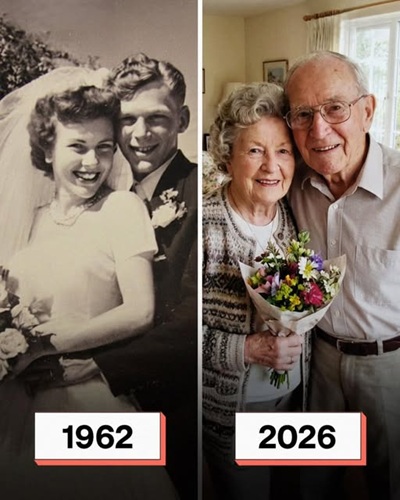
My name is Daisy. I am eighty-three years old, and for the past four months, I have been navigating the strange, uncharted world of widowhood.
Four months is a sliver of time compared to the sixty-three years I shared with Robert. Yet, these four months have stretched like an endless winter afternoon, hollow and echoing, as if the walls themselves mourn with me.
Each day begins and ends with the quiet reminder that he is not here—not in the morning sunlight that once danced on our kitchen table, not in the subtle warmth of his hand brushing mine, not in the soft, familiar hum of his voice that could fill the air even when he was asleep.
Robert proposed to me on Valentine’s Day in 1962. We were twenty years old, living in a cramped student apartment just off the university campus. The apartment was tiny, shared with two other young couples, and the kitchen never smelled quite right—there was always a faint trace of overboiled coffee or burnt toast, no matter how often we scrubbed the counters or washed the pots.
That night, he insisted on cooking. I remember watching him, his dark hair slightly mussed from studying all day, his sleeves rolled up, the tips of his fingers sticky with tomato sauce as he stirred the pot. He had tried to make spaghetti with jarred tomato sauce, a recipe that seemed simple in theory but tricky in execution for a novice. The garlic bread burned on one side and remained pale on the other, and when he noticed, his face flushed a soft pink. He lit a single candle, sticking it in an empty soda bottle for stability, apologizing repeatedly for every minor imperfection.

After dinner, he presented a small bouquet of grocery-store roses wrapped in newspaper. “I wanted to keep them warm in the February wind,” he said with a shy smile. Then he produced a silver ring, simple and unpretentious, the cost of which he had earned over two weeks washing dishes at the campus cafeteria. His hands shook—not from fear, I would later understand, but from hope, from excitement, from the raw vulnerability of offering his heart so openly.
“Daisy,” he said, forcing his voice to stay steady, “I don’t have much yet. But I will. And I want to build it with you.”
I said yes before he could finish. In that moment, I saw not just a young man proposing; I saw the foundation of a life we would spend decades constructing together.
Valentine’s Day became our quiet, sacred ritual, a rhythm that carried through every stage of our life. Some years, he brought wildflowers he had picked from the side of a country road when money was tight and our children were small. Other years, when his business prospered, he sent long-stemmed roses delivered to the house, each bloom carefully selected.
I remember one year a late frost ruined his surprise garden; he showed up with carnations and a sheepish grin, murmuring, “They’re sturdy. Like us.” And during the year we lost our second child, he brought daisies instead of roses. The choice was deliberate, tender, and painfully comforting.
Those flowers were never just flowers—they were promises. Promises renewed annually, a quiet assertion that no matter the hardships, no matter the arguments over money, sleepless nights with colicky babies, layoffs, illness, or aging parents, he would always return. They were a testament to love lived over decades, a ritual that bore witness to the ordinary and extraordinary alike.
When Robert died, it was in the fall, swift and devastating. A heart attack, the doctor said. Quick for him, though for me, time seemed to fracture. One moment, we were discussing whether the garden tomatoes should be covered before the frost; the next, he gripped the edge of the kitchen counter, color draining from his face. By the time the ambulance arrived, the world had already shifted. I was left behind, suspended in a reality that felt unfamiliar and cruelly silent.
The house became unbearably quiet. His slippers remained beside the bed, angled outward as if still expecting his feet. The coffee mug hung on its hook, a faint brown ring staining the interior, like a ghost of mornings past. Each day, I set out two cups of tea before my mind corrected me—only one pair of hands remained to lift a cup. Grief, I realized, is not always loud. Sometimes it is the hum of a refrigerator, the emptiness of a coat hanging by the door, the absence of familiar conversation in a room once filled with it.

As Valentine’s Day approached, dread gripped me. That day had been ours for more than sixty years. I did not know how to approach it alone. On the morning of February 14th, I lay in bed staring at the ceiling, bracing myself for the vast emptiness. Eventually, I rose, wrapped my cardigan tightly around my shoulders, and poured tea. I sat at the kitchen table, staring at his empty chair, feeling a heaviness that seeped into my bones.
And then, there was a knock.
It startled me. I had been expecting no one. Our children had called the night before, promising a visit later in the week. There were no deliveries scheduled, no one was supposed to be there. I walked slowly to the door and opened it.
No one was there.
Just a bouquet of roses resting on the welcome mat. Wrapped in brown paper and tied with twine, exactly as they had been in 1962. My fingers trembled as I picked them up. Nestled between the stems was an envelope.
Inside was a letter. In Robert’s unmistakable handwriting.
“My love,” it began, “if you’re reading this, I am no longer by your side.”
I sank to the step, the winter wind brushing my cheeks, grounding me.
There was a key tucked inside, and a note instructing me to go to an apartment he had kept secret. Hidden, yet somehow, I felt the trust and love radiating from every stroke of his pen. He had prepared this, anticipating even the moment of his absence. He had thought of me, even then, as he always had.
The taxi ride across the city felt both impossibly long and impossibly short. My hands gripped the key like it was a lifeline, the cool metal a sharp contrast to the heat rising in my chest. The driver, a young man with an earnest smile, tried to make polite conversation. “First time in this neighborhood?” he asked, gesturing to the tree-lined streets, the neat brick row houses, the quiet rhythm of a Saturday morning. I nodded absentmindedly, my mind elsewhere, tangled in a web of fear, hope, and longing. What would I find behind that green door? A secret family? A hidden life? Or something else entirely?
When I arrived, the street was almost too ordinary. Nothing about it suggested mystery or drama. The buildings were quiet, the only sound the occasional distant bark of a dog or the faint rustle of leaves in the winter wind. The green door in front of me looked unremarkable, almost shy, tucked neatly into the brick facade. I lingered on the sidewalk for what felt like an eternity, my heart pounding like a drum in my chest. I raised the key, inserted it into the lock, and turned. The click echoed like a small promise in the silent street.

The first thing I noticed was the smell: polished wood, old paper, and something faintly sweet, like honey left in the sun long ago. The aroma wrapped around me, warm and familiar, though I had never been here before. My fingers brushed the walls instinctively, tracing the subtle grooves in the plaster, the texture of decades lived quietly in anticipation.
Sunlight filtered through half-drawn curtains, landing in narrow beams across the floor, illuminating dust motes that danced lazily in the air. And then, I saw it: an upright piano, dark wood polished until it gleamed, standing at the center of the room like a sentinel waiting for me. Around it, shelves lined with sheet music, music theory books, and meticulously labeled recordings filled the walls, each one a testament to time, patience, and devotion.
I approached the piano slowly, my steps careful, almost reverent. On the piano bench was a neat stack of sheet music. The first piece I lifted was Clair de Lune, my favorite, the piece I had once attempted as a young woman, fingers trembling over an out-of-tune piano in our tiny student apartment. Beneath it, another sheet: Moonlight Sonata, another long-forgotten treasure of mine. My throat tightened. Tears blurred the edges of the music, and I had to set it down, pressing my palms to my face.
Beside the piano, rows of recordings in Robert’s precise handwriting were lined up chronologically:
“For Daisy – December 2018”
“For Daisy – March 2020”
“For Daisy – July 2022”
I ran my fingers over the labeled spines, realizing that for years, Robert had been quietly, secretly crafting a gift. Not a hidden life, not a betrayal, but a devotion that spanned decades, unseen yet profoundly present.
Medical reports, neatly stacked and dated, revealed the truth: he had been diagnosed with a severe heart condition, warned of limited time. He had known the fragility of his days and yet had carried on with care, patience, and quiet love. There was a formal agreement with the building’s caretaker, specifying the exact day this gift was to be delivered: the first Valentine’s Day after his passing. The delivery of roses and the key was orchestrated with the precision of a man who had spent a lifetime caring for another.
And then, a leather-bound journal caught my eye. I opened it carefully, feeling the weight of his presence in every page. The entries began decades ago, each one chronicling his secret lessons. “Today Daisy mentioned her old piano,” one read, dated twenty-five years prior.
“She said she once dreamed of being a pianist. She laughed, but I saw the sadness.” I remembered that day vividly—the attic filled with sunlight, the dusty sheet music in my hands, the gentle sigh of piano keys I could barely reach. Life had been too full of responsibilities, too urgent with children, bills, and the endless tides of ordinary existence. I had let the dream go, but he had not.

Page after page documented his learning process: the embarrassment of being the oldest beginner in the studio, the frustration of stiff fingers, the meticulous notes on rhythm and technique. Every entry was a dialogue with me, a love letter in code. “I’ve decided to learn piano,” he had written, “to give her back the dream she gave up. I want her to feel it again.”
The journal progressed in time, the handwriting growing shakier as the years advanced, as his heart condition worsened. “My hands tremble now,” one entry read. “The doctor says I am running out of time. I must finish one more piece.” And there, on the music stand, lay the culmination of all this effort: a handwritten composition titled For My Daisy.
The notes were gentle, intricate, and carried fragments of my favorite melodies woven into something entirely new. My fingers hovered above the keys, hesitant, uncertain, the weight of sixty-three years pressing down on me. I had not touched a piano in decades. Yet, as I placed my fingers on the keys, the music responded. Hesitant, uneven, unsure at first, but gradually, muscle memory awoke as though the piano itself remembered my touch. The melody unfolded beneath my fingers, tender and alive, carrying the weight of love, devotion, and grief.
When I reached the unfinished measure, the one Robert had not completed, I paused. The silence was almost tangible, sacred, as if the room itself held its breath. And then, guided by instinct, memory, and longing, I continued. I extended the phrases, added harmonies where my heart knew they belonged, and let the music resolve itself into a final, gentle cadence.
Tears streamed freely as I pressed the last note, and I remained seated for a long moment, letting the sound linger. Behind the music stand, I found one final envelope. Inside, his words:
“My darling Daisy,
This piano is yours. This studio is yours. Play again.
Even though I am gone, I am still here. In every note. In every chord.
I loved you at twenty. I loved you at eighty. I will love you forever.
Always yours, Robert.”
I pressed the letter to my chest, the weight of his devotion nearly crushing me, yet lifting me at the same time. For sixty-three years, he had brought me flowers, reminders of love and life lived together. And now, even from beyond, he had brought me back to myself.
After that first afternoon in the studio, I felt both exhausted and strangely alive. The weight of grief was still there, pressing on my chest like a winter quilt, yet beneath it was a flicker of something else—a light that Robert had left, waiting for me to find it. I returned home slowly, carrying the bouquet of roses and the letter close to my heart. The house was silent as usual, yet it no longer felt entirely empty. A part of Robert lingered there, in the spaces between rooms, in the memory of his voice, in the warmth of his carefully hidden gifts.
I began visiting the studio twice a week. At first, I could barely manage scales, my fingers stiff and uncooperative, each note a reminder of decades spent away from the piano. Sometimes, I would laugh at my own clumsiness, the awkward pauses between notes, and the way my hands seemed to forget the very shapes they had once known so well. Yet, gradually, muscle memory returned, and with it, something I had not felt in years: joy. It was quiet, subtle, but persistent—a low, comforting hum beneath the ache of loss.

I began to explore the recordings Robert had left. Each one was a snapshot in time, capturing his clumsy beginnings, his small triumphs, and the tender, sometimes hesitant way he learned for me. I could hear him stumbling over difficult passages, correcting himself, sometimes laughing, sometimes muttering encouragement under his breath. The music was imperfect, human, and full of love. Listening to it felt like sitting beside him once more, watching him work tirelessly to give me the dream I had abandoned.
One afternoon, while dust motes floated lazily in the sunlight, I noticed a particular recording labeled “For Daisy – July 2022.” It was his final attempt, the culmination of decades of secret dedication. I pressed play, and the music filled the room. Every note, every pause, carried his presence. My fingers itched to play along, to add my own voice to his, and I realized with a rush of warmth that I could. Together, across time, we could play again.
I began recording my own pieces, carefully labeling them and placing them on the shelf beside his. My first recording in sixty years was imperfect—my hands slower, my timing uneven—but it carried a tenderness and understanding that only decades of love and loss could produce. I labeled it simply: “For Robert.” Each time I played, I felt him beside me, guiding my fingers, smiling at my progress, proud even in my mistakes.
The music became a ritual, a way to navigate the hollow spaces left by his absence. I began to notice small details in the studio that brought him to life in ways I had never imagined: the slight smudge of a fingerprint on a music book, a pencil mark correcting a passage, the faint scent of his cologne lingering in a corner where he must have paused to read a note. Every detail was a reminder that love does not end with death—it evolves, it persists, it leaves traces in the world for those who remain.
I even began composing my own pieces, inspired by the melodies he had woven into his final composition. I allowed myself to add flourishes, to experiment with rhythm, to create something entirely new while honoring the foundation he had laid. Each composition was a conversation with him, a dialogue across time, a testament to a life shared and a love that could not be diminished by absence.
As the months passed, I realized that the studio was no longer just a place to remember him—it was a place to live again. I began to see myself not just as a widow, but as a musician, a woman reclaiming a part of her identity she had put aside for decades. The grief remained, but it was tempered now by purpose and presence. The silence of the house at home was no longer suffocating; I carried the music with me, and with it, Robert’s love, his foresight, his devotion.
The roses he had left that first Valentine’s Day after his passing remained on the kitchen table for days, a silent reminder that he had orchestrated even his absence with care. I kept them in a vase, arranging them carefully, as if by doing so I could maintain a connection, a bridge between what was and what remained. And in the quiet moments, when the wind rattled the windows or the light fell just so across the hardwood floors, I could almost hear him whispering encouragement, guiding me toward the notes I had once forgotten.
There were times, of course, when sorrow returned with a sharp, almost physical edge. I would pause mid-piece, tears spilling onto the keys, as if the piano itself absorbed my grief. But I discovered that music had the power to transform that pain, to channel it into something beautiful, something enduring. And in those moments, I felt Robert’s presence not as a memory but as a living part of my world, shaping my hands, my breath, my heart.
One evening, I sat at the piano long after sunset, playing softly as the room darkened, the last rays of light catching the polished wood and the dust motes like tiny sparks of memory. I paused, letting the final note linger in the air, and for the first time in months, I felt a profound peace. The gift he had left was not just music—it was a path forward, a way to honor the past while embracing the present.
I placed my latest recording on the shelf beside his, labeled simply: “For Robert – February 2026.” I imagined him listening, smiling, and nodding with quiet approval. For sixty-three years, he had brought me flowers, each one a promise renewed, a reassurance of love, care, and constancy. Now, even in death, he had brought me back to myself, guiding me to reclaim a dream that was mine all along.
And so I play. I laugh at my stubborn fingers. I falter, I restart, I perfect, and I improvise. In the music, I find him, I find myself, and I find the quiet certainty that love—real, enduring, patient love—never truly leaves. It transforms, it nurtures, it endures beyond the limits of life, a legacy not of wealth or material possessions, but of devotion, creativity, and the unwavering belief in another’s happiness.
Every time I sit at that piano, I feel Robert’s presence in the space between notes, in the press of keys beneath my fingers, in the echoes of melodies that have carried decades of life, love, and hope. And every time I finish a piece, I label it simply: “For Robert.” It is my way of continuing the conversation, of honoring the life we built together, of celebrating the music, the love, and the devotion that shaped every moment of our sixty-three years together.
In the end, the flowers were never just flowers. They were love made tangible. And the music he left me is more than music—it is proof that love, when nurtured, planned, and expressed with care, can outlast even death itself. Through the keys, the melodies, the fragile yet persistent notes, Robert and I continue our conversation. I play, he listens, and our love endures, timeless, unbroken, and infinitely tender
