
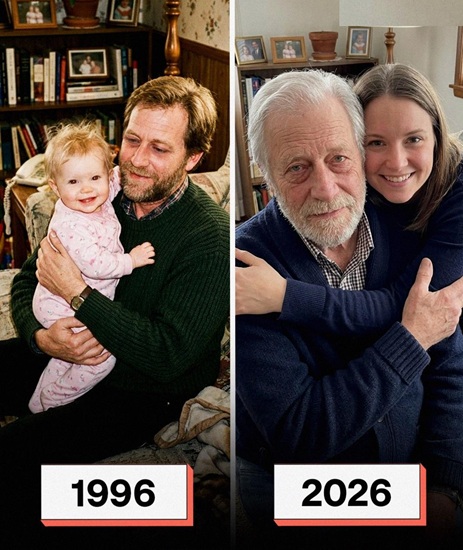
For as long as I can remember, my grandfather, Robin, carried an old photograph in his wallet. Its corners were rounded and frayed from decades of careful handling, a testament to the years he had kept it close.
The photograph showed a little girl with a wide, toothless grin that seemed to glow with innocence. The first time I noticed it, I almost gasped, realizing how much she resembled me at the same age.
I once asked Grandpa about it, gently taking the photo from his hands. On the back, written in slightly smudged blue ink, was a long phone number, with no name or explanation to accompany it.
“Is that my mom?” I asked, my voice tentative, hoping for an answer. Grandpa took the photograph back carefully and smiled sadly, shaking his head. “It doesn’t matter who that is, Amelia,” he replied softly.
He never explained further, and I learned not to press. Over the years, I would sometimes catch him in the evenings, sitting in his armchair, holding that photograph, his thumb tracing the little girl’s face absentmindedly.

Sometimes I noticed him quickly wipe his eyes with the back of his wrist, as if he didn’t want anyone to see him cry. Yet he carried that number and the photograph for over thirty years without ever calling.
“Grandpa,” I asked once, when I was twelve, “why do you keep that picture if it makes you sad?” He stared at it quietly for a long moment before replying. “Because you hold on to some things, sweetie… even when you don’t know how to fix them.”
I didn’t understand then. I just nodded silently, accepting his wisdom. Grandpa had raised me alone after my mother was gone, giving me the love and care of both parents without ever making it feel like a sacrifice.
My parents were never part of my life. Whenever I asked about them, Grandpa would pat my hand and smile sadly, saying, “Life doesn’t always go the way we plan, sweetheart,” before distracting me with a story or task.
He packed my school lunch every single morning without fail. Folded neatly under my sandwich, there was always a small note with the same words each day: “You’ve got this.” Those words became my quiet armor for the day ahead.
Grandpa taught me how to ride my bike in the parking lot behind the library. He ran alongside me until I told him I was ready, then let go without me even realizing, teaching me courage and independence.
He was the only parent I’d ever known, and for a long time, that felt enough. I never questioned whether the love and care he gave me were sufficient—they absolutely were, in every way that mattered.
Until a week ago, when Grandpa had passed, and I was standing alone in his kitchen, running my fingers over the worn countertop and wondering how the world could continue without him.
The house felt frozen, waiting for him to return. The smell of his cologne still lingered faintly in the living room, mixed with the scent of old wood and books, a strange combination that made my chest ache.

I found his wallet in the top drawer of his dresser, tucked beneath a neatly folded handkerchief. Inside were his library card, some old receipts, and, of course, the photograph. The blue ink on the back had faded even more, but the number remained legible.
I held the photo to the sunlight, studying each digit carefully. The kitchen phone sat on the counter, dusty yet familiar, its receiver slightly crooked but still connected. My cell phone was dead in my pocket.
For a long time, I simply stared at the photograph, my heart pounding. I could feel the weight of all those unspoken years—the sadness, the memories, and the love my grandfather had silently carried.
Then, with trembling hands, I lifted the receiver and dialed the number on the back of the photograph. Each ring sounded impossibly long, echoing through the quiet kitchen, until a man’s voice answered.
“Robin, is that you?” the voice asked, confusion and recognition mingling in its tone. My breath caught. I gripped the receiver tightly, my mind racing to place him.
“No, I’m Robin’s granddaughter,” I said, my voice shaking. Silence followed, heavy and uncertain. Then I added quickly, “My grandfather passed away last week.”
Another long pause. Then, from deep within the man’s chest, I heard a quiet, broken sound—grief, raw and immediate. “I’m sorry,” I said, panic rising. “Are you all right?”
“I’m not,” he admitted, his voice trembling. I asked where he lived, and he gave me an address about fifty minutes away. I hesitated to ask more, but then there was a sudden sharp crack on the line.
A thud followed. “Hello? Hello?!” I shouted, but the line remained open, the silence deafening. I called 911, gave them the address, and grabbed my keys, my hands still clutching the phone tightly.

The drive to the town felt endless, the streets stretching on as I imagined the man on the floor, possibly hurt or worse, waiting for someone he hadn’t spoken to in decades.
When I arrived, neighbors were gathered outside, murmuring quietly. An older woman in a green cardigan stepped forward, concern etched into her face. “What happened?” I asked urgently.
“His heart,” she said softly. “He collapsed. They just took Simon.” I froze, processing the name, and slowly made my way up the porch, heart pounding.
The door was unlocked. I stepped inside, noticing how meticulously the house was arranged. A newspaper lay folded on the table, the crossword half-completed. A coffee mug sat upside down, clean, beside the sink.
Photographs lined a small table near the hallway. I recognized my grandfather, younger than I had ever seen him, standing with a little girl in a red coat, her grin toothless and familiar.
The date on the back didn’t match my age or timeline. She couldn’t be me, yet the resemblance was uncanny. I placed the photo down, moving further into the house, stunned and uncertain of what I would find next.
Along the far wall, albums lined the shelf. Photographs of me as a child—my science fair, birthday parties, riding my bike—filled the room. My hands went numb as I realized the man had been observing my life quietly.
A reflection in a glass pane showed a figure standing still in the background—the same man whose photo rested on the table. My voice barely a whisper, I asked, “Who are you, Simon?” The answer would change everything.
Simon, my father, looked at me with eyes full of disbelief and recognition. He tried to sit upright in the hospital bed, his hands trembling slightly as he reached toward me.

“I… I’m your father,” he whispered, voice cracking with decades of suppressed emotion. I felt my chest tighten, unable to speak, the weight of years suddenly crashing down on both of us.
He explained slowly, every word deliberate. Thirty years ago, my mother had fallen in love with Simon, and for a brief time, they had been a young, hopeful couple full of dreams.
Grandpa Robin had never approved of Simon. Not out of malice, but because he worried my mother would be hurt. Simon had been unstable, with no stable income, and Robin wanted only security for his daughter.
The two men had clashed constantly, their disagreements loud and heated, often leaving my mother caught in the middle. Still, she chose Simon, marrying him without my grandfather’s blessing.
Before she passed, she gave Grandpa a single photograph with a phone number on the back. “Call me when you’re ready to forgive us,” she had said softly, pressing it into his hand with a tremor in her fingers.
Grandpa had never made the call. He had carried that photograph, and the unspoken tension, for over three decades, all while raising me with love, keeping me safe from the complications of adult choices.
Simon admitted he had been trying to reach Grandpa over the years. By the time he had sorted his life, I already had a stable childhood, full of the love my grandfather provided.
Over the years, Simon had watched me from a distance, taking photographs, making sure I was alright, never wanting to interfere or disrupt the life I had built with Grandpa.
I could feel my mind spinning, trying to process everything—the secrecy, the love, the sacrifices made, and the years of missed connection that had shaped all of us in quiet ways.
“Were you watching me?” I asked softly. His eyes met mine, the depth of sorrow and longing reflecting back at me. “Silently,” he admitted, “always silently, making sure you were okay.”

He explained how my mother had memorized Robin’s kitchen number and had shared it with Simon. For decades, every time his phone rang, he hoped it might finally be Robin calling.
I sat silently, absorbing the weight of thirty years of love, regret, and protection. Grandpa had loved me fiercely, but had also held everyone else at arm’s length for what he thought was my own good.
Simon was discharged three days later, and I drove him to his house, the car quiet except for the faint hum of the engine. Neither of us spoke much during the drive.
I didn’t turn on the radio. He nodded once, glancing out the window, his jaw tight, as if he was weighing every word he might say against the years he had lost.
When we arrived, the ceramic rooster by the door greeted us, chipped on its wing just like before. Simon paused, looking at the familiar marker of the house he had known from afar.
Inside, he hesitated, unsure how to act. Two strangers, bound by blood, trying to understand how to begin a relationship after decades of silence and unseen love.
I watched him step inside slowly, carefully, as if the house itself held secrets that only he could understand. I realized he had watched my life unfold without ever interfering.
“Thank you for coming, Amelia,” he said softly. “For all of it.” I nodded, unsure what to say, overwhelmed by a lifetime of story and memory finally converging in this single moment.
That night, I picked up my phone. I dialed Simon’s number once more, from memory, holding it tightly as if it were a lifeline between the past and future.
When he answered, I said the words Grandpa never could: “Dad, shall we meet for coffee tomorrow?” My voice was tentative, yet full of hope, bridging decades of silence and absence.
There was a long pause. Then, a quiet, shaky voice on the other end said, “I’d be honored, dear. I’d be honored.” Tears ran down my face as I finally felt our connection begin.
The next morning, I arrived at the café early, my hands clutching a warm cup of tea, heart racing. The thought of finally meeting my father after decades filled me with anticipation and fear.
Simon arrived a few minutes later, stepping cautiously inside. His eyes met mine immediately, and I could see the same mix of nervousness and longing mirrored in my own reflection.
We sat across from each other, the table between us feeling both enormous and insignificant at once. Words seemed inadequate to cover thirty years of absence, mistakes, and missed moments.
“I… I don’t even know where to start,” Simon admitted quietly. His hands fidgeted with the edge of his coffee cup, betraying the emotions he struggled to contain after so long.
I smiled faintly, my throat tight. “Start anywhere you want. Just… start.” My voice shook with a mixture of relief and vulnerability, years of longing surfacing in a single breath.
He told me stories of my mother, carefully recounting her laughter, the way she used to hum while baking, and how fiercely she had loved both of us.
“I wanted to call, Amelia,” Simon said, voice breaking. “I tried so many times, but Grandpa Robin’s number was the only link, and I was too afraid to intrude.”
I nodded, listening as years of confusion, hurt, and unanswered questions were finally clarified. The pain of lost time was heavy, but relief began to settle in slowly.
We laughed quietly at the small memories Simon shared, like how my mother had insisted on taking photos in every park we visited, and how Grandpa had scolded her for cluttering the house.
Then, the conversation turned to me—my childhood, my accomplishments, and the ways Grandpa had protected me while keeping Simon at a distance. Simon’s pride and regret were both visible in his eyes.
“I never stopped loving her,” he confessed. “And I never stopped thinking about you. Even when it felt impossible, I watched from afar, making sure you were safe and happy.”
I reached across the table, placing my hand over his. The connection felt fragile yet real, a bridge between our lives finally beginning to form after decades of separation and quiet observation.
Simon promised to be present now, to build a relationship not only as a father but also as someone who had deeply missed me every day of my life.
We spent hours sharing stories, tears, and laughter. The café around us faded as time condensed, the gap of thirty years shrinking with every word we exchanged.
By the end of the day, we felt like we had started again, cautiously but with determination, aware of the past but focused on creating memories together moving forward.
As we stood to leave, Simon smiled, a genuine warmth lighting his face for the first time in decades. “Amelia, thank you for giving me this chance,” he said softly.
I realized in that moment that healing didn’t erase the past, but it gave us the ability to live with it, to finally create a bond that had been postponed for far too long.
Driving home, I clutched the photograph from Grandpa’s wallet. The little girl’s toothless smile now felt like a symbol of connection, love, and the enduring thread between generations.
For the first time, I felt the weight of secrets lifted. Grandpa’s choices, Simon’s patience, and the life we had all built were finally aligned in understanding and forgiveness.
That evening, I called Simon again, and we spoke for hours, planning our next meeting. There was laughter, tears, and tentative excitement, a promise of shared time that had been denied for decades.
I realized that love often takes unexpected paths, sometimes delayed by circumstance, fear, or stubbornness, but its persistence can ultimately bring resolution and connection when least expected.
The photograph now rests in my wallet, alongside a note Simon wrote: “Always remember, we finally found each other.” I carry it with me, a symbol of enduring family and the power of hope.
