
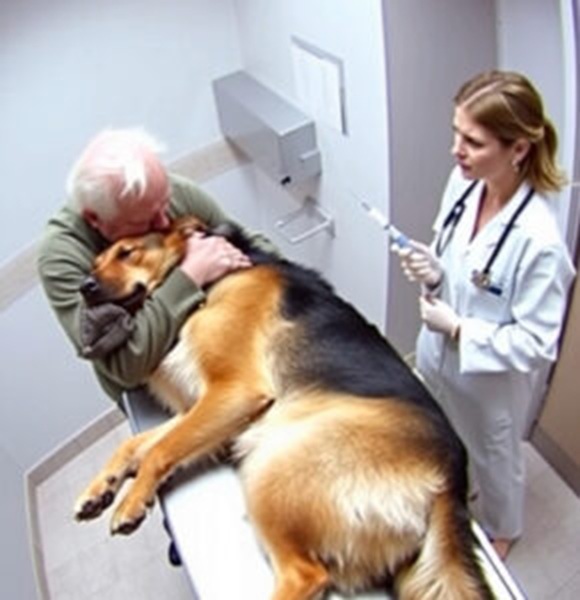
Leo’s chest rose and fell in shallow, uneven motions, each fragile inhale followed by a pause just long enough to make Artem’s heart seize.
The small veterinary clinic was nearly silent, save for the soft hum of fluorescent lights overhead and the rhythmic beeping of a nearby monitor, marking the fragile pulse of a life that had been steady for over a decade.
The antiseptic scent hung in the air, sharp and sterile, cutting through the warm, familiar undertones of dog fur and linoleum floors—a sharp contrast to the weight pressing down on Artem’s chest. It was the kind of heaviness that had no name, the kind that pressed at the ribs with invisible hands, and yet here it was, undeniable, consuming the space between them.
Leo lay on the stainless-steel examination table, his once-vibrant golden coat now thin and dulled, the softness of youth replaced by the fragility of age. The tips of his ears drooped, and faint white lines streaked his muzzle, evidence of years filled with adventures, mischief, and quiet companionship. His paws, once capable of running across fields for hours, now rested limply, joints stiffened by arthritis, claws barely scraping the metal surface. Artem ran his hand along Leo’s flank, feeling the subtle shifts of ribs beneath thinning flesh, the way a body remembers its own fragility even when the mind wants to pretend otherwise.
For over twelve years, Leo had been a constant presence in Artem’s life. Through long nights spent studying, through the tumult of career changes, the quiet collapse of a relationship that had seemed permanent, Leo had been unwavering. A warm body curled beside him during moments of heartbreak. A vigilant shadow at the door when life outside felt uncertain. A companion who never judged, who never spoke beyond the language of presence and loyalty. Now, as he watched the rise and fall of that frail chest, Artem realized just how much he had taken that silent devotion for granted.

Dr. Elena Markovic, the veterinarian, moved with calm efficiency on the other side of the room. Her dark hair was pulled back neatly, her eyes gentle but focused, reflecting the kind of practiced clarity that only comes from years of witnessing life teeter on its edge.
She held Leo’s medical chart in one hand, scanning notes with meticulous care. She had explained the situation earlier with the quiet authority of someone who had delivered difficult news countless times: Leo’s advanced heart failure, compounded by age-related complications, meant that treatments could no longer restore comfort. The goal now was dignity, a peaceful passing, and relief from suffering.
Artem had nodded when she spoke, though her words had blurred. He had known, in the deepest corners of his mind, that this day was inevitable.
Over the past year, he had seen the changes creeping into Leo’s body—the slow shortening of walks, the way he hesitated at stairs, the gradual loss of interest in food. He had watched helplessly as the once-brilliant spark in his companion’s eyes dimmed. And yet, knowing does not soften the blow when the moment arrives. Reality has a way of arriving cold and heavy, regardless of preparation.
Dr. Markovic set the syringe on the tray, her hands steady as she prepared the euthanasia solution. Artem had watched this procedure before in veterinary training videos, and yet the reality was infinitely more intimate. The medication was designed to be swift, to remove suffering with clinical precision. Artem could feel the tension coiled tight within him, a mixture of anticipation, guilt, and love. He pressed his hand against Leo’s side, feeling each shallow inhale as if measuring it against his own heartbeat, as if their two pulses could somehow speak to one another.
“Take your time,” Dr. Markovic said softly, her voice a gentle tether in the room. “You can talk to him.”
Artem leaned closer, his forehead brushing against Leo’s soft fur. He trailed his fingers through the familiar spot behind the dog’s ear, the spot that had always made him relax, even on the most restless days. His voice trembled, low and intimate.
“You’ve been the best friend I’ve ever had,” he whispered. “You know that, right? You’ve been with me through everything. And I…” He faltered, a tear sliding down his cheek. “I don’t know what I would have done without you.”
Leo’s ears twitched faintly, his eyes half-lidded. Even in weakness, he responded, a quiet acknowledgment of presence that transcended words.
Mia, the veterinary assistant, stood quietly by the door, her hands folded in front of her, tissues ready. She knew her place was silent support. The room seemed smaller now, as though grief had taken up physical space, pressing down on the fluorescent-lit air. Artem bent down further, pressing his forehead against Leo’s once more, as if proximity could somehow stave off inevitability.
“Thank you,” he murmured. “For every morning you waited by the door. For every time you knew I needed you before I even said it. Thank you for loving me without question, without conditions.”
Dr. Markovic approached with the syringe, her professional composure softening in the presence of such raw, palpable devotion. She reached for Leo’s catheter line, ready to administer the solution. And then—something shifted.

Leo drew a breath.
It was not the shallow, weak gasp that had defined the last hour. It was deep, full, as if his lungs had remembered their purpose and were reclaiming it momentarily. Another breath followed, steadier, more rhythmic. The monitor’s beeping adjusted, stabilizing rather than faltering.
Artem lifted his head, his voice barely a whisper. “Did you see that?”
Leo’s trembling softened. His limbs released tension—not in surrender, but as if the body itself had found a fleeting comfort, a brief reprieve. He lifted his head slightly, eyes clearing from the fog of exhaustion and medication. The tail, once still, gave a small, deliberate wag.
Mia’s hand covered her mouth. “Oh… my goodness,” she whispered.
Dr. Markovic placed her stethoscope against Leo’s chest, her brow furrowing in surprise. The heartbeat was steady, slow but firm. Gums had color. Breathing had normalized just enough to suggest stability. The professional in her could not ignore the data, yet the human part recognized something extraordinary.
“This is… unexpected,” she admitted, carefully measured, her voice low.
Artem’s hands trembled as he supported Leo’s head, tears streaming freely. “You’re still here,” he said. “You’re really here.”
The veterinarian lowered the syringe, uncertainty rippling through the room like sunlight through water. Where there had been finality, there was now a fragile possibility. And for Artem, that moment—so fleeting, so uncertain—felt like a gift of time, precious beyond measure.
He sank into the chair beside the table, cradling Leo’s head in his lap. He stroked the ears slowly, gently, cherishing the warmth beneath his fingers. Minutes passed. Leo’s breathing remained steady. The small, even wag of the tail continued.
Dr. Markovic rechecked vitals: improved heart rate, better oxygenation, signs of life that suggested the rally might last. She explained the clinical possibilities—stress hormone surges, adrenaline responses, temporary physiological stabilization—but for Artem, the technicalities could not capture the profound intimacy of this moment. This was more than biology. This was recognition. Connection. Presence.
Artem whispered memories to Leo, voice soft but filled with trembling joy. “Remember the lake?” he said. “You hated the water at first. Then you wouldn’t come out.” He laughed, a tearful, shaky laugh. “And the turkey… remember the turkey on the counter? I claimed responsibility.”
Leo’s tail wagged again, faint but deliberate, a signal that even in weakness, he could communicate, could respond, could be fully present.
For Artem, that moment became a sanctuary of meaning. Not a denial of mortality. Not a reversal of life’s natural course. But a reminder that even near the edge, there can be clarity, connection, and a chance to shift from fear to gratitude.

Hours could stretch. Minutes could feel eternal. And in that space, Leo’s fragile rally gave Artem something invaluable: a pause, a breath, a moment to simply be together, undisturbed by the looming shadow of farewell.
The drive home was quiet, almost reverent. Leo lay wrapped in his favorite blanket, head resting on Artem’s arm, eyes half-closed but alert in a way that startled him. The streets outside seemed sharper, more vibrant than usual, though he knew the shift was not in the world but in his perception—every sound, every color, every faint scent of winter air felt magnified, as if life itself was reminding him to notice.
At home, Leo was gently eased into his old spot by the living room window, a space he had claimed years ago to watch birds, to nap in shafts of sunlight, to simply exist in peace. Artem sat beside him, brushing back fur from the golden muzzle with trembling fingers. He marveled at how small, fragile, and yet dignified Leo still seemed. The dog’s body was fragile, but the soul that had always greeted him with unwavering loyalty was intact.
For the next few days, Artem devoted himself entirely to Leo. Work became secondary; emails went unanswered, phone calls postponed. His world shrank to the boundaries of their shared apartment, where every corner held a memory: the scratch on the wooden floor from a chase that had ended in laughter, the faint smell of pine from last winter’s walks, the soft rumble of Leo’s sighs as he slept beside Artem each night. Artem cooked small meals for the dog, carefully observing which bites he would take and which he would leave. Water bowls were refreshed constantly. Pillows and blankets were arranged for maximum comfort.
Every morning began with a ritual of gentle encouragement. Artem would sit cross-legged on the floor, calling Leo’s name softly. “Good morning, buddy,” he whispered, his voice thick with emotion. “Let’s see if we can make today a good one.” Some days, Leo would lift his head, giving a faint wag of the tail. Some days, he would merely twitch an ear, a subtle acknowledgment of Artem’s presence. But every response, however small, was celebrated as if it were a triumph.
Artem would read aloud sometimes, soft voices filling the apartment: news articles, poetry, stories from his childhood. Leo would listen—or at least seem to. Artem liked to imagine that he recognized the cadence of familiar words, the comfort of a voice that had always been present. On particularly quiet afternoons, he played soft music, the gentle hum of piano keys or string instruments washing through the room. Leo would lie still, eyes half-closed, sometimes shifting slightly toward the source of sound, as though confirming that life, however fleeting, was still here.
He documented everything. Notes in a journal captured minute changes in breathing, heart rate, appetite, movement. Artem had become hyper-aware of every subtle indicator of health, every nuance that might hint at distress or comfort. He set reminders to adjust medications, to give water, to offer gentle encouragement to rise and stretch. He learned to read Leo’s body language in ways that went beyond instinct, observing the tiniest flicker of an ear, the slightest quiver of a paw, the precise moment when a tail wagged enough to convey acknowledgment.

One evening, Artem settled onto the floor with Leo resting in his lap. Outside, the last rays of sunlight filtered through the blinds, casting stripes across fur and floorboards. Artem stroked the ears, tracing lines along Leo’s face that had once seemed too simple to matter but now carried immense significance.
“Remember the lake?” he whispered, voice low and intimate. “The first time you realized water wasn’t the enemy? You came out, shaking, and ran straight into the grass. You were soaked and proud.”
Leo’s eyes opened slightly, a glimmer of recognition. His tail moved, faintly, but with intent. Artem laughed softly through tears, pressing his forehead against Leo’s in a mirrored gesture of the clinic. “You’ve always been stubborn,” he said. “And loyal. And… I don’t think I ever thanked you enough.”
The nights were the hardest. Darkness seemed to emphasize the fragility of breath, the subtle rise and fall of Leo’s chest. Artem stayed on the floor beside him, sleeping in short intervals, ears attuned to the slightest rasp or sigh. At times, he would wake, feeling a surge of panic as he scanned Leo’s form for any sign of deterioration. Some nights, he would wake to find Leo breathing deeply, slow and steady, and tears of relief would streak down his face. The contrast between anxiety and calm became a rhythm, a reminder of how precious every uninterrupted breath truly was.
Meals became moments of ritualized care. Artem would prepare soft foods, observing Leo’s preferences with almost ceremonial attention. Tiny bites offered in a hand, encouraging movement and nourishment. Sometimes, Leo would eat slowly, deliberately, and the act felt sacred—a reaffirmation that life, even in its fragile form, could still respond to gentle encouragement. Sometimes, he would decline entirely, and Artem would simply sit beside him, whispering words of comfort, tracing soft circles behind the ears, until the dog found some semblance of peace in presence alone.
Visitors were limited. Friends who came often spoke in hushed tones, their conversations full of unasked questions, unspoken worry. Artem preferred this quiet, intimate world; it allowed him to focus entirely on Leo without distraction. Every moment became an exercise in mindfulness. Every movement, every breath, every look became laden with meaning.
In these days, the bond between human and dog deepened further. Artem discovered nuances he had never noticed before: the subtle lift of a paw when Leo wanted closer contact, the tiny tilt of the head when he heard a familiar sound, the way the eyes would brighten in recognition of a voice that had always been steady, unchanging. Artem learned patience in ways he hadn’t before—patience for movement, patience for response, patience for the rhythms of life in its most delicate form.
Yet, underlying all these hours of careful observation and gentle routines, there was always a quiet tension. Artem knew the reality. The rally in the clinic had not reversed the course of disease. It had given them time—borrowed, fragile, uncertain—but time nonetheless. He balanced hope with preparation, love with the awareness of mortality. Every wag, every lick, every quiet breath was a small miracle, yet every pause or sigh reminded him of the impermanence of it all.
Sometimes, in the quietest hours of the night, Artem would whisper stories of their shared past, small memories he thought Leo might recall: “The Christmas tree you tried to climb,” he murmured. “The first time you got into the garden and rolled in dirt. I told everyone it was your fault… but I loved it.” Leo would respond with a faint, deliberate wag, as though confirming that these moments mattered, as though presence itself could be a form of gratitude exchanged across species.

Through these days, Artem learned to embrace the paradox of grief and love coexisting. Fear for the inevitable mingled with the joy of presence. Anticipatory sorrow softened by shared laughter, by soft touches, by gentle acknowledgment of one another’s existence. Each day became an intricate mosaic of care, attention, and unspoken communication—a celebration of life even in its shadowed, fragile form.
And in those moments, Artem realized something profound: while science could measure heart rate, oxygen saturation, and the physical parameters of health, it could not measure the depth of connection, the reassurance of a familiar gaze, or the comfort of a hand resting on fur that had been a constant for over a decade. That connection—silent, persistent, unconditional—was beyond the reach of medicine, yet it carried the power to transform fear into gratitude, to turn impending loss into meaningful presence.
As the days slowly passed, Leo’s strength ebbed gradually, as Artem had anticipated. The temporary rally in the clinic had granted them more time than expected, but it could not alter the path of age and illness. Still, every moment felt like a gift—a chance to be fully present, to savor small gestures of life that might otherwise go unnoticed. Artem remained at his side constantly, a quiet guardian of comfort, devoted to making each moment meaningful.
Mornings began with soft light spilling through the windows, casting long golden streaks across the living room floor. Leo’s favorite spot, near the window, remained carefully arranged with blankets and pillows, and Artem would sit cross-legged beside him, brushing his fingers through the soft, thinning fur. The touch was gentle, deliberate, and slow, as if time itself could be coaxed into stretching.
“Good morning, buddy,” he whispered each day, his voice trembling with the weight of both love and sorrow. “Let’s see what this day has for us.”
Leo would lift his head just slightly, eyes focusing on Artem’s face with a clarity that made every shared glance profoundly significant. Some days he ate small amounts, savoring bites with care. Other days, he declined entirely, relying instead on the reassurance of Artem’s presence, the rhythmic caress of fingers tracing familiar lines behind his ears. Artem adjusted medications meticulously, cleaned water bowls, and maintained an environment optimized for warmth, comfort, and security. Every action was rooted in observation, patience, and deep empathy.
Evenings brought music, soft and enveloping. Piano keys, gentle guitar strums, and quiet orchestral harmonies filled the room. Leo would sometimes shift toward the source of sound, a subtle acknowledgment that the familiar cadence of melodies carried meaning. Artem spoke softly over the music, recounting stories from the past: misadventures, playful pranks, and quiet nights they had shared. “Remember the time you got into the garden and rolled in the dirt?” he whispered. “I told everyone it was your fault… but I loved it.” Leo’s faint tail wagged, a small signal, yet one packed with the weight of recognition.
Visitors were rare, chosen carefully, each offering quiet respect for the fragile space Artem and Leo occupied. Conversations were soft, the kind that never broke the delicate rhythm of care. Friends who came were silent witnesses to the intimacy of these final days, understanding that presence mattered more than words, that love could be expressed through touch, voice, and shared quiet.
Nights were the most profound. Darkness amplified every breath, every small stir, every subtle flicker of movement. Artem would lie beside Leo on the floor, supporting his fragile body, attuned to the faintest rasp or sigh. Sleep was brief, punctuated by moments of wakefulness in which Artem would monitor the dog’s breathing, pulse, and color, his heart alternating between relief and apprehension. When he awoke to find Leo’s chest rising and falling slowly, steadily, tears of gratitude would streak down his face, mingling sorrow and appreciation into a complex, unspoken communion.
Over time, Artem noticed subtle shifts. Movements became slower, more deliberate. Energy diminished. Appetite waned. Yet even in decline, Leo displayed moments of awareness, connection, and gentle communication. A lifted paw, a soft nuzzle, or a deliberate wag of the tail became precious signals of presence and trust. Artem cherished each gesture, recording memories in a mental journal, etching them permanently into his consciousness.
Dr. Markovic visited their home during these final days, bringing the calm authority of her profession but tempered with tenderness. She monitored vitals, adjusted supportive care, and offered quiet guidance, reminding Artem that comfort and dignity were paramount. She reassured him that these last days, though finite, could be filled with profound meaning, and Artem clung to this perspective. He had prepared his mind and heart for the inevitable, but the privilege of care allowed him to transform grief into shared serenity.
One evening, as the sun dipped below the horizon, painting the room in amber light, Leo lay nestled in Artem’s arms. Artem cradled his companion like a fragile treasure, pressing a gentle kiss to his muzzle. “It’s okay, buddy,” he whispered. “You’re safe. You’re loved. You’ve been the best part of my life.”
Leo’s eyes, still clear despite weakness, met his gaze. A subtle recognition passed between them, an unspoken acknowledgment of the bond forged over twelve years of devotion. His breaths were shallow but steady, his small body warm against Artem’s chest. The rhythm of life, so delicate and ephemeral, persisted, and Artem remained with him fully, attentive, present, grateful.
As the final day approached, Leo’s breathing slowed naturally, a gradual taper that reflected a body moving toward rest rather than sudden distress. Artem held him close, a firm yet tender support, whispering stories of the lake, of stolen turkey, of quiet mornings together. The space between each breath became hallowed, a sacred rhythm marking the passage of a life deeply lived and profoundly loved.
When Leo’s chest finally stopped rising and falling, it was gentle. Not abrupt, not frantic—just a quiet, natural closing, framed by familiarity and comfort. Artem wept, holding him close, but his grief carried a different weight than before. There was no guilt, no panic, no unfinished words. There was only gratitude—gratitude for the borrowed time, the moments of clarity, the opportunity to say goodbye fully, and the gift of presence that transcended fear.
In the weeks that followed, Artem often reflected on that pivotal day in the clinic, the deep breath, the brief rally that had shifted despair into hope. Medical explanations could account for temporary stabilization: physiological responses, stress hormone surges, and relief from pain. Yet those scientific insights could not diminish the meaning of that moment, nor the enduring depth of connection that had been shared.
He remembered each subtle gesture, each wag of the tail, each deliberate nuzzle, and every quiet evening spent in presence. He recalled the laughter and the tears, the joy of small victories, and the beauty of shared silence. Even in loss, life had offered him grace, allowing him to transition from fear to acceptance, from anxiety to profound gratitude.
Time, Artem realized, is never measured solely in hours or days. Time is measured in presence, in connection, in love fully expressed. Leo’s final days, framed by careful attention, tender touch, and deep emotional communion, had expanded the notion of what time could mean. Even in endings, there was richness. Even in absence, there was meaning.
Sometimes, love does not stop loss.
But sometimes, just before goodbye, it creates space—space to breathe, space to cherish, space to hold and be held, space to transform grief into memory, sorrow into gratitude.
Years later, Artem would speak of Leo not with the raw sharpness of early mourning, but with warmth, with clarity, and with a profound appreciation for what had been shared. The lake, the stolen turkey, the quiet mornings, the soft music, and the gentle, unexpected rally—all became part of a tapestry of love that would endure, timeless and unbroken.
He would remember that last breath, not as the end of life, but as the culmination of a shared journey, a reminder that even in frailty, even on the edge of goodbye, connection, presence, and love can transform loss into a space of grace.
Because sometimes, love is not about preventing goodbye.
It is about making sure it is filled with meaning.
And in that meaning, even endings carry beauty.
