
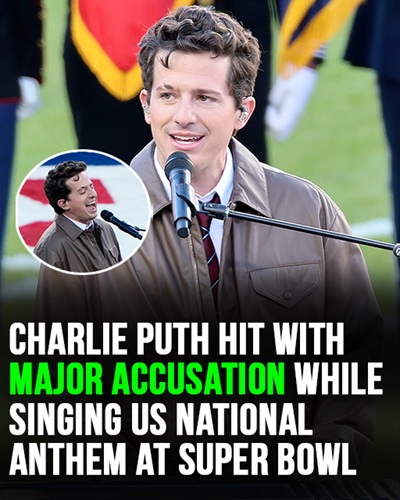
On the evening of Sunday, February 8, 2026, millions of viewers worldwide tuned into Super Bowl LX at Levi’s Stadium in Santa Clara, California, a venue renowned for hosting some of the NFL’s most significant championship games.
While the focus of the event is traditionally the clash between the New England Patriots and the Seattle Seahawks, as with all Super Bowls, the pre-game ceremonies hold an equally significant cultural weight.
One of the most eagerly anticipated moments was the performance of “The Star-Spangled Banner”, the United States’ national anthem.
This year, the honor fell to Charlie Puth, the Grammy-nominated singer-songwriter celebrated for his pop hits such as “See You Again”, “Attention”, and multiple chart-topping collaborations.

For Puth, a native of Rumson, New Jersey, and a graduate of Berklee College of Music, this moment was historic. Singing the national anthem at the Super Bowl is a milestone reserved for elite performers, combining artistic prestige with patriotic significance.
In interviews leading up to the game, Puth described the opportunity as “a humbling responsibility” and expressed awareness of the long legacy of iconic performances, from Whitney Houston’s 1991 Super Bowl rendition to Beyoncé, Lady Gaga, and Jon Batiste’s interpretations in more recent years.
A Storied Tradition: The Anthem at the Super Bowl
Performing “The Star-Spangled Banner” before a major sporting event is a tradition with deep roots in American culture. Over decades, Super Bowl audiences have witnessed renditions ranging from Billy Joel’s piano-driven performances to Celine Dion’s soaring vocals, each bringing its own personality to the anthem.
Artists face both an enormous technical challenge — navigating the song’s broad vocal range — and an emotional challenge, conveying national pride and unity in front of millions of viewers simultaneously in the stadium and at home.
Historically, the Super Bowl anthem has occasionally sparked both critical acclaim and controversy. Whitney Houston’s 1991 version, performed during the Gulf War, is remembered for its emotional resonance and subtle arrangements, while other renditions have been scrutinized for style, technique, or perceived politicization.
In this context, Charlie Puth approached the 2026 performance with both excitement and meticulous preparation.
The Performance: Emotional, Simple, and Technically Precise
When the cameras cut to the Levi’s Stadium stage, Puth stood alone at a minimalist white platform, accompanied by a small electric piano, a gospel choir, and a modest live band.

Unlike other high-profile Super Bowl pregame performances that rely on pyrotechnics or elaborate staging, Puth’s approach was understated — a deliberate choice to allow the song’s melody and lyrics to take center stage.
From the first note, it was clear that Puth prioritized vocal precision and emotional clarity. The anthem is notoriously difficult, requiring seamless navigation from low, meditative verses to soaring high notes that test even the most accomplished vocalists.
Puth’s rendition focused on clean phrasing, controlled vibrato, and a carefully measured tempo, allowing the audience to absorb each line of the patriotic text without distraction.
As he reached the climax, cameras captured players from both teams placing hands over their hearts, some with closed eyes, others nodding along with the melody, visibly moved by the moment.
The live audience rose to its feet during the dramatic military flyover that coincided with the final notes — a precision-timed visual spectacle that has become a signature part of Super Bowl pregame ceremonies.
Public and Critical Praise: “Flawless,” “Powerful,” and “Emotionally Resonant”
Immediately following the performance, social media and news outlets erupted with reactions, largely positive. Fans praised the clarity and musicality of the rendition, noting that Puth’s piano accompaniment gave the performance a modern yet reverent feel.
Highlights of fan commentary included:
- “Charlie Puth delivered one of the cleanest Super Bowl anthems I’ve ever heard — no gimmicks, just pure emotion.”
- “The simplicity of the piano and choir allowed the lyrics and melody to shine. Perfectly done.”
- “Even if you’re not a fan of his pop music, this rendition was breathtaking.”
Music critics similarly noted that the understated arrangement allowed for a fresh interpretation without compromising the song’s gravitas.
By avoiding exaggerated vocal runs or overproduction, Puth honored the anthem’s history while contributing a performance suited to contemporary tastes.

Many commentators also noted the emotional impact of the performance, emphasizing that the combination of live vocals, choir support, and the military flyover created a moment that felt both intimate and grand — a balancing act rarely achieved at events of this scale.
The Lip-Sync Controversy: Doubt and Speculation
Despite widespread praise, speculation arose almost immediately online. Many viewers questioned whether Puth had sung the anthem entirely live. The debate focused on several observations:
- Some users noted that his vocal delivery was “too perfect”, with precise pitch and tone that seemed almost studio-engineered.
- Others suggested that camera shots didn’t always align with his mouth movements, implying potential pre-recording.
- Popular posts on platforms like Reddit, X, and Instagram questioned whether Puth’s performance had relied on backing tracks or pre-recorded elements.
Examples of typical online commentary included:
- “Seems like it was lip-synced — too perfect to be live.”
- “Not one note was off — that can’t happen in front of a live audience.”
- “Maybe a bit of pre-recording to avoid mistakes?”
Understanding Modern Live Performance Practices
It is important to contextualize this controversy. Major televised events like the Super Bowl often employ hybrid performance techniques.
Due to stadium acoustics, broadcast sound limitations, and the need for consistent audio across multiple platforms, artists may sing live while relying on pre-recorded elements for support. This ensures that the audience in the stadium and viewers at home experience high-quality sound.

Historical precedent exists for such approaches. For instance:
- Whitney Houston’s 1991 Super Bowl anthem utilized subtle pre-recorded layers, though her live vocal performance remained authentic.
- Other major events routinely use a combination of live vocals and studio-enhanced backing to compensate for outdoor acoustics, wind interference, and large-scale production logistics.
In this context, even if Puth’s vocals were partially reinforced by technology, it does not imply that the performance lacked authenticity or artistry. Instead, it reflects standard practices for high-stakes live broadcasts.
Diverse Online Reactions: Support, Skepticism, and Mixed Perspectives
Reactions to the performance revealed a spectrum of opinions:
- Supportive Fans
- Praised Puth’s technical skill and mastery of the anthem’s demanding vocal range.
- Emphasized that achieving a flawless live performance under Super Bowl conditions is exceedingly difficult.
- Highlighted emotional resonance, noting that the rendition inspired patriotic reflection.
- Skeptical Observers
- Questioned the lack of visible microphone or stage mechanics in some camera angles.
- Suggested the performance may have involved significant pre-recording or audio enhancement.
- Compared the performance to other live Super Bowl anthems, noting that certain acoustic elements sounded “studio perfect.”
- Mixed or Neutral Views
- Acknowledged Puth’s talent while noting that the performance felt “less emotionally dramatic” than certain historical renditions.
- Commentators praised his musical arrangement but noted a preference for larger orchestral accompaniment or more dynamic staging.
These varied perspectives underline the heightened scrutiny performers face at major global events, where artistic choices are dissected by millions simultaneously.

Significance in Anthem History
Charlie Puth’s 2026 performance can be contextualized within a decades-long legacy of Super Bowl national anthem renditions:
- Whitney Houston’s 1991 version remains iconic for emotional resonance during a national moment of conflict.
- Subsequent performances by Celine Dion, Beyoncé, Lady Gaga, Chris Stapleton, and Jon Batiste each brought unique stylistic interpretations to the stage.
- Puth’s rendition stands out for its minimalist presentation, piano-led arrangement, and subtle emotional phrasing, providing a contemporary counterpoint to both heavily orchestrated and vocally dramatic past performances.
From a broader perspective, the performance demonstrates how national anthems continue to spark debate, admiration, and cultural reflection, highlighting the importance of tradition, technical skill, and personal artistry.
While Part One focused on the performance itself, technical mastery, and immediate fan reactions, the second part of the story examines the broader cultural, political, and historical implications of Charlie Puth’s rendition of “The Star-Spangled Banner” at Super Bowl LX.
Social Media Explosion: Fans, Critics, and Virality
Within minutes of the performance, social media platforms such as X (formerly Twitter), Instagram, TikTok, and YouTube exploded with posts analyzing every aspect of the anthem.
Unlike most regular broadcasts, the Super Bowl anthem draws attention from both hardcore sports fans and music enthusiasts, creating a highly diverse online audience.
Positive responses dominated early hashtags, including #PuthSuperBowl, #NationalAnthem, and #SuperBowlLX. Fans applauded the combination of technical skill, emotional delivery, and understated staging. Notable observations included:
- Appreciation for the piano-led arrangement, which differed from heavily orchestrated versions in previous years.
- Recognition of the gospel choir support, which added depth without overshadowing Puth’s vocals.
- Emotional resonance noted by viewers who reported being moved to tears, describing the performance as “heartfelt” and “authentically American.”
One particularly viral post highlighted the connection between visual and auditory storytelling, noting the synchronized military flyover as a “perfectly timed complement to the music, adding a patriotic cinematic effect.”
At the same time, critics raised questions that fueled discussion:
- The perceived perfection of the vocal performance led some to suspect pre-recorded backing or studio enhancements.
- Comments about visible microphone placement and camera framing suggested technical tricks may have been used to ensure sound quality for broadcast.
- A minority argued the performance was “too clean” or lacked the raw spontaneity of previous renditions by artists like Brandi Carlile or Whitney Houston.
This online debate illustrates a broader trend: viewers increasingly scrutinize live performances, especially at events as globally visible as the Super Bowl.
Historical Context: Live vs. Broadcast Performance
To understand the controversy, it is important to consider how live national anthem performances are executed at large-scale events:
- Hybrid Audio Systems: Performers typically sing live while audio engineers blend live vocals with pre-recorded tracks, ensuring consistency across in-stadium speakers and television broadcast.
- Stadium Acoustics Challenges: Levi’s Stadium, like many large venues, presents technical challenges such as wind interference, echo, and crowd noise, which can affect how a live performance sounds on TV.
- Precedent in Super Bowl History:
- Whitney Houston’s 1991 rendition used subtle pre-recorded layers to achieve perfect clarity for television broadcast, yet her live vocal delivery remained authentic and highly praised.
- Beyoncé, Lady Gaga, and Chris Stapleton have also employed blended vocal techniques, balancing live emotion with audio reliability for millions of viewers.
Thus, even if Puth’s vocals were technically supported by pre-recorded elements, the performance remains artistically valid and culturally significant, demonstrating mastery in both execution and presentation.
Political and Cultural Dimensions
The Super Bowl anthem, by nature, intersects with national identity and cultural discourse. While most responses focused on musicality, some viewed the performance through broader societal lenses:
- Political Commentary: Certain commentators interpreted the subdued, piano-driven performance as a deliberate departure from traditional, highly dramatic renditions, sparking debate about patriotism, style, and modern expression.
- Cultural Representation: Puth, a young, internationally recognized pop artist, brought a fresh, contemporary perspective to a centuries-old patriotic song. Supporters noted this reflects the evolving demographics and cultural inclusivity of America.
In interviews after the performance, Puth emphasized his respect for tradition while explaining that his interpretation aimed to highlight clarity, emotion, and accessibility, rather than spectacle. He remarked:
“I wanted people to hear every word and feel the story behind it. It’s about unity, about pride, and about moments we can all share — regardless of background.”
Mainstream media outlets quickly weighed in with analyses ranging from technical assessments to cultural interpretation:
- NBC Sports described the performance as “technically flawless and emotionally stirring,” emphasizing the integration of choir, piano, and military flyover.
- Billboard Magazine praised the artistic choice to “prioritize musicality over theatrics,” calling it a modern reinterpretation that honors the anthem’s historic roots.
- Variety highlighted social media reactions, noting that debates over lip-syncing versus live performance are common for high-stakes televised events and rarely diminish the artist’s accomplishment.
Music experts noted that Puth navigated the anthem’s wide range with precision, particularly sustaining high notes under significant pressure.
The ability to perform such a challenging song in a live, high-stakes, globally televised environment underscores his technical proficiency and composure as a professional vocalist.
Fan Perspectives: Emotional Resonance and National Unity
Beyond technical debate, Puth’s performance was notable for its emotional impact. Social media posts included personal stories of viewers who felt deeply connected to the anthem that night:
- A fan in New York wrote: “I’ve watched dozens of Super Bowls, but tonight I felt chills. Every word, every note — it felt personal.”
- Another post highlighted cross-generational appeal: “My kids were singing along even though they had never heard the anthem live before. That’s the power of music.”
For many, the performance reinforced a sense of shared national identity, demonstrating that live music can transcend language, background, and personal beliefs.
Legacy and Cultural Significance
Charlie Puth’s rendition of “The Star-Spangled Banner” at Super Bowl LX will be remembered for several reasons:
- Technical Excellence: Successfully navigating one of the most difficult songs in American music in a live broadcast setting.
- Artistic Choice: Emphasizing clarity, emotion, and simplicity over spectacle.
- Cultural Impact: Highlighting the evolving landscape of American music performance and national symbolism.
- Public Engagement: Sparking conversation about live performance standards, broadcast techniques, and artistic interpretation.
Although debates over live versus pre-recorded elements persist, these discussions often overshadow the fact that delivering a high-quality national anthem requires exceptional vocal skill, emotional sensitivity, and composure — all of which Puth demonstrated with distinction.
Comparison with Past Iconic Performances
For historical perspective:
- Whitney Houston, 1991: Emotional, war-time resonance; technically supported by backing tracks.
- Lady Gaga, 2016: Bold, theatrical, politically nuanced.
- Chris Stapleton, 2020: Blues-infused, gospel elements emphasizing soulful depth.
- Charlie Puth, 2026: Piano-driven, clear, understated, emphasizing musicality and unity.
Puth’s version sits within a continuum of Super Bowl anthems, distinguished by its minimalist staging, live instrumentation, and modern pop sensibility.
Concluding Thoughts: Performance, Identity, and Public Memory
Charlie Puth’s 2026 performance of “The Star-Spangled Banner” at Super Bowl LX demonstrates the complex intersection of music, patriotism, and broadcast media. While technical debate over lip-syncing emerged, the performance’s cultural resonance, emotional impact, and technical mastery remain undeniable.
Through the lens of history, this rendition will likely be remembered as:
- A modern, minimalist approach that elevated clarity and emotional nuance.
- A moment that engaged millions, sparking conversations about artistry, tradition, and interpretation.
- A reminder that major national events are simultaneously musical, social, and cultural touchstones.
Ultimately, Charlie Puth’s performance reaffirmed the Super Bowl national anthem as a platform for musical innovation and cultural conversation, bridging past tradition with contemporary artistry.
For fans, critics, and historians alike, it represents a defining example of 21st-century live performance, illustrating how music continues to unite, inspire, and challenge audiences in profound ways.
