
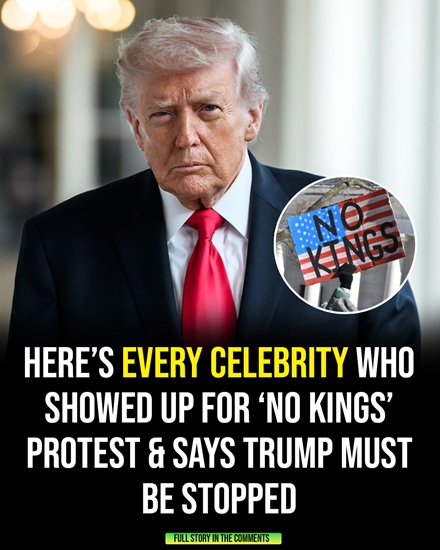
On Saturday, March 28, 2026, more than eight million people across the United States reportedly participated in the nationwide “No Kings” protests, marking one of the largest coordinated demonstrations in recent history against Donald Trump.
The protests spanned major cities, including New York, Los Angeles, Chicago, Miami, and Minneapolis, attracting Americans from diverse backgrounds who sought to make their voices heard on government accountability, civil rights, and social justice issues.
Many celebrities used their platforms to amplify the protests, joining crowds and speaking openly about their concerns regarding Trump’s policies, leadership, and perceived threats to democratic institutions and individual freedoms across the country.
Among the high-profile attendees were Robert De Niro, Jane Fonda, Bruce Springsteen, and Jimmy Kimmel, all vocal critics of the former president, drawing significant media attention and encouraging widespread participation from both fans and activists.

Robert De Niro addressed the New York rally, calling Trump a “corrupt leader” and an “existential threat,” emphasizing that unchecked political power undermines constitutional safeguards, freedoms, and the principles that form the foundation of American democracy.
“When the people chant ‘No Kings,’ it reflects a demand for accountability, not just against one man but against concentrated power that threatens freedom, equality, and civic responsibility across our nation,” De Niro said.
He outlined specific grievances, citing corruption, economic mismanagement, healthcare challenges, and international conflicts, asserting that the time had come for Americans to act collectively to prevent further erosion of public trust and safety.
“Enough is enough. No King Trump. No unnecessary wars sacrificing lives and draining resources, no self-enrichment at the expense of citizens, and no government overreach infringing upon rights and liberties,” De Niro declared to the cheering crowd.
Jane Fonda attended a Minneapolis protest, reading a powerful statement written by Becca, the wife of one of the victims memorialized during the demonstrations, highlighting personal loss and the human cost behind political policies and inaction.

“I am heartbroken, but I am inspired by Minnesota’s people,” the statement read. “We were robbed of someone whose kindness and light touched countless lives. We stand together choosing love and resilience over despair.”
Fonda also spoke the day before outside the Kennedy Center, warning that the administration had attempted to manipulate cultural narratives and public memory, including censorship, historical monument removal, and limitations on educational and artistic expression.
She highlighted the alarming trend of book bans, public plaque removals, and attempts to erase historical events, emphasizing that these efforts threaten the ability of citizens to learn, engage critically, and preserve shared heritage.
Bruce Springsteen performed his protest song “Streets of Minneapolis,” which referenced government overreach, law enforcement failures, and individuals whose deaths drew national attention, honoring victims and encouraging solidarity among attendees and citizens nationwide.
“The courage and solidarity shown by the people of Minneapolis and Minnesota sends a powerful message to the nation,” Springsteen said, praising local organizers and citizens for defending democracy through peaceful, engaged protest.
He named specific victims, including Renee Good, a mother of three, and Alex Pretti, a VA nurse, acknowledging their tragic deaths and connecting their stories to systemic issues highlighted during the demonstrations.

Maggie Rogers performed alongside Springsteen, offering musical support and representing the younger generation of activists, while Joan Baez brought her legendary folk presence to the Minnesota State Capitol, performing for large crowds and reinforcing the protest’s cultural impact.
Jimmy Kimmel attended the rallies with his children, sharing photos of signs and protest imagery online, including messages like “Enough already,” helping amplify the events digitally and encouraging those unable to attend to engage virtually.
Other notable attendees included Sam Waterston, Billy Porter, Jim Acosta, and Ann Patchett, all lending their visibility to elevate the protests’ reach, ensuring that the grievances of everyday Americans reached national media and political discourse.
In Malibu, Doug Emhoff spoke at a “No Kings” rally, accompanied by Kathy Griffin, who actively participated and shared updates across social media, demonstrating the widespread appeal and influence of celebrity advocacy during the demonstrations.
Actors Sam Elliott, Kristen Johnston, and Nancy Lee Grahn were also present at the Malibu event, highlighting the intergenerational and cross-professional support that gave these protests additional visibility and legitimacy among mainstream audiences.
Elsewhere in Los Angeles, Annette Bening and Edward James Olmos attended separate events, illustrating the breadth of participation and the convergence of local and national activism alongside high-profile cultural figures.

The organization of these nationwide protests required careful coordination, with volunteers and community leaders ensuring logistics, safety, and platform access for diverse participants while maintaining peaceful demonstrations across cities simultaneously.
Protesters carried signs, chanted slogans, and shared personal stories, highlighting systemic issues including government corruption, economic inequality, healthcare access, immigration enforcement, and civil rights, connecting policy grievances with real-world impacts on citizens’ lives.
Celebrity presence reinforced messaging, ensuring media coverage and social media amplification, encouraging broad civic engagement, and mobilizing participants who might otherwise remain disengaged from political activism or unaware of nationwide demonstrations.
The “No Kings” movement emphasized that the protests were not only about a single individual but represented resistance to authoritarian tendencies, with citizens demanding transparency, accountability, and the protection of democratic norms and civil liberties.
Participants shared deeply personal accounts of families affected by political policies, healthcare failures, and local enforcement actions, ensuring that the demonstrations conveyed both emotional resonance and tangible examples of policy consequences.
Performances, speeches, and public statements unified crowds, reinforced community identity, and transformed the events into both civic engagement and cultural commentary, bridging the gap between activism and artistic expression.

Social media played a crucial role in the movement, allowing live-streaming, posting images, and hashtags like #NoKings to reach audiences unable to attend, fostering nationwide visibility, online solidarity, and sustained discussion beyond the physical protests.
The combination of grassroots organization and celebrity involvement strengthened messaging, demonstrating that collective public action, supported by influential figures, can hold leaders accountable while inspiring broader citizen participation.
Organizers repeatedly emphasized peaceful protest and lawfulness, urging attendees to maximize impact through constructive engagement rather than confrontation, ensuring safety while amplifying the movement’s message.
The events sparked national debate on free expression, media coverage, and the responsibility of celebrities to convey accurate information while mobilizing public support without exaggeration or misinformation.
Experts noted that celebrity participation significantly affects public perception, attracting attention from demographics that may not otherwise engage politically, including younger audiences, thereby expanding the movement’s reach and influence.
The protests highlighted generational differences, with younger activists utilizing digital tools for organization, communication, and documentation, while older participants contributed historical knowledge, mentorship, and established networks to ensure cohesive action.
Celebrity involvement also added cultural resonance, merging entertainment with advocacy, allowing protests to transcend political rallies and enter mainstream discussion, demonstrating the interconnection of culture, politics, and citizen activism.
Across the nation, the “No Kings” protests represented a broad coalition united by a desire to defend democratic principles, promote transparency, and ensure public policies prioritize citizens’ well-being over personal or authoritarian interests.
The events reflected the power of coordinated action, showing that collective civic engagement remains a vital tool for expressing concern, holding leadership accountable, and influencing national dialogue in constructive ways.
Following the weekend of protests, organizers and participants reflected on turnout, diversity, and the impact on national discourse, noting that the events had raised awareness and strengthened civic engagement throughout communities.
Celebrity speeches and performances provided additional visibility, illustrating the emotional depth of the movement and demonstrating how cultural influence can complement grassroots activism to achieve broader societal impact.
By the conclusion of March 28, the “No Kings” movement had delivered a clear message to political leaders: citizens are watching, organizing, and demanding transparency, accountability, and governance aligned with public interest.
The protests demonstrated that citizen activism, amplified through cultural figures and social media, remains a critical mechanism for highlighting societal concerns, influencing discourse, and maintaining engagement in a participatory democracy.
Millions of Americans, from everyday citizens to globally recognized celebrities, participated, underscoring that democracy thrives when diverse voices engage, challenge power, and advocate for fairness, accountability, and protection of civil liberties.
