
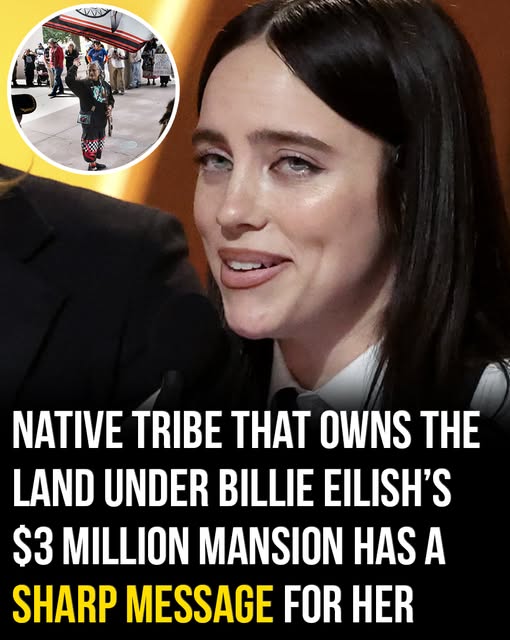
On February 1, 2026, during the 68th Annual Grammy Awards at the Crypto.com Arena in Los Angeles, Billie Eilish, the 24-year-old Grammy-winning singer-songwriter, captured global attention not just for her musical success but for a politically charged acceptance speech that immediately became one of the most talked-about moments of the awards season.
Eilish was honored with the Grammy Award for Song of the Year for “Wildflower,” a standout track written and produced with her brother Finneas O’Connell. This win marked her third Song of the Year Grammy, making her one of the most decorated artists in that category’s history.
What transformed a career milestone into an international news event was what Eilish chose to say — and not say.
The Speech: Words That Echoed Beyond Music
After expressing gratitude for the accolade, Eilish turned her attention to topics beyond art — using her platform to speak directly about immigration enforcement, colonial history, and what she characterized as ongoing injustice in the United States.

In her remarks, Eilish stated: “As grateful as I feel, I honestly don’t feel like I need to say anything but that no one is illegal on stolen land.”
She went on to call for continued activism and protest, saying, “We just need to keep fighting, speaking up, and protesting. Our voices really do matter and the people matter.”
Eilish’s speech concluded with a phrase that was bleeped on broadcast television due to profanity — widely documented online and in news coverage — which amounted to “F— ICE.”
Throughout the night, Eilish and Finneas also wore “ICE Out” pins, aligning visually with other artists’ anti-enforcement messaging at the ceremony.
While political statements at awards shows are not unprecedented, the scale and intensity of response to this moment — both supportive and critical — elevated it into a broader cultural flashpoint.
Historical and Political Context Behind the Message
“No One Is Illegal on Stolen Land”
The phrase Eilish cited — “no one is illegal on stolen land” — draws on a concept rooted in critiques of colonialism and immigration enforcement. It signals an interpretation that:
- The territory that now constitutes the United States was acquired through centuries of colonization, displacement, and treaty violations against Indigenous peoples.
- Modern borders and immigration controls, from this perspective, are built on dispossession and therefore lack moral legitimacy.
This framing has appeared in social activism and academic settings for decades, though it is seldom heard on live national television during a major entertainment event.

By linking historical dispossession with contemporary policies on immigration enforcement — especially related to Immigration and Customs Enforcement (ICE) — Eilish aligned her speech with activist critique rather than mainstream political discourse.
ICE and Controversies
ICE is a U.S. federal agency under the Department of Homeland Security. Over the past decade, it has been at the center of national debate for its role in immigration enforcement operations inside the United States, including workplace raids and deportation actions.
Critics allege that some ICE operations have involved excessive force and resulted in harm or deaths. Republicans and conservatives, by contrast, often defend the agency as essential to national sovereignty and law enforcement.
Eilish’s comments came amid heightened attention to immigration enforcement and protests in cities like Minneapolis and Portland that had seen confrontations involving federal agents, including ICE personnel, in recent months.
Amplified Reactions: Praise and Support
Many fans, activists, and public figures praised Eilish for using her platform to bring attention to issues they believe are under-reported and urgently relevant.
On social media platforms like X (formerly Twitter), supporters emphasized that the speech brought historical and moral questions into mainstream awareness.
One fan wrote: “It’s about time someone in Hollywood acknowledged the history of stolen land in the U.S.” while another said: “Billie Eilish speaking truth on stage. Love that she uses her voice for justice.” These sentiments illustrate how Eilish’s comments resonated with segments of the public.
Additionally, numerous celebrities and activists spoke in support of Eilish, sometimes amplifying her remarks or expanding the focus to broader issues of Indigenous land rights and immigrant dignity. Even those not directly involved with the Grammys acknowledged the moment as significant.
For example, actor Mark Ruffalo publicly supported Eilish against some critics, highlighting the tension between celebrity advocacy and backlash from conservative commentators.
Supporters argued that the Grammy stage — seen by millions globally — offered a rare opportunity to bring historical injustices and ongoing human rights concerns into public conversation.

The Tongva Tribe and Land Acknowledgment
One of the most consequential aspects of the conversation was the response from the Gabrieleno/Tongva people, the Indigenous nation whose ancestral territory includes what is now Los Angeles and the broader Southland region.
As news outlets reported, the Tongva tribe acknowledged Billie Eilish’s comments and saw them as an opportunity to clarify historical context. Members of the tribal community highlighted that Los Angeles — including Eilish’s own residence — sits on what they consider ancestral Tongva land.
In a statement, tribal representatives said they appreciated attention being drawn to the broader history of colonial dispossession. They also expressed a desire for future public discourse to explicitly name the Gabrieleno/Tongva people, ensuring that the public understands who the original inhabitants of the region were and remain.
The Tongva’s response underscored a common practice in cultural and civic spaces — land acknowledgment — which is intended to recognize Indigenous nations whose territories were taken through historical processes of colonization and treaties.
While this rhetoric has become increasingly familiar in academic and progressive circles, seeing it referenced in a mainstream entertainment context was unusual and deeply meaningful for many Native communities.
Backlash and Criticism: Wealth, Words, and Perceived Contradictions
Almost immediately after Eilish’s speech, critics — especially conservative commentators and political figures — seized on what they saw as a perceived contradiction between her message and her personal circumstances.

A frequent point of contention was that Eilish owns a multi-million-dollar home in Los Angeles, a city on land historically stewarded by the Tongva people. Critics argued that referencing “stolen land” while owning valuable property on that same land seemed hypocritical or inconsistent.
Conservative voices called for symbolic or even literal accountability. Some suggested that if one truly believes in the idea that land was “stolen,” then current landowners should act — for example, by divesting or returning land to Indigenous communities. This framing was echoed by political figures on social media and public platforms.
Senator Mike Lee (R-Utah), for instance, commented that anyone espousing acknowledgment of stolen land should “immediately give his or her land to Native Americans,” asserting that words alone are insufficient without actions.
Another commentator on X argued that Eilish could demonstrate consistency with her words by hosting people at her mansion — a critique that fused immigration politics with debates over wealth and property.
These responses reveal how celebrity speech can quickly become a proxy in larger cultural battles — in this case, debates over immigration policy, Indigenous sovereignty, wealth inequality, and the role of public figures in political discourse.
Polarized Political Responses from Public Figures
The controversy did not stay confined to social media.
Public figures from across the political spectrum weighed in. Some amplified the criticism, framing Eilish’s comments as emblematic of out-of-touch celebrity activism.
For example, political leaders and commentators questioned the appropriateness of using a music awards ceremony to voice political opinions, arguing that it politicized art and unfairly targeted law enforcement agencies tasked with enforcing immigration laws.
Meanwhile, conservative media sources framed the speech and Eilish’s wealth in starkly negative terms, suggesting that her message lacked credibility because of her economic status and lifestyle.
In the hours following Billie Eilish’s Grammy speech, social media platforms quickly became the primary arena where the debate unfolded. Millions of users across X (formerly Twitter), Instagram, TikTok, and Facebook shared clips of her remarks, dissecting each sentence and debating its implications.

Supporters framed the moment as an act of courage. Many argued that awards shows are among the few remaining cultural events watched simultaneously by large global audiences, making them powerful venues for raising awareness about historical injustice and present-day policies. For these users, Eilish’s wealth or celebrity status did not invalidate her message; instead, they saw her visibility as an advantage that could bring marginalized histories into the mainstream.
Others, however, viewed the speech as emblematic of what they perceive as performative activism. Critics accused Eilish of using strong rhetoric without proposing practical solutions, arguing that symbolic acknowledgment alone does little to change material conditions for Indigenous communities or immigrants affected by enforcement policies.
The polarized reaction reflects a broader pattern in modern digital discourse: complex historical and political issues are often compressed into viral soundbites, where nuance can be lost and positions become increasingly rigid.
Celebrity Activism in the Modern Era
Billie Eilish is far from the first artist to use a public stage to express political views. From Nina Simone’s civil rights anthems to Bob Dylan’s protest songs, musicians have long played a role in shaping public consciousness.
In recent decades, however, the nature of celebrity activism has shifted. Social media has intensified both reach and scrutiny. When celebrities speak, their personal lives, financial status, and perceived inconsistencies are instantly scrutinized.
Eilish’s case highlights a central tension:
Can wealthy public figures authentically advocate for justice within systems that have benefited them?
Some scholars argue that moral authority does not require personal purity. According to this view, individuals can criticize unjust systems while still existing within them, particularly when opting out entirely is unrealistic. Others counter that without material sacrifice or structural change, such advocacy risks becoming symbolic rather than transformative.
This debate has no simple resolution, but it has become a defining feature of contemporary discussions around activism, particularly when led by high-profile individuals.
The Historical Reality of Indigenous Dispossession
To understand why Eilish’s phrase “stolen land” resonates so strongly — and provokes such resistance — it is essential to examine the historical record.
Before European colonization, North America was home to hundreds of Indigenous nations with distinct languages, governance systems, trade networks, and spiritual traditions. In what is now California, the Gabrieleno Tongva people inhabited a vast area stretching across the Los Angeles basin and the Southern Channel Islands.
Spanish colonization in the late 18th century initiated a period of profound disruption. Missions, forced labor, disease, and land seizure devastated Indigenous populations. Under Mexican and later U.S. governance, Tongva lands were further divided, privatized, and transferred to settlers under legal frameworks that excluded Indigenous claims.
Unlike some tribes, the Gabrieleno Tongva lack federal recognition — a legal status that affects their ability to reclaim land, receive funding, and exercise sovereignty. This absence of recognition is itself the result of bureaucratic and political processes rather than historical absence or cultural discontinuity.
When Eilish referenced “stolen land,” she echoed a historical interpretation supported by extensive academic scholarship, even though the phrase remains politically charged.
Land Acknowledgment: Symbolism and Substance
Land acknowledgment has become increasingly common in universities, museums, and public institutions. Its purpose is to recognize Indigenous peoples as original stewards of the land and to confront the legacy of colonization.
Supporters argue that acknowledgment is a first step toward education and reconciliation. Critics argue that without policy changes or material restitution, acknowledgment risks becoming an empty ritual.
The Tongva tribe’s response to Eilish reflects this duality. While they expressed appreciation for the visibility her comments brought, they also emphasized the importance of naming their people explicitly — reinforcing that acknowledgment must be precise, not generic.
Importantly, the Tongva did not demand the return of Eilish’s property, nor did they accuse her of wrongdoing. Instead, their response highlighted a recurring theme in Indigenous advocacy: recognition, respect, and inclusion in historical narratives.
Property Ownership and Moral Responsibility
One of the most contentious aspects of the controversy centers on the question of property ownership.
Critics argue that if modern property deeds are built on historical dispossession, then acknowledging this fact implies a moral obligation to act. Suggestions range from land returns to financial reparations or long-term partnerships with Indigenous communities.
Legal scholars note, however, that modern property systems operate within frameworks that did not include Indigenous consent. Undoing these systems retroactively is extraordinarily complex, particularly when tribes lack federal recognition or legal standing.
This complexity does not negate moral questions — but it does illustrate why symbolic gestures often dominate public discourse while structural solutions remain elusive.
Eilish herself did not outline specific actions related to land restitution during her speech. Whether such actions are necessary — or even appropriate — remains a subject of ongoing debate.
Immigration, Borders, and Moral Authority
Eilish’s linking of Indigenous dispossession to immigration enforcement adds another layer of complexity.
From a historical perspective, borders imposed by colonial states often disrupted Indigenous territories that existed long before modern nation-states. Activists who argue that “no one is illegal on stolen land” frame immigration enforcement as a continuation of colonial exclusion.
Opponents argue that contemporary governments must enforce borders to function, regardless of historical injustices. They contend that acknowledging history does not invalidate present-day sovereignty or legal systems.
This ideological divide is not easily bridged. What Eilish’s speech did, however, was force these arguments into the public eye — not as abstract policy debates, but as moral questions rooted in history.
Media Framing and Political Polarization
Media coverage of Eilish’s speech varied dramatically depending on outlet and political orientation.
Progressive and entertainment-focused media emphasized the courage and historical awareness behind her remarks. Conservative outlets framed the speech as hypocritical, elitist, or disrespectful to law enforcement.
This divergence illustrates how celebrity activism often becomes a mirror for existing political divides. Rather than creating consensus, such moments frequently reinforce pre-existing beliefs.
Yet even critics inadvertently contributed to the broader conversation by amplifying the underlying issues — Indigenous land rights, immigration enforcement, and the ethical responsibilities of wealth.
The Role of Youth Voices
At 24, Billie Eilish represents a generation that has grown up amid climate anxiety, political polarization, and widespread skepticism toward institutions. Younger audiences are often more receptive to critiques of colonial history and systemic injustice.
For many young fans, Eilish’s speech validated their own concerns and values. For older or more conservative audiences, it represented a departure from what they expect from entertainers.
This generational divide may explain both the intensity of support and the ferocity of backlash.
What Comes After the Moment
One of the most important questions raised by this controversy is what happens next.
Will increased attention lead to tangible benefits for Indigenous communities like the Tongva? Will it encourage broader education about the history of colonization in California? Or will it fade as another fleeting culture-war moment?
History suggests that symbolic moments can have lasting impact when paired with sustained engagement. Whether through educational initiatives, partnerships, or policy discussions, visibility can be a catalyst — but only if followed by action.
Conclusion: A Mirror Held to Society
Billie Eilish’s 2026 Grammy speech did not offer solutions. It did something arguably more disruptive: it held a mirror to American society.
By connecting music, history, immigration, and land, she exposed unresolved tensions that many prefer to avoid. The reactions — supportive, hostile, thoughtful, dismissive — reveal as much about the public as they do about the artist.
The Tongva tribe’s response grounded the conversation in lived history rather than abstract ideology. Their emphasis on naming, recognition, and historical truth serves as a reminder that these debates are not theoretical.
Ultimately, the moment underscores a reality of modern public discourse:
Words alone cannot undo centuries of injustice — but they can reopen conversations that history tried to silence.
In that sense, whether one agrees with Billie Eilish or not, her speech succeeded in making history visible — and forcing a reckoning that continues long after the applause faded.
Media Framing and Political Polarization
Media coverage of Eilish’s speech varied dramatically depending on outlet and political orientation.
Progressive and entertainment-focused media emphasized the courage and historical awareness behind her remarks. Conservative outlets framed the speech as hypocritical, elitist, or disrespectful to law enforcement.
This divergence illustrates how celebrity activism often becomes a mirror for existing political divides. Rather than creating consensus, such moments frequently reinforce pre-existing beliefs.
Yet even critics inadvertently contributed to the broader conversation by amplifying the underlying issues — Indigenous land rights, immigration enforcement, and the ethical responsibilities of wealth.
The Role of Youth Voices
At 24, Billie Eilish represents a generation that has grown up amid climate anxiety, political polarization, and widespread skepticism toward institutions. Younger audiences are often more receptive to critiques of colonial history and systemic injustice.
For many young fans, Eilish’s speech validated their own concerns and values. For older or more conservative audiences, it represented a departure from what they expect from entertainers.
This generational divide may explain both the intensity of support and the ferocity of backlash.
What Comes After the Moment
One of the most important questions raised by this controversy is what happens next.
Will increased attention lead to tangible benefits for Indigenous communities like the Tongva? Will it encourage broader education about the history of colonization in California? Or will it fade as another fleeting culture-war moment?
History suggests that symbolic moments can have lasting impact when paired with sustained engagement. Whether through educational initiatives, partnerships, or policy discussions, visibility can be a catalyst — but only if followed by action.
Conclusion: A Mirror Held to Society
Billie Eilish’s 2026 Grammy speech did not offer solutions. It did something arguably more disruptive: it held a mirror to American society.
By connecting music, history, immigration, and land, she exposed unresolved tensions that many prefer to avoid. The reactions — supportive, hostile, thoughtful, dismissive — reveal as much about the public as they do about the artist.
The Tongva tribe’s response grounded the conversation in lived history rather than abstract ideology. Their emphasis on naming, recognition, and historical truth serves as a reminder that these debates are not theoretical.
Ultimately, the moment underscores a reality of modern public discourse:
Words alone cannot undo centuries of injustice — but they can reopen conversations that history tried to silence.
In that sense, whether one agrees with Billie Eilish or not, her speech succeeded in making history visible — and forcing a reckoning that continues long after the applause faded.
