
The 2026 Super Bowl, hosted at Levi’s Stadium in Santa Clara, California, has been one of the most widely anticipated sporting and cultural events of the year. Beyond the excitement of professional football, the Super Bowl consistently serves as a cultural touchstone that draws attention from millions of viewers across the United States and around the globe.
Traditionally, the event has blended athletics with music, entertainment, and media spectacle, creating a unique intersection where national identity, popular culture, and public discourse converge.
While fans eagerly anticipate the on-field action, halftime shows have become a major focal point, generating discussions, critiques, and sometimes controversy long before the teams even take the field.
In 2026, the official halftime performance featured Bad Bunny, the globally recognized Puerto Rican singer, rapper, and songwriter.

Known for his dynamic stage presence and socially conscious music, Bad Bunny represented an intentional choice by NFL organizers to highlight diversity, innovation, and cross-cultural appeal.
However, this year’s selection sparked debate among certain audiences, particularly conservative commentators and organizations that perceived the choice as diverging from what they considered “traditional” American cultural norms.
Among these groups, Turning Point USA (TPUSA), a nonprofit organization focused on promoting conservative values among young people, took a notable step by organizing an alternative halftime event.
This initiative, officially branded “The All-American Halftime Show,” was intended to run concurrently with the official Super Bowl halftime performance, providing viewers with a distinct cultural and musical experience aligned with the organization’s principles.
Turning Point USA: History and Leadership
Founded in 2012 by the late conservative activist Charlie Kirk, TPUSA quickly grew into one of the most recognized political nonprofit organizations in the United States.
Its mission centers on engaging young Americans with conservative ideas, including limited government, free-market principles, and traditional social values. TPUSA gained prominence primarily through campus engagement, conferences, and high-profile media appearances.
Charlie Kirk led the organization until September 10, 2025, when he was tragically assassinated in Utah while speaking at a university event.
His death shocked supporters and raised national attention, leaving a leadership vacuum. Following this tragedy, TPUSA’s board appointed Erika Kirk, Charlie’s widow, as CEO and chair, ensuring continuity in organizational activities.

Under her leadership, TPUSA continued its initiatives, including advocacy, youth engagement, and event planning, while navigating scrutiny regarding strategic decisions, public communications, and political alignment.
The Cultural Context of the 2026 Super Bowl Halftime
Super Bowl halftime shows are widely recognized as a critical platform for artistic expression, global entertainment, and cultural signaling. Traditionally, the NFL has aimed to balance mainstream appeal with artistic innovation, selecting performers who can attract massive audiences across demographics.
In 2026, the choice of Bad Bunny, performing a blend of Latin trap, reggaeton, and pop, reflected a deliberate emphasis on cultural diversity and global appeal.
For many viewers, Bad Bunny’s performance was celebrated as an example of cultural representation on a national stage. His music frequently addresses social issues, identity, and community pride, making him not only an entertainer but also a cultural ambassador.
His acceptance to perform at the Super Bowl, despite previous public hesitations related to U.S. immigration policies and concerns about ICE (Immigration and Customs Enforcement) raids during past concerts, was interpreted as a meaningful celebration of Puerto Rican heritage and global Latin culture.
Conversely, conservative commentators critiqued the choice, suggesting that a primarily Spanish-language performance did not align with what they considered “traditional American” values. This perspective, while controversial, sparked the decision for TPUSA to provide an alternative experience emphasizing faith, family, and conventional patriotic themes.
The All-American Halftime Show: Concept and Purpose
Designed to coincide with the official halftime broadcast, The All-American Halftime Show aimed to offer a parallel event that highlighted traditional American musical values.

TPUSA’s initiative was positioned not merely as entertainment but as a cultural statement, emphasizing the principles central to the organization’s identity.
The show featured performers with ties to conservative audiences and a publicly recognized commitment to patriotic or family-oriented messaging.
Key Performers and Musical Themes
- Kid Rock: Serving as the headliner, Kid Rock is a Michigan-born rock artist with a long history of public support for conservative political figures, including former President Donald Trump. His inclusion was symbolic, highlighting themes of American patriotism and cultural continuity.
- Brantley Gilbert: A country-rock artist known for Southern roots and music that celebrates working-class life, Gilbert’s performances reflect themes of perseverance and traditional values.
- Lee Brice: A country singer-songwriter whose family-oriented image and chart-topping songs resonate with audiences emphasizing home, community, and faith.
- Gabby Barrett: Recognized for her vocal talent and alignment with conservative-leaning audiences, Barrett’s inclusion further solidified the show’s focus on traditional American cultural themes.
Collectively, this lineup presented a clear contrast to the global pop influence of Bad Bunny, offering viewers an alternative experience designed to appeal to a subset of Super Bowl audiences seeking familiarity, tradition, and conservative-aligned cultural messaging.
Technical Challenges and Streaming Updates
TPUSA initially intended to stream the All-American Halftime Show on X (formerly Twitter), aiming to provide real-time access alongside the main Super Bowl broadcast.
However, licensing restrictions associated with music performances on X presented unforeseen obstacles. TPUSA announced the issue via an official update, stating:
“UPDATE: Due to licensing restrictions, we are unable to stream The All-American Halftime Show on X.”

To address the problem, TPUSA redirected viewers to their official YouTube channel, posting:
“Head on over to our YouTube channel tonight around 8PM ET to watch the full show.”
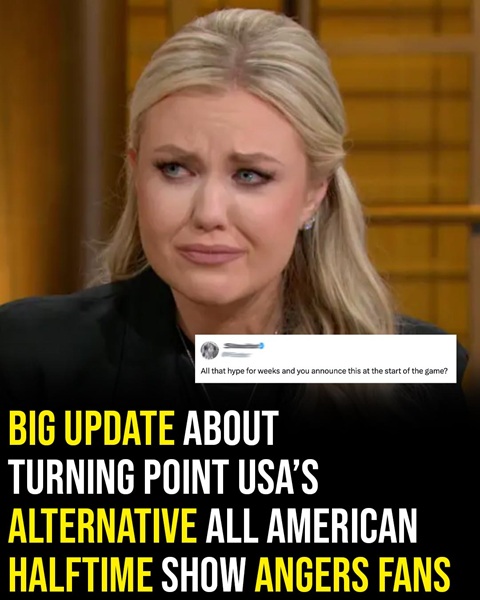
Despite the clarification, the announcement prompted public criticism regarding communication strategy. Some followers expressed frustration over the lack of a direct link to the YouTube livestream, highlighting the importance of clear digital communication in high-profile events. User comments included:
- “You should have posted a link with the post!!!”
- “Need to make this easy for folks… Give me a link and I will share.”
- “Lol, can’t even pay to have it streamed properly. You think you would have figured this out before gametime.”
These reactions underscore the challenges organizations face when delivering live digital content, particularly in high-stakes environments with significant public expectations.
Licensing Restrictions and the Complexity of Digital Broadcasting
The obstacles faced by TPUSA illustrate a broader issue in modern media: streaming live performances requires navigating complex licensing, copyright, and platform-specific regulations.
Music copyright law, performance rights, and digital distribution agreements often limit the platforms on which content can legally be broadcast. Even nonprofit or political organizations must adhere strictly to these rules to avoid legal complications.
In TPUSA’s case, X’s platform agreements likely did not permit the live broadcast of multiple copyrighted musical performances.
YouTube, with more flexible streaming rights for music content, became the practical alternative, albeit with additional logistical and communication challenges.
The 2026 Super Bowl not only brought together millions of sports fans in Santa Clara, California, but it also became a cultural flashpoint, highlighting the complex interplay between entertainment, politics, and public discourse.
While the official halftime show featuring Bad Bunny received widespread acclaim for its energy, inclusivity, and cultural significance, the alternative performance curated by TPUSA—the All-American Halftime Show—sparked intense discussion across social media, traditional news outlets, and conservative media platforms.
Public Reaction and Online Debate
The reception of TPUSA’s alternative show was multifaceted. Supporters praised the initiative as a timely counterpoint to what they perceived as an overly globalized or culturally divergent performance in the official broadcast.

For these viewers, the All-American Halftime Show was not just entertainment but a reaffirmation of values emphasizing faith, family, and traditional American culture.
Positive online responses included statements like:
- “Finally, something that reflects the values I grew up with. Kid Rock is a legend!”
- “It’s refreshing to have an alternative that focuses on our culture and heritage rather than forcing diversity narratives.”
- “I appreciate TPUSA giving an option to watch the Super Bowl halftime with music I can relate to.”
Conversely, other users criticized the execution and questioned the broader purpose of a parallel show. Some common critiques included:
- “This is starting to feel like a political stunt rather than a fun event.”
- “The streaming update was confusing. Just post a link, seriously.”
- “An alternative show is fine, but why not coordinate better with platforms to make it seamless?”
This split in perception demonstrates the dual nature of modern media events: while content may satisfy an ideological or cultural niche, accessibility, clarity, and technical execution significantly influence public reception.
It also highlights the increasingly polarized environment in which cultural programming intersects with political identity.
Media Coverage and Analysis
Mainstream media outlets provided extensive coverage of the All-American Halftime Show, often framing it within the broader discourse about culture wars and alternative media initiatives.
Coverage emphasized both the novelty of a politically affiliated organization producing a live entertainment event and the logistical challenges TPUSA faced in streaming.
Analysts noted that this initiative reflected a growing trend of parallel media experiences, in which audiences are offered curated alternatives to mainstream broadcasts based on ideological alignment or cultural preferences.
Some commentators framed the event as a “modern manifestation of cultural choice,” noting that audiences today expect agency in what they consume.
Whereas traditional media once operated as gatekeepers, digital platforms now allow organizations like TPUSA to produce content that appeals directly to their target demographic.
The All-American Halftime Show thus exemplifies the intersection of political messaging, entertainment, and audience empowerment in the digital era.
Cultural Implications and Identity Politics
At its core, the TPUSA initiative illuminates the role of cultural identity in shaping media experiences. The contrast between Bad Bunny’s global, Latin-centered performance and TPUSA’s lineup—featuring Kid Rock, Brantley Gilbert, Lee Brice, and Gabby Barrett—represents a broader societal debate about representation, inclusion, and cultural continuity.
Bad Bunny’s performance symbolized global engagement, multiculturalism, and social commentary, appealing to viewers who celebrate diversity and progressive cultural narratives.
Conversely, the All-American Halftime Show highlighted heritage, traditional music forms, and values associated with a conservative understanding of American identity.
This duality demonstrates how entertainment events like the Super Bowl now function as stages for cultural negotiation. Audiences are not only evaluating musical talent but are also interpreting symbolic messaging about who is represented, which narratives are promoted, and how cultural authority is enacted on a mass stage.
Technical Lessons and Digital Media Strategy
The licensing challenges TPUSA faced reveal essential lessons for any organization producing live-streamed content:
- Early Licensing Verification: Music streaming rights must be secured well in advance to prevent last-minute platform restrictions or takedown threats. Failure to do so can force alternative arrangements, as seen with the switch from X to YouTube.
- Platform Flexibility: Selecting platforms that accommodate live music broadcasting, copyright clearance, and audience scalability is critical. YouTube’s broader licensing capabilities made it a viable fallback, even if the communication strategy initially caused confusion.
- Communication Clarity: Effective instructions, direct links, and step-by-step guidance are essential when delivering live-streamed content to a large and potentially impatient audience. Miscommunication can overshadow the content itself.
- Audience Anticipation Management: For events with political or cultural significance, organizations must anticipate both support and criticism. Transparent communication mitigates misunderstandings and fosters positive engagement.
By adhering to these principles, TPUSA and similar groups can enhance the success and reception of future live events, ensuring that their intended audience can access the content seamlessly.
Audience Choice and Cultural Agency
One of the most remarkable aspects of TPUSA’s All-American Halftime Show is the empowerment of audience choice. In an era of fragmented media consumption, viewers increasingly seek programming that aligns with their interests, values, and cultural identity.
By offering a parallel broadcast, TPUSA acknowledged this shift, giving viewers an opportunity to actively choose how they engage with one of the most-watched events in the world.
This approach exemplifies a broader societal trend: as media consumption diversifies, audiences demand agency.
Whether a viewer prioritizes the global inclusivity of Bad Bunny’s performance or the traditional American themes in TPUSA’s show, the availability of choice becomes a statement of media empowerment and ideological self-determination.
Political Significance
While primarily a cultural event, the All-American Halftime Show also carried political undertones. Featuring Kid Rock and other conservative-aligned artists, the event reinforced TPUSA’s mission of engaging younger audiences in political discourse while celebrating American heritage.
Such initiatives blur the line between entertainment and advocacy, showing how cultural programming can serve as a platform for ideological messaging.
For political analysts, the event underscores the increasing intersection of media, entertainment, and politics. Cultural events no longer exist in isolation; they are scrutinized, interpreted, and debated as symbols of identity, values, and political alignment.
Long-Term Implications and Legacy
TPUSA’s alternative halftime show may influence how future Super Bowl halftime performances are conceptualized and received.
By demonstrating that a significant audience segment will seek alternative content if they feel underrepresented or culturally misaligned, TPUSA has illustrated the importance of inclusivity, representation, and audience engagement in national broadcasts.
Moreover, the initiative highlights that high-profile events can no longer be viewed purely as entertainment—they are arenas for cultural negotiation, identity expression, and public discourse.
Organizers of mainstream events, including the NFL, may increasingly consider how programming choices impact audience segments with distinct cultural or political perspectives.
Conclusion
The 2026 Super Bowl and TPUSA’s All-American Halftime Show offer a compelling case study in modern media, culture, and politics.
While the official halftime performance by Bad Bunny celebrated global diversity, cultural heritage, and artistic innovation, TPUSA’s alternative show provided a distinct counterpoint, emphasizing traditional American music, values, and conservative-aligned cultural messaging.
Through technical challenges, licensing obstacles, and public debate, the organization navigated the complexities of live streaming, audience expectations, and cultural representation.
The event exemplifies how high-profile entertainment experiences now operate at the intersection of ideology, culture, and digital media strategy.
Ultimately, the All-American Halftime Show reflects broader societal trends: audiences demand agency, cultural identity informs media consumption, and events of mass viewership carry both symbolic and practical significance.
By offering a curated alternative, TPUSA empowered viewers, sparked public discourse, and underscored the evolving nature of cultural engagement in a fragmented media landscape.
As discussions continue around the Super Bowl, the event will likely be remembered not only for the game or the performances themselves but also for the cultural dialogue it inspired.
TPUSA’s initiative demonstrates that in the 21st century, major entertainment events are platforms not just for sport or music, but for identity, values, and meaningful public conversation.
