
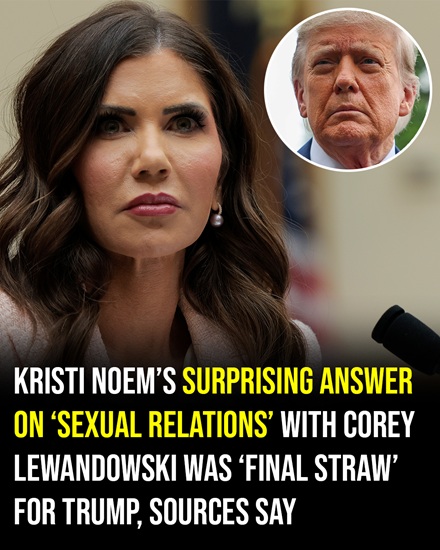
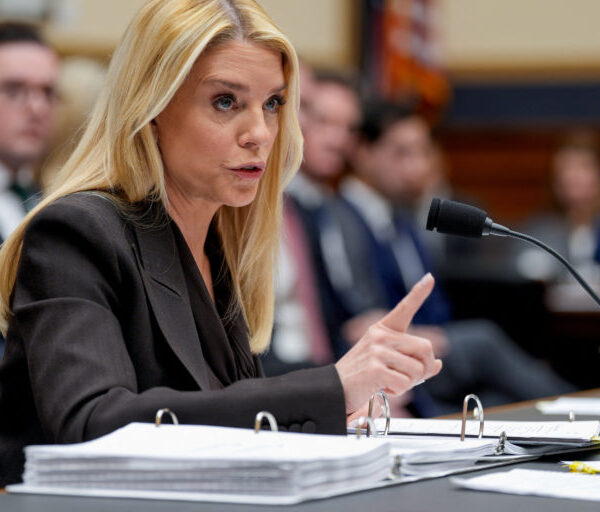
A tense moment on Capitol Hill captured national attention when Homeland Security Secretary Kristi Noem was confronted directly about her alleged relationship with longtime Trump adviser Corey Lewandowski during a high‑profile congressional hearing.
The exchange took place as Noem testified before the House Judiciary Committee on March 4, 2026, where lawmakers were questioning her about immigration enforcement policies and deadly incidents involving federal agents earlier this year.
Noem’s leadership had already been under intense scrutiny for her role in overseeing the Trump administration’s mass deportation strategy and her department’s handling of enforcement operations.
Just days earlier, President Donald Trump announced he would be replacing Noem as Secretary of Homeland Security, a major personnel shift in his administration amid growing bipartisan criticism.
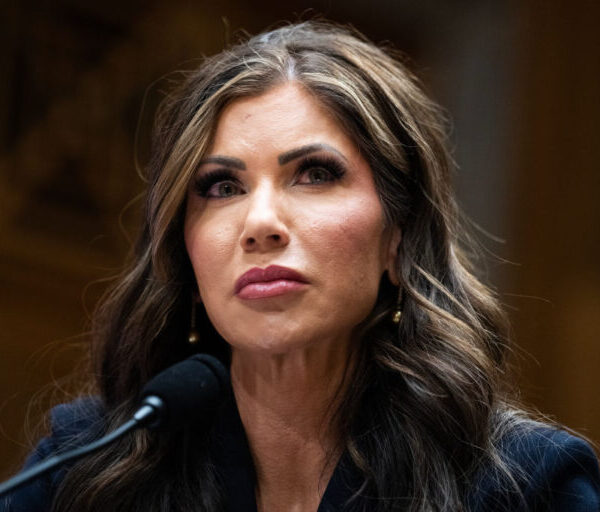
Trump said in a social media post that Sen. Markwayne Mullin of Oklahoma would take over the DHS role and that Noem would move to a newly created diplomatic post, “Special Envoy for The Shield of the Americas.”
The Shield of the Americas initiative is described by the White House as part of a Western Hemisphere security strategy, focusing on regional cooperation against cartels and illegal migration.
Noem’s controversial tenure had included publicized immigration operations, questions about advertising contracts featuring herself, and criticism over disaster response management, further fueling congressional frustration.
The hearing where the viral confrontation occurred was intended to address questions about DHS enforcement actions, including operations that resulted in the deaths of civilians and broader concerns about executive authority.
Tension in the room spiked when Rep. Sydney Kamlager‑Dove (D‑Calif.) asked Noem if she had ever had “sexual relations with Corey Lewandowski,” a top adviser affiliated with both Trump and her department.
Noem reacted sharply and rejected the premise, calling the question “tabloid garbage” and expressing shock that it had arisen in an official congressional proceeding.
She said she was “shocked we are going down and peddling tabloid garbage today” and reiterated that Lewandowski is a special government employee who works for the White House, not someone with authority over Homeland Security decisions.
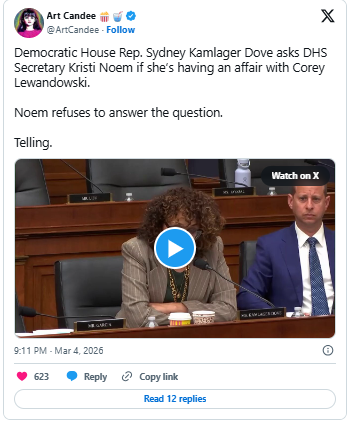
Noem insisted there were “thousands” of such temporary advisers in the federal government and that Lewandowski did not hold formal decision‑making power within DHS.
Despite her rejection of the allegation, many lawmakers pressed the issue as relevant to questions about judgment and workplace oversight, rather than mere tabloid gossip.
Rep. Kamlager‑Dove argued that concerns about whether a senior official was involved with a subordinate should be answered transparently, as it relates to professional conduct and judgment.
She said that answering clearly and without hesitation was important, framing the query as a legitimate ethical concern rather than personal gossip.
Another lawmaker, Rep. Jared Moskowitz (D‑Fla.), later encouraged Noem to simply say the word “no” into the record to clearly address the question and put rumors to rest.
Noem again rejected the premise of the question, calling the line of inquiry “ridiculous” and maintaining that she had refuted such rumors for years without changing her stance.
Rumors about a personal relationship between Noem and Lewandowski had circulated in political circles for some time, though both figures have publicly denied any such affair.
Critics noted that both Noem and Lewandowski are married, and neither has provided evidence to substantiate the persistent speculation about their relationship.
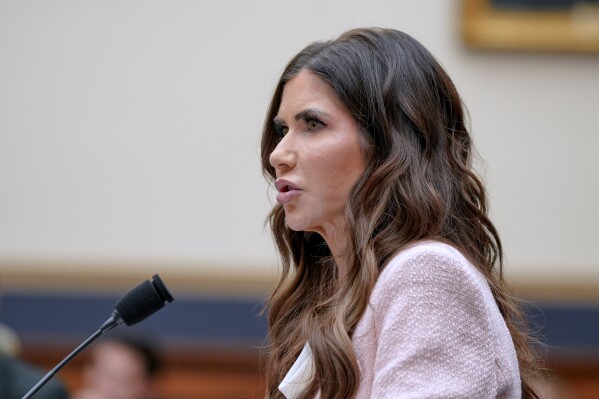
Still, the confrontation over the question became one of the most talked‑about moments of the hearing, dominating social media discussions and news headlines in the days following.
Some media commentators and conservative pundits weighed in, dividing over whether the question was appropriate in a congressional oversight context or purely personal and irrelevant to policy discussions.
The hearing itself extended beyond this moment, featuring sharp exchanges over DHS’s handling of immigration enforcement, border policy, and administrative transparency.
Noem’s testimony had already been strained by bipartisan criticism regarding a $220 million DHS advertising campaign featuring herself, which Trump later said he “never knew anything about.”
That campaign, intended to highlight border security efforts, drew scrutiny because of how the contracts were awarded, ties to political operatives, and questions about competitive bidding practices.
The combination of controversies, including enforcement outcomes, contract questions, and the Lewandowski exchange, contributed to mounting tensions between Noem and members of both political parties.
According to some political reporting, Noem’s non‑answer about her alleged relationship with Lewandowski was seen within the White House as a breaking point for Trump’s patience with her leadership.
While Trump had been considering replacing Noem for weeks — particularly after conflicting statements about the ad campaign — the viral hearing moment reportedly sealed the decision.
Sources close to White House insiders told media outlets that her handling of the question, seen by some as evasive, became a tipping point in evaluations of her tenure.
News about the staff shake‑ups extended beyond Noem’s role: reports indicate that Corey Lewandowski is also leaving his position connected to DHS following the leadership change.
Lewandowski, a longtime Trump ally and former manager of the 2016 presidential campaign, had been a controversial presence because of his unusual role as a special government employee.
His departure adds another layer to ongoing questions about the organization and staffing of the Department of Homeland Security under Noem’s leadership.
Noem’s reassignment to the new Special Envoy for The Shield of the Americas role shifts her focus from domestic enforcement to broader diplomatic and security cooperation efforts across the Western Hemisphere.
As special envoy, she is expected to work with senior officials, including the Secretary of State and Defense Secretary, on issues like cartel disruption and migration management across the region.
The Shield of the Americas initiative — set to be highlighted at an upcoming summit in Florida — reflects the administration’s emphasis on hemisphere‑wide security priorities.
Critics argue that moving Noem from DHS does not address deeper concerns about policy direction and leadership consistency within the department, particularly on immigration enforcement.
Supporters of Noem contend that her performance at DHS included notable achievements in border security metrics and enforcement actions, which they see as aligning with the administration’s priorities.
Her removal marks a rare instance of a Cabinet secretary being replaced during the same administration’s second term, underscoring the political volatility surrounding immigration policy.
The nomination of Sen. Markwayne Mullin, a Republican ally of Trump, to replace her reflects an effort to reset leadership at DHS and maintain momentum on enforcement agendas.
Mullin, a member of the Cherokee Nation and former MMA fighter before entering politics, has been praised by Trump for his staunch support of immigration restrictions.
If confirmed by the Senate, Mullin would bring experience navigating federal and state legislative environments to the DHS role, according to administration officials.
For Noem personally, the viral hearing moment, long‑running rumors, and political backlash have become focal points of public debate over transparency and accountability in government.
Observers note that the intense scrutiny reflects broader tensions in U.S. politics, where personal conduct, professional judgment, and media narratives increasingly intersect in public discourse.
Despite the controversy, Noem continues to publicly frame her new role as a continuation of her commitment to national security and regional stability.
Her supporters highlight that diplomatic initiatives like The Shield of the Americas could have long‑term implications for international cooperation on shared security concerns.
Critics, however, see her reassignment as a symbolic downgrade following her turbulent tenure at DHS and the political clashes that defined it.
The Lewandowski confrontation will likely be remembered as one of the defining moments of the hearing and of the debate surrounding Noem’s leadership.
As this story continues to develop in the coming weeks, lawmakers, media outlets, and the public will undoubtedly revisit the political and ethical questions raised during that viral exchange.
