
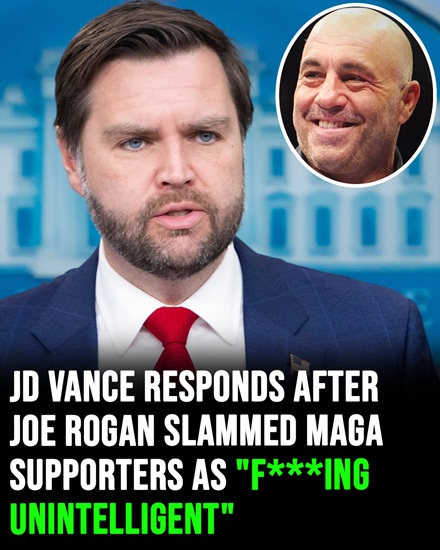
Joe Rogan, the influential podcaster and UFC commentator, recently stirred controversy after calling MAGA supporters “uninteresting and unintelligent.”
Generating intense discussion online and drawing reactions from political figures concerned about public perception of Trump’s most devoted followers.
Once a vocal supporter of Donald Trump, Rogan’s political stance has shifted in recent months, fueled by growing concerns over the Trump administration’s handling of key issues, including the Jeffrey Epstein investigation and America’s involvement in foreign conflicts.
Rogan specifically criticized decisions surrounding the U.S. military response in Iran, describing it as “the opposite of what we were promised,” highlighting the contrast between campaign promises to avoid unnecessary wars and the administration’s recent actions.
In a March 26 episode of The Joe Rogan Experience, Rogan openly denounced the MAGA movement, calling it “a movement of a bunch of f*ing dorks” and describing the “Make America Great Again” slogan as attracting supporters who lack sophistication or nuance.

“That phrase sucks… ‘Make America Great Again,’ and it becomes a movement of a bunch of f**king dorks, because many of them are simply uninteresting or uninformed,” Rogan said, emphasizing his disappointment with how some adherents behave publicly.
Vice President JD Vance responded quickly, defending MAGA supporters and emphasizing that the movement includes serious, engaged Americans who are committed to preserving the country’s future, rather than the stereotype Rogan implied.
Vance stated, “We have fewer dorks than the radical left, but everyone has some. We love our dorks, our cool kids, and all Americans who want to help protect and save the nation’s integrity and future.”
During an interview with host Benny Johnson, Vance addressed Rogan’s claims, specifically rebutting an inaccurate remark suggesting that Hillary Clinton and Barack Obama were more effective than Trump at deporting people, insisting that the statement was factually false.
“I did not see Joe make that comment, and I will text him because it is definitely incorrect,” Vance said, emphasizing that the Trump administration’s immigration enforcement and deportation numbers strongly contradict Rogan’s allegations.

Vance clarified that the administration is actively addressing the consequences of the previous administration’s policies, including the influx of undocumented immigrants under President Biden, while implementing strict border control measures and efficient deportation procedures.
“The Obama administration, or any prior administration, never deported anywhere near the number of undocumented immigrants that we are now managing,” Vance said, stressing the scale of Trump’s enforcement efforts and the administration’s commitment to law and order.
He noted that while deportation progress is significant, challenges remain due to prior policy failures, which left the United States managing a larger undocumented population than any recent administration had experienced.
Vance emphasized that the Trump administration is historically the most effective at deporting illegal aliens, but the lingering effects of prior policies require continued enforcement, monitoring, and coordination across federal agencies.
He also highlighted that accurate data, official deportation statistics, and border apprehension numbers show measurable progress, directly countering Rogan’s claims and demonstrating that Trump’s policies prioritize both security and legal compliance.

The Rogan-Vance exchange has sparked widespread discussion online, prompting social media users and news outlets to dissect the implications of influential podcasters criticizing political movements and the responsibilities of prominent public figures.
Analysts have suggested that the debate highlights internal tensions within American conservatism, as outspoken media personalities challenge aspects of political movements while leaders work to preserve unity and defend the accomplishments of their base.
Rogan’s global platform reaches millions, amplifying his criticisms and commentary, and influencing political perceptions far beyond his podcast audience, creating ripple effects in media narratives, public discussions, and voter sentiment across the country.
Conversely, JD Vance focuses on fact-based rebuttals, reinforcing the administration’s achievements, emphasizing deportation statistics, border security successes, and the operational efficiency of immigration enforcement programs to provide a factual counterbalance to Rogan’s commentary.
This interaction underscores the growing influence of media figures in shaping political discourse, highlighting the interplay between public perception, political leadership, and the accountability of those with large followings in shaping informed debate.
It also reflects the challenges leaders face when defending political movements, as generalized criticisms from influential voices can affect morale, public image, and voter perception of the movement’s seriousness and effectiveness.

The conversation further illustrates the power of modern podcasting and digital media as platforms where political criticism, analysis, and debate intersect with national political narratives, influencing the way the public interprets policies and leaders’ actions.
Vance’s response aims to dispel stereotypes, affirm the seriousness of MAGA supporters, and highlight that the movement includes committed citizens working to improve the country, countering the dismissive tone presented by Rogan’s remarks.
Public engagement with this exchange demonstrates the critical role of informed discussion, media literacy, and fact-checking in preventing misinterpretation of political claims, especially when influential voices are involved in shaping public discourse.
The episode highlights how political commentary, social media influence, and public debate are increasingly intertwined, with each contributing to the broader national conversation about policy, leadership, and civic responsibility.
This dialogue emphasizes the importance of accountability and accuracy in public statements, illustrating how even casual commentary by high-profile personalities can have real-world implications on political discourse and perceptions.

Citizens are reminded of the value of examining statements critically, verifying claims, and considering evidence-based information when forming opinions about political movements, policies, or leadership decisions in the United States.
The Rogan-Vance exchange also reflects the dynamics of modern politics, where podcasters, influencers, and elected officials engage in continuous, real-time discussions that can influence public understanding and shape political narratives across platforms.
It illustrates the balance between personal opinion and factual accuracy, emphasizing that public commentary on sensitive topics, such as immigration enforcement or policy effectiveness, carries responsibility and potential consequences for public perception.
Ultimately, this situation highlights how public dialogue, political critique, and media influence converge in today’s digital age, creating opportunities for debate, clarification, and accountability while shaping collective understanding of government action.
The discussion has encouraged broader conversations about how Americans engage with political content, the role of high-profile commentators in shaping perception, and the importance of informed analysis when interpreting complex policy decisions.
In conclusion, the Rogan-Vance controversy demonstrates how influential media figures can spark discussion, provoke rebuttals, and influence public opinion, underscoring the ongoing interaction between political leaders, media, and engaged citizens in American society.
