
The opening ceremony of the 2026 Winter Olympics in Milan’s historic San Siro Stadium was meant to be a night of celebration — a global gathering symbolizing unity, athletic achievement, and the shared human spirit that defines the Olympic Games.
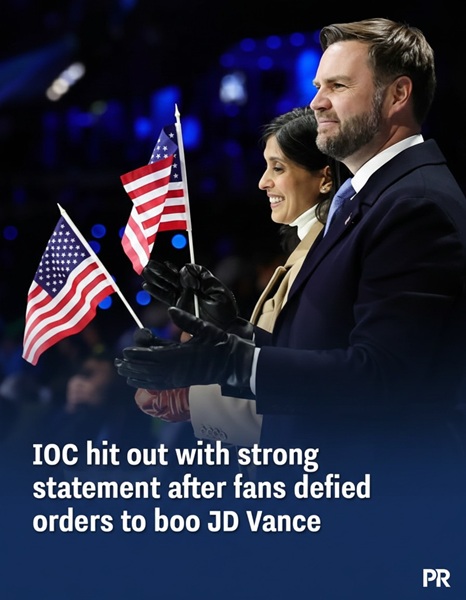
Yet, a moment that drew intense public attention occurred not on the snow or ice, but in a brief reaction from the crowd when U.S. Vice President JD Vance was shown on the stadium’s big screen.
As the parade of nations unfolded, millions of viewers around the world watched a meticulously planned sequence of music, light, and cultural pageantry.
Internationally recognized performers took the stage, and audiences saw delegations from more than ninety nations celebrated and cheered. It was an evening designed to celebrate diversity and the dedication of athletes who had spent years training to be there.
When the United States delegation entered the stadium, they were greeted with applause. Moments later, when cameras cut to Vice President Vance — attending as the official U.S. government representative — a noticeable segment of the crowd audibly booed.

The reaction was reported widely by international broadcasters and captured on many feeds outside the United States.
The moment was brief, but unmistakable: whistles, jeers, and audible expressions of displeasure broke the rhythm of the ceremony.
The reaction stood out in contrast to the overall atmosphere of celebration and goodwill, underscoring how global political sentiment can surface even in settings designed to transcend politics.
The Crowd Reaction in Context
International Olympic Committee (IOC) leadership had publicly urged respect and sportsmanship in the days leading up to the ceremony. IOC President Kirsty Coventry emphasized that the opening night should be a respectful celebration of the athletes’ efforts and the Olympic spirit.
Coventry’s statements reflected the long-held principle that the Olympic Games provide a neutral platform for athletic competition — one that should rise above geopolitics.
Nevertheless, global political realities often extend beyond the boundaries of stadia and arenas. Earlier in the day, demonstrators in Milan protested various policies tied to the U.S. government — including immigration enforcement measures — highlighting broader social tensions that had become intertwined with the local atmosphere.
While these demonstrations were separate from Olympic organizers and activities, the public sentiment they reflected likely influenced the mood of some attendees at the ceremony.
The boos directed at Vance were widely interpreted in this light: not as a personal attack on him or on the United States as a nation, but as a public expression of dissatisfaction and global tensions that extend well beyond sport.
Even so, the visibility of that reaction during one of the world’s most-watched ceremonies raised questions about how much political expression is appropriate in spaces designed to promote international cooperation.
Live Coverage and Broadcast Reactions
The debate over the reaction gained further traction online and in media coverage due in part to differences in how the crowd response was broadcast in different regions.
Some international feeds — including coverage from the Canadian Broadcasting Corporation — captured the crowd’s reaction in real time, with commentators acknowledging audible boos and whistles.

In contrast, some U.S. broadcasts appeared to focus primarily on the athletic procession and offered minimal commentary about the reaction.
This difference between broadcasts contributed to a broader conversation about media coverage and how moments at major international events are framed for different audiences.
Social media amplified the attention on the reaction. Clips of the crowd’s response circulated widely online in the hours following the ceremony, prompting commentary and debate across national lines.
For many viewers outside the United States, the booing became a focal point of the first night’s coverage — not because it defined the Olympics, but because it highlighted the complex intersection of global politics and international sport.
IOC Statements and the Official Response
In the immediate aftermath of the opening ceremony, the IOC addressed the situation publicly. IOC spokesperson Mark Adams reaffirmed the organization’s support for constructive engagement between the IOC and the United States leadership, particularly as preparations continued for the 2028 Summer Games in Los Angeles.
Adams emphasized that cooperation with host nations and visiting dignitaries is essential for the success and continuity of the Olympic movement — an institution that depends on collaboration among governments, national committees, and international bodies.
In remarks aimed at reaffirming the Olympic movement’s commitment to mutual respect, Adams also stressed that no competitor — or official representative — should be targeted or held responsible for a government’s policies or decisions.
“The Olympics are built on respect, fairness, and appreciation of excellence — regardless of nationality,” he said, framing the conversation in terms of the organization’s fundamental values rather than the specific political context of the moment.
The IOC’s response went beyond addressing a single booing incident. It served as a reminder that the organization sees its primary mission as safeguarding an environment where athletes can compete without hostility — a position that reflects lessons learned from past Olympic controversies, where political disputes threatened to overshadow athletic achievement.
Although the crowd reaction during the opening ceremony was directed at a political figure, its broader implications extended far beyond one individual.
The incident reignited a long-standing debate within international sport: how athletes, officials, and institutions can remain focused on competition when global politics increasingly shape public sentiment.
For athletes, the Olympic Games represent the culmination of years—often decades—of discipline, sacrifice, and relentless training. Many begin preparing in childhood, structuring their lives around a single goal: earning the chance to compete on the world’s largest sporting stage.
Their presence at the Games is not a political statement, but a testament to personal perseverance and professional excellence.

Yet on a stage as visible as the Olympics, athletes and officials inevitably become symbols. They carry flags, wear national uniforms, and represent countries whose political decisions may be controversial or deeply contested internationally.
This symbolic association places them at the intersection of sport and politics, whether they choose it or not.
The reaction to Vice President Vance highlighted this tension. While the boos were aimed at a government representative, the moment unfolded during a ceremony meant to honor athletes.
That overlap raised concerns among Olympic leaders that political expression—however understandable—can unintentionally overshadow the very individuals the Games are meant to celebrate.
IOC officials have long acknowledged this challenge. The organization’s position is not that political realities do not exist, but that the Olympic stage should prioritize athletes over agendas.
When spectators project political grievances onto Olympic ceremonies, athletes risk becoming collateral figures in debates they did not initiate.
The Fragile Boundary Between Sport and Politics
The Olympics have never been entirely separate from politics. History offers numerous examples where global tensions influenced participation, boycotts, or public demonstrations.
From Cold War-era rivalries to modern disputes over human rights and international policy, the Games have often mirrored the state of the world.
What has changed in recent decades is the speed and scale at which reactions spread. Social media, live global broadcasting, and instant commentary mean that even brief moments—like a few seconds of booing—can dominate international discourse within hours.
The incident in Milan demonstrated how quickly a symbolic gesture can eclipse broader narratives. While thousands of athletes marched into the stadium representing unity and diversity, global headlines focused on a political reaction lasting mere moments.
For Olympic organizers, this reality presents a difficult balancing act. Suppressing public sentiment risks accusations of censorship. Allowing unchecked political expression risks undermining the neutrality that gives the Games their unique value.
The IOC has consistently argued that the answer lies not in denial, but in restraint. Respect, according to Olympic leadership, is not about eliminating disagreement—it is about choosing appropriate spaces for its expression.

Crowd Behavior and Institutional Responsibility
In responding to the incident, the IOC emphasized that spectators play a crucial role in shaping the Olympic environment. While audiences bring passion and emotion to sport, they also bear responsibility for maintaining an atmosphere that honors the spirit of competition.
IOC spokesperson Mark Adams referenced past incidents involving various delegations, noting that targeting individuals based on nationality or political affiliation runs counter to Olympic principles.
The Games, he reiterated, are designed to celebrate excellence, not to serve as battlegrounds for unresolved political disputes.
This stance reflects institutional lessons learned over decades. Olympic leadership understands that once political confrontation becomes normalized within ceremonies or competition venues, it becomes difficult to contain.
What begins as a reaction to one figure can quickly expand into broader hostility that affects athletes, officials, and spectators alike.
By responding quickly and clearly, the IOC aimed to reaffirm boundaries without escalating the situation. The message was measured: political tensions exist, but the Olympic platform must remain anchored in respect.
The Olympics as a Reflection of the World
The booing incident also underscored a deeper truth about the Olympic Games: they do not exist in isolation. They are shaped by the world’s conflicts, frustrations, and aspirations.
Every host city brings its own social and political context. Every delegation carries national history. Every spectator arrives with opinions shaped by media, experience, and personal values.
In this sense, the Olympics function as a mirror. They reflect progress and division alike. They show how interconnected the world has become—and how difficult it can be to separate shared celebration from unresolved disagreement.
Yet this same visibility is what gives the Games their enduring significance. Few global events still bring together so many nations under a common set of rules. Fewer still ask competitors to face one another not as enemies, but as equals bound by mutual respect.
The challenge, as highlighted in Milan, is preserving that shared space in an era of polarization.
Protecting the Integrity of the Olympic Experience
Following the opening ceremony, the IOC made clear that the heart of the Olympic movement remained unchanged. The focus would return—firmly—to athletic performance, fair competition, and the stories of the athletes themselves.
Organizers emphasized that while moments of controversy may arise, they should not define the Games. Instead, the measure of success lies in whether athletes are able to compete without fear of hostility and whether audiences can engage without reducing individuals to political symbols.
This perspective is not idealistic; it is pragmatic. The Olympic movement depends on cooperation among nations with profoundly different political systems and values. Without a shared commitment to neutrality and respect, that cooperation would become impossible.
The IOC’s response therefore served a dual purpose: addressing a specific incident while reinforcing a broader framework designed to protect the Games from becoming a platform for division.

A Moment of Reflection in a Divided Era
In a global climate marked by sharp ideological divides and competing narratives, moments like the one in Milan serve as reminders of the difficulty—and necessity—of coexistence.
Unity does not mean uniformity. It does not require the absence of disagreement. It requires the ability to prioritize shared principles even when differences persist.
The Olympic Games remain one of the few arenas where that balance is tested repeatedly. Their power lies not in pretending the world is harmonious, but in demonstrating that competition, dignity, and mutual recognition are still possible.
As the 2026 Winter Olympics continued beyond opening night, attention gradually shifted back where it belonged: to the athletes, the events, and the achievements unfolding across venues.
The brief controversy did not define the Games.
But it did underline an enduring truth.
Sport cannot solve political conflict—but it can remind the world of what cooperation looks like when respect is chosen over reaction.
In reaffirming this message, the IOC made its position clear: athletic excellence should speak louder than politics. And when it does, it offers a rare glimpse of shared humanity in an increasingly complex world.
Although the crowd reaction during the opening ceremony was directed at a political figure, its broader implications extended far beyond one individual.
The incident reignited a long-standing debate within international sport: how athletes, officials, and institutions can remain focused on competition when global politics increasingly shape public sentiment.
For athletes, the Olympic Games represent the culmination of years—often decades—of discipline, sacrifice, and relentless training. Many begin preparing in childhood, structuring their lives around a single goal: earning the chance to compete on the world’s largest sporting stage.
Their presence at the Games is not a political statement, but a testament to personal perseverance and professional excellence.
Yet on a stage as visible as the Olympics, athletes and officials inevitably become symbols. They carry flags, wear national uniforms, and represent countries whose political decisions may be controversial or deeply contested internationally.
This symbolic association places them at the intersection of sport and politics, whether they choose it or not.
The reaction to Vice President Vance highlighted this tension. While the boos were aimed at a government representative, the moment unfolded during a ceremony meant to honor athletes.
That overlap raised concerns among Olympic leaders that political expression—however understandable—can unintentionally overshadow the very individuals the Games are meant to celebrate.
IOC officials have long acknowledged this challenge. The organization’s position is not that political realities do not exist, but that the Olympic stage should prioritize athletes over agendas. When spectators project political grievances onto Olympic ceremonies, athletes risk becoming collateral figures in debates they did not initiate.
The Fragile Boundary Between Sport and Politics
The Olympics have never been entirely separate from politics. History offers numerous examples where global tensions influenced participation, boycotts, or public demonstrations. From Cold War-era rivalries to modern disputes over human rights and international policy, the Games have often mirrored the state of the world.
What has changed in recent decades is the speed and scale at which reactions spread. Social media, live global broadcasting, and instant commentary mean that even brief moments—like a few seconds of booing—can dominate international discourse within hours.
The incident in Milan demonstrated how quickly a symbolic gesture can eclipse broader narratives. While thousands of athletes marched into the stadium representing unity and diversity, global headlines focused on a political reaction lasting mere moments.
For Olympic organizers, this reality presents a difficult balancing act. Suppressing public sentiment risks accusations of censorship. Allowing unchecked political expression risks undermining the neutrality that gives the Games their unique value.
The IOC has consistently argued that the answer lies not in denial, but in restraint. Respect, according to Olympic leadership, is not about eliminating disagreement—it is about choosing appropriate spaces for its expression.
Crowd Behavior and Institutional Responsibility
In responding to the incident, the IOC emphasized that spectators play a crucial role in shaping the Olympic environment. While audiences bring passion and emotion to sport, they also bear responsibility for maintaining an atmosphere that honors the spirit of competition.
IOC spokesperson Mark Adams referenced past incidents involving various delegations, noting that targeting individuals based on nationality or political affiliation runs counter to Olympic principles. The Games, he reiterated, are designed to celebrate excellence, not to serve as battlegrounds for unresolved political disputes.
This stance reflects institutional lessons learned over decades. Olympic leadership understands that once political confrontation becomes normalized within ceremonies or competition venues, it becomes difficult to contain. What begins as a reaction to one figure can quickly expand into broader hostility that affects athletes, officials, and spectators alike.
By responding quickly and clearly, the IOC aimed to reaffirm boundaries without escalating the situation. The message was measured: political tensions exist, but the Olympic platform must remain anchored in respect.
The Olympics as a Reflection of the World
The booing incident also underscored a deeper truth about the Olympic Games: they do not exist in isolation. They are shaped by the world’s conflicts, frustrations, and aspirations.
Every host city brings its own social and political context. Every delegation carries national history. Every spectator arrives with opinions shaped by media, experience, and personal values.
In this sense, the Olympics function as a mirror. They reflect progress and division alike. They show how interconnected the world has become—and how difficult it can be to separate shared celebration from unresolved disagreement.
Yet this same visibility is what gives the Games their enduring significance. Few global events still bring together so many nations under a common set of rules. Fewer still ask competitors to face one another not as enemies, but as equals bound by mutual respect.
The challenge, as highlighted in Milan, is preserving that shared space in an era of polarization.
Protecting the Integrity of the Olympic Experience
Following the opening ceremony, the IOC made clear that the heart of the Olympic movement remained unchanged. The focus would return—firmly—to athletic performance, fair competition, and the stories of the athletes themselves.
Organizers emphasized that while moments of controversy may arise, they should not define the Games. Instead, the measure of success lies in whether athletes are able to compete without fear of hostility and whether audiences can engage without reducing individuals to political symbols.
This perspective is not idealistic; it is pragmatic. The Olympic movement depends on cooperation among nations with profoundly different political systems and values. Without a shared commitment to neutrality and respect, that cooperation would become impossible.
The IOC’s response therefore served a dual purpose: addressing a specific incident while reinforcing a broader framework designed to protect the Games from becoming a platform for division.
A Moment of Reflection in a Divided Era
In a global climate marked by sharp ideological divides and competing narratives, moments like the one in Milan serve as reminders of the difficulty—and necessity—of coexistence.
Unity does not mean uniformity. It does not require the absence of disagreement. It requires the ability to prioritize shared principles even when differences persist.
The Olympic Games remain one of the few arenas where that balance is tested repeatedly. Their power lies not in pretending the world is harmonious, but in demonstrating that competition, dignity, and mutual recognition are still possible.
As the 2026 Winter Olympics continued beyond opening night, attention gradually shifted back where it belonged: to the athletes, the events, and the achievements unfolding across venues.
The brief controversy did not define the Games.
But it did underline an enduring truth.
Sport cannot solve political conflict—but it can remind the world of what cooperation looks like when respect is chosen over reaction.
In reaffirming this message, the IOC made its position clear: athletic excellence should speak louder than politics. And when it does, it offers a rare glimpse of shared humanity in an increasingly complex world.
