
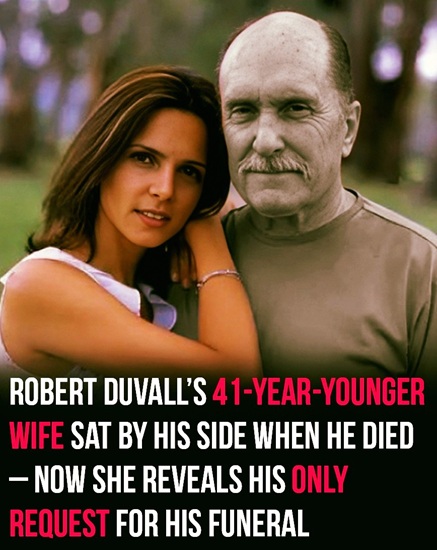
Hollywood and the global film community are in profound mourning following the death of one of the most versatile and respected actors in cinematic history.
Robert Selden Duvall, whose extraordinary career spanned over seven decades and whose performances shaped the very fabric of modern American cinema, passed away peacefully at his home in Virginia on February 15, 2026, at the age of 95.
His wife, Luciana Pedraza, announced that he died “surrounded by love and comfort,” bringing to a close a life defined by artistic devotion, emotional authenticity, and quiet humanity.
For generations of audiences, Duvall’s work was more than entertainment—it was a reflection of life’s complexity. His portrayals spanned the morally conflicted, the tenderly human, and the intensely dramatic, offering a mirror to the American experience.
From his understated yet unforgettable debut as Boo Radley in To Kill a Mockingbird (1962) to his commanding presence in The Godfather (1972), Apocalypse Now (1979), and Tender Mercies (1983), Duvall’s performances left an indelible mark on Hollywood and culture at large. Beyond the screen, he was an artist, a storyteller, and a man whose curiosity about humanity fueled his craft.

Early Life and Formative Years
Robert Selden Duvall was born on January 5, 1931, in San Diego, California, into a family with deep military and civic roots. His father, William Howard Duvall, was a rear admiral in the United States Navy, while his mother, Mildred Virginia Duvall (née Hart), came from a family that valued education and artistic appreciation. The frequent relocations associated with his father’s career—moving between military bases along the East Coast and time spent in the Washington, D.C., area and Maryland—instilled in young Robert both discipline and adaptability. These early experiences of observing human interactions across varied social milieus subtly influenced the actor’s lifelong fascination with character psychology.
From a young age, Duvall exhibited a keen interest in storytelling and performance. Encouraged by his mother, he participated in school plays and cultivated a curiosity about literature, history, and the arts. His education at the prestigious Severn School, known for its rigorous academics and emphasis on leadership, provided a structured environment that complemented his innate introspection and burgeoning artistic sensibilities.
Following high school, Duvall attended Principia College in Elsah, Illinois, where he majored in drama. It was here that his ambition to pursue acting professionally crystallized. Immersed in theater studies, he developed an appreciation for character-driven storytelling and began exploring the psychological underpinnings that would later define his nuanced approach to performance. His collegiate years were punctuated by an engagement with classic texts and contemporary plays alike, helping him hone a versatility that would characterize his future film work.
After college, Duvall served in the U.S. Army from 1953 to 1955, during the post-Korean War period. Though his service did not involve front-line combat, the discipline, hierarchy, and camaraderie of military life left a lasting impression. Upon completing his service, Duvall moved to New York City to study under Sanford Meisner at the Neighborhood Playhouse. Meisner’s method emphasized truthful emotional responses and living authentically in the moment, principles that became central to Duvall’s approach to acting. His rigorous training refined his skill at creating emotionally resonant performances, whether in subtle gestures, quiet moments, or intense dramatic confrontations.
The First Steps Toward Hollywood
Duvall’s professional career began in the theater. He performed in a series of off-Broadway and regional productions, where his talent for embodying a range of characters—from brooding introspective figures to outwardly charming personalities—earned him early recognition. In the late 1950s, he made his television debut with minor roles on programs such as Naked City and Route 66, showcasing an understated realism that set him apart from the era’s more theatrical styles.

His breakthrough to film came in 1962 with To Kill a Mockingbird, directed by Robert Mulligan. Duvall’s portrayal of Boo Radley, the enigmatic neighbor whose mysterious presence casts a shadow over the Finch children’s lives, was brief but unforgettable. The role demonstrated his ability to convey profound depth and vulnerability without extensive dialogue, a skill that would become a hallmark of his career. Critics and audiences alike noted the quiet emotional resonance he brought to the character, setting the stage for decades of memorable performances.
During the 1960s, as Hollywood entered a transformative period known as the New Hollywood era, Duvall became a sought-after actor for projects that demanded both authenticity and intensity. This was a time when directors such as Francis Ford Coppola, Martin Scorsese, and Peter Bogdanovich were breaking free from conventional studio formulas, favoring stories that explored moral ambiguity, psychological complexity, and social realism. Duvall fit seamlessly into this cinematic evolution, capable of immersing himself fully into roles that were at once relatable, complex, and compelling.
Early Milestones and Expanding Recognition
Throughout the 1960s, Duvall’s filmography grew steadily. He took on a series of supporting roles in films such as Bullitt (1968), where his understated presence added texture to a story of law enforcement and moral ambiguity, and True Grit (1969), in which he demonstrated a rugged adaptability that would serve him well in later Westerns. These early roles allowed him to cultivate a reputation as a dependable, transformative performer, one whose dedication to craft elevated every project he joined.
By the early 1970s, Duvall’s career trajectory positioned him for iconic status. He collaborated with emerging and established directors who recognized his rare combination of humility, intelligence, and emotional honesty. His talent for conveying inner life without relying on theatricality or exaggeration made him a standout in ensemble casts, where he could anchor a narrative with quiet authority.
By the early 1970s, Robert Duvall had moved from a promising actor into the realm of true cinematic icon. His ability to convey depth, complexity, and nuanced emotion made him a natural fit for projects that demanded both intensity and subtlety. Among the most formative of these roles was Tom Hagen in Francis Ford Coppola’s The Godfather (1972).

As the calm and loyal consigliere of the Corleone crime family, Duvall brought a quiet, understated authority to a role that could easily have been overshadowed by the film’s larger-than-life figures. He communicated loyalty, intelligence, and moral complexity with restrained gestures, slight inflections, and a penetrating gaze. Critics and audiences alike were captivated by the way he embodied a man whose personal ethics and professional duty constantly intersected in morally ambiguous ways. The performance earned Duvall his first Academy Award nomination, solidifying his position among Hollywood’s most serious and talented actors.
Following this, Duvall’s career trajectory accelerated during a period of transformative American cinema. His collaboration with Francis Ford Coppola continued in Apocalypse Now (1979), where he portrayed Lieutenant Colonel Bill Kilgore, a war-hardened officer whose philosophy of combat and personal bravado became emblematic of the film’s exploration of human morality in extreme circumstances.
Duvall’s delivery of the iconic line, “I love the smell of napalm in the morning,” remains one of the most quoted moments in cinematic history. Yet beyond the bravado, he infused Kilgore with layers of humanity and vulnerability, capturing the contradictions of a man both fearless and deeply flawed. The role demonstrated Duvall’s extraordinary range, proving he could dominate screen presence while still honoring the psychological and emotional depth of a character.
The 1980s marked a further evolution in Duvall’s career as he embraced intimate, character-driven narratives that explored the human condition with compassion and realism. Perhaps most emblematic of this period was his Academy Award-winning performance in Tender Mercies (1983), directed by Bruce Beresford. Playing Mac Sledge, a washed-up country singer seeking redemption, Duvall delivered a quiet, tender performance that resonated with audiences worldwide.
The role required him not only to act but to sing authentically, playing guitar and conveying emotion through music and silence alike. Critics praised the performance for its understated power, noting that Duvall’s ability to inhabit the nuances of grief, regret, and hope created a cinematic experience that was both profoundly personal and universally relatable. This role earned him the Academy Award for Best Actor, cementing his legacy as one of Hollywood’s finest performers.
Mastery Across Genres: Westerns, Dramas, and Television
While many actors excel in a single genre, Duvall’s versatility was extraordinary. In addition to intense dramas and psychological explorations, he became synonymous with the American Western, bringing gravitas, authenticity, and humanity to a genre often populated by archetypes. His role as Woodrow F. Call in the television miniseries Lonesome Dove (1989), adapted from Larry McMurtry’s Pulitzer Prize-winning novel, remains a defining example. The miniseries, which won multiple Emmy Awards, showcased Duvall’s capacity to embody rugged resilience tempered by moral reflection.

He portrayed Call with meticulous attention to detail, conveying the burdens of leadership, the weight of personal loss, and the quiet strength of a man who had endured the hardships of frontier life. The performance elevated the Western genre, demonstrating that it could carry profound emotional resonance and human complexity.
Duvall’s television work further illustrated his range. He appeared in various made-for-TV movies and miniseries, earning Emmy Awards for projects such as Lonesome Dove and Broken Trail (2006), which he also directed. These performances reflected his commitment to character-driven storytelling, emphasizing authenticity, subtlety, and emotional truth across both cinematic and televised mediums.
Artistic Ambition Beyond Acting
While Duvall’s acting achievements are legendary, he was equally devoted to the broader craft of filmmaking. His interest in directing, writing, and producing allowed him to explore storytelling from multiple perspectives. One of the most significant examples of this artistic ambition is The Apostle (1997), a film he wrote, directed, and starred in. The project tells the story of a Pentecostal preacher who, after a personal moral failing, seeks redemption and spiritual renewal. Duvall’s work on the film was widely praised for its emotional honesty, spiritual depth, and commitment to human authenticity. It reflected not only his talent but also his philosophical and spiritual sensibilities, showcasing a performer who sought meaning and truth in every narrative he touched.
Duvall’s later career continued to balance commercial appeal with emotional gravitas. He appeared in films such as Jack Reacher (2012), Widows (2018), and Hustle (2022), bringing the same dedication to craft that defined his earlier work. Even in his 80s and early 90s, he maintained an intense focus on character development, reading scripts with meticulous care, and ensuring that each performance, whether a lead role or supporting part, contributed meaningfully to the story’s emotional and narrative core. His presence on set was frequently described as grounding, elevating the performances of fellow actors, and inspiring directors with his knowledge and insight.
While Robert Duvall’s professional achievements are monumental, those who knew him personally often emphasized that his humanity, generosity, and curiosity defined him even more profoundly than his public persona. Outside of acting, Duvall cultivated a rich and varied life, filled with passions that reflected his love for culture, nature, and human connection.
Duvall was married four times over the course of his life. He found enduring companionship and artistic collaboration with his fourth wife, Luciana Pedraza, an Argentine actress, filmmaker, and cultural ambassador. The two first met in the 1990s, long before their marriage in 2005, and developed a bond rooted in mutual respect, shared artistic vision, and deep personal affection. Pedraza remained a central figure in Duvall’s life, supporting his creative endeavors and joining him in projects that explored storytelling, culture, and human connection. Their partnership exemplified a relationship built on intellectual engagement, artistic collaboration, and love.

Despite multiple marriages, Duvall did not have children. He sometimes spoke of this fact with gentle humor, once noting in an interview that he might be “shooting blanks,” but he did not view it as a source of regret. Instead, he cherished the deep friendships, professional relationships, and familial connections he formed throughout his life. Colleagues described him as a man who valued honesty, loyalty, and sincerity above all, both on set and in personal interactions.
Beyond his relationships, Duvall had a profound love for music, particularly the guitar and the rhythms of Argentine tango. He often expressed admiration for Buenos Aires, a city he described as “alive with passion and rhythm,” and would frequently draw inspiration from the culture, music, and human energy he experienced there. Music, for Duvall, was not merely a pastime; it was another form of storytelling, a language of emotion and expression that complemented his craft as an actor and director.
A Life of Active Engagement
Even into his 90s, Duvall maintained an active and engaged lifestyle. Friends and family recall that he enjoyed swimming, horseback riding, and tennis—activities that not only kept him physically fit but also nourished his mind and spirit. His personal discipline, cultivated during his youth in a military family and reinforced by decades of professional dedication, allowed him to sustain his craft at an elite level long after many of his contemporaries had retired.
Colleagues frequently highlighted Duvall’s dry humor and grounded presence, noting that he could balance the intensity of professional work with moments of warmth and levity. On set, he was known to mentor younger actors, offering insights drawn from decades of experience while remaining humble and approachable. His reputation for meticulous preparation, emotional authenticity, and ethical conduct earned him the respect of directors, co-stars, and crews alike.
Legacy of Storytelling and Influence
Robert Duvall’s contributions to cinema were not limited to individual performances. He influenced generations of actors, directors, and writers, shaping the craft of film and television in profound ways. He demonstrated that subtlety, emotional honesty, and attentiveness to character could produce performances as compelling as those that relied on spectacle or dramatic flair. His work helped redefine how complex characters—particularly those rooted in moral ambiguity—could be portrayed with realism and integrity.
Directors who collaborated with Duvall often praised his ability to elevate material, bringing nuance and emotional resonance to even modestly budgeted productions. His insistence on authenticity pushed filmmakers to explore richer narratives, deeper character studies, and stories that emphasized human connection over spectacle. Actors cited him as a model of professionalism and artistic rigor, someone whose approach to preparation and performance set a high standard for the industry.
Duvall’s legacy is also evident in the continuing popularity of his films. Works like The Godfather, Apocalypse Now, Tender Mercies, and Lonesome Dove remain cultural touchstones, studied by film students, critiqued by scholars, and celebrated by audiences worldwide. His ability to inhabit characters who were morally complex, vulnerable, or quietly heroic contributed to a new paradigm in American acting, one that emphasized truth, empathy, and human complexity.
Tributes and Global Recognition
News of Duvall’s passing on February 15, 2026, prompted an outpouring of tributes from across Hollywood and the international film community. Actors, directors, writers, and fans alike recognized his towering contributions to the art of storytelling.
Adam Sandler, who appeared with Duvall in Hustle (2022), remembered him as “one of the greatest actors we ever had,” highlighting not only his talent but his generosity, warmth, and mentorship. Viola Davis described Duvall as an icon of American cinema, emphasizing the humanity he brought to every role and the enduring inspiration his career provides to actors of all generations. Directors, co-stars, and industry professionals echoed similar sentiments, celebrating a career defined by excellence, integrity, and unwavering dedication to craft.
In addition to public accolades, Duvall received numerous awards and honors throughout his career, including an Academy Award for Best Actor, multiple Emmy Awards, and recognition from various film academies and critics’ organizations. These accolades, while significant, only tell part of the story; his true legacy lies in the emotional resonance of his performances, the ethical rigor with which he approached his work, and the humanistic qualities that informed both his art and his life.
The End of an Era
With Robert Duvall’s passing, Hollywood has lost one of the last great figures of the generation that reshaped American cinema in the late 20th century. Alongside contemporaries such as Al Pacino, Meryl Streep, and Jack Nicholson, Duvall helped define the era’s approach to storytelling, emphasizing character depth, psychological realism, and moral complexity. His influence extended far beyond box office success; it reshaped how audiences understand and connect with film, demonstrating that cinema can explore the human condition with honesty, compassion, and emotional resonance.
Duvall’s work also serves as a reminder of the power of perseverance, discipline, and curiosity. Across decades of changing cinematic landscapes, he maintained a commitment to truth in performance, embracing roles that challenged him artistically and morally. From the intensity of war dramas to the quiet redemption of a country singer in decline, he navigated every narrative with integrity, depth, and subtlety, leaving an indelible mark on the art form.
Remembering Robert Duvall
Ultimately, Robert Duvall was more than an actor—he was a storyteller, an observer of humanity, and a teacher through example. His performances captured not only the grandeur of life but its quiet, often overlooked moments of vulnerability, courage, and grace. He invited audiences to reflect on their own experiences, to empathize with flawed and complex characters, and to recognize the beauty and tragedy inherent in human life.
In his passing, the world loses a singular talent, but his films—rich with emotion, insight, and authenticity—remain immortal. The characters he inhabited, the stories he told, and the humanity he infused into every role will continue to inspire, challenge, and move audiences for generations to come.
Robert Duvall’s life, from the disciplined child of a naval family to a global icon of cinema, stands as a testament to the transformative power of storytelling. Rest in peace, Robert Duvall—a towering presence on screen, a devoted artist, and a gentle force off it. Your legacy endures not only in your films but in the hearts and minds of all who witnessed your artistry.
