
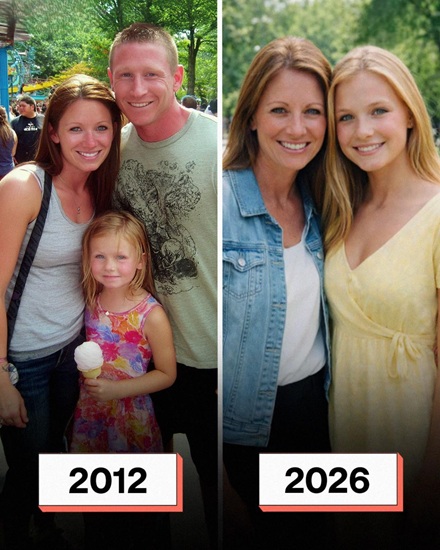
I was twenty years old when I discovered that the story I had carried my entire life about my father’s death was a lie.
Fourteen years of carefully constructed truths had masked the reality, and I had believed them without question.
For as long as I could remember, Meredith—my stepmother—had been the voice of reason, the keeper of the narrative, the gentle guardian who explained my world in small, manageable pieces. “It was a car accident,” she would say, her voice soft but unwavering whenever I asked. “It was raining. The roads were slick. It was random. Nothing anyone could have done.”
Her words were calm, precise, almost ritualistic in their repetition. And I believed them. They felt complete. Tragic, yes—but complete. Life had taught me, even at a young age, that accidents happened. People died. The world did not owe us explanations beyond the ones it provided. And so, I carried her version of the story like a carefully closed book, one that held a sadness that was heavy but digestible. I never doubted it. I never questioned it. Until that day in the attic.
For the first four years of my life, it had been just me and Dad. My biological mother had died giving birth to me. That was always part of the narrative too, but it was a distant grief—an abstraction made of photographs, quiet memories my father whispered in her name, and a small, persistent ache I carried but could not fully understand. I did not remember her voice. I did not remember her face. I remembered only what I had been told and the warmth in my father’s stories about her, the way his eyes would soften when he mentioned her. My grief for her was borrowed, a fabric woven from the threads he left behind, stitched together with tenderness and memory.
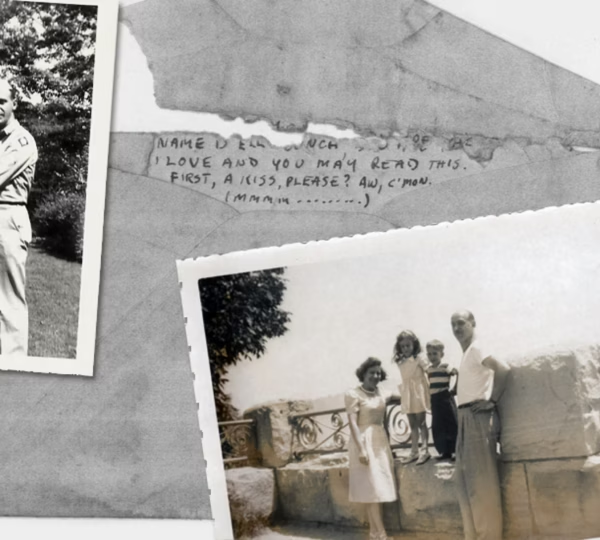
My earliest recollections of him were a mosaic of fleeting sensations. I remembered the rough scratch of his cheek when he kissed me goodnight, the comfort of his arms lifting me onto the kitchen counter while he prepared dinner, and the way he would look at me when he spoke, as if the weight of the world was contained entirely within his gaze.
“Supervisors sit up high,” he had said once with a grin while I perched on the counter, “but you’re my whole world, kiddo.”
Even the smallest, seemingly mundane routines were magical in his presence. Pancakes shaped like animals, for instance, were masterpieces in his eyes, even if the elephants looked like lumpy blobs and the rabbits had ears that seemed to defy symmetry. Each plate was presented with the kind of reverence usually reserved for art in galleries, and I would eat them with the solemnity of someone acknowledging a sacred offering.
I remember asking him, when I was just three, a question that suddenly felt enormous to me:
“Did Mom like pancakes?”
He paused, just for a heartbeat, and then answered softly:
“She loved them,” he said, “but not as much as she would’ve loved you.”
Even at that age, I understood that I had asked something important, fragile, the kind of question that could shatter or heal depending on the answer. And he had answered with care, choosing love over sorrow, protection over fear.
Then everything changed.
I was four when Meredith came into our lives. I remember her first appearance as if it were a scene frozen in my mind. She arrived at our door for dinner wearing a soft blue sweater and carrying a pie she claimed she had baked herself. Later, I would learn she had called my aunt three times for instructions. She crouched to meet my eyes, rather than towering over me like so many adults did, as if she understood intuitively that trust is built, not demanded.
“I’ve heard you’re the boss around here,” she said with a tentative smile, a hint of humor in her eyes.
I hid behind my father’s leg, gripping the denim of his jeans with small, unsure hands. He rested a steady hand on my shoulder but did not push me forward. I felt the weight of choice, of agency, given to me in a moment when I had very little control over my world.
Over the next few weeks, Meredith continued to appear in small, intentional ways. She read me stories in the living room, her voice a gentle melody threading through our home. She joined my tea parties on the floor, never attempting to take command but instead allowing me to lead, to dictate the terms of my small kingdom. She never tried to erase what existed before her arrival; she simply added herself to it, quietly, respectfully.
I tested her once with a drawing I had labored over for hours. It was a wild composition: a pink sky streaked with green clouds, a crooked house with windows that refused to align, a chaotic world contained in the borders of a small sheet of paper.
“For you,” I said solemnly, presenting it as if offering a sacred artifact.
She held it delicately, like it had been framed in gold.
“I promise I’ll keep it safe,” she said.
Six months later, she married my father in a small church ceremony. I wore a stiff, itchy white dress and insisted on holding both of their hands during the vows. There was a sense of solemnity in the air, a small acknowledgment that our little family was shifting shape. Not replacing, not erasing, but growing.
Meredith adopted me shortly afterward. I began calling her Mom, naturally, unforced, the word arriving organically the day I realized I needed her and she was there. It was a quiet evolution, almost imperceptible, the kind of love that forms in the spaces between moments, in shared glances, in small, daily acts of care.
Then, two years later, our world tilted again.
Her hands were ice cold when she knelt before me.
“Sweetheart,” she whispered, struggling to steady her voice, “Daddy isn’t coming home.”
I was six.
The funeral was a blur—flowers, black coats, whispered condolences, hands resting heavily on my small shoulders. I remember staring at the casket and thinking it looked too small, almost fragile, to contain someone who had been my whole world.
The house felt alien afterward. Shadows seemed longer. Spaces seemed emptier. Meredith moved through it with a careful deliberation, making lunches, braiding my hair, sitting on the edge of my bed until I fell asleep. She carried her own grief silently, never burdening me with it, but leaving traces in the way her eyes occasionally shimmered with unshed tears.
And through it all, the story of my father’s death remained simple.
Car accident. Rain. Slick roads. Tragic, random, unavoidable.
Sometimes I asked questions—small, tentative inquiries into details that I could not grasp fully at six, eight, ten years old.
“Was he tired?”
“Was he speeding?”
Meredith would repeat the mantra with infinite patience:
“It was an accident. Sometimes bad things just happen.”
Eventually, I stopped asking. Not because my curiosity vanished, but because I understood the boundary, the line of silence she had drawn to protect me from a truth I was too young to carry.
Years passed. Meredith remarried when I was fourteen. Daniel, her new husband, was kind, measured, and patient. He never tried to assume a role he hadn’t been given, never sought to overwrite memories that were already mine.
“I already have a dad,” I told Meredith once, defensive, protective of the space in my heart reserved for him.
“No one’s replacing him,” she said gently, “You just get more people who love you.”
When my little sister was born, she handed her to me first, a small gesture of inclusion, a quiet acknowledgment that I had not been replaced but expanded, welcomed into an evolving circle of love.
By the time I turned twenty, I believed I understood the story of my life: marked by loss, yes, but contained. Clear. Tragic, but finite.
Then I found the box in the attic.

The attic smelled of dust and old wood, of summer heat trapped beneath shingles, of forgotten years and the faint tang of mothballs. Sunlight filtered through the small, high window, illuminating motes that danced like tiny spirits in the air. I had come up in search of old textbooks, relics from my first year of college, tucked away in cardboard boxes that hadn’t been touched since my father’s passing.
In the farthest corner, hidden beneath a tarpaulin and a stack of unused suitcases, I found a box labeled simply: Photos. The letters were uneven, hand-written with care, and the edges of the box were frayed from time. My heart skipped. I had not seen it in years, not since I had been a child peering up at the staircase, wondering what lay above.
Curiosity tugged at me, insistent, almost insatiable. I knelt on the wooden floorboards, the ones that creaked under my weight, and opened the lid. Inside were albums stacked neatly, each wrapped in tissue paper, each a capsule of a past I thought I knew.
I lifted the first album carefully, reverently, as though it might shatter if handled roughly. The photographs were small, some faded, some crisp and bright with color, but all familiar and yet not quite what I remembered.
There he was—my father—captured in moments I had never seen. There was a photograph of him holding newborn me outside the hospital. He looked exhausted, hair mussed, eyes wide with the weight of awe, fear, and love all tangled together. Another showed him sitting on the porch, my tiny body asleep against his chest, the late summer sun catching the fine lines of his hair and the soft curves of his smile.
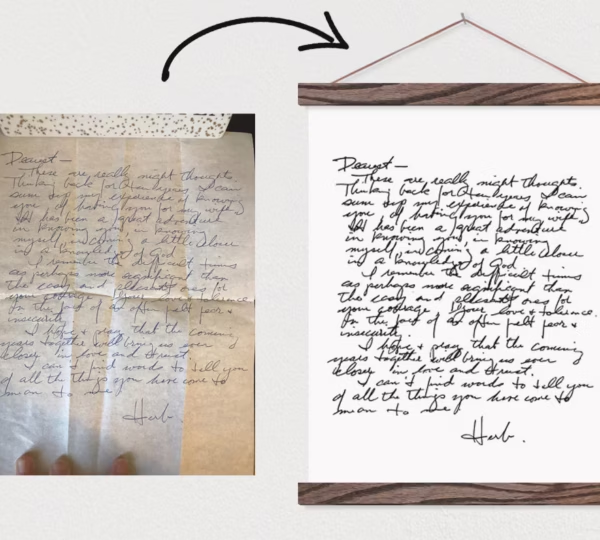
I turned page after page, and then something slid out, falling softly onto my lap. A folded piece of paper, delicate and worn along the creases. My name was written on the front in his handwriting. My pulse thundered in my ears as I unfolded it.
The date on the top made my chest tighten: the day before he died.
I read the first line once. Then again. And again. Each word felt impossibly precious, imbued with the presence of a man I had loved and lost, and yet now felt closer than I had in fourteen years.
He hadn’t just been leaving work that day, heading home in the rain for the mundane rhythms of life. No. He had left early, deliberately, with a plan in mind: for me. For pancakes, for a moment together he had envisioned for months, perhaps. And the weight of that intention pressed down on me, almost suffocating in its poignancy.
I stood abruptly, the album slipping to the floor with a muffled thud. My hands shook as I carried the letter downstairs to the kitchen. Meredith sat there, the steam from her tea curling in gentle spirals. She looked up at me and in that instant, I saw it—the flicker of anticipation, the recognition that she had been waiting for this moment, silently, for fourteen long years.
“Where did you find that?” she whispered, her voice tight.
“In the album,” I said. “Where you hid it.”
She closed her eyes briefly, exhaling as if letting go of a breath she had been holding for over a decade.
I unfolded the letter again, my voice trembling, and began to read aloud:
“My sweet girl, if you’re old enough to read this, you’re old enough to know where you came from…”
He wrote about my biological mother—her bravery, her quiet courage, the ways she had prepared for life and death, the love she had for me even in the hours before it ended. He wrote about the fear he had felt raising me alone, the sleepless nights spent listening to my breath, making sure I was safe, trying to protect the fragile spark of my life in a world that could be cruel.

And then he wrote about Meredith.
“If you ever feel caught between loving your first mom and loving Meredith, don’t. Hearts don’t split. They grow. They expand to make room for love, even when it seems impossible.”
I faltered on the words, my throat tight with the weight of their meaning.
“Lately I’ve been working too much. You asked me why I’m always tired. Tomorrow I’m leaving early. No excuses. We’re making pancakes for dinner, like we used to.”
I couldn’t continue. The sentence ended there, unfinished, a symbol of a life interrupted. Tears burned my eyes as I looked at Meredith, my voice breaking, whispering the question that had haunted me for years:
“Is it true?”
“Was he driving home early… because of me?”
She gestured for me to sit, but I remained standing, my body taut with tension, grief, and revelation.
“It was raining hard that day,” she said softly. “He called me from work. He was excited. He said, ‘Don’t tell her. I’m going to surprise her.’”
The room seemed to tilt, the air heavy with the sudden gravity of truth.
“And you… you never told me?” I sobbed, the words shaking loose the burden I hadn’t known I carried. “You let me think it was random?”
“You were six,” she said, fear and love flickering across her face. “You had already lost one parent. If I had told you he died because he was rushing home to you, you would have carried that guilt forever.”
Her words settled like stones into the hollow spaces of my chest, reshaping the narrative I had clung to for years. The distinction was subtle, but profound: he had not died because of me. He had died living, loving, choosing me even in the final hours of his life.
I broke, but not from blame or sorrow alone. I broke from understanding, from recognition of the delicate balance of love and loss, protection and truth, that Meredith had maintained all those years. She had shielded me, cradled me in silence, preserved my childhood from a burden no child should ever bear.
“He loved you,” she said firmly, wrapping me in her arms. “He wasn’t dying because of you. He was living for you.”
And in that embrace, the world felt strangely whole. Years of confusion, of partial truths, of whispered reassurances, all fell away. The story of my father’s death transformed before my eyes—from a tale of random tragedy to a testament of love so vivid, so deliberate, that it redefined everything I thought I knew about him, about loss, about family.
“He was going to write more letters,” Meredith whispered, her voice barely audible, trembling with the weight of secrets kept. “A stack of them. For every stage of your life. But he only finished that one.”
I looked at her differently then. Fourteen years of questions absorbed. Fourteen years of silence carried with unwavering love. Fourteen years of patience, shielding, and guidance. She had kept the letter hidden, yes, but not from malice. She had kept it hidden to preserve me, to protect the fragile balance of a childhood already marred by loss.
And finally, I understood the enormity of her care, her courage, and her love.

I pulled back, cheeks wet, chest aching, and whispered words I had never said aloud, even as a child:
“Thank you for staying. Thank you for being my mom.”
Her smile trembled, fragile and radiant all at once.
“You’ve been mine since the day you handed me that drawing,” she said, voice steady despite the tears glistening at the corners of her eyes.
In that moment, the sound of my younger brother’s cautious footsteps on the stairs reminded me that life went on, that we were not frozen in grief, but moving forward together.
“Are you guys okay?” he asked, the question simple, innocent, yet profound.
I squeezed Meredith’s hand, the warmth of her skin grounding me in the present.
“Yeah,” I said softly. “We’re okay.”
And for the first time, I believed it.
Even after the letter, after the revelation that had broken open my childhood narrative, the world did not simply fall into place. It was more complicated than relief or clarity—it was a reshaping of how I understood love, loss, and the invisible scaffolding that had supported me all these years. I sat with Meredith long after my brother had left the room, the quiet punctuated only by the faint hum of the refrigerator and the occasional creak of the old floorboards.
For fourteen years, she had carried my questions. She had absorbed my grief, my confusion, my need for answers, and she had placed them carefully, like fragile glass, on a shelf inside her heart. She had kept secrets, yes—but they were secrets born of love, not deception. Her protective silence had preserved a child’s innocence in ways I had never understood until now.
I thought about the letter itself, the neat, looping handwriting of my father, so full of intention and tenderness. The way he had paused mid-sentence, as if life had intervened, as if the world had shifted while he was writing words meant only for me. There was a grace in that pause, a reminder that life does not always allow us to finish what we start. And yet, in that unfinished sentence, there was also an echo of his care, of the choices he made every day to prioritize love over convenience, presence over routine, connection over distraction.
I remembered the rain that day, the slick roads, the early hour when he had decided to leave work just to be with me. For six-year-olds, cause and effect are everything. I could have easily internalized that tragedy as my fault, believing that my excitement, my need for him, had somehow set the chain of events in motion. But now I understood the truth: he had not been racing home to escape something. He had been racing toward something—toward me, toward a moment that mattered more than any work obligation, more than any fear of the storm.
Meredith had known that telling me the truth at six could have crushed me under a weight far too heavy. I would have carried that guilt like a stone in my chest, a burden that would have shadowed every joy, every achievement, every quiet moment of happiness. She had made a choice to protect me, to give me the years I needed to grow, to understand life and love and loss in increments I could bear. Her actions were not secrecy—they were love, deliberate, profound, and selfless.
I thought back to all the years that had followed my father’s death: the meals she made, the braiding of my hair, the bedtime stories, the quiet patience during my tears and tantrums, the way she never forced me to call her Mom, but allowed the word to arrive naturally when my heart was ready. Love, I realized, is not always loud. Sometimes it is measured in gestures, in presence, in the consistency of being there, quietly, every day.
When I was fourteen, Meredith remarried. Daniel was patient, steady, and kind. He did not try to take a place that had been lost, nor did he attempt to rewrite memories. He simply added to the love that already existed. I had been afraid, at first, that adding another adult would dilute what I held for my father. But Meredith reassured me in a way I never forgot:
“No one’s replacing him. You just get more people who love you.”
And when my little sister was born, she handed her to me first. That small act said everything: I belonged. I was not being replaced. I was being expanded. The circle of love that Meredith had carefully built around me had grown, accommodating new lives without diminishing my own.
Now, years later, the discovery of my father’s letter added another layer to that circle. It was not just that he had loved me. It was that he had loved intentionally, every day, even in the small, mundane details. Pancakes for dinner. A surprise visit home. Listening to my breathing in the night. These were not trivial acts—they were the language of love, written in ordinary gestures that, in retrospect, carried extraordinary weight.
I realized something else too: grief does not always speak in loud, dramatic ways. Sometimes it whispers through the choices people make on our behalf. Sometimes it hides in the quiet protection of a stepmother who steps forward, not to replace a parent, but to stand guard over a child’s heart.
The moment I understood this, I felt a shift inside me. I had spent twenty years believing my life was a story of loss and accident. But now I saw that it was a story of presence, of deliberate love, of people who showed up in ways I did not even know I needed. The narrative of tragedy remained—but it was intertwined with a deeper, more powerful story: the story of care, devotion, and resilience.
I spent the evening with Meredith and my brother, talking in fragments, lingering on memories, laughter, and tears. We did not rush through our emotions. We let them settle, layer upon layer, as if the act of sitting together, of sharing space and silence, could weave the past and present into something whole.
I kept the letter close that night. I reread it in the quiet hours, tracing each word with my fingers, letting the meaning sink into the fibers of my being. My father had been fully present in the life he could live, even if fate had cut it short. And Meredith had been fully present in the life she could shape, even if it meant carrying a truth alone for fourteen years.
Love, I realized, is not the cause of tragedy. It is the reason people take risks. It is the reason they hurry home in the rain. It is the reason they stay, quietly, steadily, for fourteen years, protecting someone else from a burden they do not yet need to carry.
In the following weeks, I found myself looking at my life differently. I reflected on the small details—the way the sunlight hit the kitchen in the morning, the sound of my father’s laugh in photographs, the smell of Meredith’s tea. I thought about the mornings when Daniel made pancakes with me for my little sister, the quiet rituals that carried the weight of love across generations. I understood now that family is not only defined by blood but by those who choose to show up, day after day, in ways both monumental and imperceptibly small.
I began to journal, attempting to capture the layers of memory, the intersection of grief and joy, the subtle lessons of love that had been taught without words. Each page reminded me that my life was a mosaic of care: my biological mother’s bravery, my father’s intention, Meredith’s protection, Daniel’s steadiness, my siblings’ presence, my own ability to survive and thrive despite loss.
I also forgave myself. For years, I had unconsciously carried guilt, wondering if somehow I had caused my father’s death, if my existence had been a burden. But now I saw the truth: he had been living for me. His choices, even in the final hours, were guided by love, not fate or accident. The pancakes he had promised, the letter he had written—these were tokens of deliberate affection, reminders that even the smallest gestures carry meaning beyond measure.
It took time, but gradually, I felt a new sense of balance. My grief remained, of course, but it was no longer a weight pressing down on my chest. It became a lens through which I could appreciate love more deeply, a prism that illuminated the beauty of human connection in all its complexity. I learned that resilience is not the absence of sorrow, but the capacity to recognize love, even in moments of devastating loss, and to carry it forward.
Now, when I look back on my childhood, I see it with clarity. The house that once seemed vast and empty after my father’s death is filled with memory, with echoes of laughter and small acts of care. Meredith’s presence is a constant, unshakable force. The drawings, the bedtime stories, the quiet mornings—they were all forms of love, stitched carefully into the fabric of my life.
I see my father, not only in photographs, but in the intentionality of love he modeled. I see him in the way I care for others, in the way I make space for people who need support, in the way I choose presence over indifference, love over fear. And I see Meredith in the same way—in the way she shields, nurtures, and remains steadfast, even when the burden of silence weighs heavily.
The story of my life remains marked by loss. My biological mother died giving me life. My father died on a rainy afternoon, hurrying home to make pancakes, leaving words he never finished. But my life is not defined by tragedy. It is defined by love—the kind that wakes early, the kind that shows up in the rain, the kind that stays quietly for fourteen years, protecting a child from truths they are not ready to bear.
Now I carry that story differently. Not as a burden. Not as guilt. Not as sorrow. But as proof. Proof that love endures. Proof that care can exist in the smallest gestures and the quietest moments. Proof that hearts, as my father wrote, do not split—they grow.
And so, I live with gratitude, with awareness, and with a profound respect for the invisible work of love that shapes our lives long before we even understand it. I live knowing that while tragedy may be part of the human experience, it is never the whole story. There is always, woven through the loss, the quiet, persistent, transformative power of love—the kind that hurries home, that protects, that stays.
In the end, that is what matters. The acts of love we leave behind, the care we extend even when it is difficult, the courage to protect and nurture—the story of my life is built on that. And in carrying it forward, I honor not just those I have lost, but those who have stayed, quietly, steadily, for me.
