
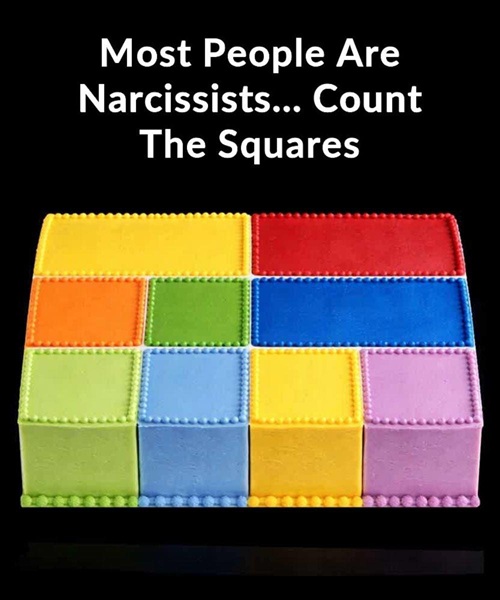
At first glance, it looks like the kind of image you would scroll past without a second thought. A colorful arrangement of geometric blocks.
A neat stack of squares layered in a tidy pattern. Beneath it, a caption that reads: It feels playful, slightly provocative, and easy.
You glance at the image, quickly count the squares you notice, decide on a number, and move on. It seems like a harmless visual brain teaser — simple arithmetic wrapped in a bold statement. But the moment you slow down and genuinely try to count, something changes.
The task becomes unexpectedly slippery. You begin to notice shapes you did not see at first. You may second-guess your initial answer. Perhaps you recount. Perhaps you defend your first number. What appeared trivial suddenly feels complex. And that subtle shift — from confidence to uncertainty — is where the real lesson begins.

This kind of puzzle is not really about squares. It is about perception, interpretation, and the psychology of being right.
Why the Puzzle Feels Simple — and Then Suddenly Isn’t
Visually, these puzzles usually display stacked cubes or layered square blocks arranged in a pseudo-three-dimensional format. Some faces are fully visible. Others are partially visible. Some edges suggest additional layers hidden from direct view.
At first, your brain does what it always does: it seeks efficiency.
The human visual system is designed to prioritize clarity and speed. We evolved to scan environments quickly, detect patterns, and make rapid decisions. When we see a grid of squares, our brain recognizes a familiar pattern and simplifies it instantly. We identify the most obvious shapes — typically the top-facing squares — and treat them as the complete set.
But that simplification is not the full picture.
Once you intentionally examine the image, you begin to see more layers:
- Squares on the top surface
- Squares visible on the front or side faces
- Partial squares formed by overlapping layers
- Implied squares suggested by edges or depth
What seemed like a flat grid transforms into a structure with dimension. The puzzle becomes less about counting and more about defining what qualifies as a “square.”
And that distinction is crucial.
The Mechanics Behind the Illusion
To understand why people arrive at different answers, it helps to break down how these puzzles are typically constructed.
Most “count the squares” images fall into one of three categories:
- Flat grid puzzles – A 2D arrangement with overlapping lines that create smaller squares inside larger ones.
- Layered 2.5D puzzles – A 2D image drawn to simulate depth, showing stacked or overlapping cubes.
- True 3D cube representations – Illustrations suggesting full cube stacks, where some faces are hidden from view.
In the second and third types, ambiguity is intentional.
Consider a simplified example: a three-by-three arrangement of cubes stacked in layers. If you look only at the top surface, you may count nine squares. That feels logical. It matches what your eyes immediately recognize.
But if you include the front-facing squares, you might add four more that are partially visible.
If you imagine the entire structure — including squares that are hidden from view but logically exist in the stack — the number increases again.
None of these interpretations are incorrect. They are simply based on different definitions of what counts.
The puzzle does not state whether you should count only visible faces, partially visible faces, or the total number of square faces in the entire structure. That ambiguity is deliberate. It creates space for interpretation — and disagreement.

The Psychology of First Impressions
The most fascinating aspect of this puzzle is not mathematical. It is psychological.
When you first see the image, your brain forms an immediate answer. That answer feels correct because it is the product of rapid pattern recognition — a cognitive strength that usually serves us well.
Psychologists refer to this kind of thinking as “fast thinking,” a term popularized by Nobel laureate Daniel Kahneman in his book Thinking, Fast and Slow. Kahneman describes two systems of thought:
- System 1: Fast, intuitive, automatic
- System 2: Slow, analytical, deliberate
When you glance at the square puzzle and instantly think “There are 9,” that is System 1 at work. It is efficient, confident, and usually adequate for simple tasks.
But when you pause and reconsider — noticing hidden layers or partially visible faces — System 2 activates. You begin analyzing. You question your assumptions. You count methodically.
The tension between these two systems explains why the puzzle feels easy at first and complicated moments later.
It also explains why people defend their first answer so strongly.
Cognitive Bias in Action
Several well-documented cognitive biases influence how we approach puzzles like this.
1. Anchoring Bias
Your first answer becomes your anchor. Even if you later notice additional squares, your mind tends to stay close to that initial number. Adjustments happen slowly and often insufficiently.
2. Confirmation Bias
Once you believe your number is correct, you look for evidence supporting it. You may ignore shapes that challenge your count.
3. Selective Attention
You focus on what stands out most — typically the top-facing squares — while overlooking less obvious faces.
4. Overconfidence Effect
Humans naturally overestimate the accuracy of their initial judgments, especially in tasks that seem simple.
These biases are not flaws. They are normal features of human cognition. They allow us to make fast decisions in complex environments. However, in ambiguous tasks, they can lead to disagreement.
And that disagreement often feels personal.
The “Narcissism” Hook — What It Really Does
The caption “Most People Are Narcissists” is not a clinical claim. It is a rhetorical device.
Clinically speaking, narcissism refers to a personality trait involving grandiosity, a strong need for admiration, and reduced empathy. Narcissistic Personality Disorder is a defined psychological condition with specific diagnostic criteria. The majority of people do not meet those criteria.
So why use that label in a puzzle?
Because it triggers ego involvement.
The moment you feel evaluated — even indirectly — your mindset shifts. Instead of solving a puzzle for fun, you are now protecting your identity.
If someone comments that your answer is wrong, it can feel like a challenge to your competence. Even though the task is trivial, the emotional response can be surprisingly strong.

This reaction is not proof of narcissism. It is evidence of a universal human tendency: we prefer to be correct.
When ego enters the equation, the puzzle stops being about geometry and becomes about status, validation, and self-image.
Why People Argue Over Simple Puzzles
Scroll through comment sections under these puzzles, and you will often see heated debates:
- “It’s obviously 8. Learn to count.”
- “You’re wrong. There are 14.”
- “You’re overthinking it.”
- “No, you’re not thinking enough.”
What is happening here is not mathematical disagreement — it is definitional disagreement.
One person is counting visible top faces only.
Another is counting all visible faces.
Another is imagining the full structure, including hidden squares.
Without clarifying definitions, the conversation becomes circular. Each person believes they are correct because they are solving a slightly different problem.
This dynamic mirrors real-world disagreements in business, politics, and relationships. Often, conflict arises not from opposing facts, but from unspoken assumptions.
A Clear Example of Diverging Counts
Imagine a three-layer stack arranged as follows:
- Top layer: 3 × 3 squares
- Middle layer: 3 × 3 squares
- Bottom layer: 3 × 3 squares
If you count only the top-facing squares, you see 9.
If you include visible front faces from the middle and bottom layers, you might count 14.
If you count every square face in the entire structure (top, bottom, front, back, left, right), the number increases significantly.
If you count every square unit in the full cube stack (3 × 3 × 3), the total number of cube units is 27 — but that is counting cubes, not faces.
The answer depends entirely on the question being asked.
And that is the central lesson: clarity matters.
The Broader Cognitive Lesson
These puzzles demonstrate something profound about human thinking:
- We simplify complexity automatically.
- We trust first impressions.
- We defend our conclusions.
- We rarely clarify definitions before debating.
In everyday life, this pattern appears constantly. Two coworkers may disagree on a project’s success because they define “success” differently. Two friends may argue over fairness because they have different criteria for what fairness means.
The square puzzle condenses this dynamic into a visual exercise.
It shows that perception is not passive. It is interpretive.

And interpretation is shaped by assumptions.
Slowing Down Changes Everything
When you deliberately slow down and examine each layer, something interesting happens. The frustration fades. Curiosity replaces defensiveness. You begin exploring possibilities instead of protecting answers.
This shift — from certainty to inquiry — is intellectually powerful.
Instead of asking, “What is the correct number?” you begin asking:
- What definitions am I using?
- What assumptions did I make?
- What might I be missing?
These are the same questions that drive scientific thinking, effective leadership, and personal growth.
The puzzle is small. The principle is large.
The Real Value of the Exercise
Without the actual image, there is no single definitive number to provide. Different designs produce different counts. And that uncertainty is not a flaw — it is the point.
The value lies in how you approach ambiguity.
Do you cling to the first answer that feels right?
Do you dismiss alternative perspectives quickly?
Or do you examine, reconsider, and refine?
That moment of reconsideration — that pause before defending — is where learning happens.
And that is only the beginning of what this deceptively simple square puzzle can teach about perception, bias, ego, and growth.
It is tempting to believe that vision is objective. After all, we trust our eyes. But neuroscience consistently shows that perception is an active process. The brain does not record the world like a camera. It reconstructs it.
When you look at a stacked-square puzzle, your brain performs several operations instantly:
- It detects edges and contrasts.
- It groups shapes into patterns.
- It infers depth from shadows and perspective lines.
- It fills in missing information automatically.
This filling-in process is known as perceptual completion. When part of a shape is hidden, your brain assumes continuity. You rarely notice that this assumption is happening.
For example, if two edges align in a way that suggests a hidden square behind another layer, your brain may unconsciously “complete” that square even if it is not fully visible. Another person, focusing only on fully outlined shapes, may not count it.
Neither perception is wrong. They are simply different cognitive interpretations of the same stimulus.
This principle has been demonstrated for decades in research on visual illusions. Classic illusions show how identical lines can appear different in length depending on context, or how stationary images can appear to move. The square puzzle belongs to that same family of perceptual challenges.
It does not trick your math skills. It highlights how context shapes interpretation.
Ambiguity and the Human Need for Closure
One reason this puzzle spreads widely on social media is that it creates ambiguity without providing closure.
Psychologists describe a trait called need for cognitive closure — the desire for a firm answer and discomfort with uncertainty. Some individuals tolerate ambiguity easily. Others feel tension until a definitive solution is reached.
When confronted with a square puzzle that does not specify counting rules, people experience mild cognitive discomfort. The mind seeks resolution.
That discomfort can manifest in different ways:
- Some people quickly settle on the simplest answer and move on.
- Some analyze carefully until they feel confident in a more comprehensive count.
- Some argue vigorously to defend their interpretation.
The intensity of the reaction often correlates not with intelligence, but with tolerance for ambiguity.
In everyday life, tolerance for ambiguity influences how we handle uncertainty in business decisions, relationships, and risk assessment. The square puzzle becomes a miniature training ground for dealing with incomplete information.
The Role of Mental Models
Every person approaches a problem with pre-existing mental models — internal frameworks shaped by education, culture, experience, and habit.
When you see stacked squares, your mental model determines what you assume the task requires.
Some common mental models include:
Surface Model:
“If I can clearly see it, I count it. If I cannot see it fully, it does not count.”
Structural Model:
“If the structure logically includes hidden components, they should be included.”
Literal Model:
“I will count only complete, fully outlined square shapes.”

Conceptual Model:
“If edges form a square, even partially, it counts.”
These models operate silently. Most people do not consciously decide which model to use. They simply apply it.
When two people argue over the answer, they are often defending different mental models — not different arithmetic.
This insight is important beyond puzzles. In negotiations, disagreements frequently arise because people are using different mental models to evaluate fairness, risk, or value.
The square puzzle exposes this invisible layer of thinking.
Ego, Identity, and Being Right
Although the puzzle itself is neutral, the provocative caption introduces an emotional layer. When a statement implies that your answer says something about your personality, the stakes rise.
Human beings are deeply motivated to maintain a positive self-image. When someone suggests that your interpretation reflects narcissism, ignorance, or carelessness, even playfully, it can trigger defensiveness.
Defensiveness does not mean someone is narcissistic. It means they care about being perceived as competent.
Research in social psychology shows that when people feel their competence is challenged, they are more likely to double down on their initial belief rather than reconsider it. This is sometimes referred to as belief perseverance.
In the square puzzle context, this might look like:
- Recounting repeatedly to confirm the same number.
- Dismissing alternative interpretations without examination.
- Interpreting disagreement as a personal attack.
The irony is that the puzzle becomes a test not of counting ability, but of flexibility.
Can you revise your view when presented with new information?
Can you acknowledge multiple valid interpretations?
These questions matter far more in life than the actual number of squares.
Slow Thinking as a Skill
Returning to the idea introduced by Daniel Kahneman in Thinking, Fast and Slow, deliberate reasoning is not automatic. It requires effort.
When you engage System 2 thinking, you:
- Slow down.
- Examine details.
- Question assumptions.
- Cross-check conclusions.
In the puzzle, this may involve:
- Counting row by row.
- Tracing edges carefully.
- Identifying overlapping boundaries.
- Avoiding double-counting.
This methodical approach often yields a more comprehensive answer.
However, slow thinking consumes mental energy. That is why many people default to quick estimates.
In daily life, the ability to switch from fast intuition to deliberate analysis is a critical skill. Leaders, analysts, engineers, and decision-makers benefit from knowing when to slow down.
The square puzzle provides a low-stakes opportunity to practice that shift.
Counting Strategies in Depth
To approach these puzzles systematically, consider several structured methods.
1. Layer-by-Layer Analysis
Imagine the structure as horizontal layers.
- Count all top-facing squares.
- Identify squares visible in the next layer down.
- Continue layer by layer.
This reduces the chance of missing partially visible faces.
2. Orientation-Based Counting
Instead of thinking in layers, think in orientations:
- Count all squares facing upward.
- Count all squares facing forward.
- Count all squares facing sideways.
Keep categories separate to avoid duplication.
3. Edge Tracking
Trace each boundary line carefully. Whenever four connected edges form a square, verify whether it is complete and distinct from previously counted ones.
4. 3D Reconstruction
If the puzzle suggests depth, sketch a quick diagram. Reconstruct the cube stack conceptually. Count the number of cubes and multiply by visible faces if the instructions specify faces rather than units.
Each method produces clarity — but only if you define your counting rule first.
Without defining the rule, even a perfect counting method cannot produce agreement.
Ambiguity in Communication
The square puzzle mirrors a frequent communication problem: unspoken definitions.
Consider workplace examples:
- A manager says, “We need this done quickly.”
Does quickly mean within hours? Days? A week? - A team member says, “The project was successful.”
Does success mean on-time delivery? Profitability? Client satisfaction?
In both cases, disagreement may arise not from opposing facts, but from undefined criteria.
The puzzle’s ambiguity trains us to ask clarifying questions:
- What exactly are we counting?
- What criteria determine inclusion?
- Are hidden elements part of the total?
These questions, applied outside puzzles, prevent misunderstanding.
Emotional Regulation and Intellectual Humility
A subtle but powerful lesson from these puzzles is emotional regulation.
When someone provides a different answer, notice your internal response. Do you feel irritation? Skepticism? Curiosity?
Intellectual humility is the willingness to recognize that your knowledge may be incomplete. It does not mean you are wrong. It means you are open to refinement.
Research consistently shows that individuals who practice intellectual humility are better learners and collaborators. They update beliefs when presented with credible evidence.
The square puzzle becomes a training tool for that mindset.
Instead of reacting with:
“That’s wrong.”
You can respond with:
“Interesting. What counting method did you use?”
That small shift transforms conflict into dialogue.
Why These Puzzles Go Viral
From a media perspective, square-counting puzzles are highly shareable because they combine:
- Simplicity (easy to attempt)
- Ambiguity (multiple possible answers)
- Mild controversy (encourages debate)
- Identity triggers (suggestions about intelligence or personality)
They generate engagement without requiring advanced knowledge.
But their educational value is often overlooked.
Used intentionally, they encourage:
- Close observation
- Structured reasoning
- Clear definition of terms
- Respect for alternative perspectives
That is far more valuable than simply landing on a number.
The Difference Between Error and Interpretation
One of the most important distinctions is this:
Some answers are incorrect due to miscounting.
Other answers differ because the definition differs.
Confusing these two categories fuels unnecessary conflict.
If someone double-counts a square accidentally, that is a computational error.
If someone counts hidden squares based on a structural definition, that is an interpretive choice.
Clarity dissolves most disputes.
The Broader Application: Decision-Making Under Uncertainty
Life rarely presents us with fully visible information. We often see only the “top layer” of a situation.
In business, financial markets, relationships, or policy decisions, hidden variables influence outcomes. Some people focus only on visible data. Others attempt to infer underlying structures.
The skill lies in knowing which approach fits the situation.
Overcomplicating simple problems wastes energy. Oversimplifying complex problems invites risk.
The square puzzle teaches discernment: evaluate the depth of the problem before choosing your method.
Reframing the Puzzle
Instead of asking, “How many squares are there?” try reframing the question:
- What assumptions am I making?
- What perspectives am I ignoring?
- How does my definition shape my conclusion?
When framed this way, the puzzle becomes an exercise in metacognition — thinking about thinking.
Metacognition improves learning efficiency, problem-solving, and adaptability. It allows you to monitor your reasoning process rather than blindly trusting it.
That awareness is powerful.
The Invisible Square
There is a metaphor hidden within the puzzle.
Some squares are obvious.
Some are partially visible.
Some are implied.
Similarly, in life:
Some facts are obvious.
Some are subtle.
Some require imagination and inference.
The difference between a surface-level thinker and a deep thinker is not intelligence alone. It is willingness to look beyond the first layer.
The puzzle rewards attention — but more importantly, it rewards perspective.
The “count the squares” challenge is deceptively simple. It engages multiple cognitive processes simultaneously: attention, memory, pattern recognition, and problem-solving. What makes it compelling — and sometimes frustrating — is that it highlights the limits of human perception.
Our brains are designed to prioritize efficiency. In most situations, scanning the top layer, recognizing obvious patterns, and quickly responding serves us well. It allows us to navigate complex environments with minimal cognitive load. However, the efficiency-driven approach can obscure subtle details, hidden layers, or alternative perspectives.
When applied to the square puzzle, this cognitive shortcut leads to different interpretations. Two people looking at the same image may report different answers — not due to error, but because their perception filters reality differently. This filtering is a central feature of human cognition.
This principle extends far beyond optical illusions. In business, politics, and interpersonal relationships, the information we receive is always partial. The ability to recognize that our perception is inherently limited is critical for effective reasoning and decision-making.
Leadership Lessons: Seeing the Hidden Layers
Leaders face situations where critical information may be incomplete or partially obscured, much like hidden squares in a puzzle. Effective leadership requires more than intuition — it requires conscious attention to multiple layers of information.
Consider a manager evaluating a project. Surface-level metrics may indicate success: milestones met, tasks completed, deadlines respected. However, deeper analysis may reveal hidden issues: team morale, resource allocation challenges, or potential risks.
The square puzzle teaches that:
- Observation alone is not enough. You must actively explore hidden factors.
- Multiple perspectives are valuable. Consulting diverse team members provides insights that a single viewpoint may miss.
- Structured analysis reduces bias. Layer-by-layer, edge-by-edge evaluation ensures no critical detail is overlooked.
The puzzle becomes a metaphor for strategic thinking: success depends not only on what is visible, but on how thoroughly you examine the unseen.
Collaboration and Conflict Resolution
Disagreements over square counts are common in online discussions. Observing them provides insight into conflict dynamics. Often, the dispute is not about factual accuracy but about definitions, assumptions, or mental models.
In collaborative work, conflict often arises from:
- Misaligned assumptions: Different team members may define success differently.
- Incomplete communication: Key criteria or rules may be unstated.
- Ego-driven defense: Individuals may defend positions to protect perceived competence.
By approaching the puzzle as a shared problem rather than a personal test, you can practice essential collaborative skills:
- Clarify definitions upfront. Specify counting rules or evaluation criteria before beginning analysis.
- Separate facts from interpretations. Acknowledge that alternative perspectives may be valid.
- Promote curiosity over defensiveness. Encourage exploration rather than judgment.
These skills are transferable to negotiations, project planning, and team leadership. They reduce friction, improve understanding, and increase collective accuracy in problem-solving.
Cognitive Flexibility and Adaptive Thinking
The puzzle demonstrates the importance of cognitive flexibility — the ability to adapt thinking based on new information or perspectives. Individuals who rigidly cling to their first impression may miss alternative interpretations, while those who are willing to reconsider can achieve deeper understanding.
Cognitive flexibility is particularly valuable in:
- Decision-making under uncertainty: Complex problems rarely present all variables clearly.
- Creative problem-solving: Recognizing hidden patterns allows innovative solutions to emerge.
- Critical thinking: Evaluating assumptions and mental models reduces errors and biases.
Practicing flexibility with a low-stakes puzzle prepares the mind to handle ambiguity in high-stakes situations. It strengthens metacognitive skills — thinking about how you think — which is essential for lifelong learning.
Ego, Humility, and Emotional Intelligence
One of the most subtle lessons from the puzzle is the interplay between ego and perception. The provocative caption — “Most People Are Narcissists” — triggers emotional responses. Even mild suggestions about personality can prompt defensiveness.
Emotional intelligence involves recognizing these reactions and responding deliberately. Key strategies include:
- Self-awareness: Notice when your response is driven by ego rather than objective analysis.
- Perspective-taking: Consider why someone else might see a different answer.
- Regulated response: Pause before reacting, especially in debates or conflicts.
Developing these skills fosters humility. Humility, in turn, enhances collaboration, learning, and leadership. The puzzle acts as a mirror, reflecting not just cognitive patterns but emotional tendencies.
Advanced Analytical Strategies
For those who wish to master these puzzles — or any complex analytical task — several advanced strategies are valuable:
1. Systematic Enumeration
Break down the structure into discrete units. Count each visible face systematically, marking them to avoid duplication.
2. Multi-Angle Visualization
Mentally rotate the structure or sketch it in 3D. This reduces errors caused by hidden or overlapping layers.
3. Explicit Rule Definition
Before counting, clarify the rules: top faces only, visible sides included, or hidden elements counted. Defining parameters reduces subjective disagreements.
4. Layered Verification
After completing an initial count, verify each layer independently. This technique mirrors scientific peer review — checking assumptions and results before finalizing conclusions.
These strategies encourage precision, patience, and methodical reasoning — qualities that extend far beyond puzzles.
Real-World Implications: Life Lessons from Squares
The true power of these puzzles lies in metaphorical application. They teach lessons about:
- Perspective: Different observers can see the same reality differently. Recognizing this reduces conflict and enhances empathy.
- Definitions Matter: Clarity in communication prevents misinterpretation and disagreement.
- Attention to Detail: Careful observation uncovers subtle patterns often missed by cursory inspection.
- Decision-Making Under Ambiguity: Life presents incomplete data; skillful inference improves outcomes.
- Humility and Curiosity: Accepting alternative interpretations fosters growth and collaborative learning.
In essence, the puzzle transforms from a brain teaser into a cognitive and emotional training tool.
The Philosophical Dimension: Seeing the Unseen
Beyond practical lessons, there is a deeper, almost philosophical insight: reality is multilayered. Much like squares stacked in layers — some hidden, some partially visible — life is rarely fully transparent.
Success, understanding, and wisdom require the ability to:
- Infer hidden structures without jumping to conclusions.
- Accept multiple valid interpretations simultaneously.
- Pause, observe, and reconsider before acting.
The most important square in the puzzle is never actually in the image. It is the metaphorical square representing awareness, perspective, and reflection.
This realization transforms the act of counting into a practice of mindfulness and critical thinking. It teaches that the first, most obvious answer is rarely the only answer — or the most insightful one.
Conclusion: Growth Beyond the Puzzle
“Count the squares” is more than a viral social media post. It is a window into human cognition, perception, and social behavior. It demonstrates how attention, mental models, bias, and ego shape understanding.
Engaging with the puzzle mindfully cultivates:
- Attention to detail — noticing what is visible and implied.
- Cognitive flexibility — adapting thinking to accommodate multiple perspectives.
- Emotional intelligence — managing defensiveness and ego in ambiguous situations.
- Communication clarity — defining assumptions and criteria explicitly.
- Strategic thinking — recognizing hidden variables and planning accordingly.
Every time you encounter ambiguity, incomplete data, or differing viewpoints — in business, relationships, or personal growth — you are essentially facing a real-world version of the square puzzle.
The most important square is not in the image. It is the moment you choose to pause, reflect, and approach complexity with patience, humility, and curiosity.
That is the enduring lesson: the value is not in the number you report, but in how you see, think, and grow.
