
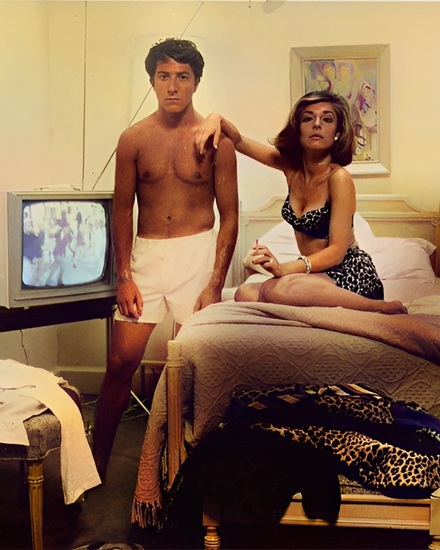
The Graduate remains one of the most celebrated films in American cinema, blending comedy and drama in a way that continues to resonate nearly six decades after its release.
Directed by Mike Nichols and released in late 1967, the film tells the story of Benjamin Braddock, a recent college graduate unsure of his future who becomes involved in a complicated affair with an older woman.
Dustin Hoffman, who had worked in theater and television for years, was cast as Benjamin Braddock, giving him the breakthrough role that would instantly make him a star.
Hoffman’s portrayal of Benjamin captured his awkwardness and uncertainty about life after college, giving audiences a deeply relatable emotional core amid the film’s humor and social commentary.
Anne Bancroft was cast as Mrs. Robinson, the married woman who seduces Benjamin. Her performance brought sophistication, allure, and emotional depth, making the character one of cinema’s most memorable figures.

Despite her powerful performance, Bancroft later said she had mixed feelings about the role because its popularity sometimes overshadowed her work in other films and on Broadway.
Katharine Ross played Elaine Robinson, the daughter of Mrs. Robinson, creating a complicated love triangle that would become central to the film’s emotional tension and narrative payoff.
The casting process for The Graduate was famously challenging. Director Nichols considered numerous actors for the role of Benjamin, including Robert Redford, before ultimately choosing Hoffman.
Nichols rejected Redford’s audition because he felt the actor did not convincingly embody the awkward, uncertain qualities essential to Benjamin’s character, even after Redford argued his own understanding of the role.
There’s a well‑known story that when Hoffman first arrived at producer Joseph Levine’s office for his audition, Levine mistook him for a window cleaner, a moment that became part of the film’s casting lore.
During rehearsals of the iconic hotel‑room scene between Benjamin and Mrs. Robinson, Hoffman improvised a playful physical gesture that made everyone laugh so much it remained in the final cut.

This spontaneous moment of humor — and Nichols’s willingness to keep it — helped contribute to the film’s blend of naturalism and unpredictable comedic energy.
The film’s screenplay was written by Buck Henry and Calder Willingham, adapted from a 1963 novella by Charles Webb, who based the story on his own post‑college experiences.
Nichols’s direction emphasized the contrast between suburban conformism and the emotional confusion of youth, a theme that would strike a chord with audiences living through shifting cultural norms.
The Graduate premiered at a moment of social change in the United States, with young people questioning traditional paths and seeking alternatives to the expectations of earlier generations.
The film’s opening visual — Benjamin alone in his parents’ empty house — perfectly set the tone for his existential disorientation and search for identity.
One of the most famous lines in cinema history — “Mrs. Robinson, you’re trying to seduce me, aren’t you?” — captures both the awkwardness and the boldness of the story’s central relationship.
The Graduate was not just a critical success but also a massive box office hit. It grossed over $104 million in North America, making it the highest‑grossing film of 1967.
At the time, only a handful of films — including Gone with the Wind and The Sound of Music — had ever crossed that threshold, highlighting the movie’s remarkable commercial impact.

Nichols’s direction earned him the Academy Award for Best Director, the film’s only Oscar win, though it received a total of seven nominations, including Best Picture and Best Actor.
Critics and audiences alike responded enthusiastically, with many praising the film’s sharp satire, intelligent dialogue, and emotional complexity.
Part of the film’s distinctive voice came from its soundtrack, which featured songs by the folk‑rock duo Simon & Garfunkel, an unconventional but influential choice at the time.
Tracks like “The Sound of Silence” and “Mrs. Robinson” became inseparable from the movie’s identity and helped bridge the emotional experience of the film with the cultural rhythms of the era.
Interestingly, “Mrs. Robinson” was not originally written for the film. Paul Simon expanded a song he was working on to fit the movie’s themes, and director Nichols chose to include it.
The success of the film and its music propelled Simon & Garfunkel to greater fame, and their soundtrack went on to win Grammy awards and influence generations of filmmakers.
The Graduate was selected by the U.S. Library of Congress for preservation in the National Film Registry as a culturally and historically significant work.

American Film Institute rankings have repeatedly placed The Graduate among the greatest American films ever made, reflecting its lasting influence and artistic achievement.
The film’s narrative — focused on generational conflict, uncertain adulthood, and the collision between desire and responsibility — remains relevant to viewers of all ages.
Several camera and editing techniques in the film subtly reinforce Benjamin’s emotional perspective, contributing to its reputation for innovative visual storytelling.
For example, long telephoto shots and strategic blocking visually emphasize Benjamin’s sense of isolation, subtly communicating themes without words.
The juxtaposition of Benjamin’s affair with Mrs. Robinson and his romantic pursuit of Elaine adds emotional complexity that continues to spark discussion among critics and film scholars.

Many viewers have pointed out continuity and minor production details that go unnoticed on first viewing, but these quirks only add to the movie’s charm and legacy.
The interplay between humor and social critique in The Graduate helped usher in the era of New Hollywood, where films explored complex psychological and cultural subject matter.
Decades after its release, students and cinephiles still study The Graduate for its rich characters, subversive themes, and influential style.
The movie continues to resonate because it captures both the personal uncertainty of growing up and the larger cultural shifts of its time with remarkable nuance.
Even though fashions and social contexts have changed drastically since 1967, The Graduate remains a foundational work in American cinema, timeless in its exploration of love and identity.
The enduring popularity of The Graduate is underscored by its frequent references in television, music, and popular culture, from parodies to homages that keep its influence alive.
Whether encountered by first‑time viewers or returning audiences, the film’s blend of wit, emotional depth, and striking character dynamics continues to captivate and provoke thoughtful reflection.
