
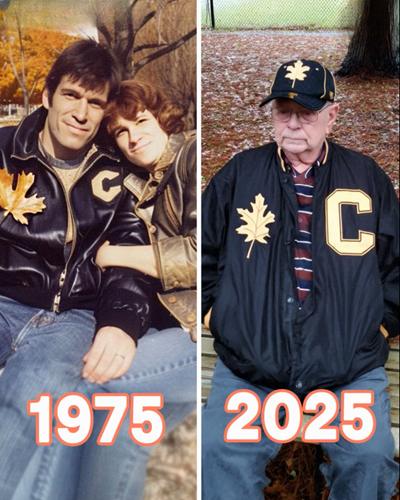
Every single day, for as many years as I can recall, I made my way to the same bench at the far edge of Maplewood Park.
Its iron arms were rust-speckled, the original black paint long peeled away by relentless sun, rain, and wind.
The wooden slats had been worn smooth over decades of weather and weary visitors, their surface polished to a soft, almost tactile memory of countless hands that had rested there.
To a passerby, I was just another elderly man, a fixture of the park as permanent and unobtrusive as the towering oaks or the flickering lampposts that marked the winding paths. Children would sprint past, their laughter tumbling like bright pebbles across the grounds. Joggers traced the same looping trails, their rhythmic footfalls a quiet accompaniment to the chirping of sparrows. Dog walkers offered polite nods, their pets tugging impatiently at leashes. I rarely spoke.
Yet that bench was never merely a bench. It was my sanctuary, my small, sacred shrine where memory, longing, and hope converged. It was a place suspended outside time, a quiet harbor in a life that had learned too well the heavy cost of absence.
Long ago, it had been Clara and I who occupied that bench. I remember how we would slip through the park’s wrought-iron gates on warm spring mornings, our steps light with anticipation, our laughter mingling with the hum of the world waking up around us. Back then, the park was lush and wild in its innocence — dandelions peeking through the grass, the pond’s surface reflecting sunlight like tiny mirrors, and the scent of blooming lilacs drifting through the air. Maplewood Park was our refuge from the noise of our young lives, a place where love felt infinite and unbreakable.

Clara had a small thermos that always smelled faintly of cinnamon and sugar. I would tease her about the absurd amount of sugar she insisted on stirring in, and she would laugh — that radiant, uncontainable laugh that seemed to lift the very air around us, making the birds pause mid-song. I would bring a newspaper, though neither of us ever really read it. Instead, we sat close, her hand tucked into mine, exchanging our dreams in hushed tones. We talked of distant lands, of little homes painted in warm shades, of the gardens we would cultivate, and of the children we imagined raising. We whispered about names, debated ideas, and imagined the texture of a life still untouched by heartbreak or compromise.
We were young, poor, but rich in hope and belief. Every small joy was monumental: a shared coffee, a sunbeam catching her hair just so, the gentle brush of hands as we passed a pigeon crumbs. We spoke of painting the kitchen yellow, planting tomatoes in the backyard, and of simple rituals that would someday mark our domestic eternity. Her eyes glimmered with ambition and tenderness, a mixture that made me believe that we could face anything together.
But life, unpredictable as wind through the oaks, often rearranges our plans in ways we cannot foresee. Misunderstandings grew in the spaces between our hearts, fueled by silence and pride. Words we meant to speak never left our lips; letters meant to bridge gaps went astray. And then, one day, without warning or farewell, Clara was gone.
Not in the dramatic sense you see in films — there were no rushing hands, no trembling goodbyes. Just absence. A hollow in the chest that never fully healed. I was left with a silence that settled over my life like winter frost, cold and unyielding. The apartment we had shared became a mausoleum of memories, the walls echoing with a life half-lived.
Yet I returned to my routine, ritualistic in its simplicity, as if repetition alone could stave off despair. Every morning, I rose before the sun crested the rooftops, my small apartment bathed in the pale, indifferent light of early day. Breakfast was an act of memory — oatmeal stirred slowly on the stove, mixed with shredded carrots exactly as Clara had insisted, though I never really liked it. A vinyl record would spin softly, Frank Sinatra’s warm voice drifting through the rooms, as if he were delivering a private serenade from the past. Each note felt less like music and more like an echo of the life I once held in my hands.
I donned my worn coat, gripped my cane, and made the familiar walk to Maplewood Park, a pilgrimage rather than a stroll. The seasons passed over the park and me, each altering the world in subtle, relentless ways. Spring brought blossoms that mirrored the renewal I could never quite feel. Summer offered warmth, but also the stark brightness of loneliness in broad daylight. Autumn painted the trees in golds and ambers, as if to remind me that beauty and decay often coexist. Winter draped the park in a crystalline silence, the paths empty, the air sharp, and my breath clouding the gray sky in small, ephemeral puffs.

Still, I returned. Some called it stubbornness; others, loneliness. I called it faith. As long as I occupied that bench, some part of our story endured, some shard of love remained alive against the tide of years. The bench became a vessel of memory, a thin membrane separating past from present. When I sat there, I could almost feel her presence beside me, her hand brushing against mine, her laughter folding through the air.
People assumed I was a widower. Occasionally, someone would offer a polite greeting or a tentative smile, trying to bridge the invisible distance I kept. I answered, but I never explained. How could I? How could I distill decades of love, loss, waiting, and devotion into casual conversation? The truth was far too intricate, far too fragile to risk sharing with strangers.
And then, on one gray, rain-heavy morning, everything changed.
The morning arrived heavy and gray, as though the sky itself were weighed down by decades of unspoken stories. Rain fell in soft, persistent sheets, pattering against the sidewalks, pooling in the hollows of the park, and tracing delicate rivulets down the iron arms of my old bench. Normally, I would have stayed indoors on a day like that. Rain, after all, was meant for quiet contemplation in the warmth of home, not for a man already carrying the weight of years upon his shoulders. Yet something — I cannot tell if it was habit, hope, or an almost instinctive yearning — drew me out.
My coat, once black but now faded to a soft charcoal, clung to my shoulders as I walked, my cane tapping a slow rhythm on the slick pavement. The air smelled of wet earth, of the fresh tang of rain striking leaves and grass, of something indefinable that stirred deep, buried memories. Each step was deliberate, careful, as if the park itself demanded reverence on such a morning.
When I reached the bench, it seemed smaller than I remembered, yet impossibly familiar. Raindrops slid down the wooden slats, forming little streams that converged in puddles around the base. I lowered myself onto the bench, the iron cold against my palms, and allowed myself to sink into a silence that was both heavy and comforting. The rhythmic drumming of rain became a kind of lullaby, each drop echoing a fragment of years gone by.
I had been there for what felt like hours, lost in memory, when a small sound caught my attention: a light, deliberate splash, uneven, yet confident. I turned my gaze, squinting through the downpour, and saw a little girl navigating the puddles with careful, almost deliberate steps. Her umbrella was too large for her frame, tilting slightly with each gust of wind, but she held it with determination. She moved with an ease and grace that seemed almost uncanny, the kind of composure rare in children who should still be learning the boundaries of the world.

“You look cold,” she said, her voice clear, steady, and gentle, carrying across the wet air in a way that startled me.
Before I could respond, she stepped closer and, with the natural certainty of someone unafraid to act out of kindness, removed her jacket and draped it across my lap. It was warm, its fabric still infused with the subtle heat of her body. I froze, my fingers brushing the soft material. There was something strikingly familiar about the jacket, a weight in memory I could not immediately place.
“What’s your name?” I asked, my voice trembling more than I cared to admit.
“Leah,” she replied, her tone calm and unhesitant, as though this small exchange required no introduction or preamble.
I thanked her, though my gratitude felt like an inadequate whisper against the sudden flood of emotion stirring within me. And then my eyes, almost involuntarily, moved to the inside of the jacket’s collar. There, stitched delicately in gold thread, was a single letter: “C.” Beside it, a small oak leaf shimmered faintly in the dim light, embroidered with such care that the hand which had stitched it must have known the significance it would one day hold.
My breath caught. Clara. That jacket. Forest green, a subtle sheen to the fabric, embroidery that had been her favorite design in the little boutique she had adored. I traced the stitching with trembling fingers, memories cascading like water: her laughter, her hands, the certainty in her smile.
“Where did you get this jacket?” I asked, my voice strained but controlled, my eyes never leaving her small face.
“It was my grandmother’s,” Leah said simply, her innocence carrying a weight I could not yet understand.
The world seemed to pivot, tilting in ways that defied sense and reason. I wanted to ask questions that spilled into a thousand unformed sentences, yet I knew I could not capture the significance of this moment in words without shattering it. The jacket, simple in appearance, had become a bridge across decades, connecting a past I had mourned every single day to a present I could scarcely comprehend.
Rain intensified, drumming on the umbrella above her head, and she glanced toward the park entrance. “I have to go. Grandma will be worried,” she said, slipping her small hands back into the sleeves of her own coat.
Before I could respond, she was gone, vanishing into the curtain of rain like a fragment of a dream. I remained seated, the jacket draped over my lap, water seeping into the edges of my coat, but my mind was far from discomfort. It raced, colliding memory with reality, assembling possibilities I had buried deep within my heart.
Was it coincidence? Or had fate, in its quiet, inscrutable way, orchestrated this encounter? Could a child, unaware of her own significance, truly bridge a gap that decades of silence and misunderstanding had widened?

The next morning, I arrived at the park earlier than usual. My anticipation was an ache, a mixture of hope and anxiety that tightened my chest with every step. Every passerby’s face became a potential revelation, every small movement a possibility that this child, Leah, might appear again. And on the third day, she did.
I watched as she approached the small community shelter near the park’s edge, a modest building with flower boxes that added life to its otherwise unassuming brick walls. She moved with the same quiet determination as before, her presence almost luminous against the muted backdrop of rainy gray.
Inside the courtyard, I saw her grandmother. Older now, her hair streaked with silver, shoulders carrying the quiet burden of years gone by. But even from this distance, the resemblance was undeniable, the same spark in her eyes that I had loved decades ago.
Clara.
The recognition was instant, primal, a force that left me breathless. For a long, suspended moment, time itself seemed to still. Rain fell in gentle sheets, blurring the world around us, yet leaving us sharply in focus. Years of silence, misunderstanding, and absence hung between us like fragile glass, translucent but weighty.
“Clara,” I whispered, my voice a quiver of disbelief and longing.
Her eyes widened, catching mine with a mix of shock, relief, and something I could not yet name. “I thought you left,” she murmured, her voice trembling, “I thought you didn’t want us.”
Those words struck like a physical blow, yet beneath them I felt the fragile pulse of hope. “I never left,” I said, my tone steady, though my heart raced. “I waited. Every day.”
In that moment, decades of assumption and pride, of misdelivered letters and silenced messages, began to unravel. We had both believed the other had chosen absence. And yet, here she stood, alive, and our daughter — grown, nurturing, and compassionate — had unknowingly facilitated this reunion through a simple act of generosity.
Leah, small and unassuming, had carried more than a jacket. She had carried a fragment of truth, a key to restoring what time and circumstance had hidden.
The days that followed were slow, deliberate, and filled with tentative rediscovery. Each morning, I found myself arriving at Maplewood Park with a new sense of purpose, a quiet eagerness I had not felt in decades. The bench no longer symbolized only longing; it was a place of possibility, a bridge between what was lost and what might yet be reclaimed.
Clara and I began cautiously at first, lingering conversations that felt fragile, as though a single misstep might shatter the tentative peace. We sat together on the familiar wooden slats, fingers brushing, sharing glances, and cautiously filling in the gaps of decades spent apart. She told me about Leah, our daughter, and the challenges of raising her alone. How she had navigated life with quiet strength, how she had struggled with the absence of family she never fully knew, and how she had grown into a young woman who carried kindness like a light through the world.
Leah, unaware of the profound role she had played in our reunion, became the quiet catalyst for healing. Her laughter echoed through my apartment as she recounted small stories, anecdotes from school, drawings of imagined worlds, and the simple triumphs and mischief of childhood. Her presence was a balm, a reminder that life, though interrupted, could continue with joy and warmth.

We began to integrate our routines again, slowly knitting a life that included all three of us. Breakfasts became communal affairs. The oatmeal, once a lonely relic of memory, was now shared over conversation and laughter. Clara would hum as she arranged fresh flowers in a jar by the window, the petals catching sunlight and scattering color across the worn wooden table. I would pour coffee, sweetened now with just a hint of sugar, and we would sit together, savoring not only the warmth of the cups in our hands but the warmth of presence.
Walks through the park became rituals of reclamation. The oak trees that had once silently witnessed our solitary vigil now observed the unfolding of a life reunited. We watched the seasons change once more, but this time with eyes that appreciated beauty rather than lamenting loss. In autumn, we would crunch through the amber leaves together; in winter, we wrapped scarves and bundled Leah close as she laughed at the small clouds of breath that floated into the air. Spring brought lilacs and dogwoods, and with them, a sense of renewal that mirrored the internal landscape we were painstakingly nurturing.
Conversations that had once been suspended in silence were now spoken aloud with careful attention. We apologized for what had gone unsaid, for the letters that had never reached their destinations, for pride and stubbornness that had kept our hearts apart. We mourned the years lost, yet we did not dwell only in grief. We celebrated the resilience that had brought us here, the courage it took to continue waiting, to continue hoping, to remain open to life’s quiet miracles.
The bench itself, once a monument to absence, took on new meaning. Children still ran past it, joggers still traced their paths, dog walkers still nodded politely. But now, when I sat there, it was with Clara beside me, her hand resting in mine, and Leah nearby, offering crumbs to the birds or sketching in a notebook. The air felt lighter, filled with laughter, conversation, and the small, enduring joys that make a life whole. It was no longer a place to measure time against loss; it was a place where love, endurance, and reconciliation were tangible, immediate, and present.
Sometimes, in the quiet moments, I reflected on the years I had spent waiting. Was it foolish to return to the same spot day after day, clinging to hope when the world had seemed to have moved on? Perhaps some would say so. Yet I now understand that waiting was not a waste of time. It was an act of faith, a testament to the quiet, unyielding power of love that persists even in absence, even in misunderstanding.
Life does not always offer second chances, but when it does, they arrive softly, often in ways we do not expect. Leah’s simple act of kindness, extending a jacket to a stranger who was anything but a stranger, became the fulcrum of reunion. It reminded me that love, in its most profound form, is often expressed not in grand gestures, but in small, unassuming acts that ripple through time.
As days became months, and months stretched into years, our family settled into a rhythm of ordinary, extraordinary life. We cooked together, shared stories, celebrated birthdays, and mourned quietly when necessary. Our conversations ranged from the mundane — whose turn it was to water the plants — to the profound — reflecting on the mysteries of time, love, and fate. Each day was an accumulation of small moments that, together, built a life richer than either Clara or I had imagined in our youth.
Sometimes I would sit on the bench alone, even now, but it was no longer a vigil of longing. It was a place for reflection, for gratitude, and for the quiet recognition that life, with all its unpredictable turns, had offered me the gift of reunion. I would watch Leah chase the pigeons, her laughter ringing out like bells over the park’s gentle landscape. I would watch Clara, her hair silvered now but still luminous in sunlight, adjusting her scarf or reading a book with contented focus. And I would breathe in the air, scented with grass, rain, and the faint sweetness of lilacs, and feel the weight of decades dissolve in the presence of what remained, not what was lost.
The bench endured, as it always had, a constant amidst the flux of seasons, of life, of human hearts. Where it once held only absence, it now held a tapestry of love renewed, of patience rewarded, of understanding restored. I often find myself marveling at how life’s smallest gestures — a jacket, a smile, a hand offered in warmth — can carry the weight of years and alter the course of hearts.
And so, each evening, as the lamppost flickers to life and the shadows stretch long across the paths, I sit on the bench with Clara beside me, Leah’s small hand resting on my knee or reaching for a handful of crumbs. The oak trees sway gently overhead, leaves whispering in the wind like old friends sharing secrets. The air is filled with the soft symphony of life: the distant laughter of children, the rustle of branches, the quiet hum of the world moving forward.
I do not wait anymore. Waiting has fulfilled its purpose. The past, with all its longing, is a tapestry of memory; the present, rich and textured, is a gift I no longer take for granted. Love, even when separated by time, misunderstanding, and distance, can find its way home. And here, on this old, weathered bench at the edge of Maplewood Park, I am home.
For that, I am endlessly grateful.
