
Out on our family farm, silence has taken on a weight I never knew it could have. It isn’t the gentle quiet that falls over freshly plowed fields at dawn or the soft hush after snow blankets the pasture.
This silence presses into every corner of the land, sinking into the soil, curling around the wooden beams of the barns, and lingering long after the sun goes down.
It is heavy. It is unyielding. And it carries the memory of what was lost. My younger brother, Leo, used to be anything but quiet. He was a force of motion and sound—a small whirlwind of energy that could not be contained.
One morning, you might find him sprinting across the hayfield, feet barely touching the ground, hair tangled by the wind, laughter echoing through the rows of corn. The next, he would be climbing fences, daring the world to keep up, or hiding behind the apple trees to scare our dog.
He had an impulsive streak that left every adult exasperated and every sibling both terrified and amused. Life on the farm was never dull with Leo around.
That child disappeared last fall. Not in the literal sense, but the Leo I knew—the one who filled the air with sound and curiosity—vanished. What remained was a withdrawn boy who speaks only in soft, unsteady murmurs, as if sound itself had become dangerous.
The change was subtle at first, easily dismissed as mood swings or growing pains. But slowly, layer by layer, it became impossible to ignore.
His laughter, once frequent and unrestrained, evaporated. His footsteps, once bounding and confident, became hesitant and careful. And in the spaces where his voice should have been, there was only silence.
Everything changed after one particular afternoon in late October. We had wandered to the far reaches of the property, past the old stone fence that marks the edge of the woods and beyond the creek where wildflowers bloom in spring.
We had been exploring, as we often did, when something happened—something I cannot put into words, not yet. The memory of that day hangs over Leo like a shadow.
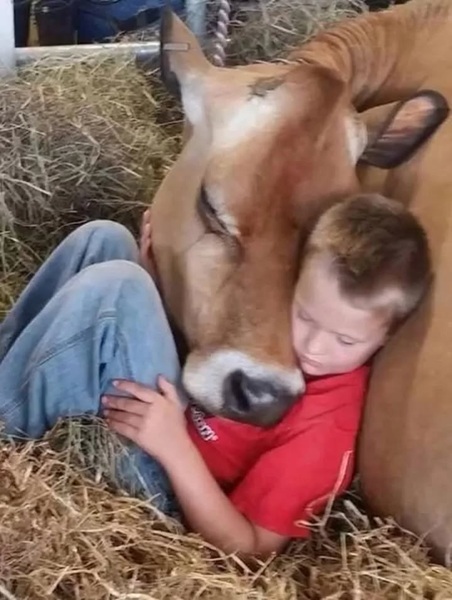
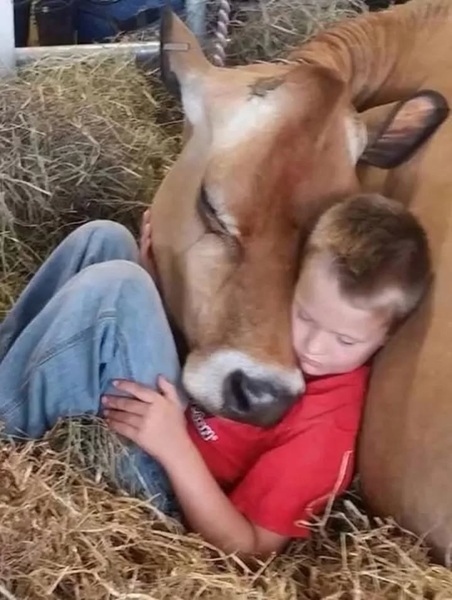
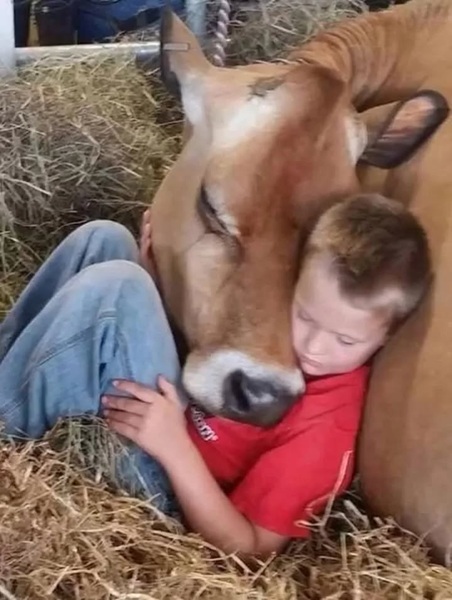
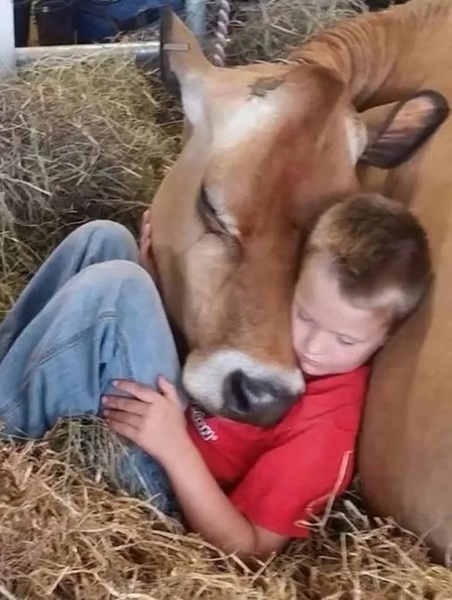
After that, he refused to sleep in our shared bedroom. He wouldn’t touch the blankets, the mattress, or the room itself. Even the house seemed unsafe. Instead, he relocated to the old barn, choosing the hayloft beside Daisy, our calm, aging Jersey cow.
Watching him there is unsettling. He curls against her broad, warm side, a small boy pressed to the animal’s steady heartbeat, eyes closed, trying to find solace in silence.
My mother insists it’s harmless—a child finding comfort in an animal, nothing more. My father waves it off as a temporary phase, a blend of farm life and imagination. But I’ve always known better.
Leo isn’t there out of affection alone. He’s hiding. The barn isn’t a preference—it’s a refuge.
A few nights ago, curiosity and unease compelled me to follow him. Once the house had fallen silent and the last lights were out, I slipped into the barn. The smell of hay, earth, and old wood was heavy, broken only by the slow breathing of livestock.
Shadows danced across the loft as the moon filtered through dusty windows. I stayed out of sight, holding my breath as I watched him settle against Daisy’s side. He didn’t know I was there. Then, almost inaudibly, he whispered.
“I didn’t tell them it was me,” he said. “I know you saw. I know you remember. Thank you for not saying anything.”
Daisy didn’t react. She blinked slowly, deliberately, as though acknowledging the words without needing to respond. In that moment, I understood something deeply unsettling: Leo wasn’t simply avoiding his bed.
He had chosen the only witness who could never speak, the only companion who could not betray his secret. The barn, the hay, and Daisy had become his sanctuary for the unspeakable.
The next day, I confronted him behind the grain silo. I expected resistance, maybe silence, perhaps a shrug or a muttered denial. Instead, he collapsed. His fear, tightly coiled for weeks, spilled out in a rush of relief.
He grabbed my hand tightly, gripping it as if letting go would undo the fragile trust between us. “Don’t open the red toolbox,” he begged. “And don’t show anyone the picture. Promise me.”
I promised, to calm him in that moment. But the words lingered all day, echoing through the house, through the fields, and in my own mind.
When I later searched for the toolbox, it took hours. My father owns countless metal boxes, each a repository for tools, nails, screws, and farm miscellany.
But finally, I found the one Leo meant: an old red metal box hidden beneath the floorboards of the tool shed, buried under rotting burlap sacks. Its paint was chipped, the latch stiff with age. I lifted it gently, aware that the contents were more than mere objects—they were a fragment of a story that no one else could hear.
Inside lay a faded Polaroid photograph. Its edges were curled, and the image was grainy, but the scene it captured was unmistakable. It showed the woods near the abandoned stone well at the edge of our land.
A figure stood near the opening, wearing Leo’s blue windbreaker. What lay at his feet made my stomach drop.
Beneath the photo were several items that did not belong to our family: a single cufflink, unfamiliar car keys, and a small leather-bound notebook with no name inscribed. The air seemed to thicken around me as pieces fell into place.
The disappearance of a hiker in the nearby state park last fall, the searches that yielded nothing, the quiet hush in the news after initial coverage—all of it converged. Leo hadn’t changed because he was growing up. He had changed because he had seen, touched, and carried something no child should ever bear.
He slept beside Daisy not simply for comfort, but because she asked no questions. She offered presence without demand, warmth without judgment. She was the only witness he could trust.
I sat there for a long time, the toolbox open on the floor, processing the weight of what had been passed to me. When I looked toward the barn, I could imagine him curled against Daisy, safe in silence.
The photo, the notebook, the keys—they were not evidence in the legal sense. They were fragments of a moment when his childhood was irreversibly altered. The moment needed to be protected, hidden, understood.
When I closed the toolbox and slid it back beneath the floorboards, I realized my own role had changed. I had become part of the silence, another witness who would not speak. Another keeper of the secret buried deep in the woods, sealed beneath our feet.
As I walked back toward the house, the farm felt louder than ever. The wind in the trees, the rustling of the leaves, the distant lowing of cattle—it all seemed magnified, filled with the weight of things that would never be spoken. That silence had a voice now, and it spoke through everything Leo had left behind.
In the days that followed, life on the farm felt surreal. The ordinary rhythms—the crow of the rooster, the clatter of feed buckets, the hum of the tractor—suddenly seemed layered with a quiet tension.
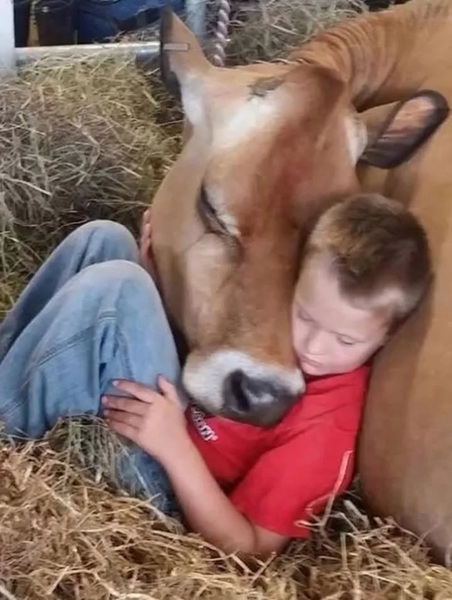
I kept finding myself glancing toward the barn, half-expecting to see Leo there, curled against Daisy as before. But now, every movement, every sound, seemed charged with meaning. It was as if the farm itself had become a living witness, silently observing, holding space for what could not be spoken aloud.
Leo remained in the hayloft most nights, and while he no longer spoke of the Polaroid, the red toolbox, or the small leather notebook, I knew the memory weighed on him constantly.
I began noticing other changes—small, subtle behaviors that hinted at an inner world far beyond his years. He avoided shadows, flinched at sudden noises, and sometimes stayed motionless for hours, staring into nothing. Even meals were different.
He rarely touched the food he once devoured with reckless enthusiasm. The farm that had been a playground for his energy had transformed into a stage for his fear.
One evening, as the sun dipped behind the distant hills and painted the sky in shades of burnt orange and violet, I followed him again. I didn’t speak. I didn’t move. I simply watched him from the doorway as he tended to Daisy, brushing her coarse hair gently, whispering words I couldn’t hear.
She leaned into him, patient and steady. In that quiet ritual, I realized that their bond had become a lifeline, a bridge between the chaos of what Leo had seen and the fragile reality he now inhabited.
The notebook inside the red toolbox remained unopened. Its blank pages—filled only with faint pencil markings and smudged sketches—were like fragments of a world he had been forced to carry alone.
Each symbol, each scribbled note, seemed heavy with meaning that only Leo could interpret. I felt the pull of curiosity, the desire to peek inside, but I restrained myself. This was his burden, not mine, and violating it would break the fragile trust between us.
At night, the house felt empty without him. I would lie awake listening to the soft groan of the old wooden floors and the distant echo of the barn doors creaking in the wind.
Sometimes, I imagined him there, watching the stars through the rafters, the same stars that had witnessed the moment his life changed. Daisy’s steady breathing became a heartbeat for both of us, a reminder that there was still life, still warmth, and still something worth protecting.
Weeks passed. The seasons shifted. Frost crept over the fields, turning the ground white and brittle. Yet Leo’s routine never wavered. He rose before dawn, tending to the livestock, feeding Daisy and the other cows, caring for the chickens with a diligence that bordered on ritualistic.
I began helping, silently, from the edges, learning to respect his boundaries. The silence between us was no longer oppressive—it became a language of trust, a way to show solidarity without words.
One crisp morning, while spreading hay in the loft, I finally spoke. “Leo,” I whispered, careful not to startle him, “I saw the notebook today. You don’t have to carry it alone.”

He froze, eyes wide, then slowly looked at me, the unsteady voice I remembered barely audible. “You promised,” he murmured. “You can’t open it. You can’t tell anyone.”
“I know,” I replied softly. “I’m not going to. But you don’t have to face this by yourself.”
He looked away, focusing on the soft clatter of Daisy chewing her hay. After a long pause, he spoke. “I just… I don’t want them to know. I don’t want to hurt anyone. They can’t understand.”
And in that moment, I understood. This wasn’t about hiding a mistake or mischief. It was about protecting others, shielding them from a truth that could shatter the fragile balance of our lives. Leo had become the silent guardian of a memory too heavy for any child, and the farm had become a sanctuary for the unspeakable.
I began keeping a closer watch, documenting nothing, saying nothing, but observing everything. Every interaction with Daisy, every cautious step through the fields, every glance toward the woods—the patterns of his behavior became clear, like a map to his internal struggle.
And as I observed, I learned to read him without words: the tightening of his jaw, the flicker in his eyes, the way he lingered over certain sounds. He had a language beyond speech, and it was my responsibility to understand it.
At times, I imagined what the world might think if they knew. Headlines, police investigations, questions from neighbors. But none of that mattered. The only reality that counted was the one Leo lived in—the fragile balance between fear and safety, between exposure and concealment. It was a delicate dance, and Daisy was the rhythm that kept it moving.
Even the smallest events became monumental. A crow landing on the fence, a sudden gust of wind through the barn doors, or a rustle in the nearby woods—all were potential triggers. Leo’s reactions were subtle: a tightening of his grip on the railing, a quiet intake of breath, a whispered reassurance to Daisy. And each time, I felt the weight of the silence deepen, pressing against the walls, filling the spaces where laughter and childhood had once lived.
But there were moments of light, too. Sometimes, after a long day of work in the fields, Leo would sit beside Daisy in the hay, brushing her coat with care, and for a few minutes, he would hum softly—a tune that wasn’t spoken, but that carried the echo of a boy still alive beneath the trauma.
In those moments, the farm felt less oppressive, less haunted. It reminded me that even in the darkest silence, life persisted, resilient and patient.
The toolbox, the photo, and the notebook remained hidden. I had become their keeper, entrusted with preserving a story that might never be told.
Every time I passed the tool shed, I felt a pang of reverence, a recognition that some truths are too powerful for the outside world, and some burdens are meant to be carried in silence.
As the winter deepened, snow blanketed the farm. The fields that once shimmered with golden corn were now ghostly white expanses, silent and still. Leo moved through this landscape with careful steps, his blue windbreaker bright against the frost.
Daisy followed him closely, a living shield, a silent witness. And I followed at a distance, a guardian of his secrets, a witness to the weight of what a child should never have to carry.
Through it all, I realized that the farm itself had changed. The barns, the fields, even the wind through the trees seemed aware of the story we were living. Every creak, every rustle, every soft moan of the earth beneath our feet was a reminder that silence carries memory, that some truths are not spoken, and that love and loyalty can exist without words.
And so, I became part of the silence. A silent partner, a witness without voice, keeping vigil over Leo, over Daisy, over the secrets buried beneath the floorboards and the soil.
In a world that demanded explanation, I had learned that some stories are meant to remain hidden, preserved not by neglect but by care, by respect, and by a steadfast commitment to the fragile heart of a child.
The farm, once a place of simple routines and daily labor, had transformed into a landscape of quiet endurance, a sanctuary for a boy who had faced horrors beyond his years
. And as I walked the fields, the snow crunching beneath my boots, I understood fully: silence is not absence. Silence is presence. Silence is protection. And in that silence, we find what words cannot contain.
