At first, Emma and Josh struggled with the separation.
Emma was angry.
Josh became quieter.
They both wanted to know why their father had chosen another woman over our family.
I didn’t have many answers.
Daniel never explained much.
He simply accepted their disappointment and continued attending birthdays, school events, and important family occasions.
But something about him had changed.
He rarely stayed longer than necessary.
He would congratulate the children, ask about their studies, and sometimes bring small gifts.
Then he would leave.
Even when we invited him to stay for dinner, he usually found a reason to decline.
I thought he was uncomfortable being around me.
I thought he wanted to avoid remembering the life he had abandoned.
And because I was still hurt, I never tried to understand his silence.
I told myself he had made his choice.
For five years, I believed that.
I never saw evidence of another relationship.
Our children never mentioned meeting anyone.
Friends occasionally told me they had seen Daniel shopping alone or sitting by himself at a small restaurant.
But I didn’t think much about it.
Perhaps the relationship hadn’t worked out.
Perhaps he preferred being alone.
Either way, I had stopped making his personal life my concern.
I concentrated on raising Emma and Josh and rebuilding my own routine.
Slowly, the anger became less intense.
It never disappeared completely, but I learned how to live with it.
Then, five years after our divorce, my phone rang.
It was Daniel.
I almost didn’t answer.
When I finally picked up, his voice sounded strangely weak.
“Claire?”
“Yes?”
“Can you come to the hospital?”
My heart immediately started beating faster.
“What’s happened?”
There was a pause.
“I need to tell you something.”
“Are the children okay?”
“They’re fine. Please, just come.”
I asked which hospital he was in.
He gave me the name and then added something I wasn’t expecting.
“Don’t call Emma and Josh yet.”
I wanted to ask why, but he sounded exhausted.
So I agreed.
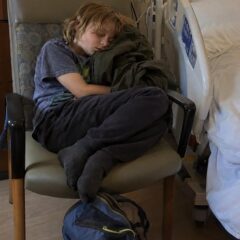
When I entered his hospital room, I stopped at the doorway.
The man lying in the bed looked much older than the Daniel I remembered.
His cheeks were thinner. His movements were slow, and he seemed to struggle even with small adjustments to his blanket.
There were bruises along one of his arms.
A hospital monitor stood beside his bed.
For a few seconds, neither of us spoke.