
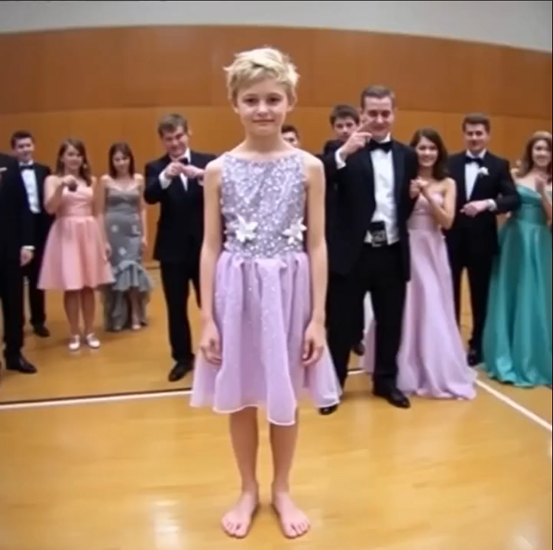
The words fell into the auditorium like a stone into a still pond, and for a moment, the ripples of sound that had always filled the room vanished entirely.
It was a hush so complete, so absolute, that it seemed to suspend time itself. The laughter of teenagers, the nervous shuffling of feet, the whispered plans for post-graduation celebrations—all of it evaporated, leaving only a pregnant silence that felt almost sacred.
My heart seized in my chest. Each beat thundered like a drum in my ears, demanding attention, refusing to be ignored. I could feel the heat rising in my face, the sharp intake of breath as disbelief and awe collided in my mind.
My child, the boy who had once clutched my hand as he learned to walk, the boy whose laughter had once reverberated through every corner of our home, was no longer Liam. He was Lila.
It took several heartbeats, several ragged gulps of air, before I could fully grasp the reality of it. Lila. The name was a soft echo, a gentle vibration that carried with it a weight I could scarcely comprehend. Pride and fear warred within me, twisting and coiling together in a tangle that made it impossible to sit still. Tears, long held in check, pressed against my eyelids, threatening to spill in a tide I had no intention of stopping.

I thought back to the subtle signals that had always been there, quiet and fleeting, but unmistakable in retrospect. The way Liam’s laughter sometimes faltered, the way his eyes could look away when someone complimented him on traditionally masculine achievements, the delicate insistence on wearing certain clothes, expressing certain preferences that hinted at an identity he hadn’t yet felt safe to claim. As a mother, I had noticed. I had felt it in the small, almost imperceptible pauses, the quiet discomfort he tried to hide, the nights when he lay awake, staring at the ceiling with thoughts too complex to voice.
But hearing it—hearing her announce it to the world—was something altogether different. It was raw, courageous, and unyielding. Lila’s voice, steady and clear, carried across the room, each word punctuated with the bravery I had prayed she would one day summon.
“For the longest time, I’ve been trapped, pretending to be someone I’m not,” she said. Her words hung in the air, fragile yet unshakable. “Tonight, I’m taking back my identity. I am a woman, and my name is Lila.”
The words struck like lightning, illuminating every shadowed corner of my mind. The auditorium was no longer merely a venue for celebration; it had become a sanctuary of truth, a stage for courage that demanded recognition. Parents, students, teachers—all of us were witnesses to something far beyond a typical ceremony.
I felt my mind reel back through years of memories, searching for moments that now aligned in perfect clarity. The quiet evenings when Liam had dressed in ways that made him feel comfortable, the subtle blushes when certain subjects came up, the moments of private sorrow and frustration he had never shared, all pieces of a puzzle that had been waiting for this night to make sense.
Tears finally broke free, coursing down my cheeks with the force of a long-suppressed river. I could barely contain the swell of emotion threatening to drown me—pride, deep and overwhelming, mingled with a gnawing fear for the challenges Lila would inevitably face in a world that is often unkind to those who deviate from its rigid expectations. And above all, there was love—a fierce, unyielding force that refused to diminish, regardless of confusion, fear, or societal expectations.
“I know some of you might not understand,” Lila continued, her gaze sweeping across the room with a steady confidence that belied her years. “Some of you might never accept me. But that’s okay. I’m finally free, and I want to thank my mom for teaching me to be strong, for loving me even when things got tough.”
Her voice quivered ever so slightly on the final words, a reminder that beneath the armor of public confidence, she remained my child—vulnerable, brave, and searching for acceptance. I wanted to run to her, to envelop her in my arms and shield her from every potential hurt. I wanted to promise her that the world’s cruelty could never diminish the fierce, protective love I held for her.
Yet I remained seated, paralyzed by the enormity of the moment. I could only watch as she stood before everyone, claiming her space, radiating authenticity, and demanding recognition.
The principal, a man of few words and composed demeanor, stepped forward. His expression softened, and his voice, calm yet imbued with respect, resonated through the auditorium. “Lila, we respect your courage and your truth. Congratulations on your graduation.”

The room hesitated, suspended in the delicate balance between shock and admiration. And then—a single, tentative clap echoed from the back.
It was small at first, almost imperceptible, but it was enough to spark a wave. One by one, hesitant hands joined in. The applause grew, initially uncertain, then gradually swelling into a tide of genuine recognition. It was a sound that seemed to cleanse the room of disbelief, transforming tension into respect, confusion into understanding.
As Lila descended the stage, each step deliberate and grounded, I observed every nuance: the slight lift of her chin, the steady rhythm of her stride, the quiet confidence radiating from her posture. She had claimed her identity fully, and the world—if only in that moment—was bearing witness.
When she reached me, my restraint shattered. I threw my arms around her, holding her as though I could shield her from every cruelty and every doubt that might exist beyond these walls.
“I’m so proud of you,” I whispered, my voice thick with tears and emotion. “I love you, Lila.”
Her hands rested lightly on my shoulders as she pulled back just enough for our eyes to meet. In that gaze, I saw a universe of gratitude, of vulnerability, and of fierce determination. She was still my child—my brilliant, resilient, courageous child—but now she was entirely herself, standing fully in the light of her truth.
“Thank you, Mom. For everything,” she said softly, the words fragile yet powerful, carrying the weight of years of unspoken struggle and quiet triumph.
For a moment, nothing else existed. The claps, the murmurs, the collective awe of the auditorium faded into irrelevance. All that remained was Lila—brave, radiant, authentic—and the boundless love that surged through me, impossibly deep, impossibly protective.
After the applause faded and the crowd began to drift out of the auditorium, a quiet settled over us—a hush that was no longer imposed by shock, but by something deeper, more intimate. It was the kind of silence that wraps around your heart, soft yet profound, leaving space for reflection and understanding. I held Lila’s hand in mine as we walked slowly down the steps, each footfall a gentle grounding of reality after the intensity of the stage.
I couldn’t help but replay the evening in fragments in my mind. Every smile she had forced, every laugh she had faked, every hesitation she had tried to hide—now they all coalesced into a story I could finally see in its entirety. I remembered Liam as a little boy, wide-eyed and curious, endlessly asking questions about the world. He had always been observant, sensitive in ways that made him different from the other boys his age, and at times, that difference had made him retreat inward, away from the teasing, away from expectations he could not reconcile with himself.
I remembered one evening in particular, when he was about seven. We were sitting in the living room, and he had been quietly drawing in his sketchbook. I glanced over his shoulder and noticed the figures he had drawn—not trucks or soldiers or superheroes, but delicate dresses, flowing and vibrant, swirling figures that moved as if alive. I asked, “What are these?” and he looked at me with wide, earnest eyes and whispered, “Just people… people like me.” At the time, I didn’t fully understand what he meant, but I remembered feeling a sudden ache in my chest, an unspoken knowledge that he was carrying something inside him, something we hadn’t yet named.

There were the afternoons he spent insisting on choosing clothes from my wardrobe—bright, soft fabrics that felt right to him, no matter how many sideways glances we received from neighbors or friends. There were quiet evenings when he would lie awake in his room, the faint glow of a nightlight casting shadows across his walls, and I would hear the occasional sigh, the trembling of a hand brushing his hair from his face. I would knock gently, ask if he needed anything, and he would mumble a quiet “I’m okay,” though I knew he was not. He had been trying to fit a shape the world demanded of him, even as every fiber of his being resisted.
High school had brought its own set of challenges. The awkwardness of adolescence was always there, layered over a deeper tension I could sense but could never fully articulate. Social events, gym classes, sports teams—he would participate, but there was often a shadow over his joy. I noticed it in the way his smile sometimes faltered when a peer made a joke about being “just a boy,” in the way he hesitated before responding to questions about the future, unsure how to navigate a world that seemed to insist he conform to a mold he didn’t fit.
And yet, even in those moments of quiet struggle, there were flashes of brilliance, of courage, of self-expression that shone through like sunlight through clouds. He had always been fiercely creative, deeply empathetic, and startlingly perceptive for his age. I remembered the night he had cut his hair into a style that felt right to him—shorter, softer, expressive. I had watched, silently, as he examined himself in the mirror, a mixture of apprehension and exhilaration in his gaze. “Mom, do you like it?” he asked, almost tentatively. I had smiled, hugged him tightly, and whispered, “I love it because it’s you.” That had been a small victory, a quiet assertion of identity that felt monumental at the time.
Then came the teenage years, where the internal struggle became more pronounced. I remembered the nights he would confide in me, trembling as he spoke of confusion, of fear, of the gnawing sense that he was living a life that wasn’t fully his own. “Mom,” he whispered one night, tears spilling down his cheeks, “will you still love me if I’m not Liam anymore?” My arms had enveloped him then, tighter than ever, and I had whispered back, “I will love you exactly as you are. Always.” That promise, sacred and unbreakable, had been the foundation on which we both relied, a thread of trust that carried us through countless storms.
All of these memories collided in my mind as I watched Lila in that moment—standing before me, radiant and unwavering in her truth. The girl who had once been my son had always existed within him, quietly, patiently waiting for the right moment to emerge. And now, in the fullness of her courage, she had claimed her identity, and the world had finally seen her as she had always been.
As we reached the car and drove home, the streets quiet in the late evening, I found myself reflecting not just on her journey, but on mine as a parent. Loving a child whose identity doesn’t fit society’s rigid definitions requires a patience and understanding that is often tested by fear, doubt, and the unknown. There had been moments of uncertainty when I worried that I wouldn’t know how to support her fully, moments when I questioned if the world would ever accept her, moments when I silently grieved the innocence of a childhood untroubled by societal expectations.
But there were also moments of profound clarity, moments when I realized that love is not defined by conformity, but by acceptance, advocacy, and unwavering support. Each small act of courage she displayed—telling me the truth about her feelings, asserting her preferences, choosing her own identity—was met with a response of love and respect. And each of those responses had reinforced the bond between us, transforming fear into mutual trust, uncertainty into unwavering loyalty.

At home, the familiar walls welcomed us back like an embrace. The living room, dimly lit by the soft glow of the lamps, seemed to hum with the energy of the evening’s events. Lila settled into the armchair, brushing a strand of hair from her face, and I watched her with a mixture of awe and reverence. Here was the child who had navigated so many internal and external challenges, the young woman who had faced the world and spoken her truth, sitting calmly, yet undeniably powerful, in the comfort of her home.
I thought again about the journey that had led to this night—the countless conversations, the silent tears, the small victories that had often gone unnoticed by others. I thought about the courage it had taken for her to announce her identity in front of peers, teachers, and strangers, fully aware that reactions could range from acceptance to confusion to outright rejection. And yet she had done it anyway, driven by an unshakable understanding of herself, and by a bravery that only grows from deep, lived experience.
As the evening wore on, we talked quietly, reflecting on what had happened and sharing our thoughts on the road ahead. She spoke of hope, of excitement, and of the challenges she anticipated encountering in the coming months and years. I listened, interjecting words of encouragement, promising my continued support, reminding her of the unwavering love that had always been present, even in the moments when she felt most alone.
And in the quiet spaces between our words, I allowed myself to grieve—not for her identity, but for the moments lost to fear, to societal expectation, and to misunderstanding. I grieved the years when she had felt unseen, unheard, and constrained by a world that too often imposes labels and boundaries on those who are different. But alongside that grief was a profound gratitude—gratitude that she had endured, that she had thrived, that she had emerged whole and luminous, ready to embrace life as her authentic self.
That night, as I watched her prepare for bed, her reflection in the mirror steady, confident, and serene, I realized that this was more than a milestone—it was a rebirth. The child I had once known, the boy who had clung to my hand in uncertain moments, had transformed into a young woman who owned her truth without hesitation. And in witnessing that transformation, I felt an awe that was almost sacred, a reverence for the resilience of the human spirit and for the profound power of self-acceptance.
The journey had been long, and the road ahead would undoubtedly present its own challenges, but I knew with certainty that Lila possessed the courage, the intelligence, and the resilience to face whatever lay ahead. And I, as her mother, would walk beside her, offering love, guidance, and unwavering support, as we had always done.
In that quiet, luminous night, I whispered a prayer—not for protection, not for certainty, but for the continued blossoming of her spirit, for the assurance that she would always feel safe in her own skin, and for the enduring bond between us that had been strengthened through struggle, understanding, and love.
The morning after the graduation felt different—lighter, more expansive, as if the air itself had shifted in acknowledgment of what had transpired the night before. The sun streamed gently through the curtains, painting warm patterns across the walls of our home. Lila moved through the house with a newfound ease, her movements deliberate, her posture unburdened by the weight of uncertainty that had once shadowed her steps. She smiled at me with a quiet confidence, the kind that comes not from validation by others, but from a deep, internal understanding of oneself.
We prepared breakfast together, a ritual that had always been simple yet comforting, but now it carried an extra layer of significance. The sound of laughter—pure, unrestrained, and joyous—filled the kitchen. For the first time in a long time, I noticed the subtle ways she carried herself, gestures that had once seemed small, tentative, now fully expressive and radiant. She hummed a soft tune while slicing fruit, her hands steady, her movements precise, yet fluid, reflecting a harmony between her inner self and the outer world.
I remembered the countless mornings of anxiety and unease, the silent breakfasts where I had watched my child pick at food while lost in thought, unsure how to navigate the expectations of others. Now, sitting across from her at the table, I could see the sheer relief etched into her features—the sense of liberation that comes from finally being able to inhabit one’s own skin without compromise or concealment.
Later that day, friends and extended family began to arrive for a small, intimate celebration. There were hugs, congratulations, and well-wishes, many accompanied by cautious smiles as people adjusted to using her new name, embracing her new identity. Each acknowledgment was a step toward understanding, a ripple in the pond of societal perception. Some faces displayed visible surprise, others tentative curiosity, and yet almost all carried a quiet respect—a recognition that courage like hers commands attention, even when it challenges conventional expectations.

Throughout the gathering, I observed Lila with a mixture of pride and awe. She engaged with guests with the poise and grace of someone who had spent years refining her understanding of self, yet beneath that exterior lay the tender vulnerability that only those closest to her truly knew. When a family friend whispered, “She’s so brave,” I could only nod, my throat tight with emotion. Brave—yes, but also enduring, resilient, and unyieldingly authentic.
As the day progressed, I found moments to retreat with her into quieter spaces, where conversation flowed freely, unencumbered by social expectations. We spoke of everything—the past, the present, and the future—with a candor that had often been difficult to achieve. She confided her hopes, her fears, and the aspirations she had held quietly, nurturing them as one might care for fragile seedlings until they were strong enough to thrive in the open.
I listened, offering guidance where appropriate, but mostly bearing witness. There is a profound honor in observing the blossoming of one’s child, especially when that blossoming emerges from struggle, self-discovery, and courage. I marveled at the seamless blending of strength and vulnerability, of resilience and tenderness, that she now carried so naturally.
Later, as the evening drew near, we stepped outside onto the patio. The sky had turned a deep, velvety blue, punctuated by the first glimmers of evening stars. Lila stood there, framed by the fading light, and I felt a surge of emotion that was almost spiritual in its intensity.
Here was the person she had always been, fully realized, radiant in her authenticity. Her gaze met mine, steady and luminous, and in that simple act, I felt a communication deeper than words—a mutual acknowledgment of the journey we had shared, the challenges we had faced, and the unbreakable bond that had grown stronger with each step.
“I feel… lighter,” she said softly, her voice carrying the weight of months and years finally released. “Like I can breathe in ways I didn’t know I needed to.”
I nodded, tears brimming in my eyes, and whispered, “You can breathe now, fully. You’ve earned this freedom, and I will be here with you for every breath after.”
The conversation shifted naturally, meandering through topics both trivial and profound. She spoke of friends who had shown acceptance, of moments of uncertainty that had now transformed into learning experiences, and of the ambitions she held for her future. Education, career aspirations, personal growth—every dream seemed now more tangible, more attainable, because she had faced the greatest challenge first: claiming her own identity.
That night, as the household settled into quiet, I watched her prepare for bed. She moved with a calm grace, brushing her hair, arranging her belongings, and pausing to admire her reflection in the mirror. I stayed nearby, reluctant to intrude, yet unable to tear my eyes away from the young woman who had emerged from so much struggle, yet radiated serenity, confidence, and a quiet defiance of societal expectation.
I thought back to the earliest memories of her childhood—the soft sobs whispered into my shoulder, the tiny victories of self-expression, the moments when she had sought reassurance that she would still be loved unconditionally. Each memory, each fragment of the past, now formed a luminous tapestry, a narrative of resilience and courage that culminated in the person standing before me.
I realized then, in a moment of profound clarity, that the journey had not been hers alone. It had been ours together, a shared odyssey of learning, growing, and discovering the depth of love, patience, and understanding. And that understanding had transformed us both, teaching lessons about acceptance, empathy, and the enduring power of unconditional love.
In the days that followed, life began to settle into a new rhythm. School routines, social interactions, and community life continued, but the shadow of uncertainty had lifted. Lila navigated each encounter with confidence, facing curious questions, cautious acceptance, and the occasional misunderstanding with a quiet dignity that left those around her inspired. Even the small victories—the correct pronouns used by teachers, the thoughtful support of friends, the gentle acknowledgment from acquaintances—felt monumental, because each represented the world’s gradual recognition of her truth.
I marveled at how she navigated these moments, with the same poise and bravery she had demonstrated on the stage that unforgettable night. And in those moments, I felt a profound sense of gratitude—not only for her courage but for the gift of witnessing the emergence of her true self.
On quiet evenings, we would often sit together, reflecting on the journey, speaking of dreams and fears, laughter mingling with occasional tears. She would recount the small acts of defiance, the moments of self-discovery, the silent acknowledgments from those who had begun to understand her. And I would listen, cherishing each word, each revelation, each spark of hope that shone from her being.
Through it all, one truth remained constant: the bond between us had grown immeasurably stronger. Love had been tested, stretched, and refined through adversity, and it now existed in a form deeper than I had ever imagined possible. It was a love that demanded nothing but presence, understanding, and unwavering support—a love that mirrored the courage and authenticity that Lila had shown the world.
Years later, I would look back on that graduation night as a turning point—not merely a ceremonial milestone, but a sacred moment of transformation. A moment when identity was claimed, when courage was celebrated, and when love, in its purest form, revealed its boundless capacity to heal, to support, and to empower.
Lila’s story, our story, became a beacon—not only for ourselves but for anyone who had ever felt unseen, unheard, or trapped by expectation. It was proof that authenticity is its own triumph, that courage carries the power to reshape perception, and that love, unreserved and unconditional, is the foundation upon which every transformation must rest.
And as I held her hand in the quiet moments of reflection, as I whispered my pride and love into the night, I understood something eternal: that the journey to truth is never solitary. It is shared, nurtured, and witnessed. And in that shared witnessing lies the deepest form of connection—the kind that binds hearts, transcends fear, and illuminates the world with the brilliance of being unapologetically oneself.
Lila had always been extraordinary, but now, fully herself, she radiated a light that touched every corner of our lives, every heart that encountered her. She was no longer merely my child; she was a symbol of resilience, bravery, and the unshakable power of truth. And I, her mother, had the honor of watching, guiding, and loving her through every step of that remarkable journey.
In the quiet aftermath, after the echoes of applause and congratulations had faded, there remained only the profound, unassailable certainty that Lila was home in her own skin. She was free, brave, and luminous. And I, her mother, would carry her story, her courage, and our shared love in my heart forever.
