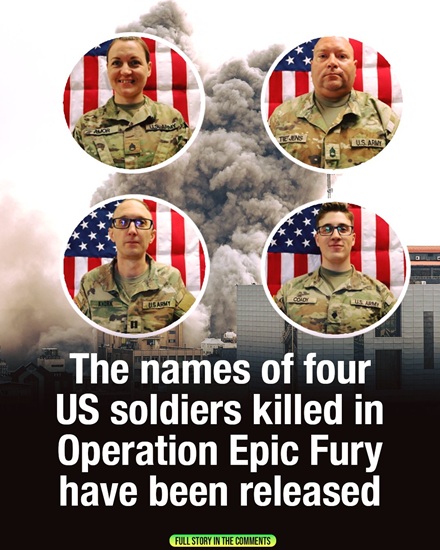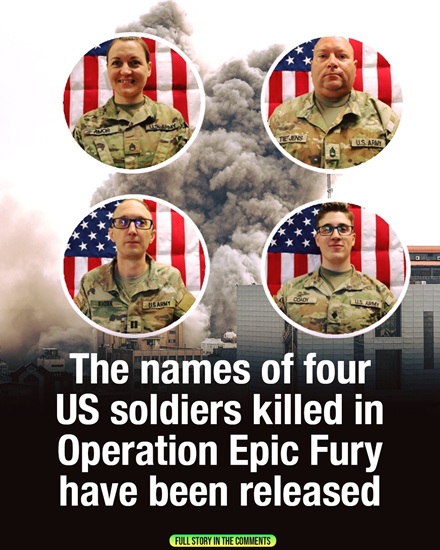
In late February 2026, amid a dramatic escalation of hostilities in the Middle East, the United States and allied forces launched a large‑scale military campaign known as Operation Epic Fury.
Designed as a decisive response to mounting threats posed by Iran, the operation quickly expanded into one of the most intense military engagements involving U.S. forces in recent years.
Within the opening days of the campaign, the grim reality of war struck with force: the first confirmed American combat casualties of the conflict. On March 1, 2026, six U.S. service members were killed during a retaliatory drone strike on a logistics and command facility at the Port of Shuaiba in Kuwait — a strategic hub used by U.S. and coalition forces to support operations across the wider theater of conflict.
According to official Pentagon statements, the attack involved an unmanned aircraft system that breached protective defenses and hit a tactical operations center where the service members were stationed in support of Operation Epic Fury.
The deaths of these service members marked the first U.S. combat fatalities since the broader conflict began — a sobering and solemn milestone that underscored the dangerous and unpredictable nature of modern warfare. U.S. Central Command later confirmed that the remains of two previously unaccounted‑for soldiers were recovered from the attack site, completing the official casualty count at six.

Operation Epic Fury: Context and Escalation
Operation Epic Fury was initiated in late February after coordinated strikes by U.S. and Israeli forces targeted a broad range of Iranian military and strategic assets. These preemptive operations aimed to degrade Iran’s offensive and defensive capabilities, including ballistic missile brigades, drone swarms, naval platforms, and other high‑value targets.
Over the first 72–100 hours of the campaign, U.S. forces struck thousands of targets, including air defense sites and naval vessels, while mobilizing more than 50,000 troops, 200 combat aircraft, and multiple carrier strike groups.
In response, Iranian forces launched extensive counterattacks across the region, using a combination of ballistic missiles, armed drones, and other long‑range systems. These attacks targeted not only Israeli cities and military infrastructure but also U.S. bases and facilities in neighboring Gulf states.
The assault on Port Shuaiba — a key logistical node — came amid this intense exchange, highlighting how rapidly the conflict’s dangers extended beyond front‑line battlefields into areas previously considered secure.
The Strike at Port Shuaiba
The Port of Shuaiba, located on the southern coast of Kuwait along the Persian Gulf, has long served as a crucial logistical staging point for U.S. military operations in the region. It supports the movement of fuel, equipment, and supplies essential to sustain forces deployed across the Middle East. Despite its importance, the facility was struck by an unmanned aircraft system — widely reported as a drone — in the early hours of March 1.
U.S. military officials described the target of the attack as a tactical operations center used for command, control, and logistical coordination. Although such facilities are typically hardened against threats, multiple news reports and satellite imagery analyses have indicated that structures at the site offered limited overhead protection, which may have contributed to the devastating effects of the strike.

The attack instantly killed several soldiers at the scene; others succumbed to injuries later or were initially unaccounted for until their remains were recovered as the investigation progressed. CENTCOM formally announced that six U.S. service members had been killed in action during the incident — a number that included personnel whose identities were confirmed both immediately and in the days following the strike.
The human cost of Operation Epic Fury became tragically tangible on March 1, 2026, when six members of the 103rd Sustainment Command (Expeditionary) — an Army Reserve unit based in Des Moines, Iowa — lost their lives at Port Shuaiba, Kuwait. Beyond the headlines and official statements, each soldier represented years of dedication, sacrifice, and service to both country and community. Their stories illustrate not only military achievement but also personal courage, commitment to family, and the enduring bonds formed in the armed forces.
Captain Cody A. Khork, 35 — Winter Haven, Florida
Captain Khork’s career exemplified the modern Army Reserve professional: highly skilled, deeply committed, and broadly experienced. Enlisting in 2009, Khork trained as a Military Police Officer, a role that demanded both leadership under pressure and a nuanced understanding of operational security. Over the years, he deployed to Saudi Arabia, Guantánamo Bay, and Poland, contributing to stability operations, joint exercises, and law enforcement support within military contexts.
Khork’s decorations, including the Meritorious Service Medal and the Military Outstanding Volunteer Service Medal, reflect not only operational excellence but also his dedication to volunteerism. Fellow soldiers remembered him for his meticulous planning, calm leadership, and a quiet determination to ensure the welfare of his team.
In civilian life, Khork was active in local veteran support initiatives, mentoring young service members and contributing to community development programs in Florida. His sudden loss has resonated widely, leaving a profound void among peers and residents who knew him personally.
Sergeant 1st Class Nicole M. Amor, 39 — White Bear Lake, Minnesota
Sgt. 1st Class Nicole Amor began her military service with the Minnesota National Guard in 2005, later transitioning to the Army Reserve where she specialized in logistics and operational support. Over two decades of service, she became widely respected for her meticulous approach to sustainment operations, ensuring troops in forward-deployed areas had the supplies and equipment essential to mission success.

Amor’s deployments to Kuwait and Iraq demonstrated her ability to navigate the complex logistical demands of modern operations. Colleagues frequently praised her mentorship of junior soldiers and her commitment to creating a positive, cohesive unit culture.
Amor earned multiple service awards for her leadership, efficiency, and dedication. Beyond the uniform, she was known for her devotion to family and community initiatives, often volunteering to assist military families facing relocation or hardship. Her loss is felt deeply by the Army Reserve and by those whose lives she touched both on and off duty.
Sergeant 1st Class Noah L. Tietjens, 42 — Bellevue, Nebraska
Sgt. 1st Class Noah Tietjens was a wheeled vehicle mechanic, specializing in maintaining and repairing the vehicles critical for operational mobility. His expertise ensured that convoy and transport missions could be executed safely and efficiently across hostile environments. Over the course of multiple deployments — including two tours in Kuwait — Tietjens earned commendations for his technical skill, problem-solving ability, and leadership under pressure.
Peers described him as the “steady hand” of the unit, someone who could be relied upon to troubleshoot complex mechanical issues even in high-stakes situations. Tietjens also devoted considerable time to training and mentoring junior mechanics, leaving a lasting imprint on the next generation of Army Reserve personnel. Outside the military, he was known for his community engagement, supporting local STEM education initiatives and youth programs that encouraged technical skills. His death not only removes a critical operational asset but also a mentor and friend to many.
Sergeant Declan J. Coady, 20 — West Des Moines, Iowa
Sgt. Declan Coady represented the new generation of service members combining military service with academic ambition. Enlisting in 2023 as an Army Information Technology Specialist, Coady balanced his Reserve duties with university studies in cybersecurity and information systems. Despite his youth, he quickly distinguished himself through technical acumen, professionalism, and a commitment to teamwork.
In recognition of his service, he was posthumously promoted from Specialist to Sergeant, honoring both his achievements and potential. Family, friends, and instructors remembered him as bright, disciplined, and compassionate — qualities that promised a long and impactful career both in the Army and in technology fields. His loss resonated strongly in Iowa, with community leaders and educators highlighting his promise, dedication, and the stark reality of sacrifice young Americans face when serving their nation abroad.
Chief Warrant Officer 3 Robert M. Marzan, 54 — Sacramento, California
Chief Warrant Officer Marzan served as a senior technical officer within the 103rd Sustainment Command, providing crucial oversight for operational support missions. With over three decades of military experience, Marzan’s career spanned multiple conflicts and peacekeeping operations. His expertise lay in coordinating logistics, supply chains, and command operations, ensuring that forward-deployed units had the equipment and support necessary to sustain combat readiness.
Marzan’s colleagues recall him as a leader who combined rigorous standards with personal care for those under his supervision. His decades of experience helped shape the operational capabilities of the Army Reserve, leaving a legacy of discipline, mentorship, and strategic foresight. In Sacramento, he was active in veteran advocacy and public service programs, further demonstrating his commitment to both military and civilian communities.
Major Jeffrey R. O’Brien, 45 — Indianola, Iowa
Major O’Brien, like Marzan, played an essential role in the logistics and operational management of U.S. forces during Operation Epic Fury. His career was marked by assignments that demanded both strategic oversight and hands-on management of complex operations. Known for his decisiveness and tactical planning ability, O’Brien was integral in coordinating sustainment efforts, ensuring mission objectives were met efficiently and safely.
Family and fellow officers remembered him as a professional with unwavering integrity, a mentor to junior officers, and a dedicated father. His leadership extended beyond the battlefield, influencing the culture and effectiveness of the units he served in, and setting a standard for excellence in Army Reserve service.

The sacrifices of these six individuals resonate across the United States, particularly in the communities from which they hailed. From Iowa to Minnesota, Florida to California, local leaders, military officials, and residents have expressed profound grief and respect. Tributes emphasize not only the operational significance of their roles but also the human dimensions of service — the family connections, mentorship, and community engagement that each soldier embodied.
As Lieutenant General Robert Harter, Chief of Army Reserve, said in an official statement:
“We honor our fallen Heroes, who served fearlessly and selflessly in defense of our nation. Their sacrifice, and the sacrifices of their families, will never be forgotten.”
Similarly, Major General Todd Erskine reflected on the collective loss:
“These Soldiers are the heart of America. Their courage, professionalism, and dedication safeguard our freedom every day.”
Finally, Brigadier General Clint A. Barnes highlighted the character and legacy of the fallen:
“They are the ultimate ambassadors for freedom. Their lives reflect the best ideals of the United States Army.”
The stories of Capt. Khork, Sgt. Amor, Sgt. Tietjens, Sgt. Coady, CWO3 Marzan, and Maj. O’Brien remind us that behind every statistic of wartime casualties lies a tapestry of personal sacrifice, leadership, and enduring service — a legacy that will continue to inspire future generations of Americans.
The deaths of six U.S. service members at Port Shuaiba sent immediate shockwaves through their hometowns, the military community, and the nation at large. While military reports provided the operational details of the attack, the personal dimension of the tragedy quickly became the focal point for local and national media. Families, neighbors, and colleagues rallied to honor the fallen, emphasizing the human stories behind the headlines.
Community Response and Local Mourning
In West Des Moines, Iowa, the hometown of Sgt. Declan Coady, community members organized vigils at local schools and civic centers. Candles and banners bearing his name and rank appeared across public spaces as residents expressed solidarity with his family.
Teachers and university professors highlighted Coady’s dedication to cybersecurity studies and his promise as a young leader in technology and military service. One professor described him as “a young man who carried the weight of responsibility with grace and curiosity, always eager to learn and support others.”
Similarly, in White Bear Lake, Minnesota, Sgt. Nicole Amor’s neighbors and fellow service members gathered to remember her decades of dedication to both military service and volunteer work. Local news outlets covered her life extensively, recounting her deployments, mentorship of junior soldiers, and community initiatives. Her extended family shared memories of her devotion to children’s programs, local charities, and her unwavering commitment to her loved ones.
In Winter Haven, Florida, memorials were held for Capt. Cody Khork, with local veteran organizations and municipal leaders participating in ceremonies that celebrated both his military achievements and community contributions.
Sacramento, California, honored Chief Warrant Officer Robert Marzan with gatherings at veteran centers and public spaces where Marzan had contributed through advocacy and mentorship programs. In Indianola, Iowa, Major Jeffrey O’Brien was remembered for his leadership in the Army Reserve and his service to local schools, youth programs, and civic organizations.
Across these communities, a recurring theme emerged: the acknowledgment that military service extends beyond uniformed duty. Each fallen soldier represented the values of leadership, mentorship, and public service, leaving a legacy that would endure far beyond the battlefield.
National and Military Tributes
The Pentagon and U.S. Army Reserve leaders issued formal statements paying tribute to the fallen. Lieutenant General Robert Harter, Chief of Army Reserve, emphasized that the sacrifices of these soldiers epitomize the courage and dedication that underpin the nation’s defense: “These brave individuals exemplified the highest standards of service, professionalism, and selflessness. Their legacy will inspire all who wear the uniform.”
Other military leaders echoed these sentiments. Major General Todd Erskine remarked: “Their courage reminds us that freedom is protected by the valor of ordinary men and women who answer an extraordinary call.”
Brigadier General Clint A. Barnes highlighted their role as “ambassadors for freedom,” underscoring how their conduct embodied American values in the theater of operations.
At the national level, congressional leaders and policymakers offered statements of condolence, while veteran organizations launched campaigns to support the families, emphasizing mental health services, financial assistance, and ongoing recognition of the sacrifices made by military households.
Operational Context and Strategic Implications
While the focus on human loss is paramount, understanding the broader military and geopolitical framework of Operation Epic Fury is critical. The operation was part of a larger regional escalation involving the United States, Israel, and allied forces responding to Iranian military activities, including drone strikes, missile launches, and the fortification of strategic military positions in the Gulf.
Port Shuaiba’s role as a logistics hub underscores the vulnerabilities inherent even in facilities not directly engaged in frontline combat. Analysts note that modern conflicts increasingly involve asymmetric threats, such as unmanned aerial systems and long-range precision strikes, capable of reaching supply lines, command centers, and rear-echelon personnel.
The attack in Kuwait illustrates the changing nature of warfare, where non-combat spaces can become targets, demanding adaptive defense strategies, hardened facilities, and rapid intelligence response mechanisms.
U.S. Central Command, following the March 1 attack, implemented heightened security protocols at all overseas bases and ports of entry, emphasizing drone detection systems, reinforced protective measures, and the redistribution of critical personnel to minimize exposure. These measures reflect lessons learned from evolving threat landscapes and signal the military’s commitment to safeguarding personnel and mission readiness.
Memorials and Remembrance Efforts
Plans for permanent memorials are underway both in the United States and at military sites abroad. Local veteran organizations are coordinating commemorative plaques, scholarship funds, and annual remembrance events in honor of the fallen service members. For example:
- In Iowa, the community has established the Sgt. Declan Coady Memorial Scholarship, aimed at supporting students pursuing studies in cybersecurity and technology, reflecting his dual passion for military service and academic achievement.
- In Minnesota, volunteers are expanding a logistics and leadership mentorship program in Sgt. Amor’s name, designed to encourage young service members to pursue excellence in operational support roles.
- Florida and California are planning memorial ceremonies at civic centers to celebrate Capt. Khork’s and CWO3 Marzan’s service, ensuring public awareness of their contributions both domestically and internationally.
These initiatives serve not only as a tribute to individual sacrifice but also as enduring educational tools, illustrating the personal and societal value of military service to the broader public.
Reflections on Service and Sacrifice
The loss of Capt. Khork, Sgt. Amor, Sgt. Tietjens, Sgt. Coady, CWO3 Marzan, and Maj. O’Brien is a stark reminder that the human dimension of warfare extends far beyond headlines and strategy briefings. Families mourn, communities rally, and the nation reflects on the cost of freedom and security. Their lives were defined by courage, professionalism, and devotion to others — qualities that leave an indelible mark on the Army Reserve and the communities they served.
In this context, Operation Epic Fury continues, but with the somber recognition of the stakes involved. As U.S. and allied forces adapt to evolving threats, the sacrifices of these six soldiers provide a poignant reminder: every operational success carries the weight of human life, and every victory is inseparable from the valor and commitment of those who serve.
By commemorating their lives, sharing their stories, and supporting their families, the nation ensures that their legacies will endure. They remain symbols of dedication, courage, and the unwavering spirit of service — the true heart of America’s military strength.