
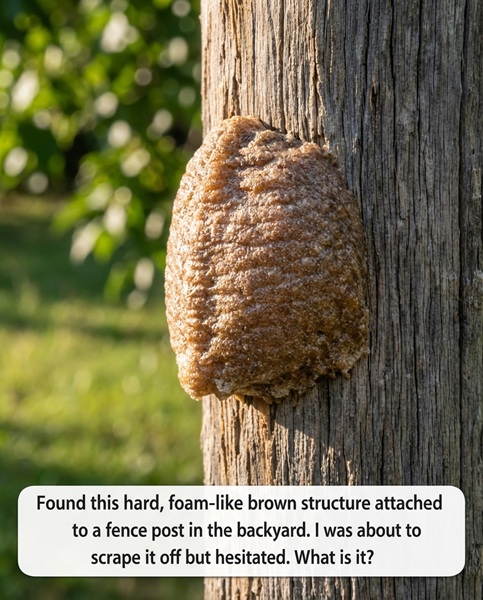
At first glance, a praying mantis ootheca—a small, hard, foam-like mass clinging to a fence post, branch, garden stake, or shrub—can seem oddly out of place, even unattractive.
Its surface is tan or light brown, ridged and spongy, with a texture that is simultaneously firm yet slightly springy. To the casual observer, it may not immediately register as a living structure.
It doesn’t look like a nest, it isn’t a fungus, and it certainly isn’t something you remember creating. In many cases, the initial instinct is to remove it—scrape it off, discard it, or destroy it—viewing it as a minor obstruction or an unsightly object in the otherwise tidy garden space.
Yet, that pause—the moment when hesitation takes over—is crucial. It is a moment that, if heeded, allows us to recognize the subtle complexity of life quietly unfolding in our backyards. This seemingly mundane object is, in fact, a masterpiece of natural engineering: the ootheca, the protective egg case of a female praying mantis. Though it may appear insignificant, it is a critical element in the intricate web of a functioning garden ecosystem.
Nature’s Ingenious Survival Strategy
The ootheca is the product of a reproductive strategy refined over millions of years. Female mantises construct these cases in late summer or early autumn, shortly after mating. Timing is essential: the eggs within must survive the cold winter months to hatch in spring. The ootheca serves as the first line of defense, ensuring that the developing embryos are shielded from frost, rain, wind, and predators.
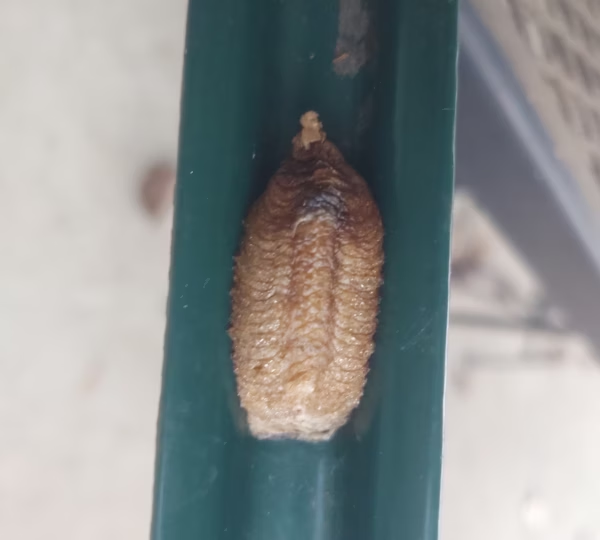
The process begins with the female mantis secreting a frothy, sticky substance from glands in her abdomen. This substance rapidly expands into a foamy mass around the clutch of fertilized eggs. Within minutes, it hardens into a light, spongy yet resilient shell, forming a structure both strong enough to withstand external pressures and lightweight enough to cling securely to branches or other substrates. Depending on the species, an ootheca typically measures between one and two inches in length, though some species produce larger or more elongated cases containing hundreds of eggs.
The foam-like casing is carefully ridged and patterned. These ridges are not merely decorative—they serve functional purposes. They increase the surface area, allowing the case to expand slightly under pressure without breaking, and contribute to its insulating properties, protecting the eggs from extreme temperatures. The ootheca’s texture is soft enough to absorb minor impacts, yet firm enough to prevent predation by small birds, rodents, or other insects.
Camouflage and Ecological Integration
One of the most remarkable aspects of the ootheca is its camouflage. Evolution has finely tuned its coloration, shape, and placement to make it nearly invisible against its typical background. A tan, ridged egg case attached to a twig, branch, or fence post blends seamlessly into the environment. Its resemblance to a hardened lump of debris, bark, or dried plant matter ensures it remains overlooked by potential predators. Even birds and small mammals, which might prey on eggs, often fail to recognize it as a source of food.
The placement of the ootheca is no accident. Female mantises select locations with care, guided entirely by instinct. Factors like exposure to sunlight, proximity to prey-rich areas, protection from heavy rainfall or wind, and relative safety from human or animal interference all play a role. Some oothecae are attached vertically, clinging to plant stems or fence posts; others are tucked under leaves, hidden along tree branches, or affixed to horizontal surfaces. Each choice increases the likelihood of the eggs’ survival through winter.
Life Encased Within
Beneath the unassuming exterior lies a marvel of life. Each ootheca contains dozens, sometimes hundreds, of tiny eggs. These eggs are microscopic at first, yet each one represents a future predator, a small but highly effective participant in the ecosystem. Inside, the embryos develop slowly over winter. Unlike many other insects that overwinter in larval or adult forms, mantises survive in this embryonic stage, shielded by the sturdy casing of the ootheca.

As the winter progresses, the ootheca maintains a microenvironment that stabilizes moisture, protects against frost, and provides structural security. Even moderate disturbances—a branch swaying in the wind, light snow accumulation, or brief contact with a human hand—rarely compromise its integrity. Nature’s design emphasizes resilience: even if some eggs fail to hatch due to environmental stresses or predation, enough survive to sustain the population. This redundancy ensures the survival of the species year after year.
The Miracle of Hatching
When spring arrives and temperatures rise, the ootheca transforms from a static, inert object into a site of extraordinary activity. Tiny fissures appear along its ridged surface, and delicate juvenile mantises begin to emerge. These hatchlings are pale, almost translucent at first, and astonishingly self-sufficient. Within hours, they exhibit instinctive predatory behaviors, seeking out aphids, small caterpillars, flies, and other soft-bodied insects. Their emergence initiates a natural form of pest control, providing a sustainable and chemical-free method to regulate insect populations in gardens.
For gardeners, the presence of these predators is highly beneficial. Unlike pesticides, which often harm a wide range of insects including pollinators, the tiny mantises are selective hunters. They contribute to plant health, control garden pests, and foster a balanced ecosystem—all while requiring no human intervention. A single ootheca, therefore, represents not just reproductive effort but also a quiet, natural form of ecological management.
Human Interaction: To Move or Not to Move
For the homeowner or gardener, the discovery of an ootheca often raises the question: should it be removed, or should it be left undisturbed? In most cases, leaving it in place is the best course of action. The egg case poses no risk to humans, pets, or domestic animals, and interference may prevent hundreds of future predators from entering the ecosystem.
If an ootheca is in a location prone to accidental damage, careful relocation is possible. Using scissors or pruners, one can gently remove the branch or stem on which it is attached, ensuring the structure remains intact. The egg case can then be secured in a sheltered spot—along the side of a shed, hidden among shrubs, or on a tree branch protected from foot traffic and direct sunlight. This small act of conservation ensures that the next generation of mantises will hatch safely and continue to support the garden’s ecological balance.
Observing Nature’s Craftsmanship
Examining an ootheca closely reveals the incredible precision of natural design. Its ridged foam texture, subtle color variations, and careful placement are all products of instinctual intelligence encoded over millennia. Each egg case is a testament not only to the mother mantis’s reproductive effort but also to the evolutionary success of a species that has thrived for millions of years.

By observing these structures, humans gain insight into the strategies nature employs for survival: protection, patience, and foresight. The female mantis does not nurture her young beyond laying the eggs; instead, she invests in the structure of the ootheca itself, allowing nature to continue its work in a self-sufficient and resilient way.
As winter wanes and the first warmth of spring begins to touch the garden, the ootheca transitions from a dormant, protective capsule to the epicenter of one of nature’s most remarkable events: hatching. What seemed like a small, unremarkable foam mass transforms into a lively gateway for hundreds of new predators, each tiny mantis an evolutionary marvel in miniature. The process is both delicate and dramatic, revealing the careful orchestration that nature has honed over millions of years.
The Hatchlings’ First Emergence
The hatching begins subtly. Small cracks or fissures appear along the hardened exterior of the ootheca. These fissures may start as thin lines, almost invisible to the naked eye, before widening as the pressure from the developing nymphs inside increases. From these tiny openings, pale, almost translucent juvenile mantises begin to wriggle into the world. At first, they are fragile, their tiny limbs delicate, their exoskeletons soft and vulnerable. Yet, despite their apparent fragility, these hatchlings are instinctively equipped to survive. Within hours, they exhibit complex behaviors: climbing, hunting, and exploring the immediate environment with a precision that seems almost preordained.
Unlike mammals or birds, praying mantises receive no parental care after the ootheca is formed. Their survival depends entirely on the protective design of the egg case and their innate instincts. Each nymph emerges ready to hunt, move, and hide, demonstrating behaviors that are entirely hardwired. This instinctual readiness is a cornerstone of their evolutionary success, allowing them to thrive in diverse environments without relying on learned behavior from adults.
A Delicate Dance of Survival
The young mantises are tiny, often no longer than a few millimeters, yet their impact on the ecosystem begins immediately. They disperse from the ootheca, climbing nearby plants, branches, or garden structures in search of their first prey. At this stage, their diet consists primarily of soft-bodied insects such as aphids, thrips, and tiny caterpillars. These initial feeding efforts are critical—not only do they provide sustenance, but they also help control pest populations that could otherwise damage plants.
Because they are so small, hatchlings are themselves vulnerable. Birds, spiders, and even larger insects pose threats to these juveniles. Survival is a matter of balance: while some will inevitably fall prey, the sheer number of eggs laid in an ootheca ensures that enough individuals survive to adulthood to maintain the population. This principle of redundancy is a hallmark of mantis reproductive strategy. By producing dozens or hundreds of eggs, the female maximizes the likelihood that the species will persist despite environmental pressures.

Ecological Significance and Garden Benefits
The presence of mantis hatchlings has profound implications for backyard ecosystems. These tiny predators act as natural pest control agents, reducing the need for chemical insecticides that can harm beneficial insects, soil microbes, and pollinators. By selectively preying on pests while leaving pollinators unharmed, the mantises help maintain a balanced garden ecosystem. Over time, this natural regulation fosters healthier plants, more robust flowers, and higher yields for fruit and vegetable gardens.
For gardeners, this is a powerful reminder of the interconnectedness of life. The simple act of leaving an ootheca undisturbed can yield tangible benefits months later. A single egg case can produce dozens of predators, each contributing to the regulation of insect populations. In this way, the mantis not only preserves its own lineage but also serves as a guardian of the garden’s health and vitality.
Species Variations and Ootheca Diversity
Praying mantises are an incredibly diverse group of insects, with species-specific differences reflected in their oothecae. Some species produce long, narrow cases that resemble dried seed pods; others create more compact, heavily ridged structures. The placement varies as well: some attach their oothecae to vertical surfaces, like tree trunks or fence posts, while others favor horizontal surfaces or concealed spaces under leaves and within dense foliage.
These variations are not merely aesthetic—they reflect evolutionary adaptations to specific habitats, predator pressures, and climatic conditions. For example, mantises in colder climates may produce thicker, more insulated egg cases to survive harsher winters, while tropical species may opt for thinner, lighter structures. By observing these differences, gardeners and naturalists can gain insight into local species, their survival strategies, and the environmental pressures that have shaped them over millennia.
Human Interaction and Conservation
For those interested in fostering a garden ecosystem that supports mantises, careful observation and thoughtful intervention are key. The first principle is simple: avoid disturbing the ootheca unnecessarily. Interference, whether by scraping, squashing, or relocating without care, can destroy the eggs and disrupt the delicate balance of the local ecosystem.
If relocation is necessary—for instance, if an ootheca is in a high-traffic area or at risk from pets—precision and patience are required. Using sharp scissors or pruners, one can carefully cut the branch or stem to which the egg case is attached. It should then be placed in a sheltered location, preferably shaded and protected from wind and direct rain. Over time, the relocated ootheca can still produce healthy hatchlings that will integrate seamlessly into the garden environment.
Beyond passive conservation, gardeners can actively create mantis-friendly habitats. Planting nectar-producing flowers supports adult mantises, while maintaining a diverse insect population ensures that the hatchlings have sufficient prey. Avoiding pesticides is essential, as chemical sprays can eliminate not only pests but also the beneficial predators themselves. By fostering an environment that supports mantises, gardeners contribute to a sustainable, balanced ecosystem where predator-prey relationships function naturally.
Observing the Life Cycle
Watching the hatching process unfold is an extraordinary experience. Over several days, fissures in the ootheca expand, and dozens—or even hundreds—of nymphs emerge. They spread across nearby vegetation, their tiny bodies moving with an almost synchronized precision. Within hours, they are hunting, climbing, and avoiding threats, fully engaged in the struggle for survival that will define their early lives.

For naturalists and children alike, this observation offers invaluable lessons. It illustrates the principles of instinctual behavior, the importance of survival strategies, and the role of predators in maintaining ecological balance. The ootheca itself becomes a living classroom, demonstrating how life persists through seasons, how organisms adapt to environmental pressures, and how even the smallest creatures contribute to the health of the larger ecosystem.
The Broader Impact
The ecological impact of a single ootheca extends beyond the mantises it produces. By regulating insect populations, these predators indirectly support plant growth, soil health, and pollinator activity. Flowers bloom more robustly, vegetables thrive, and fruit-bearing plants yield more consistently. In essence, the humble ootheca acts as a catalyst for a cascade of benefits, illustrating how even a small, often overlooked component of nature can have far-reaching effects.
In this context, the egg case is more than just a reproductive structure. It is a testament to evolutionary ingenuity, an agent of ecological stability, and a symbol of life persisting against the odds. Each ootheca encapsulates not only the efforts of the female mantis but also the continuity of a lineage that has survived, adapted, and thrived over millions of years.
As the hatchlings disperse and establish themselves within the garden, the story of the ootheca does not end—it is only the beginning. What initially appeared as a simple, tan foam mass now reveals itself as a cornerstone of a thriving, self-sustaining ecosystem. The life cycle of the mantis, beginning with the careful creation of the ootheca, continues to influence garden health, biodiversity, and human understanding of the natural world.
Long-Term Ecological Contributions
Praying mantises are apex invertebrate predators in the microcosm of a backyard. From the moment they emerge, the nymphs help regulate populations of insects that could otherwise become pests. Aphids, whiteflies, caterpillars, leafhoppers, and other soft-bodied insects are quickly consumed, reducing the need for chemical interventions. Unlike generalist pesticides that indiscriminately kill insects, mantises are natural selectors—they target only the prey that threatens plant health while leaving pollinators, butterflies, bees, and other beneficial insects unharmed.
Over time, this natural predation creates a dynamic equilibrium. Plants experience less damage, flowers bloom more abundantly, and soil organisms benefit indirectly from the healthier plant biomass. This cascade effect illustrates the profound yet often unseen impact of even a single ootheca. A small, seemingly insignificant object has the potential to improve soil health, boost biodiversity, and create a balanced, resilient garden environment.
Moreover, mantises themselves become food for higher-level predators. Birds, small mammals, and larger insects may prey upon them, integrating them into a larger food web. The ootheca, therefore, represents the entry point for countless ecological interactions, spanning multiple trophic levels. It is a humble yet critical element in the broader tapestry of life, demonstrating that even minute structures can hold immense ecological significance.
Gardening Practices That Support Mantises
For gardeners interested in maximizing the benefits of praying mantises, several best practices can enhance their survival and ecological impact:
- Preserve Natural Habitats: Avoid removing dead plants, tall grasses, or shrubs where mantises may lay future oothecae. These areas provide shelter, protection, and microhabitats for emerging nymphs.
- Provide Nectar and Flowering Plants: Adult mantises feed occasionally on nectar and need small insects for protein. Planting flowering species such as marigolds, sunflowers, and dill attracts insects and creates a balanced food source.
- Minimize Pesticide Use: Chemical sprays not only kill pests but also destroy mantises and other beneficial insects. Opt for natural pest management strategies, allowing predator-prey relationships to regulate populations organically.
- Careful Relocation: If an ootheca is in a high-traffic area, it can be relocated gently. Use scissors to cut the branch it is attached to and place it in a protected, shaded area. Avoid handling the eggs directly, as even minor pressure can damage developing embryos.
- Encourage Biodiversity: Plant a mix of native species to attract a range of insects. A diverse insect population ensures that mantises have a consistent food supply while supporting pollinators and soil organisms.
By taking these steps, gardeners do more than protect a single species—they nurture a self-sustaining ecosystem where multiple forms of life coexist in balance, contributing to soil health, plant vitality, and overall environmental stability.
Educational and Philosophical Insights
The ootheca is not only an ecological marvel but also an educational tool. Children and adults alike can observe the life cycle of mantises and learn lessons about predator-prey dynamics, survival strategies, and natural resilience. Watching hatchlings disperse, hunt, and grow fosters curiosity and respect for the complexities of life, emphasizing the interconnectedness of all organisms.
From a philosophical perspective, the ootheca is a symbol of patience, foresight, and subtle power. Its quiet presence teaches that significant forces in nature often operate without spectacle. Life persists in hidden ways, quietly preparing for the right conditions to flourish. This humbling insight encourages humans to pause, observe, and respect natural processes that are larger than ourselves yet visible in miniature if we take the time to look.
The maternal investment of the female mantis is remarkable. She produces a structure designed for the long-term survival of her offspring, requiring no further intervention once the eggs are laid. Her efforts highlight an elegant efficiency: survival and reproduction achieved through instinctual wisdom encoded over millions of years. By protecting oothecae, humans participate in this timeless cycle, fostering life and promoting ecological health.
Species-Specific Fascinations
Across the world, mantises produce a variety of oothecae adapted to their specific environments. Some tropical species produce thinner, elongated cases with a smooth surface, optimized for rapid development in warm climates. Temperate species often produce thicker, heavily ridged oothecae capable of withstanding frost and snow. Even within a single species, environmental conditions can influence size, texture, and placement, demonstrating the adaptability and ingenuity of evolutionary design.
Close observation of these differences provides opportunities for scientific inquiry, photography, and nature study. Each ootheca is a microcosm of evolution’s problem-solving—material selection, placement strategy, and developmental timing are all optimized for survival. By documenting and comparing cases, naturalists can gain insights into local species, climate adaptation, and ecological trends, all from a simple, often overlooked structure.
The Spectacle of Nature in the Backyard
When spring progresses, and hatchlings mature into juvenile mantises, the garden is transformed into a living theater of predator-prey interactions. The tiny mantises move with stealth, ambushing insects with remarkable speed and precision. Their hunting success contributes to plant health and biodiversity while providing an ongoing lesson in natural balance for anyone who observes them.
The quiet power of the ootheca extends beyond immediate ecological benefits. It inspires reflection on the resilience of life, the ingenuity of evolution, and the importance of patience and observation. What seemed like an odd, mundane object is, in fact, a cornerstone of the ecosystem, a silent guardian of garden vitality, and a testament to the interconnectedness of all living things.
Conclusion: Honoring Nature’s Subtle Miracles
In conclusion, the praying mantis ootheca is far more than a small brown foam-like mass attached to a fence post or tree branch. It represents the intricate interplay of biology, ecology, and evolution. Its protective design ensures the survival of future predators, regulates insect populations, supports plant growth, and enhances overall biodiversity.
By observing, protecting, and even thoughtfully relocating oothecae when necessary, humans engage with the natural world in a meaningful way. We learn to appreciate the patience, resilience, and intelligence inherent in nature. The ootheca becomes a bridge between human curiosity and ecological stewardship, providing both practical benefits for the garden and profound lessons about life.
Next time you encounter an ootheca clinging quietly to a branch or fence, pause. Observe its ridges, feel its subtle texture without disturbing it, and consider the hundreds of tiny predators it protects. Recognize that life is thriving within, ready to emerge, hunt, and sustain the delicate balance of your garden ecosystem.
In this small, often overlooked structure, we find a profound reminder: the smallest, quietest acts of nature—meticulously executed, often unseen—can have the most significant impact. By respecting these processes, we participate in a living network of life, fostering ecosystems that are resilient, diverse, and wondrously intricate. The praying mantis ootheca is not just an egg case—it is a symbol of nature’s ingenuity, a promise of life, and an invitation to witness the extraordinary in the ordinary.
