
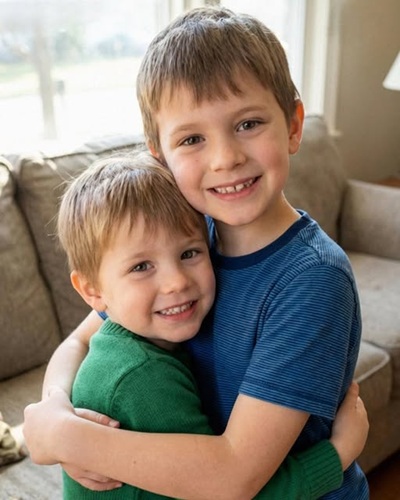
My son had only been back at kindergarten for a week when he climbed into the car, tugged the door shut with both hands, and announced something that split my world in two.
He buckled himself halfway into his seat—straps twisted, sneakers tapping against the back of my chair—and said it as casually as if he were telling me about finger painting.
“Mom, Ethan came to see me.”
For a moment, I didn’t understand the sentence. The words floated between us, light and harmless in tone, but heavy in meaning. Then my brain caught up with what my ears had heard.
Ethan.
My firstborn.
My eight-year-old boy who had been gone for six months.

The late afternoon parking lot buzzed with life—car engines idling, doors slamming, children shouting goodbye to one another—but everything around me dulled into a distant hum. My fingers tightened instinctively around the steering wheel. I was still standing outside the driver’s side door, frozen halfway between closing it and getting in.
I forced myself to breathe.
“Oh?” I said, trying to keep my voice soft, measured, unshaken. “You missed him today?”
Noah frowned, his small face scrunching in confusion. His cheeks were still round with baby softness, and there was a smudge of purple marker near his ear.
“No,” he said carefully. “He was here. At school.”
The word here did something to my chest. It landed hard, as though dropped from a height.
Ethan had been eight when the accident happened. It was an ordinary Tuesday. Mark had taken him to soccer practice like he had done dozens of times before. There had been no storm, no dramatic warning signs. Just a truck drifting across a yellow line.
Mark survived.
Ethan didn’t.
I never saw my son after that. The doctors, speaking in low professional tones, said I was in too fragile a state. They advised against viewing him. They said they wanted to “protect” me from further trauma.
Grief, apparently, revoked my right to say goodbye.
And now my five-year-old was telling me that his brother had visited kindergarten.
“What did he say?” I asked gently, though I could feel the tremor beneath the surface of my voice.
Noah smiled. A dimple appeared in his cheek—the same dimple Ethan had when he grinned.
“He said you should stop crying.”
The air in my lungs turned sharp and brittle. I swallowed, finished buckling him properly, and got into the driver’s seat. My hands moved automatically—seatbelt, ignition, reverse—but inside, something was spiraling.
I did cry. Not always loudly. Not always in front of Noah. But grief is not tidy. It seeps under doors. It lingers in bathrooms at night. It echoes in quiet kitchens.
The asphalt ahead blurred for a moment before I blinked it back into focus.

“How did he look?” I asked, keeping my eyes on the road.
“Like Ethan,” Noah said simply. “He was by the fence.”
By the fence.
A detail. A location. Something physical.
I told myself children imagine things. They fill in gaps adults can’t see. They cope in their own ways.
But something about the certainty in Noah’s tone unsettled me.
The Silence That Followed
That night, after Noah was asleep, I sat on the edge of my bed and tried to steady my thoughts.
Mark and I hadn’t spoken much about grief in the same language. We were surviving differently. He went back to work quickly, burying himself in routine. I stayed home longer than expected, unable to face grocery stores or school pickups without feeling like the air might split open.
Ethan’s room remained the same. His cleats still by the door. His soccer trophy still on the shelf. I hadn’t moved anything.
Maybe Noah had simply woven his brother into his day because he missed him.
Maybe he had overheard me crying and wanted to comfort me in the only way a five-year-old could.
But the detail about the fence lingered.
The next morning, as I poured cereal into a bowl shaped like a dinosaur, Noah looked up at me with bright, matter-of-fact eyes.
“He came again,” he said.
The spoon slipped from my hand and clinked against the counter.
“At school?” I asked.
He nodded. “By the back fence. He said hi.”
A chill slid down my spine, slow and deliberate.
“What else did he say?”
Noah shrugged, then lowered his voice slightly, as though sharing something important.
“He said it’s a secret.”
Every instinct in me sharpened.
Secrets.
“Noah,” I said, crouching to his level. “We don’t keep secrets from Mom. If anyone tells you to keep a secret, you always tell me. Okay?”
He hesitated just long enough for my stomach to twist.
“Okay,” he said softly.

The Cemetery
That Saturday, I took Noah to the cemetery.
I told myself I was grounding us in reality. Reminding him—and maybe myself—of what was true.
The winter sun cast a pale light across the rows of headstones. The air smelled of cold stone and damp earth. I carried white daisies because they felt simple and clean.
Ethan’s grave still looked too new. The engraving sharp. The stone too bright.
“Come say hi to your brother,” I whispered.
Noah didn’t step forward.
He stared past the headstone, not at it. His gaze fixed somewhere beyond, as if trying to see something just out of reach.
“Mom,” he said quietly. “Ethan isn’t there.”
The words sent a ripple through me.
“What do you mean?”
“He told me,” Noah said calmly. “He’s not in there.”
Children understand death differently. They don’t always grasp permanence. I knew that. Every parenting book says it.
But his certainty unsettled me.
“Where is he then?” I asked gently.
Noah shrugged. “He didn’t say.”
I placed the daisies down, pressing them carefully into the small vase holder attached to the stone.
For months, the cemetery had felt heavy. Weighted with finality. With unanswered questions.
Now it felt… uncertain.
The Fence
Monday morning was gray and damp. I parked near the kindergarten entrance but lingered longer than usual, watching the playground through the chain-link fence.
Children scattered across the yard in bright jackets. Teachers stood in clusters, coffee cups in hand.
No one looked unusual.
Noah leaned forward from the back seat.
“He’s over there sometimes,” he said, pointing toward the far end of the fence line. “Near the trees.”
My heartbeat quickened.
“Does he come inside?” I asked.
“No,” Noah said. “He stays outside.”
Outside.
On the other side of the fence.
That detail lodged itself firmly in my mind.
I watched as Noah walked toward the entrance. He paused halfway across the yard and glanced toward the back fence.
Then he smiled.
And lifted his hand in a small wave.
My blood ran cold.
There was no one immediately visible from where I stood. But the fence line curved slightly near the trees, creating a blind spot from the parking lot.
I stepped out of the car.
Before I could walk closer, a teacher gently redirected Noah toward the building.
But the image stayed with me all day: my son smiling at someone I couldn’t see.
The Call
That afternoon, after pacing my kitchen for an hour, I called the school.
I kept my voice calm. I said I had concerns about someone possibly interacting with my son near the back fence.
The secretary—Ms. Alvarez—listened politely and told me the school had contractors repairing exterior lighting fixtures along the perimeter.
Contractors.
Men working near the fence.
“Are they supervised?” I asked carefully.
“They’re background-checked,” she said. “They’re not allowed to engage with students.”
But someone had.
“I’d like to come in tomorrow,” I said.
There was a pause.
“Of course,” she replied.

The Footage
The next morning, I stood in the kindergarten office. My hands were steady on the outside, but inside, something was vibrating.
“I’d like to see the playground footage,” I said.
Ms. Alvarez hesitated, then nodded. “We can review yesterday morning.”
The screen flickered to life.
Children ran across the frame in blurs of motion. Jackets in bright primary colors. Teachers crossing from one end to the other.
Then Noah entered the frame.
He wandered toward the far fence.
He stopped.
He smiled.
He waved.
“Zoom in,” I said quietly.
The image sharpened.
A man crouched on the other side of the fence. He wore a dark work jacket and a baseball cap pulled low over his forehead. He leaned close to the metal bars.
Noah laughed.
The man spoke.
And then—my breath stopped—he slipped something small through the fence.
Noah reached out and took it.
The office felt suddenly too small.
“Who is that?” I asked, my voice thinner than I intended.
Ms. Alvarez squinted at the screen.
“One of the contractors,” she said slowly. “They’ve been fixing the lights along the back lot.”
The man lifted his head slightly.
And even through the grainy security footage, recognition hit me like ice water.
I had seen that face before.
Not in person.
In paperwork. In reports. In a photograph attached to a police summary I had forced myself to read only once.
My pulse pounded in my ears.
“That’s him,” I whispered.
“Who?” Ms. Alvarez asked.
“The driver,” I said, my throat tightening. “The man who hit my husband and my son.”
The room went completely silent.
And in that silence, the truth began to settle.
Ethan hadn’t come to kindergarten.
But someone else had.
For a few seconds after I said it, no one in the office moved.
The image on the screen remained frozen—Noah’s small hand reaching through the metal bars, the man’s face partially obscured by the brim of his cap. It felt unreal, like watching someone else’s life unfold in grainy pixels.
Ms. Alvarez slowly turned toward me. “You’re certain?”
I nodded, though my mouth had gone dry. “I’ve seen his photo before. In the accident report.”
The memory came back with unwanted clarity—the official language, the diagrams of the roadway, the word fatality typed in sterile black letters. Attached to the report had been a driver’s license photo. I had forced myself to look at it only once. I didn’t want to memorize his face.
But grief has a way of preserving what you wish it wouldn’t.
“I need you to call the police,” I said.
Ms. Alvarez hesitated for only a moment before reaching for the phone.
When Reality Steps In
Two patrol officers arrived within minutes. Their presence shifted the atmosphere of the school office immediately. What had felt like confusion now felt like procedure.
I explained everything carefully. My son’s statements. The reference to secrets. The footage.
One of the officers, Officer Haines, asked to see the video himself. He watched it twice, leaning closer to the monitor.
“Did the contractor have clearance to work here?” he asked Ms. Alvarez.
“Yes,” she replied nervously. “The district approved the maintenance contract. Background checks were completed.”
Officer Haines nodded but didn’t look satisfied.
“Where is he now?”
“He should be near the maintenance shed,” she said.
They left to locate him.
I stood there, staring at the paused image of Noah smiling at the fence. My body felt strangely disconnected from the room. My hands were cold, yet my face burned.
This wasn’t supernatural.
It wasn’t grief inventing signs.
It was a grown man inserting himself into my child’s world.
The Detention
The officers found him quickly.
He didn’t run. He didn’t argue. He didn’t even appear surprised.
When they brought him into a small conference room near the office, I saw him clearly for the first time in person.
Raymond Keller.
He looked older than in the photo I remembered. His shoulders sagged slightly. His hands were clasped tightly together as though he were trying to contain a tremor. The baseball cap had been removed, revealing thinning hair and a tired face.
Officer Haines stood near the door.
“You can speak to him,” the officer said to me carefully. “But we’ll remain present.”
I nodded.
Noah waited outside with Ms. Alvarez. I had told him there was a problem that grown-ups needed to fix.
When I stepped into the room, Raymond looked up.
“Mrs. Elana,” he said hoarsely.
Hearing my name on his lips made my stomach turn.
“Don’t,” I said quietly. “Don’t say my name.”
He swallowed and lowered his gaze.
“Why were you talking to my son?” I asked.
He rubbed his hands together. “I didn’t mean any harm.”
“That wasn’t the question.”
He exhaled slowly, as though the truth had been sitting heavy in his chest.
“I saw him last week at pickup,” he said. “He looks like Ethan.”
My breath caught.
“He has the same smile,” Raymond continued. “Same hair. I recognized your husband too. I knew immediately.”
“And you applied for a job at the school?” I asked, disbelief sharpening my tone.
He nodded.
“I saw the district had an opening for electrical repairs. I’ve done that work before.”
“You did it on purpose.”
“Yes.”
The word settled between us like a weight.
Guilt and Rationalization
“I can’t sleep,” he said after a moment. “Not since the accident. Every time I close my eyes, I’m back in that truck.”
His voice cracked, but I did not let that move me.
“I have syncope,” he continued. “Fainting spells. I was supposed to get more testing done. My doctor warned me about driving until I was cleared.”
“And you drove anyway,” I said.
“I needed the work.”
“And my son needed to live,” I replied, my voice steady but edged with steel.
Silence filled the room.
He nodded once, tears forming in his eyes.
“I thought… if I could help somehow,” he said. “If I could make something better. I saw you crying that day in the parking lot months ago. I recognized you from court.”
Court.
There had been a hearing regarding liability. It was brief. I had barely been present emotionally.
“I thought if I could tell Noah something comforting,” he continued, “if I could tell him Ethan wanted you to stop crying… maybe it would ease something.”
“Ease what?” I asked sharply.
“My guilt.”
The honesty of it stunned me.
“So you told my five-year-old that you were his dead brother.”
He looked ashamed. “Yes.”
“You told him to keep secrets.”
“I didn’t want to upset you.”
“You didn’t want to get caught.”
His shoulders slumped further.
Officer Haines stepped in. “Mr. Keller, did you give the child anything through the fence?”
Raymond nodded. “Just small toys. Little plastic dinosaurs. I bought them at a dollar store.”
“To gain trust?” the officer asked.
Raymond didn’t answer directly.
What the Law Sees
From a legal standpoint, what he had done crossed multiple boundaries. While he had not physically entered school grounds, he had knowingly misrepresented himself to a minor, encouraged secrecy, and initiated repeated unsupervised contact.
Intent matters.
And so does pattern.
The officers placed him under temporary detention for questioning. The school district was notified immediately. His contractor access was revoked on the spot.
I requested a formal no-contact order.
I also requested that the school review its perimeter security and adjust contractor supervision protocols. To their credit, the administration acted swiftly.
Within hours, additional supervision was added to the back fence area, and the district suspended all contractor activity pending review.
But administrative fixes could not undo the fact that my son had believed, even briefly, that his brother was speaking to him.
Telling Noah the Truth
When I brought Noah home that afternoon, he was unusually quiet.
“Is Ethan in trouble?” he asked softly from the back seat.
The question pierced me.
“No,” I said gently. “Ethan isn’t in trouble.”
“Then why were the police there?”
I pulled into the driveway and turned off the engine before answering.
“Because that man told you something that wasn’t true,” I said.
Noah stared at his hands.
“He said he was Ethan,” Noah whispered.
“I know,” I replied.
“He sounded like a grown-up.”
“That’s because he is a grown-up.”
Noah’s lip trembled. “So Ethan didn’t tell him to tell me things?”
“No,” I said carefully. “He didn’t.”
I reached back and unbuckled him, pulling him into my lap in the front seat despite how cramped it felt.
“Sometimes adults make very bad choices,” I explained. “And sometimes they let their sadness hurt other people. But that’s not your fault.”
“Was he sad?” Noah asked.
“Yes.”
“Because Ethan died?”
“Yes.”
Noah nodded slowly, processing.
“Are you sad too?”
“Every day,” I said honestly.
He leaned his head against my shoulder.
“I don’t like secrets,” he said after a moment.
“Neither do I.”
The Emotional Aftermath
That night, I didn’t sleep much.
The anger came in waves.
Not explosive, but deep and steady.
He had inserted himself into our grief. He had used my child’s innocence as a balm for his own conscience.
I thought about the fragility of boundaries—how thin a fence can be when someone decides to cross it emotionally rather than physically.
The next day, I met with a counselor who specialized in childhood trauma and grief. I wanted guidance on how to support Noah without amplifying fear.
Children at five don’t need full legal explanations. They need clarity and safety.
We agreed on a few principles:
- Reinforce that Ethan is not coming back physically.
- Clarify that no adult should ever claim to be someone else.
- Encourage open communication.
- Avoid framing the situation as frightening, but be firm about safety.
It was a delicate balance.
Grief was already part of Noah’s world. I didn’t want suspicion to become another layer.
Mark’s Response
When I told Mark everything, he went very still.
He didn’t shout. He didn’t rage.
But his jaw tightened in a way I recognized.
“He sought out our son,” Mark said quietly.
“Yes.”
“For himself.”
“Yes.”
Mark stared out the window for a long time.
“I live every day knowing I survived,” he said eventually. “I don’t need him trying to rewrite what happened.”
Neither did I.
The Investigation
Over the next week, the school district cooperated fully with authorities.
It was determined that Raymond had no prior criminal record related to children. His background checks had come back clean because technically, until now, there had been nothing on them.
His medical condition—syncope—had been noted in previous employment paperwork. He had been advised against operating heavy machinery without clearance. Whether he had disclosed it properly to his insurance company was another matter entirely.
The civil case regarding the accident had already concluded months earlier. Financial settlements cannot restore a child.
But now, a new legal issue had emerged: harassment and inappropriate contact with a minor.
The district attorney reviewed the footage.
While the actions did not involve physical assault, they did demonstrate deceptive behavior toward a child and deliberate emotional manipulation.
Charges were considered.
At minimum, the no-contact order was granted.
He was barred from approaching our family or the school property.
What Remains
In the quiet days that followed, I noticed subtle shifts in Noah.
He asked fewer questions about Ethan’s “visits.”
He stopped glancing toward the fence at drop-off.
But sometimes, at bedtime, he would ask, “Do you think Ethan knows I love him?”
And I would answer, “Yes.”
Because that was true in the only way truth can exist after loss: in memory, in love, in what remains.
The man at the fence had tried to borrow my son’s voice.
He had tried to ease his own conscience by stepping into a space that did not belong to him.
But grief cannot be rewritten by strangers.
And Ethan did not need a spokesperson.
The week after the confrontation felt surreal. The routine of daily life—dropping Noah at kindergarten, returning home, making lunches, answering emails—was no longer mundane. Every moment carried the echo of what had happened at the fence. My body felt taut, my mind alert to every small movement near doors, windows, and gates. And yet, even with the fear and anger, there was relief. The man was gone. Noah was safe. The boundaries were restored.
But healing, I realized, would take more than legal orders and procedural changes. It would take time, attention, and conscious work to untangle grief from fear, love from guilt, and memory from imagination.
Supporting Noah
I started each morning differently. Before breakfast, I would sit with Noah at the small round table in the kitchen. I asked him gently how he felt. Sometimes he said “good,” sometimes he said “sad,” and sometimes he didn’t know. I learned not to interrupt uncertainty.
“Mom,” he asked one morning, his cereal untouched, “do you think I imagined him?”
“No,” I said softly, reaching for his hand. “You didn’t imagine him. You saw someone. But he wasn’t Ethan.”
He nodded, his thumb brushing the back of my hand. There was a quiet acceptance in his gesture, as though he were acknowledging a truth too complex for words.
We began drawing together—Noah, me, and a stack of paper I bought just for this purpose. Noah drew Ethan as he remembered him: tall for eight, hair messy from the soccer field, a cheeky smile that could light up a room. I drew what I felt: my heart, broken and tender, holding both my sons in memory.
Then we talked. Not about the man at the fence. Not about the accident. But about Ethan. About his favorite foods, his silly jokes, the way he danced to music in the living room even when no one was watching.
We created a ritual: every night, we would tell one story about Ethan. Sometimes it made us laugh, sometimes we cried, but every time, it reminded us of what was real—what had truly belonged to us, untouched by lies.
Legal and Administrative Resolution
In the weeks that followed, Raymond Keller faced legal repercussions. While no physical harm had occurred, his repeated deception and engagement with a minor were taken seriously. The no-contact order was permanent, and the school district revised its contractor policies. No employee, contractor, or visitor would have unsupervised access to students near perimeters.
The authorities documented the case as an emotional harassment incident. They also recommended counseling for all parties affected—including myself and Noah—to ensure we processed the incident without lingering trauma.
While I understood that punishment would not resurrect Ethan or erase the intrusion into my child’s life, I found a certain calm in the clarity. Boundaries were restored. Safety was reinforced. And, importantly, Noah knew the truth.
Mark and I began to talk about our grief differently. Not every day. Not for long stretches. But enough to notice that sharing the weight made it lighter. We spoke about Ethan without panic. We told stories about him that were not bound by tragedy.
We also spoke about our fears. About the vulnerability of children. About how fragile trust could be, and how we needed to protect it—not just with locks and rules, but with honesty and presence.
I realized something crucial: Noah’s grief, while not identical to mine or Mark’s, was just as real. And just as deserving of careful attention.
Returning to the Cemetery
Two days later, I decided to visit Ethan’s grave alone. The sky was pale gray, the winter wind soft against my coat. I carried a small bouquet of daisies, white and simple, like the ones I had taken the first time.
I approached the headstone, tracing the engraved letters with my palm. The cold stone was grounding. Solid. Real. Unchangeable.
“Hi, baby,” I whispered. “I’m sorry I couldn’t see you after the accident. I’m sorry I didn’t get to say goodbye. But I promise I am taking care of Noah. I promise I am keeping him safe.”
The cemetery was quiet except for the occasional gust of wind stirring the dry leaves. In that silence, I felt a shift—not supernatural, not haunted, but profoundly honest.
“I can’t forgive him,” I said aloud, the words tasting bitter but true. “Maybe not ever. But I won’t let anyone speak for you. No more borrowed words. No more secrets.”
I pressed my palm to the stone again, letting the chill seep into my skin. I imagined Ethan smiling, that cheeky grin, the mischievous dimple, the energy he carried that had been stolen too soon.
“I love you,” I whispered. “And I will keep your brother safe. Always.”
The grief was still there. It would never leave. But now, it had a shape I could hold. No longer tangled with fear, guilt, or lies. Just a clean, hard-edged sorrow that could exist alongside love, memory, and protection.
Noah’s Understanding
When I returned home, Noah asked if he could come with me next time. I agreed. I wanted him to know that visiting Ethan’s resting place was a safe, honest way to remember him.
We walked together slowly, holding hands. I told him, again, that no one—not even adults—should ask him to keep secrets, and that truth was always the safest place.
Noah placed his small hand over the stone, just as I had. “I love you, Ethan,” he said softly.
And in that moment, I realized that our family could carry grief without it poisoning innocence. That love could coexist with loss. That memory could protect the heart rather than shatter it.
Reflections on Truth and Healing
Over time, I understood that the real visit from Ethan was never through a man at the fence. It was through Noah’s heart, through memory, through the stories we shared. Children have a remarkable ability to perceive and hold what is essential.
The man’s deception had been frightening and wrong. But it also became a pivot, a turning point. A moment that forced us to confront boundaries, safety, and the delicate interplay of grief and reality.
Now, when I walk Noah to school, I notice him smiling at the ordinary world: at his friends, at birds flitting past the playground, at sunlight on puddles. There is no man at the fence, no borrowed voice, no secret to guard.
There is only him. And there is only truth.
And in that truth, Ethan’s memory remains untarnished, a quiet, enduring light guiding us through the shadows of what was lost.
