
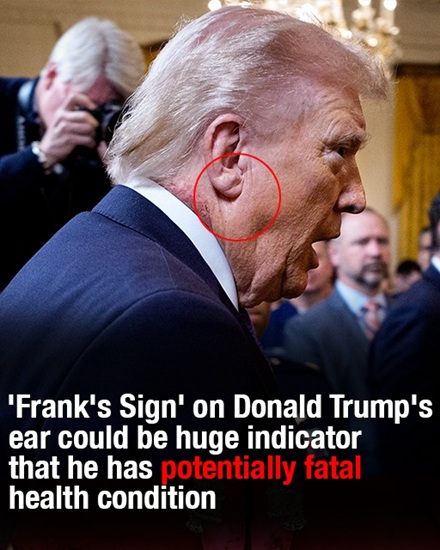
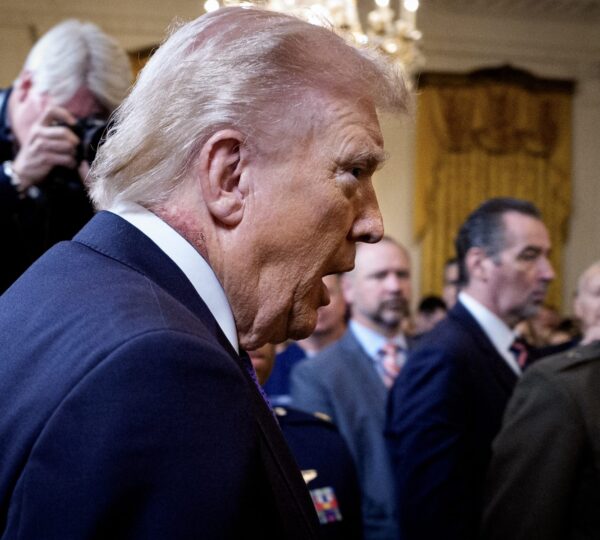
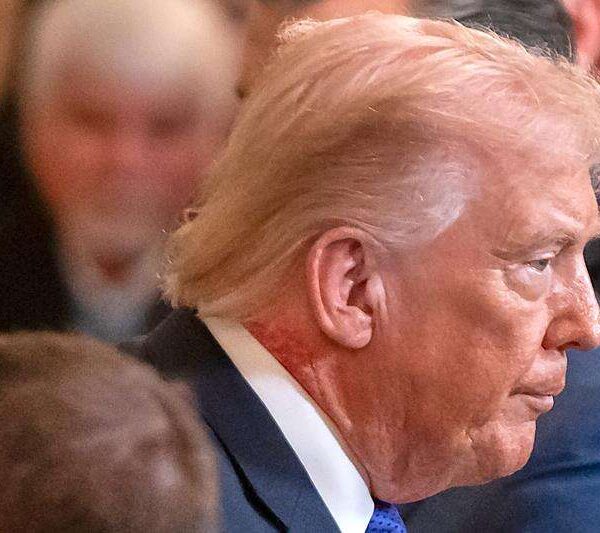
Over the past week, public attention focused on President Donald Trump after photographs revealed a prominent red rash on the side of his neck during the Medal of Honor ceremony at the White House.
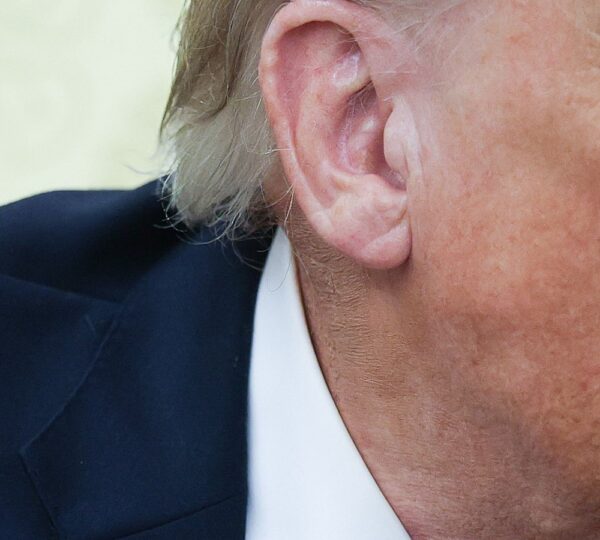
Observers quickly noticed its visibility above the shirt collar. The skin irritation appeared slightly raised and scabbed, prompting photographers and commentators to closely examine the affected area.
Many media outlets published enlarged images to highlight the noticeable redness on the president’s neck. Following the circulation of images online, Trump’s personal physician, Dr. Sean Barbabella, issued an official statement regarding the visible rash.
He attributed the redness to the use of a “very common cream” applied as a preventive skin treatment.
Barbabella clarified that the president had been using the topical cream for approximately one week prior to the ceremony. He emphasized that the reaction was expected to persist for several weeks, describing it as a temporary, non-serious skin response.
The White House has not publicly disclosed the specific condition the cream is intended to prevent. Officials declined to elaborate further beyond Barbabella’s statement, leaving observers to note only that it is part of a preventive routine.
Subsequent photographs taken at the Trump National Doral golf resort on March 9 showed that the rash, while still present, appeared somewhat less severe. Reporters noted that the redness remained visible during public interactions with the president.
During a meeting with German Chancellor Friedrich Merz, some observers noted that makeup appeared to partially conceal the rash. The White House has not clarified whether cosmetic coverage was applied intentionally to reduce visual prominence.
The ongoing visibility of the rash has fueled public and media questions about Trump’s health, particularly given his advanced age of 79. Journalists and commentators have revisited prior observations of visible bruises or marks.
Medical analysts have noted past signs including periodic bruises on Trump’s hands and swelling in the ankles. While the White House previously provided explanations for these issues, the appearance of the neck rash continues to generate interest.
Several experts have expressed a desire for additional transparency regarding the treatment. Medical analyst Dr. Vin Gupta suggested that vague descriptions could prompt public speculation about underlying health conditions, even if the reaction itself is benign.
Cardiologist Dr. Jonathan Reiner and other professionals emphasized the importance of clear communication from presidential medical advisors. They urged that detailed explanations reduce unnecessary concern and provide context for visible physical changes.
Political commentators and late-night television hosts, including Jimmy Kimmel, have discussed the incident, highlighting the White House’s limited disclosure. Commentary often included humor, but consistently emphasized the absence of detailed medical information.
Social media reactions have ranged from jokes to speculative theories, yet these comments are not grounded in medical evidence. Public posts should not be considered reliable sources regarding presidential health matters.
The neck rash occurs within broader ongoing interest in Trump’s physical condition. Given his high-profile role and advanced age, any visible health changes naturally draw public and media attention, particularly when officials provide limited context.
Historically, the White House has issued periodic updates on Trump’s health. These reports have included examinations, assessments, and diagnoses, such as chronic venous insufficiency, a circulatory condition considered common and generally benign.
Dr. Barbabella’s recent statement reaffirmed that the neck treatment is intended as preventive care. Officials have not clarified exactly what condition is being prevented, maintaining that the reaction is temporary and not dangerous.
Despite limited information, the White House has defended the president’s overall health. Statements emphasize routine monitoring, regular medical staff consultations, and ongoing oversight of any visible marks or reactions.
Medical analysts stress that skin reactions can result from multiple causes, including mild irritation, allergic reactions, or topical treatments. Such visible changes do not automatically indicate serious disease without further evaluation.
Healthcare professionals note that meaningful assessments require context, including medical history, concurrent conditions, and prior treatments. Skin changes alone are insufficient for reliable conclusions about overall health status.
Journalists covering the story have reiterated that visible rashes cannot substitute for a full medical examination. The lack of detailed disclosure has prompted questions, yet no verified evidence links the neck redness to a serious condition.
Transparency is a key concern for both the public and professional observers. Clear reporting by medical staff usually prevents speculation and ensures that reactions are understood as part of routine care or preventive treatments.
Observers continue to monitor the situation, noting whether the rash resolves fully over subsequent weeks. Current reporting indicates that the reaction is consistent with temporary irritation from a topical cream, as previously stated by Dr. Barbabella.
Age-related health considerations remain central to public interest. At 79, Trump’s physiological responses, including minor skin reactions, are naturally scrutinized, particularly given the demands of presidential duties and frequent public appearances.
Medical analysts emphasize that preventive skin treatments are common among older adults. Reactions such as redness or irritation can occur even with widely used creams, and they generally resolve without long-term consequences.
White House officials maintain that the president’s overall health is monitored continuously. Statements assert that visible reactions are observed, assessed, and managed as part of routine medical supervision, reinforcing that no immediate concern exists.
While the precise purpose of the cream remains undisclosed, its temporary effects align with common dermatological responses. Experts note that similar topical treatments often cause short-term redness, which subsides as the skin adapts.
Public curiosity persists, fueled by limited official details. Observers continue to compare recent photographs with prior appearances, noting variations in skin tone, mark visibility, and the possible use of makeup to reduce prominence.
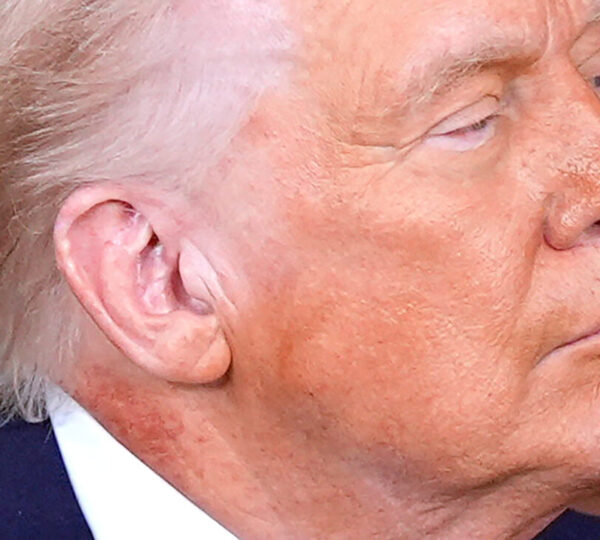
Analysts caution against overinterpretation of isolated visual signs. Without clinical evaluation, drawing conclusions about internal health conditions based solely on external appearances is medically unreliable and can perpetuate misinformation.
The broader lesson highlighted by this coverage is the importance of professional transparency. Clear communication from physicians and officials helps manage public concern while ensuring accurate understanding of routine or preventive care measures.
In summary, the rash on President Trump’s neck has drawn attention due to its visibility and the lack of detailed public explanation. Current medical statements describe it as temporary, related to preventive topical treatment, and not indicative of serious disease.
Officials and medical staff continue to emphasize routine monitoring and care, maintaining that the president’s health is regularly evaluated. Observers will likely track resolution over the coming weeks to confirm that the redness dissipates as expected.
The incident reinforces broader considerations about public interest in presidential health. Age-related conditions, minor reactions, and preventive treatments are naturally scrutinized, highlighting the need for clear, factual, and transparent communication.
Medical experts generally agree that short-term skin reactions are common and often harmless. When disclosed appropriately, such information reassures the public and avoids the spread of misinformation or unnecessary concern regarding a leader’s health.
