

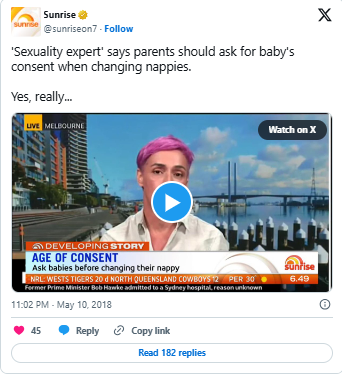
An Australian sexuality educator has sparked a heated debate online by suggesting that parents should ask infants for permission before changing their diapers, a claim that has prompted both confusion and widespread ridicule.
Deanne Carson, who identifies as a sexuality educator, speaker, and author, emphasizes the need to cultivate a “culture of consent” from birth, arguing that even infants can benefit from early exposure to respect and boundaries.
The suggestion that parents should ask for consent during diaper changes has divided online communities, with some praising the focus on respect, while others mock the idea as impractical or even absurd in real-world parenting.
Many users took to social media, comparing the concept to asking pets for permission. One comment humorously asked, “Do you need consent from your cat to change its litter tray?” highlighting public skepticism toward the idea.
Parenting methods continue to evolve rapidly, and discussions around consent are entering spaces previously considered uncontroversial, including routine infant care, feeding, and changing routines, prompting questions about feasibility and developmental appropriateness.
Carson’s position is not necessarily about obtaining verbal consent. Instead, it focuses on setting foundations for autonomy and respect by narrating actions and observing non-verbal cues from the baby during care routines.
She advises parents to say phrases such as, “I’m going to change your diaper now, is that okay?” and then pause to observe the child’s body language, eye contact, or reactions, emphasizing communication.
According to Carson, infants may not verbally respond, but their reactions convey awareness and agency. Pausing to notice these signals introduces early concepts of consent, fostering trust and positive parent-child interactions from a young age.
Early childhood experts often stress the importance of responding to non-verbal cues such as coos, smiles, or movements. Carson’s approach aligns with this guidance, framing consent as attentive observation and respectful interaction rather than formal agreement.
In an interview with Australia’s ABC network, Carson explained that while babies cannot articulate a “yes,” leaving space for reactions demonstrates that the child’s response matters, reinforcing the child’s understanding of bodily autonomy.

Critics, however, argue that infants are too young to comprehend consent. Rowan Dean, editor of The Spectator Australia, labeled the idea “lefty lunacy,” reflecting a broader skepticism toward applying abstract concepts to infants.
John Rosemond, a psychologist and parenting columnist, has similarly criticized Carson, claiming she deserves the title for the “most bizarre idea of all time,” suggesting the approach could create confusion and mistrust in family dynamics.
Rosemond wrote in the Reno Gazette Journal that Carson’s “culture of consent” may paradoxically result in dysfunction, as asking for permission from infants could undermine clear parental authority while exposing children to mixed signals.
Online reactions were immediate and varied. Some users mocked the approach, claiming that a crying baby already communicates the need for a diaper change, framing it as an implicit demand rather than a matter of consent.
One social media user commented, “Pretty sure when a baby is crying due to the discomfort of a full diaper…that’s consent. In fact, I would go further and call it a demand,” reflecting common practical reasoning.
Others criticized Carson’s lack of direct experience with infants. “A self-proclaimed ‘expert’ wants parents to ask permission before changing their child’s diaper. This tells me she has no experience with kids whatsoever,” one online post read.
The comparison to pets reemerged in online discourse. “Do you need to get consent from your cat to change its litter tray? No. If it stinks, change it. Same with a baby,” remarked another skeptical user.

Some even suggested that leaving infants in soiled diapers could be harmful. “Leaving a child in a dirty nappy is legally recognized as child abuse. Does this nut job believe in child abuse? She is more dangerous than anti-vaxxers,” wrote one critic.
Despite the backlash, some parents and caregivers defended Carson’s intentions, noting that the concept of consent is more about teaching respect, awareness, and communication rather than delaying necessary care or compromising safety.
A supporter wrote, “Babies and toddlers learn to communicate well before they can speak. Thank you for tolerating the trolls to create dialogue. Even if you’re wrong, what harm is there in showing respect?”
Another user commented, “I think she wants to encourage a conversation about consent amongst kids but has taken it to the extreme. Babies can’t consent to anything—they’re babies! Safety and survival are assumed.”
Some parents echoed the idea that narrating routines like diaper changes or feeding can foster respect without requiring literal consent. “Easy to chat to your baby. Easy to create a climate of consent in your home,” one user commented.
In practice, Carson encourages parents to observe reactions such as squirming, giggling, or eye contact. By acknowledging these responses, caregivers help infants feel seen and respected, even without verbal agreement or understanding.
Pediatricians often note that infants’ non-verbal communication is critical for social and emotional development. Teaching awareness of bodily autonomy may contribute positively to long-term understanding of personal boundaries and interpersonal respect.

Carson frames her approach as part of broader education on sexuality, personal agency, and consent, arguing that early exposure can influence later understanding of boundaries, relationships, and self-respect, even if abstract for infants.
Critics continue to express concern that applying concepts like consent to infants is unnecessary and potentially counterproductive. They argue that parents should prioritize safety, hygiene, and immediate needs rather than hypothetical autonomy exercises.
While extreme interpretations are controversial, the underlying principle—communicating with infants during care routines—has support among child development specialists. Narration, eye contact, and attention to reactions are established practices for fostering trust.
Carson’s approach can also be seen as an extension of responsive parenting, where caregivers actively interpret signals, respond appropriately, and reinforce secure attachment, contributing to cognitive and emotional development during early years.
The debate reflects broader tensions between traditional parenting practices and emerging philosophies emphasizing autonomy, respect, and mindfulness in child-rearing, particularly in societies increasingly focused on consent culture.
Media coverage amplified the discussion. Interviews and opinion pieces highlighted the polarizing nature of Carson’s suggestion, fueling discussions in parenting blogs, social media platforms, and news comment sections worldwide.
Some parents expressed willingness to experiment with Carson’s approach, reporting that narrating actions and pausing to observe responses enhanced communication, attentiveness, and engagement, even if literal consent was not possible.

Others emphasized practicality and safety. They noted that infants’ immediate needs—hunger, discomfort, or hygiene—must take precedence, and that creating respectful routines can occur simultaneously without waiting for imagined consent.
Educational psychologists have weighed in, observing that early experiences shape children’s perception of control and agency. Practices like narrating care can strengthen attention, social-emotional learning, and awareness, contributing to a healthy developmental environment.
The debate underscores the diversity of parental philosophies. Some caregivers value autonomy-oriented approaches, others prioritize efficiency and safety, while many strive to balance communication, attachment, and responsive caregiving in daily routines.
While some critics deride the idea as extreme, supporters argue that it sparks important dialogue about respect, agency, and communication in parenting, encouraging reflection on long-term developmental benefits beyond immediate practicality.
Carson’s example also illustrates the challenge of translating abstract educational principles into everyday parenting scenarios, where developmental limitations, safety concerns, and practical constraints must be carefully considered.
Social media responses reveal both humor and concern. Memes comparing infants to pets, sarcastic commentary, and critical analysis illustrate the range of public reaction, reflecting broader cultural debates about parenting, education, and consent.
Ultimately, Carson frames the practice as optional, not mandatory. Parents may “ask” for consent symbolically, narrate actions, or simply engage infants attentively, with the focus on communication, recognition of cues, and fostering respect from the earliest stages.
Experts emphasize that the goal is not to allow infants to refuse care but to demonstrate attentiveness and empathy, helping children feel seen, acknowledged, and valued, even when immediate compliance is necessary for safety and well-being.
Research shows that responsive and engaged caregiving, including observing non-verbal communication, strengthens attachment, reduces stress, and improves social-emotional outcomes, supporting the broader principles Carson promotes, regardless of the literal concept of consent.
For many families, Carson’s approach provides a lens for thinking about respectful communication, mindfulness, and interaction patterns, encouraging reflection on how language, observation, and intention shape early childhood experiences.
While extreme interpretations remain controversial, the discussion highlights the importance of adaptability, responsiveness, and attentiveness in parenting, recognizing that each child communicates differently and caregivers must balance care with engagement.
The conversation also raises broader questions about cultural shifts in parenting norms, consent education, and the integration of social-emotional learning principles into everyday routines, from diaper changes to mealtimes and play.
Ultimately, whether parents choose to ask symbolically, narrate actions, or simply respond attentively, the underlying message is consistent: children benefit from caregivers who communicate, observe, and respect their signals, fostering a secure and trusting environment.
Even if the concept of asking infants for permission remains divisive, most agree that mindfulness, engagement, and attention to cues improve the parent-child relationship, supporting emotional development, attachment security, and healthy communication habits.
The ongoing debate illustrates how evolving parenting philosophies challenge conventional assumptions, inviting reflection on how principles of consent, autonomy, and communication can be adapted appropriately for early developmental stages.
In conclusion, Deanne Carson’s proposal has ignited strong opinions, both supportive and critical. Regardless of perspective, the discussion encourages parents to consider the importance of communication, observation, and respect in everyday infant care routines.
Parents may choose approaches that suit their values, balancing immediate needs with developmental guidance, and fostering secure, respectful, and attentive relationships that cultivate trust, awareness, and empathy from the earliest months.
Ultimately, whether applied literally or symbolically, narrating care routines, observing reactions, and acknowledging infant cues remains a widely recognized principle in child development, emphasizing attentiveness, empathy, and secure attachment in everyday parenting.
