
Over the past 24 hours, significant developments have emerged in the high-profile investigation into the disappearance of 84-year-old Nancy Guthrie, mother of NBC TODAY co-anchor Savannah Guthrie.
This case has captivated public attention since the senior woman went missing on January 31, 2026, and the events of the past day have added layers of complexity, raising new questions and providing the first clear visual leads in an otherwise opaque investigation.
Nancy Guthrie, an elderly woman described by authorities as a vulnerable adult with serious health needs, including a pacemaker and daily prescription medications, was last seen returning home in Tucson, Arizona, after a family dinner on the evening of January 31.
According to family reports, she had appeared healthy and in good spirits that evening. The next morning, she did not attend a livestreamed church service she regularly participated in, and her absence quickly triggered concern among her family members.
The initial response involved contacting friends, neighbors, and local businesses to ascertain her whereabouts. When no information surfaced, a formal criminal investigation was reported. The involvement of the Federal Bureau of Investigation (FBI) and the Pima County Sheriff’s Department reflected both the urgency and sensitivity of the situation, given Nancy’s age, health vulnerabilities, and the unexplained nature of her disappearance.

Investigators faced the dual challenge of addressing the immediate welfare of a potentially endangered adult and navigating the scrutiny that accompanies a case connected to a high-profile public figure.
The Timeline and Context of the Investigation
From January 31 onward, law enforcement coordinated extensive search efforts. Officers canvassed the surrounding neighborhoods, spoke to potential witnesses, and reviewed existing surveillance footage from nearby homes and businesses. Despite these efforts, details remained scarce.
Public statements by authorities were deliberately cautious, emphasizing both the ongoing nature of the investigation and the need to prevent speculation that could impede progress or compromise the safety of Nancy Guthrie.
The case entered its eleventh day as of February 10, 2026, with authorities indicating that progress had been made in uncovering evidence but stressing that no formal suspect had been identified. During this period, public curiosity surged, fueled by the dual factors of Nancy Guthrie’s high-profile family connection and the alarming nature of her disappearance.
Social media, news outlets, and online forums became hotbeds of discussion, often blending verified facts with unconfirmed theories. Authorities consistently urged the public to avoid speculation and to provide credible tips through official channels.
Breakthrough: Release of Previously Unseen Surveillance Footage
A major development arrived on February 10, when the FBI released previously unseen footage and images recovered from a smart doorbell camera installed at Nancy Guthrie’s residence. The camera, a Google Nest device, captured early morning activity on February 1 — the day following her last confirmed sighting.
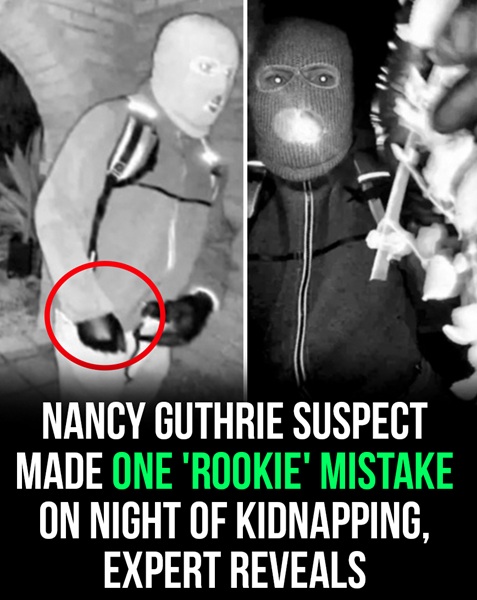
The footage shows a masked individual, wearing gloves and a backpack, standing on the front porch. At multiple points, the person appears to be handling a firearm in a manner described by former FBI experts as unusual and potentially indicative of inexperience.
The individual also interacts with the doorbell camera, blocking its lens momentarily with gloved hands and later returning to manipulate nearby vegetation, seemingly in an attempt to obscure the device. These behaviors, combined with the lack of specialized tools or coordinated concealment techniques, led experts to speculate that the person might be a “rookie” in terms of criminal activity — someone without extensive prior experience in violent or premeditated offenses.
FBI Director Kash Patel noted that the images were retrieved from the camera’s residual backend data. Nancy Guthrie had not subscribed to a paid storage plan, which initially made the footage inaccessible. Law enforcement worked closely with private-sector technology partners to reconstruct the video from residual data, a process that required significant technical expertise and careful handling to maintain the integrity of the evidence.

The successful recovery of this footage represents the first concrete visual lead in the investigation and marks a turning point in the case, providing both law enforcement and the public with a potential window into the events surrounding Nancy Guthrie’s disappearance.
Expert Commentary on Suspect Behavior
Since the release of the surveillance footage, former law enforcement professionals have publicly analyzed the suspect’s behavior. One retired FBI agent observed that the manner in which the individual handled a firearm — openly, awkwardly, and without apparent concealment — is atypical for someone with a history of violent crime. Seasoned perpetrators typically take measures to avoid drawing attention, and visible mishandling of a weapon suggests inexperience or nervousness.
Further scrutiny of the footage revealed additional details. The suspect’s handling of the doorbell camera was notably clumsy; instead of using tools to disable the device, the individual appeared to improvise, using vegetation found on the property to block the lens. Analysts noted that this ad hoc approach to concealing activity further reinforces the theory that the person may not have professional criminal training.
Additionally, the suspect’s movement patterns — including moments when they paused in view of the camera and interacted with objects in the yard without apparent awareness of surveillance angles — suggest a lack of careful planning. Former profilers commented that the person’s hesitation and uncertainty could indicate that the act was not premeditated or, at the very least, not executed by someone experienced in criminal operations.
The release of the first clear images of a potential suspect in Nancy Guthrie’s disappearance instantly sparked widespread public interest. Within hours, news outlets across the country highlighted the surveillance footage, while social media platforms became saturated with commentary, speculation, and theories about the individual’s identity and motivations.
Public reactions have ranged from expressions of concern for Nancy’s well-being to detailed amateur analyses of the suspect’s posture, gait, and physical characteristics. Observers noted the individual’s height, body build, and even how they moved across the porch. Some users dissected the footage frame by frame, attempting to match physical features to known profiles, while others speculated about the type of backpack or gloves worn, hypothesizing whether these details could provide clues about the suspect’s origin, occupation, or prior experience.
Despite the flood of online attention, law enforcement officials repeatedly cautioned the public against drawing conclusions based solely on social media speculation. Authorities emphasized that while public engagement can be helpful, inaccurate assumptions or misidentifications could hinder the investigation and, in some cases, place innocent individuals at risk. The FBI and Pima County Sheriff’s Department encouraged citizens to provide verified tips through official channels rather than relying on conjecture or unverified leads circulating online.

Savannah Guthrie herself addressed the public in a series of social media posts, appealing directly for assistance. She expressed hope and concern in equal measure, urging anyone with potential information to come forward, emphasizing that even the smallest observation could provide a critical lead. The family’s openness helped maintain public attention on the case while reinforcing the importance of responsible reporting and information sharing.
The Brief Detention of Carlos Palazuelos
Following the release of the surveillance footage, law enforcement took action on potential leads. South of Tucson, authorities conducted a traffic stop and briefly detained a man identified in media reports as Carlos Palazuelos, a delivery driver from Rio Rico, Arizona. While the connection to the Guthrie case was never formally confirmed by authorities, media outlets reported that Palazuelos was questioned in relation to the investigation and that a search warrant was executed at his residence, during which investigators examined various items for potential evidence.
Palazuelos was held for several hours before being released without charges. In interviews following his release, he described feeling bewildered by the sudden attention and stressed that he had no prior knowledge of Nancy or Savannah Guthrie. He stated that he was unsure whether he had ever delivered packages to the Guthrie residence and emphasized that he had not been involved in the disappearance.
Media reports indicated that authorities showed Palazuelos a photo of the masked individual captured in the surveillance footage. According to Palazuelos, a family member suggested that the eyes of the masked figure resembled his own, a factor that may have prompted his temporary detention. He also noted that the process of questioning felt unclear at times and that he was not immediately informed of his rights, though these claims have not been independently corroborated.
Authorities clarified that detaining individuals for questioning is a standard investigative procedure, particularly in high-profile cases with limited initial evidence. While the public may perceive such actions as indicative of guilt, law enforcement routinely follows up on leads in order to rule out potential connections, ensure no stone is left unturned, and protect both the public and the integrity of the investigation. The case’s complexity, compounded by the age and vulnerability of the missing individual, underscores the necessity of thorough investigative protocols.
Technical Challenges and Surveillance Recovery
One of the central questions posed by the public was why the surveillance footage was not released immediately after Nancy Guthrie’s disappearance. Investigators explained that the Google Nest doorbell camera had been removed from the residence and that the Guthries did not maintain a paid cloud storage subscription, leaving no conventional repository of recorded video.

To overcome this obstacle, FBI technicians collaborated with private-sector technology partners to recover residual data from the camera’s backend systems. This process involved reconstructing digital footage from fragments left in the camera’s memory and associated network systems, a procedure requiring specialized knowledge of cloud architectures, encryption protocols, and digital forensics. The successful extraction of these images demonstrates the sophisticated capabilities of modern law enforcement agencies in recovering evidence that might otherwise be considered lost or inaccessible.
Once recovered, the images and short video clips were analyzed by both the FBI and the Pima County Sheriff’s Department. Investigators noted several key details: the suspect appeared armed, their movements were deliberate but clumsy, and interactions with the doorbell camera suggested unfamiliarity with surveillance technology. These observations informed the release strategy — authorities shared only verified images with the public while withholding sensitive details that could compromise investigative methods or reveal information about ongoing search efforts.
The Role of Experts in Public Analysis
Following the footage release, former FBI and law enforcement professionals provided expert commentary to help contextualize the suspect’s behavior. Analysts focused on patterns that could suggest the individual’s level of criminal sophistication.
One former agent highlighted that the visible and awkward handling of a firearm is atypical for a professional perpetrator, who would usually conceal a weapon to avoid drawing attention. Another expert noted that the suspect’s improvised efforts to obscure the doorbell camera using vegetation, rather than employing tools or pre-planned methods, further suggested a lack of experience. Former profilers also observed that the suspect’s pauses and hesitations within camera range, combined with seemingly uncoordinated movements, align with behavior commonly seen in individuals undertaking a criminal act for the first time.
While these analyses provide valuable insight into potential behavioral tendencies, authorities cautioned that they are interpretations, not definitive statements about the suspect’s identity or criminal history. Law enforcement continues to treat all leads as part of a comprehensive investigative strategy, relying on verified evidence rather than public speculation to guide decisions.
Community Engagement and Ongoing Search Efforts
Law enforcement has also underscored the importance of community involvement. Officers have systematically canvassed neighborhoods, checked local traffic and security camera footage, and coordinated with utility and delivery services to trace potential sightings of Nancy Guthrie or the individual captured in the footage.
Tip lines remain active, and authorities encourage the public to report any relevant information, no matter how minor it may seem. A $50,000 reward has been offered for information leading to Guthrie’s safe return or the arrest of individuals responsible for her disappearance. Investigators stress that public cooperation is a critical element in the resolution of missing-person cases, particularly when the missing individual is elderly or medically vulnerable.
As the Nancy Guthrie case enters its second week, law enforcement agencies have intensified both digital and physical search efforts. Authorities are now employing a multi-pronged investigative strategy that combines traditional police work with advanced technological methods. Teams from the FBI and Pima County Sheriff’s Department have been systematically canvassing the area surrounding Guthrie’s Tucson residence, including roadways, parks, vacant lots, and nearby residences that may have surveillance cameras capable of capturing additional angles or relevant activity.

Search teams are also using drone technology to survey locations difficult to access on foot, allowing investigators to cover a broader area efficiently while minimizing disturbance to private property. Canine units trained in locating missing persons have been deployed, particularly in areas identified based on tips from the public. These efforts aim not only to locate Nancy Guthrie but also to recover any evidence that may shed light on the circumstances of her disappearance.
Authorities are reviewing vehicle records, delivery logs, and financial transactions that may intersect with Guthrie’s movements or potential interactions leading up to February 1, 2026. By cross-referencing multiple data sources, investigators hope to identify patterns or anomalies that could point to a suspect or provide insight into how the disappearance occurred. Law enforcement officials have emphasized that these investigative processes are meticulous and deliberate, prioritizing accuracy and evidence preservation over speed, given the delicate nature of the case.
Public Appeals and Family Statements
Savannah Guthrie and her family have remained actively involved in public appeals. Through social media and media interviews, the family has emphasized the urgency of locating Nancy Guthrie, reiterating that she is medically vulnerable and may be unable to care for herself. The family has appealed for calm and responsible engagement from the public, asking that anyone with credible information contact law enforcement directly rather than speculating online.
Savannah Guthrie expressed in a public statement that her family holds hope that her mother may still be alive and that the collective efforts of the community could prove instrumental in securing her safe return. She highlighted that even seemingly minor details — such as unusual sightings near the home or information about unfamiliar individuals in the neighborhood — could provide investigators with critical leads. The family has also been transparent about hearing reports of alleged ransom notes but has confirmed that no verified communication has been received regarding a demand for money or confirmation of Nancy Guthrie’s location.
The FBI and Pima County Sheriff’s Office have reiterated the importance of verified information and encouraged members of the public to use official tip lines. They caution that sharing unverified information on social media can misdirect resources and potentially harm innocent individuals.
Analyzing the Suspect and Behavioral Insights
The recently released surveillance footage continues to be a focal point of expert discussion. Former FBI profilers and law enforcement specialists have noted that the suspect’s behavior — including awkward handling of a firearm, hesitation while interacting with the doorbell camera, and improvised attempts at concealment — suggests a level of inexperience atypical of professional criminals.
Behavioral experts have emphasized that these traits may indicate a suspect acting impulsively or without prior planning, potentially narrowing the profile of individuals likely to commit such an act. While these analyses are not official law enforcement conclusions, they provide context for both the public and investigators, helping to guide searches and identify possible connections.
Experts also point out that certain subtle behaviors, such as the suspect briefly pausing to adjust the mask or manipulating nearby objects, can reflect nervousness or unfamiliarity with the environment — important clues when determining whether the act was opportunistic or premeditated. Investigators are integrating these behavioral observations with physical evidence and digital forensic data to construct a comprehensive understanding of the suspect’s potential methods and motivations.
Coordination Across Agencies
The Nancy Guthrie investigation highlights the importance of interagency collaboration. The FBI, Pima County Sheriff’s Department, local Tucson police, and technology partners are working in tandem to ensure no investigative lead is overlooked. Digital forensics teams have been meticulously analyzing data from multiple devices in the Guthrie residence, while local law enforcement continues to canvass neighborhoods and follow up on tips.
This cooperation has allowed investigators to combine resources effectively, leveraging advanced technology while maintaining the human element essential to interpreting evidence and interacting with witnesses. Officials note that such coordination is particularly crucial in high-profile missing-person cases, where time-sensitive information and careful management of public communication can significantly influence the outcome.
Reward and Incentives for Information
In an effort to encourage community participation and expedite the investigation, authorities have offered a $50,000 reward for information leading to Nancy Guthrie’s safe return or the apprehension of those responsible. This reward aims to incentivize the public to provide credible and actionable tips, while simultaneously reinforcing the importance of reporting information directly to law enforcement rather than relying on online speculation or third-party intermediaries.
Authorities stress that rewards are part of a broader investigative strategy and that the information leading to resolution often comes from seemingly minor observations, such as unusual deliveries, unfamiliar vehicles, or the behavior of neighbors in the days surrounding a disappearance. Every tip is treated with careful consideration, with investigators cross-referencing data to validate its accuracy before taking further action.
The Importance of Remaining Vigilant and Patient
While the release of surveillance footage has provided the first tangible visual lead, authorities caution that the investigation remains in its early stages. No suspect has been publicly charged, and law enforcement continues to treat all leads as potential avenues of inquiry rather than definitive conclusions. The complex nature of the case — involving an elderly, medically vulnerable individual, sophisticated digital recovery methods, and multiple potential leads — underscores the need for both patience and vigilance from the public and media alike.
Officials continue to urge the community to stay alert, report credible information, and avoid the spread of unverified claims. Maintaining the integrity of the investigation is considered paramount, as premature conclusions could hinder the discovery of evidence or misdirect valuable resources.
Looking Forward
As the case moves beyond its first week, the focus remains on recovering Nancy Guthrie safely and identifying those responsible for her disappearance. Investigators are combining behavioral insights, recovered digital evidence, and physical search strategies to piece together the timeline of events leading up to February 1. With public cooperation, technological expertise, and methodical investigative work, authorities hope to resolve one of the nation’s most closely followed missing-person cases in recent memory.
The Guthrie family continues to appeal for hope and community engagement, expressing faith in law enforcement and the support of the public. In the coming days, investigators are expected to continue sharing verified updates while maintaining the operational discretion necessary to protect the integrity of ongoing searches. The combination of careful investigative work, public assistance, and expert analysis remains critical to uncovering the truth behind Nancy Guthrie’s disappearance.
