
The day doctors told us Thomas had five to twelve months to live, the words landed like stones in our hearts, shaking our entire family. We could hear them, but our minds struggled to process what “aggressive” truly meant.
Thomas squeezed my hand as Dr. Patel spoke. His touch was weak but warm, a fleeting reminder of strength he still carried despite the relentless progression of his illness. His attempt at humor barely masked the fear we all felt.
“I’m on a schedule now,” Thomas said, trying to lighten the moment. The doctor didn’t smile. “It’s aggressive. We’ll fight it, but this will be tough,” she warned, leaving us with a heaviness that clung to the walls.
For 33 years, I had known Thomas as my partner, my confidant, my anchor. Together we raised seven daughters, each a miracle of its own. Their names—Emily, Grace, Lily, Hannah, Nora, Paige, and Sophie—filled the house with constant movement and laughter.
Our home was a cacophony of late-night talks, glitter, and hair ties, every corner holding memories. Thomas would often joke, “I’ve got seven miracles,” unaware that those miracles might soon be counted in fleeting moments, each more precious than the last.
Cancer’s arrival turned our lives upside down, replacing everyday chaos with hospital appointments, bloodwork, infusions, and quiet dread. Every family member silently wrestled with fear while pretending, for the sake of each other, that things were manageable.

Emily’s wedding loomed on the horizon, and Thomas harbored one deep wish: to walk each of our daughters down the aisle, a dream that felt urgent as his strength waned with every passing day. His voice, thin yet determined, carried an emotional weight that was impossible to ignore.
We noticed Emily growing distant, shorter visits and curt texts filled with three words: “Busy. Love you.” Each message felt colder than intended, and Thomas quietly observed, his eyes betraying the pain he never voiced aloud, fearing to burden anyone further.
“I might only get one,” he whispered one night, gazing at a framed family photo. I refused to accept such a grim possibility. “Don’t talk like that,” I replied, my voice trembling but firm, determined not to let despair define our time together.
After a long day of chemotherapy, Thomas slept early. I sat alone at the kitchen table, staring at a calendar marked with red circles for treatment days and Emily’s wedding. I realized that waiting passively wasn’t an option—we needed a plan.
I called the girls together and laid it out clearly: “No partners, just you. Your dad might only get one wedding,” I said, leaving silence in the room that weighed heavier than words could describe. Their reactions ranged from wide-eyed fear to immediate determination.
Paige’s eyes welled up. Nora protested, “That’s not fair.” Emily stared at the floor, twisting her ring nervously. I explained, “Cancer is trying to steal what’s precious. We’re going to make sure he gets to walk each of you, even briefly.”
They agreed instantly, understanding the urgency. We planned a surprise moment: each daughter, in her wedding dress, would take a few steps with Thomas. Hannah handled music, Grace and Lily the dresses, and Nora coordinated the church logistics with meticulous care.
The week leading to the wedding, Thomas’s strength declined sharply. One morning, he sat on the bathroom floor, trembling. “Maybe I can’t do it,” he whispered. I held his face, insisting gently, “You will. One step at a time.”
Wedding morning arrived. Thomas, frail in a suit, needed steadying. I adjusted his tie, whispered reassurances, and promised him, “You will walk Emily down the aisle.” Every small motion was a test of patience, love, and willpower.
At the church, Emily knelt before him, whispering encouragements. He stood with my support, shaky but determined. The doors opened, music started, and they began walking down the aisle. Every step carried immense emotional weight, a fleeting triumph over cancer’s harsh reality.
Halfway through, the music stopped. Thomas froze, shock etched on his face. My heart stopped with him. Then I saw the lineup: Grace, Lily, Hannah, Nora, Paige, and finally Sophie—all in wedding dresses—creating a miraculous, emotional tableau that nearly brought everyone to tears.

As Thomas froze midway down the aisle, the room held its collective breath, the silence stretching impossibly long. Shock and awe mingled on his face as he absorbed the incredible sight of six daughters waiting in line for him.
Grace stepped first, her white lace gown flowing elegantly, trembling as she placed her hand on his arm. Thomas squeezed gently, a fractured smile breaking through exhaustion, each movement deliberate yet loaded with unspoken love.
Next came Lily, in a vintage ivory dress, softly exhaling as she allowed her father to support her weight. Thomas kissed her hand, whispering, “I love you,” each syllable fragile yet resonant with years of shared memories.
Hannah followed, sleek satin brushing the floor as she met Thomas’s gaze. His tired eyes lit briefly with recognition, and she whispered encouragement. He took measured steps, savoring the fleeting connection between father and daughter.
Nora approached, brave yet vulnerable, her borrowed gown slightly oversized. Thomas steadied her, his touch light but grounding, a silent promise that this moment—though brief—would never be forgotten by either of them.
Paige, in soft tulle, took her father’s arm with a whisper and tentative smile. Thomas’s steps faltered slightly, but he drew strength from the presence of all his daughters, feeling their love buoy him forward through weakness.
Finally, Sophie, youngest and smallest, approached. Thomas’s breath caught. Her voice trembled as she whispered, “I’m sorry it’s not real,” referencing her age and the circumstances. He shook his head and reassured her gently, “You’re real. You’re my miracle.”
With Sophie, he took three deliberate steps, holding her a little longer, as if trying to freeze time. Every hug, every kiss on the forehead, every whispered “I love you” was a rebellion against the cruel timeline cancer had imposed on him.
The church was full of gasps, tears, and quiet sobs. Guests, photographers, even the musicians paused, caught in the gravity of a father experiencing a moment that felt suspended outside ordinary time and reality.
Emily squeezed Thomas’s arm as the music softly resumed, signaling the final part of the surprise. He looked around at all his daughters, seeing them fully—alive, present, radiant—and rasped, “All of them?” Emily nodded, confirming that this shared moment was theirs alone.

Step by step, Thomas escorted each daughter down the aisle, pausing to kiss foreheads and exchange whispers. Every small gesture carried the weight of decades of shared experiences, triumphs, and now, the fragility imposed by illness.
For many in the church, it was more than a wedding tradition. It was a demonstration of resilience, love, and family unity, an emotional masterclass in how to cherish fleeting time with those we hold dearest.
As Sophie completed her steps, Thomas hugged her tightly, lingering as if to imprint the moment into memory. His strength was waning, but the emotional energy coursing through the room temporarily replenished him, fueled by love and devotion.
Finally, Thomas and Emily completed her actual walk down the aisle together, real and official. Vows were exchanged, rings placed, tears flowed, and the congregation erupted in applause. Every heart in the room felt the intensity of that once-in-a-lifetime sequence.
At the reception, Thomas found the strength for one slow dance with me, leaning his head on my cheek. He whispered, “I’m so tired,” and I reassured him softly, reminding him that he had triumphed over the moment cancer tried to steal.
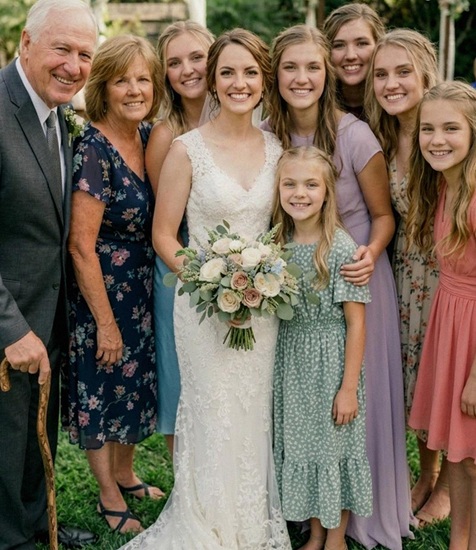
Looking at all seven daughters clustered together, he smiled faintly, acknowledging the day’s impossible success. “You gave me all of them,” he murmured. My response was simple, but filled with meaning: “For one day, cancer didn’t get to decide what we remember.”
Later, in the quiet side room, Thomas and Emily shared intimate reflections. Emily apologized for fear or hurried moments, but he reassured her, “You meant to. Your mom meant to. It was perfect.” Each word echoed decades of trust, love, and connection between father and family.
Even as exhaustion overtook him, Thomas managed to give the girls a final family moment under string lights outside. Cameras clicked, memories were captured, and for a brief time, the relentless shadow of illness faded, replaced with pure love.
By the end of the night, we had a plan to keep creating memories, even as Thomas’s condition progressed. Laughter, tears, and shared stories became our shield against despair, a blueprint for living fully in every fleeting, precious moment.
After the reception, we guided Thomas back to the side room, closing the door to shield him from lingering guests. He sank into a chair, eyes heavy, body trembling from the exertion, yet his heart seemed full from the morning’s miracle.
Emily stayed close, brushing a strand of hair from his face. “Dad, I didn’t mean to stress you,” she whispered. Thomas shook his head, smiling faintly. “You meant to love me too hard. That’s all that matters,” he replied softly.
The girls trickled in, still in their wedding dresses, laughing despite tears streaking their cheeks. The room was chaotic yet intimate, a safe haven where the family could absorb what had just transpired together.
Thomas took slow breaths, gazing at all of us clustered in front of him. “I thought cancer stole it,” he said, voice barely audible. I squeezed his hand, whispering, “Not today. Not now. You got every single one of them.”
He pressed his forehead against mine, murmuring quietly, “You gave me all of them.” I replied, “For one day, cancer didn’t get to decide what we remember.” Every syllable became a shared promise between us.

The girls began reflecting aloud, excitedly recounting moments from the aisle, their own steps, and whispered words to Thomas. Each story reinforced the sense of triumph, proving that love and intention could outmaneuver even the harshest circumstances.
Hannah pulled out her phone, suggesting, “Let’s make a memory list.” Emily nodded, wiping mascara from her cheeks. “We make a list. All the moments Dad gets to share with us,” she said, a mixture of determination and tenderness.
Sophie leaned against me, wide-eyed. “Mom, can we do more? More memories?” I hugged her, feeling the magnitude of the day and the hope we could create, even with Thomas’s fragile health as a constant backdrop.
Nora declared, “Rule one: Dad gets veto power.” Paige added, “Rule two: We don’t waste good days.” Lily whispered, “Rule three: We tell the truth.” Each rule felt like a roadmap for living fully despite looming uncertainty.
Thomas listened quietly, eyes closed at times, absorbing the laughter and voices around him. Each sound, each word, seemed to lift him momentarily above illness, giving him strength he hadn’t realized remained within him.
Later, we lined up for the final family photo. Marco, the photographer, counted down. “One, two, three—look at Thomas.” Flashbulbs illuminated the room, capturing seven daughters, a devoted father, and a mother holding everything together.
Thomas laughed softly, exhaling like relief had finally reached him. “Thank God,” he whispered. I wrapped my arm around his waist, heart pounding, realizing the day’s emotional marathon had been worth every effort and planning detail.
Emily rode behind him on the way home, supporting his shoulders, recounting stories from the aisle with rapid, shaky words. Thomas chuckled weakly, savoring the familiarity of family jokes, moments, and small triumphs over life’s cruelties.
At home, Thomas paused at the doorway, eyes tracing the height marks of our daughters on the hallway trim. “Look,” he whispered, “they’re all taller than me now.” I nodded, knowing he cherished the physical and emotional growth he’d helped foster.
He leaned back into his chair, exhausted but satisfied. “I’m so tired,” he admitted. I held his hand tightly. “I know. You did everything today that matters. Cancer didn’t win.” His grip tightened, acknowledging the truth in those words.
That night, as the girls drifted off to sleep, we reflected on the day’s extraordinary efforts. Laughter, tears, whispered stories, and gentle embraces became a bulwark against grief, creating memories that would endure long after Thomas’s illness progressed.
Even in weakness, Thomas found joy and completion, having experienced the fulfillment of a lifetime wish. The combination of planning, love, and courage had ensured that he walked with each of his daughters, marking a memory that no disease could erase.
By the time silence settled in the house, I felt something solid beneath my feet—not hope, nor denial—but a carefully crafted plan. A plan to continue building memories, cherishing every moment, and ensuring Thomas’s love lived in each of us.
We understood, in that quiet night, that family, intention, and deliberate actions could create miracles. Every carefully orchestrated step had transformed fleeting moments into a timeless testament of love, resilience, and shared humanity.
