
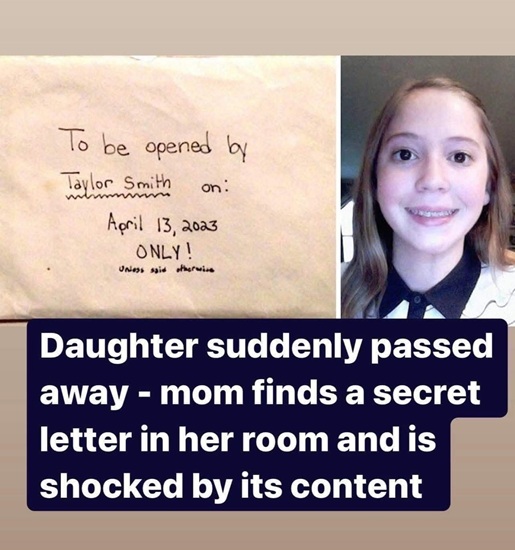
The lives of Tim and Mary Smith, a devoted couple from Tennessee, were forever changed by a tragedy no parent should ever have to endure.
Their 12-year-old daughter, Taylor, a bright, curious, and deeply compassionate child, passed away suddenly on January 5, 2014. The cause was a brief but aggressive case of pneumonia, which had struck swiftly, leaving little time for preparation or understanding.
Taylor was not just any child. She radiated joy and curiosity, filling every room she entered with laughter and warmth. Her intelligence was evident in her early academic achievements, her creativity shone through in countless drawings, and her empathy was apparent in the way she cared for others.
Her parents often described her as a “little light in human form,” whose absence created a void that seemed impossible to fill.

In the weeks following her passing, Tim and Mary found themselves navigating the overwhelming task of going through Taylor’s belongings. Each item they touched—a school project, a drawing, a favorite book—triggered memories of her vivacity and charm.
Amid the piles of her possessions, a small, unassuming box captured their attention. The box was neatly labeled, and inside it lay an envelope that immediately drew their curiosity and stirred a mixture of dread and anticipation.
On the front of the envelope, in Taylor’s unmistakable handwriting, was her name and a date: April 13, 2023. The envelope was clearly addressed to her future self. The Smiths were stunned.
Taylor had written this letter less than a year before her untimely death, when she was only 11 years old. The act of imagining her adult life, coupled with the tragic fact that she would never reach it, made the moment almost unbearable.
Despite their grief, Tim and Mary felt an unspoken understanding: they needed to open the letter. Trembling with emotion, they carefully broke the seal and unfolded the paper inside.
What they read left them overwhelmed with both sorrow and awe. Taylor’s words were astonishingly mature, full of wisdom, reflection, and encouragement that seemed beyond her years.
The letter began with a warm, conversational tone:
“Dear Taylor,
How’s life? Life is pretty simple right now (10 years in your past). I know I’m late for you, but as I’m writing, this is early, so; congratulations on graduating high school! If you didn’t, go back and keep trying. Get that degree! Are you (we) in college? If not, I understand. We do have pretty good reasoning, after all.”
Even in these first lines, Taylor’s intelligence and thoughtfulness shone through. She not only acknowledged the passage of time but also encouraged perseverance, demonstrating a deep understanding of personal growth and responsibility.

The letter then moved to reflections on her family, highlighting her empathy and the close bond she shared with her younger sister, Allana:
“Don’t forget, it’s Allana’s 11th birthday today! Sheesh, 11 already? In my time, she just turned 1! I didn’t get to go to that party though, because I was in Cranks, Kentucky for my first mission trip. I’ve only been back for 6 days!”
Even at 11, Taylor had an awareness of the passage of time and its significance in family life. Her words reflected both her excitement for her sister’s milestones and her desire to remain connected, even while away on mission trips, demonstrating a maturity beyond her years.
The spiritual depth in Taylor’s letter was especially striking. She took time to speak to her future self about faith, morality, and gratitude, revealing a perspective that was profound for someone so young:
“Speaking of, how’s your relationship with GOD? Have you prayed, worshipped, read the Bible, or gone to serve the Lord recently?
If not, get up and do so NOW! I don’t care what point in our life we’re in right now, do it! He was mocked, beaten, tortured, and crucified for you! A sinless man, who never did you or any other person any wrong!”
Her devotion, sense of moral responsibility, and understanding of sacrifice were remarkable. The letter reflected not only her spiritual awareness but also her desire to impart guidance and encouragement, ensuring that her future self would remember the values she cherished.
Taylor’s words seamlessly moved from faith to curiosity, adventure, and the excitement of exploring the world. She asked her future self about experiences she hoped to have:
“Now, have you gone on any more mission trips? Have you been out of the country yet? How about on a plane?”
Even in these simple questions, her adventurous spirit and longing for meaningful experiences were evident. She imagined a life rich with exploration, service, and learning—goals that, tragically, she would never have the opportunity to achieve.

Taylor also shared her lighthearted interests and daily joys, giving her parents a glimpse into the child they had lost:
“Is Doctor Who still on the air? If not, what regeneration did they end it with? You should go watch some Doctor Who! Later though, you gotta finish reading your own words of wisdom!”
In these moments, her humor, curiosity, and personality shone. Even brief mentions of television shows or technological gadgets made the letter feel alive, as if Taylor were sitting beside her parents, engaging in playful conversation.
Her aspirations and practical considerations about her adult life were equally poignant:
“Do you have your own place yet? If we’re in college, what are we majoring in? Right now, I wanna be a lawyer.”
For an 11-year-old, Taylor’s ambition and forward-thinking mindset were striking. She displayed not only intelligence but also a sense of planning, independence, and hope for a future she could only imagine.
Taylor’s love for life’s simple pleasures also emerged in her writing:
“Have you been to Dollywood recently? Right now, their newest attraction is the Wild Eagle. It’s so fun!”
And her fascination with technology, typical of her generation, was expressed in her desire to upgrade her iPad:
“Also I think I’m going to sell my iPad and buy an iPad mini. Don’t forget to tell your kids that we’re older than the tablet! Attached I also have a drawing of an iPad, so you can show them.”
Finally, the letter concluded with a gentle, reflective note:
“Well, I think that’s all. But remember, it’s been 10 years since I wrote this. Stuff has happened, good and bad. That’s just how life works, and you have to go with it.
Sincerely,
Taylor Smith”
For Tim and Mary, the letter was a mixture of grief, gratitude, and wonder. In a single piece of paper, their daughter had managed to convey faith, love, curiosity, humor, ambition, and reflection, leaving behind a lasting message that transcended her short life.

Sharing Taylor’s letter with the world, the Smiths hoped to honor her memory, inspire others, and provide comfort to families who had suffered similar losses. The letter resonated with tens of thousands online, touching the hearts of readers across generations.
Parents saw reflections of their own children, while others admired Taylor’s maturity, thoughtfulness, and enduring wisdom.
Taylor’s story is a powerful reminder of life’s fragility and the enduring impact of love. Through her brief existence, she left a legacy that continues to influence, teach, and inspire.
Her letter shows that wisdom, kindness, and hope are not bound by age, and that even a short life can leave a profound mark on those around us.
Through this simple yet profound act—writing a letter to her future self—Taylor reminded the world to cherish each moment, pursue dreams, nurture faith, and approach life with curiosity and compassion. For her parents, it was a bittersweet gift, a bridge connecting them to the daughter they loved, even after her passing.
After opening Taylor’s letter, Tim and Mary Smith found themselves holding a tangible piece of the child they had lost, a piece that spoke directly to their hearts despite the years of absence since her passing.
For a moment, time seemed suspended. The house, usually filled with echoes of Taylor’s laughter, felt impossibly quiet, yet in that silence, her voice resonated more vividly than ever.
The letter became a catalyst for reflection, not just on Taylor’s brief life but on the immense depth of her character. Her parents noticed, in particular, how Taylor had addressed her future self with guidance, encouragement, and accountability.
She had a clear vision of the kind of person she wanted to be, and she was already laying a foundation for that identity—even at 11 years old.
Tim recalled, with tears streaming, the line where Taylor urged her future self to maintain a relationship with God. “It was as if she understood, in a way we could only hope to understand, the importance of faith as an anchor in life,” he said later.
Mary added, “Even in that small hand-written note, she was teaching us how to keep perspective, how to face challenges, and how to nurture love and kindness.”

Taylor’s Words and Their Wider Impact
Once the letter was shared online, the response was immediate and profound. Hundreds of thousands of people read Taylor’s words, many moved to tears.
Parents saw in her insights a reflection of their own hopes and fears for their children. Many remarked on her maturity, noting that few adults could articulate life lessons with such clarity and warmth, let alone an 11-year-old.
The letter became more than a personal memento—it became a symbol of childhood resilience, curiosity, and wisdom. People from across the world responded with messages of support, sharing stories of their own children, or recounting how they had experienced loss.
Taylor’s words reminded readers that even young voices can carry enduring insight and that every life, no matter how brief, holds significance.
Through her reflections, Taylor demonstrated a rare understanding of life’s dualities: joy and sorrow, growth and struggle, curiosity and responsibility. She reminded her future self—and by extension, her parents and the public—that life is a journey filled with challenges and triumphs, and that the best approach is one of faith, perseverance, and love.
The Healing Power of Taylor’s Letter
For Tim and Mary, reading Taylor’s letter was both painful and profoundly healing. They described it as a bittersweet gift—a connection to the daughter they had lost, providing a sense of closeness they feared they might never feel again. It offered them guidance on grief itself, a roadmap of sorts to help them navigate life without Taylor physically present.
Mary explained, “The letter reminded us that Taylor wanted us to continue living fully, even after her passing. It was her way of telling us, ‘It’s okay to grieve, but also okay to find joy.’”
The parents gradually began to frame their memories and their loss through this lens. They realized that honoring Taylor’s life wasn’t just about mourning her absence—it was about celebrating her curiosity, her kindness, and her intellect, and carrying those values forward.
They began using the letter as a teaching tool for their younger children, including Allana. The parents would read excerpts aloud, not to dwell in sadness, but to highlight Taylor’s love for learning, exploration, and faith. In doing so, they kept her memory alive in ways that nurtured growth and understanding.
Lessons from Taylor’s Life
Taylor’s foresight and introspection contained numerous lessons:
- The Value of Reflection: Her ability to consider her future self and offer guidance illustrates the importance of self-reflection, even from a young age. Reflecting on goals, beliefs, and values can guide decisions and foster personal growth.
- Curiosity and Exploration: Taylor’s questions about travel, technology, and cultural experiences underscore the significance of curiosity. Her words encourage us to embrace learning and adventure as lifelong pursuits.
- Faith and Spiritual Awareness: Her strong devotion demonstrates the grounding role faith or personal values can play in life, offering a sense of purpose and resilience during difficult times.
- Connection and Empathy: Taylor consistently thought of others—her sister, her parents, and even the wider world. Her empathy and attention to relationships remind us to prioritize love and connection.
- Courage in the Face of Loss: Although she never had to face adulthood, her letter teaches readers how courage and hope can coexist with uncertainty, challenges, and tragedy.
Taylor’s Legacy
Beyond the immediate family, Taylor’s story has resonated as a universal message about the human capacity for wisdom, even in the youngest among us. Her letter is often cited in discussions of how children perceive life, how they process experiences, and how their perspectives can sometimes illuminate truths adults overlook.
Educational and parenting communities have used the letter as an example of the profound insight children can offer when encouraged to express themselves. It highlights the importance of nurturing curiosity, reflection, and faith in young people, allowing them to explore ideas, dreams, and emotions safely and thoughtfully.
Her story has also inspired charitable initiatives. Families who have experienced similar tragedies have created memorial funds and projects in Taylor’s name, supporting children’s education, mission trips, and creative expression. In this way, Taylor’s brief life has sparked a ripple effect of kindness, generosity, and inspiration across communities.
Reflections on Grief and Healing
The Smiths’ experience underscores a broader truth about grief: that it is complex, multifaceted, and often counterintuitive. Taylor’s letter offered them a unique perspective, bridging the gap between loss and remembrance.
It reminded them—and those who read the letter—that grief does not end, but it can transform. Pain can coexist with joy, memory can coexist with hope, and loss can coexist with profound inspiration.
The couple emphasized the importance of cherishing every moment, documenting thoughts, and expressing love while you can.
They encourage other parents and families to support their children in exploring their creativity and inner thoughts, whether through writing, art, or conversation. As Tim said, “Taylor taught us that life is measured not just in years, but in the depth of connection and the courage to dream.”
A Timeless Message
The final lines of Taylor’s letter continue to resonate:
“Stuff has happened, good and bad. That’s just how life works, and you have to go with it.”
This simple acknowledgment of life’s unpredictability encapsulates a philosophy that is both practical and profound. Life is inherently uncertain, but embracing it with curiosity, faith, empathy, and courage allows us to navigate its challenges with dignity and grace.
For readers around the world, Taylor’s letter has become a source of hope, teaching that wisdom and insight are not limited by age. Her ability to express thoughtful guidance, empathy, and ambition at such a young age reminds us that even brief lives can leave lasting impacts on families, communities, and the world.
Conclusion
Taylor Smith’s story is both heartbreaking and inspiring. Through a single letter written to her future self, she left a legacy of wisdom, love, faith, curiosity, and empathy.
For Tim and Mary Smith, it became a lifeline—a way to connect with their daughter after her passing and a means to navigate grief while celebrating her life.
For the broader public, it has become a reminder that the human spirit, even in its briefest expressions, can leave an indelible mark. Taylor’s insights encourage reflection, courage, and the pursuit of meaningful experiences. They remind parents to nurture their children’s curiosity, spirituality, and individuality, and they offer solace to those grappling with loss.
In a world often focused on accomplishments, possessions, or external milestones, Taylor’s letter is a quiet testament to what truly matters: love, connection, curiosity, faith, and the courage to face life with compassion.
Though Taylor was taken from this world far too soon, her words continue to guide, inspire, and comfort. They remind us that the legacy of a life is not measured solely by its length but by the depth of wisdom, love, and joy shared with others. Her letter stands as a timeless, beautiful, and profound reminder that even the youngest among us can leave lessons that echo across generations.
Through her brief yet remarkable life, Taylor Smith demonstrated that courage, thoughtfulness, and hope are qualities that transcend age, and that even in the face of unimaginable loss, the human heart can continue to connect, heal, and inspire.
Lessons from Taylor’s Life
Taylor’s foresight and introspection contained numerous lessons:
- The Value of Reflection: Her ability to consider her future self and offer guidance illustrates the importance of self-reflection, even from a young age. Reflecting on goals, beliefs, and values can guide decisions and foster personal growth.
- Curiosity and Exploration: Taylor’s questions about travel, technology, and cultural experiences underscore the significance of curiosity. Her words encourage us to embrace learning and adventure as lifelong pursuits.
- Faith and Spiritual Awareness: Her strong devotion demonstrates the grounding role faith or personal values can play in life, offering a sense of purpose and resilience during difficult times.
- Connection and Empathy: Taylor consistently thought of others—her sister, her parents, and even the wider world. Her empathy and attention to relationships remind us to prioritize love and connection.
- Courage in the Face of Loss: Although she never had to face adulthood, her letter teaches readers how courage and hope can coexist with uncertainty, challenges, and tragedy.
Taylor’s Legacy
Beyond the immediate family, Taylor’s story has resonated as a universal message about the human capacity for wisdom, even in the youngest among us. Her letter is often cited in discussions of how children perceive life, how they process experiences, and how their perspectives can sometimes illuminate truths adults overlook.
Educational and parenting communities have used the letter as an example of the profound insight children can offer when encouraged to express themselves. It highlights the importance of nurturing curiosity, reflection, and faith in young people, allowing them to explore ideas, dreams, and emotions safely and thoughtfully.
Her story has also inspired charitable initiatives. Families who have experienced similar tragedies have created memorial funds and projects in Taylor’s name, supporting children’s education, mission trips, and creative expression. In this way, Taylor’s brief life has sparked a ripple effect of kindness, generosity, and inspiration across communities.
Reflections on Grief and Healing
The Smiths’ experience underscores a broader truth about grief: that it is complex, multifaceted, and often counterintuitive. Taylor’s letter offered them a unique perspective, bridging the gap between loss and remembrance.
It reminded them—and those who read the letter—that grief does not end, but it can transform. Pain can coexist with joy, memory can coexist with hope, and loss can coexist with profound inspiration.
The couple emphasized the importance of cherishing every moment, documenting thoughts, and expressing love while you can. They encourage other parents and families to support their children in exploring their creativity and inner thoughts, whether through writing, art, or conversation. As Tim said, “Taylor taught us that life is measured not just in years, but in the depth of connection and the courage to dream.”
A Timeless Message
The final lines of Taylor’s letter continue to resonate:
“Stuff has happened, good and bad. That’s just how life works, and you have to go with it.”
This simple acknowledgment of life’s unpredictability encapsulates a philosophy that is both practical and profound. Life is inherently uncertain, but embracing it with curiosity, faith, empathy, and courage allows us to navigate its challenges with dignity and grace.
For readers around the world, Taylor’s letter has become a source of hope, teaching that wisdom and insight are not limited by age. Her ability to express thoughtful guidance, empathy, and ambition at such a young age reminds us that even brief lives can leave lasting impacts on families, communities, and the world.
