
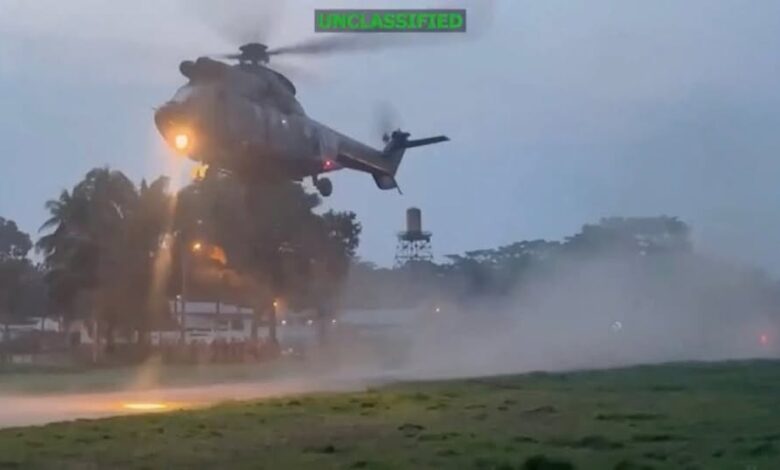
In the early days of March 2026, the global geopolitical landscape continues to be characterized by rapid, high-velocity information flows, where the “light of truth” is often obscured by fragmented narratives circulating online.
On March 5, 2026, a surge of reports began spreading across various social media platforms suggesting that the United States had initiated military operations within the sovereign territory of Ecuador.
These reports, largely originating from unverified accounts, brief video clips, and speculative commentary, have sparked a wave of heightened awareness and concern among observers, policymakers, and citizens both within the Americas and abroad.
While the notion of a U.S. military operation in South America immediately captures public attention, it is critical to examine these claims through a careful and factual lens.
As of this writing, no official confirmation has been issued by either the United States Department of Defense or the Ecuadorian government regarding any shift from the established framework of security cooperation to an active combat operation.
In modern international relations, the deployment of foreign troops—even in a supportive or limited capacity—requires formal notification to relevant diplomatic channels, congressional briefings in Washington, and coordinated communication from the host nation’s leadership.
The absence of such notifications strongly suggests that any current military activity, if occurring, is likely routine or limited in nature rather than indicative of a large-scale intervention.
To understand the implications of these reports, it is essential to consider Ecuador’s recent domestic and regional context. Since early 2024, Ecuador has faced a persistent and complex internal security challenge, with organized crime networks and transnational drug cartels exerting influence over certain areas.
The increasing prevalence of violent incidents, combined with the erosion of effective local governance in some regions, prompted President Daniel Noboa to declare a state of “internal armed conflict.”
This legal and political designation has allowed Ecuador to receive expanded support from international partners, particularly in areas such as intelligence sharing, counter-narcotics operations, and the provision of specialized training and equipment.
Historically, U.S.-Ecuadorian military and security cooperation has remained firmly within the scope of advisory, logistical, and technical assistance.
The leap from this established model to a direct combat operation would represent a significant historical departure and would likely generate scrutiny from international bodies including the United Nations and the Organization of American States.
Complicating the situation further is the digital environment of 2026, which often amplifies uncertainty and blurs the line between verified reporting and speculation.
Social media platforms, video-sharing services, and messaging networks allow content—ranging from images of military aircraft to personnel in uniform—to circulate instantly across the globe.
Without corroboration from official sources, such content can be misleading. Movements interpreted as evidence of combat operations may instead reflect routine activities, including joint training exercises, humanitarian support missions, or logistical rotations.
In this era, the instantaneous nature of information distribution frequently outpaces the institutional mechanisms designed to provide clarity, leaving both the public and media organizations navigating a landscape of incomplete or ambiguous data.
For citizens of Ecuador, the possibility of foreign military involvement elicits a spectrum of responses. Many individuals, fatigued by persistent threats from criminal networks, may welcome additional security measures, viewing foreign support as a stabilizing force.
Others, however, approach the notion of intervention with skepticism informed by historical experiences of external influence in Latin America.
The tension between these perspectives underscores a broader regional dialogue about sovereignty, foreign assistance, and the balance between security needs and national autonomy.
From a broader strategic perspective, any potential U.S. deployment to South America would require careful consideration in the context of concurrent global priorities.
With substantial American military resources currently engaged in ongoing operations or heightened alert postures in regions such as the Middle East and Eastern Europe, opening a new operational front in South America would involve significant logistical planning, personnel allocation, and political risk.
Analysts observing these developments emphasize that the verification of unconfirmed reports is crucial before drawing conclusions about the scale, intent, or significance of any movements.
Even in the absence of confirmed operations, the social and economic implications of such reports are notable. Rumors of U.S. troop presence can influence regional markets, affect local business confidence, and shape the public’s perception of safety.
Furthermore, the circulation of digital content suggesting military action—whether accurate or not—demonstrates the power of narrative in shaping perceived reality. It underscores the need for critical media literacy, careful verification, and reliance on multiple credible sources when interpreting complex international events.
As of March 5, 2026, the focus of attention remains on Ecuador’s major urban centers, communication hubs, and transportation infrastructure. Any genuine deployment of military forces on a substantial scale would be observable through satellite imagery, international monitoring systems, and corroborated reporting channels.
Until such confirmation is available, all public information must be treated with caution. This situation exemplifies the interplay between rapidly evolving digital narratives and traditional diplomatic, military, and institutional procedures.
The events surrounding these unverified reports also highlight a recurring phenomenon in modern global affairs: the lag between the speed of information dissemination and the ability of official institutions to provide verified accounts.
In this environment, a single misleading post or video can amplify anxiety, influence policymaker decision-making, and create ripple effects across both domestic and international arenas.
In Ecuador, the public debate surrounding security, sovereignty, and foreign involvement remains dynamic, reflecting the complex interplay of history, local conditions, and global attention.
As reports of potential U.S. operations circulated, analysts emphasized the distinction between observed troop movements and confirmed combat deployments. Logistical activity, such as cargo flights and personnel rotations, is not necessarily indicative of offensive operations.
Satellite imagery and open-source intelligence tracking are continuously monitored by both U.S. and international agencies. Any significant military maneuver would likely appear in these datasets long before confirmation from official channels becomes public.
The Pentagon has maintained a deliberate silence. Historically, any deployment of this scale would involve a detailed public explanation, including objectives, scope, and expected duration, alongside congressional briefings. The absence of such transparency signals caution.
Ecuador’s government likewise refrained from issuing statements linking foreign military presence to active combat. Instead, domestic announcements have focused on intensified police operations, judicial measures against organized crime, and logistical reinforcement of vulnerable border regions.
Regional organizations, including the Organization of American States, are closely monitoring developments. Any foreign military intervention, even limited, would require consultation with diplomatic bodies and could trigger immediate regional discussions or emergency sessions.
Neighboring countries are assessing potential spillover effects. Colombia, Peru, and Brazil, each with shared borders and security interests, have expressed concern regarding unverified military reports and emphasized the importance of respecting Ecuadorian sovereignty.
Economic analysts warn that speculation about U.S. intervention may affect trade, currency stability, and investment in Ecuador. Financial markets often react to perceived geopolitical risk, amplifying uncertainty even when reports remain unconfirmed.
Humanitarian agencies have reiterated the need for careful assessment. Increased troop presence, whether domestic or foreign, can influence civilian movement, access to services, and local security, necessitating robust contingency planning for potential escalation.
The complexity of modern military logistics further complicates interpretation. Movements of transport aircraft, personnel, and equipment could easily reflect pre-scheduled rotations, training exercises, or support missions rather than a newly initiated combat operation.
Social media amplification continues to play a critical role. Viral posts, live streams, and eyewitness accounts rapidly shape public perception, creating a narrative environment that sometimes outpaces formal verification and careful analysis by authorities.
U.S. diplomatic channels have reportedly been in discreet contact with Quito. Historically, coordination ensures that military support aligns with Ecuadorian consent, operational requirements, and broader strategic objectives without breaching international norms or bilateral agreements.
Analysts note that even routine security cooperation between countries of the Western Hemisphere often involves visible troop movements. Misinterpretation of such standard operations can fuel speculation about intervention where none exists.
Despite the lack of confirmed action, the situation has prompted extensive media coverage. News organizations worldwide emphasize verification, cautioning that initial reports should not be equated with confirmed military engagement.
Intelligence-sharing agreements between the United States and Ecuador have historically included monitoring of organized crime networks. Observed movements of specialized units may reflect targeted law enforcement support rather than large-scale foreign military deployment.
In this climate, public reaction remains mixed. Some Ecuadorian citizens call for international assistance to stabilize regions affected by cartel activity, while others express concerns about potential infringement on national sovereignty.
Finally, any eventual confirmation of operations would likely involve multiple stages: formal announcements, joint press conferences, detailed explanations of objectives, and clarification of the duration and scope of involvement, consistent with historical precedent.
The situation in Ecuador illustrates the broader challenges of modern international security, where internal crises intersect with global attention, creating a complex interplay between sovereignty, regional stability, and the responsibilities of external actors.
Any verified U.S. involvement would be analyzed globally as a signal of renewed interventionist policy in the Americas, prompting debate about long-term foreign policy strategies, historical precedent, and the potential impact on diplomatic relations.
International markets remain sensitive to perceived instability. Even unverified reports can influence investment, trade, and commodity prices, particularly in countries with strong economic ties to Ecuador or regional supply chains dependent on security stability.
Digital media narratives amplify uncertainty. The speed and reach of online reporting often outpace traditional verification, creating a feedback loop in which speculation drives public perception and may pressure policymakers to respond prematurely.
Social networks, video-sharing platforms, and messaging apps contribute to widespread dissemination of content, often stripped of context. Viral posts can exaggerate or misrepresent standard military exercises, producing an impression of escalation where none exists.
Global organizations such as the United Nations have emphasized the importance of verified information before issuing statements. Premature conclusions about foreign military action could escalate tensions and affect international negotiations or aid efforts.
Neighboring nations continue to monitor airspace, ports, and borders closely. They remain alert to potential cross-border effects, including migration flows, criminal activity, and economic disruption resulting from perceived or real military operations.
Civil society in Ecuador has expressed a range of views. Many support enhanced security measures against cartels, while others remain cautious, advocating for diplomacy, law enforcement, and regional cooperation over direct foreign military engagement.
The role of intelligence and reconnaissance is crucial. Advanced satellite monitoring, signal interception, and field observation ensure that any significant troop deployment cannot remain hidden indefinitely, providing both governments and analysts with factual verification.
Any confirmed intervention would require careful coordination between U.S. forces, Ecuadorian authorities, and international partners, including clear mandates, operational guidelines, and civilian protection protocols, ensuring compliance with international law and human rights standards.
Analysts warn that misinterpretation of military activity can have long-lasting reputational effects. Erroneous reporting can shape historical narratives, influence policy decisions, and affect public trust in both media and government institutions.
Educational efforts to promote digital literacy are increasingly important. Citizens must be able to distinguish between verified reports and speculative content, ensuring informed discussions and reducing the risk of panic or misinformation-driven conflict.
Even routine security cooperation can be misunderstood. Equipment transfers, training missions, and advisory deployments often involve visible assets, yet they rarely indicate an escalation into combat operations, highlighting the need for careful interpretation.
The situation also underscores the delicate balance between domestic priorities and foreign assistance. Ecuador must weigh internal security needs against potential political repercussions of hosting foreign military personnel, particularly in historically sensitive contexts.
Ultimately, the events of March 5, 2026, whether culminating in verified action or remaining speculative, serve as a reminder of the power of perception in international affairs, where rumors can have tangible political, social, and economic consequences.
The lessons of this episode extend globally. Governments, media organizations, and the public alike are reminded that verification, context, and patience are essential in interpreting reports of military activity and regional instability.
Digital platforms, while offering rapid communication, also demand responsible use. The spread of unverified claims can influence not only public sentiment but also diplomatic postures, emergency response planning, and market confidence across continents.
In conclusion, the situation in Ecuador highlights the intersection of internal conflict, international oversight, and digital information dynamics. It underscores the critical need for transparency, verification, and measured interpretation of events in 2026.
As global observers await official confirmation or clarification, the broader implications for Latin American security, U.S. foreign policy, and digital information integrity remain significant, serving as a contemporary case study in modern international relations.
Ultimately, March 5, 2026, serves as a stark illustration of how fast-moving digital narratives, historical sensitivities, and regional security challenges converge, emphasizing vigilance, informed analysis, and responsible reporting as tools for global stability.
