

In a renewed and highly publicized exchange, former U.S. Secretary of State and 2016 Democratic presidential nominee Hillary Clinton has sharply criticized former President Donald Trump over the handling and delayed release of documents connected to convicted sex offender Jeffrey Epstein.
Speaking with BBC News during an international policy forum in Berlin, Clinton underscored the importance of transparency, fairnes.
And public accountability in managing sensitive records tied to Epstein’s criminal activities, his associates, and the broader social networks in which he operated.
The discussion comes amid heightened scrutiny following the partial release of documents from Epstein’s estate, ongoing court proceedings, and federal investigations. These documents have shed light on Epstein’s interactions with a wide spectrum of public figures across politics, business, academia, and entertainment.
The public interest in these records has been fueled not only by Epstein’s criminal convictions but also by the involvement of high-profile individuals whose connections, whether social or professional, have raised questions about oversight, ethics, and accountability.
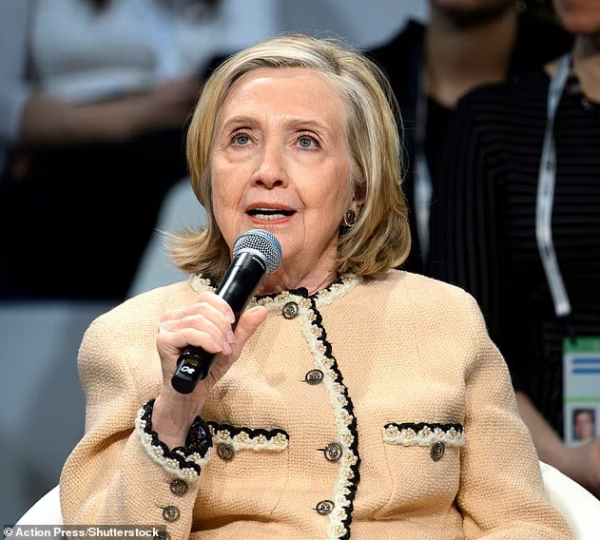
Clinton’s Accusations and Call for Transparency
During the BBC interview, Clinton delivered a pointed message directed at the Trump administration, saying: “Get the files out. They are slow-walking it.” She suggested that the delayed release of critical materials may not be a matter of administrative procedure alone but could also reflect political considerations, highlighting the persistent focus on her family as a distraction from other pressing issues. Clinton framed her argument around the principle that all individuals, regardless of their public stature or political affiliation, should be subject to the same level of scrutiny when it comes to matters of public interest.
Clinton emphasized that she and her family have consistently maintained they have never met Epstein and have no involvement in his criminal activities. “We have nothing to hide,” she told the BBC. “We have called for the full release of these files repeatedly. Sunlight is the best disinfectant.” By invoking the concept of sunlight as a metaphor for transparency—a principle famously articulated by Supreme Court Justice Louis Brandeis—Clinton stressed the need for openness in governmental processes, particularly those involving sensitive legal and investigative materials.
Clinton criticized what she described as attempts to politicize the Epstein case, asserting that attention directed at her and her family serves as a “shiny object” to divert public attention from other matters of governance and policy. She explicitly stated that any insinuations about her involvement with Epstein were false, reaffirming that both she and former President Bill Clinton have never been accused of wrongdoing by Epstein’s survivors or by law enforcement authorities.
The Partial Release of Epstein-Related Documents
The federal authorities, including the U.S. Department of Justice (DOJ), have released substantial amounts of documents connected to Epstein, his inner circle, and associated legal cases. Among these are:
- Flight logs documenting travel on Epstein’s private aircraft, often referred to in media reports as the “Lolita Express.” These logs include trips by numerous prominent figures, including politicians, business leaders, and celebrities.
- Contact lists of individuals who had social, professional, or philanthropic interactions with Epstein. These documents reflect Epstein’s extensive network rather than implying criminal involvement.
- Deposition transcripts from civil and criminal proceedings related to Epstein’s victims, associates, and business dealings.
- Internal correspondence between Epstein and his associates, legal advisors, and financial contacts, providing insight into his operations but not directly indicating wrongdoing by third parties included in communications.
Legal experts emphasize that appearances in flight logs, emails, or social networks alone do not imply criminal behavior. Epstein maintained a broad social and professional network, and many individuals listed in these documents were involved purely in business, philanthropy, or social contexts unrelated to illegal activity. The DOJ and court officials have repeatedly cautioned the public and media against drawing conclusions based solely on the inclusion of a name in such records.

Public Figures Named in Records: Trump and Clinton
Both Donald Trump and Bill Clinton appear in publicly available records due to prior social or professional interactions with Epstein. These records have generated significant media attention, often fueling speculation about the nature of their relationships with Epstein. Legal analysts and ethics experts emphasize that mere documentation of contact or association does not equate to criminal culpability, and any accusations must be supported by verified evidence.
Bill Clinton’s interactions with Epstein primarily occurred in the 1990s and early 2000s, before Epstein’s most widely publicized convictions. After leaving the presidency, Clinton reportedly took a number of flights on Epstein’s private jet for trips related to the Clinton Foundation, a global nonprofit dedicated to humanitarian and philanthropic projects. Clinton’s representatives have stated that he was unaware of Epstein’s criminal behavior at the time and that all contact ended long before Epstein’s later arrests and convictions. These trips, according to public records and legal reviews, were strictly professional and philanthropic in nature and do not appear to be linked to any illegal activity.
Hillary Clinton has consistently reinforced that neither she nor her husband had knowledge of Epstein’s criminal conduct during the period of their interactions. She frames the ongoing focus on her family as part of a politically motivated distraction that undermines broader efforts to examine accountability, transparency, and the integrity of the justice system in handling Epstein-related cases.
Encounters With Ghislaine Maxwell
Hillary Clinton has publicly acknowledged brief social encounters with Ghislaine Maxwell, a close associate of Epstein convicted in 2022 for her role in recruiting and grooming underage girls for sexual abuse. Clinton described these meetings as limited and socially casual, occurring years before Maxwell’s criminal conduct became publicly known. She emphasized that these interactions were not indicative of any close personal or professional relationship.
Maxwell’s conviction has heightened public scrutiny of all individuals who had contact with Epstein or his inner circle. Clinton has consistently stressed that her encounters with Maxwell were incidental, socially brief, and entirely unrelated to criminal activities, underscoring that mere association with Epstein’s network should not be automatically interpreted as wrongdoing.
As scrutiny of the Epstein case continues, congressional oversight has become a central element in the public debate over accountability, transparency, and fairness. The involvement of high-profile political figures such as Hillary Clinton, Bill Clinton, and Donald Trump has added both complexity and media attention to ongoing investigations, highlighting tensions between procedural justice and political optics.

Congressional Hearings and Oversight Efforts
The U.S. House of Representatives, particularly the House Oversight Committee, has played a pivotal role in investigating the Epstein case and the handling of related documents. Committee chair James Comer, a Republican, has repeatedly emphasized the need for thorough investigation and timely access to relevant records. Public criticism of the pace and completeness of document release prompted calls for formal testimony from key individuals who appeared in Epstein’s social and professional networks.
Hillary and Bill Clinton formally agreed to provide testimony before the Oversight Committee, following initial reports that suggested potential delays or resistance. The planned hearings were initially under threat of a contempt of Congress vote, which would have legally compelled the Clintons to appear. However, once both agreed to participate, the vote was dropped, and arrangements were made for public sessions. Hillary Clinton has expressed a preference for transparency in these hearings, stating, “We will show up. It should be in public.” Her emphasis on public proceedings reflects a broader concern that secretive or closed-door testimony could contribute to speculation, misinformation, or perceived inequities in the handling of sensitive materials.
Experts in congressional procedure note that public testimony is essential not only for political accountability but also for maintaining public confidence in investigative processes. By agreeing to appear before the committee, the Clintons signal a willingness to cooperate fully while insisting that procedural fairness and transparency remain central to the hearings. This stance aligns with Hillary Clinton’s broader public messaging on the Epstein case: that all individuals, regardless of political affiliation or social status, should be subject to equal scrutiny.
Trump’s Response and Political Counterpoints
Former President Donald Trump has responded to the renewed focus on Epstein-related records with a firm denial of any wrongdoing. In public remarks, Trump stated, “I have nothing to hide. I have nothing to do with Jeffrey Epstein.” While he acknowledged knowing Epstein socially in the past, Trump claimed that their relationship ended long before Epstein’s criminal activities became publicly known.

Trump’s responses also framed Clinton’s criticisms as politically motivated, part of ongoing partisan attacks rather than substantive commentary on justice or transparency. The White House has defended its handling of records, noting the official release of documents and cooperation with congressional inquiries. Legal analysts, however, caution that political framing often intersects with public perception, making it challenging to distinguish between procedural delays and politically motivated maneuvering.
The interaction between Clinton and Trump in public discourse underscores how the Epstein case continues to shape political narratives. Even years after Epstein’s death in 2019, his network and associated records remain a focal point in U.S. politics, demonstrating the enduring power of high-profile criminal cases to influence partisan debate and media coverage.
Legal Considerations and Public Interpretation
Legal experts emphasize several principles when interpreting Epstein-related materials:
- Social contact does not imply criminal involvement. Appearances in flight logs, contact lists, or correspondence may reflect routine social or professional interactions rather than illicit activity.
- Context is critical. Each document must be analyzed carefully to understand the circumstances of the interaction or reference.
- Verified evidence is paramount. Conclusions regarding criminality or misconduct must be based on verified documentation, sworn testimony, or judicial findings rather than speculation or media interpretation.
Authorities also note that the release of sensitive materials is a careful, legally regulated process. Privacy protections for victims, ongoing investigations, and procedural checks can slow disclosure. These measures are necessary to prevent interference with active cases, ensure the integrity of judicial proceedings, and avoid potential violations of individual rights.
Broader Political Implications
The Epstein case intersects with ongoing political rivalries, media narratives, and public perceptions of justice in the United States. Critics argue that the pace of document release is slow, fueling suspicions of selective disclosure or politically motivated obstruction. Proponents of careful procedural review emphasize the necessity of protecting legal processes and individual privacy, highlighting the tension between public demand for transparency and the practical requirements of justice.

Hillary Clinton frames the issue as one of principle rather than partisanship. In her remarks, she stressed the importance of equal treatment under the law, stating, “I just want it to be fair. I want everybody treated the same way.” This perspective resonates with broader public concerns about the unequal application of justice, particularly in cases involving influential or wealthy individuals.
The case has become a symbol of the public’s anxieties about power, privilege, and accountability. The Clinton and Trump interactions in this context illustrate how high-profile legal investigations can be intertwined with political strategy, media narratives, and societal concerns about fairness.
Institutional Integrity and the Call for Sunlight
Clinton’s repeated invocation of the metaphor “sunlight is the best disinfectant” underscores her focus on institutional integrity. Popularized by Supreme Court Justice Louis Brandeis, the phrase highlights the idea that transparency and public scrutiny serve as the most effective safeguards against corruption, misconduct, or selective enforcement. By advocating for a full, systematic, and unbiased review of all Epstein-related documents, Clinton emphasizes the importance of a process that prioritizes justice over political expediency.
Her statements suggest that the release of documents should not be used as a tool for political attacks or media sensationalism. Instead, they should provide clarity, factual evidence, and insight into complex networks of social and professional interactions. This approach aligns with her broader argument that public trust in government institutions requires both openness and fairness, particularly when high-profile individuals are involved.
Intersection With Media Coverage
Media coverage has played a crucial role in shaping public perception of the Epstein case. High-profile figures such as Hillary Clinton, Bill Clinton, and Donald Trump have been the focus of intense reporting, often emphasizing social connections over verified evidence. Experts caution that the media’s focus on sensational details—flight logs, social interactions, or casual encounters—can distort public understanding if not contextualized properly.
Clinton has consistently encouraged careful, fact-based interpretation of records, warning against the assumption that mere association constitutes wrongdoing. By framing the discussion around transparency, accountability, and fairness, she seeks to shift the focus from speculation to substantive oversight and responsible reporting.
The Jeffrey Epstein case, and the ongoing public and political discourse surrounding it, has evolved beyond individual legal proceedings into a broader symbol of accountability, privilege, and institutional integrity in the United States. While Hillary Clinton and Donald Trump remain central figures in public discussions due to their appearances in Epstein-related records, the case has sparked nationwide debate about how powerful individuals are investigated and how justice is administered when social, financial, or political influence is involved.
Transparency as a Core Principle
At the heart of Clinton’s remarks is the principle of transparency, which she frames not as a political tactic but as a foundational requirement for public trust in governance. By advocating for the prompt and full release of Epstein-related documents, Clinton emphasizes the importance of clarity, accessibility, and accountability in government and judicial processes.
Transparency, in this context, serves multiple purposes:
- Public oversight: Allowing citizens, journalists, and independent analysts to review documents ensures that government actions are observable and subject to scrutiny.
- Deterrence of misuse: Open access reduces the risk that sensitive information is manipulated for political or personal advantage.
- Historical record: Comprehensive release preserves a factual record for future reference, academic study, and legal precedent.
Clinton’s repeated reference to “sunlight as the best disinfectant” underscores the enduring relevance of transparency in democratic governance. This metaphor, widely recognized in legal and political discourse, encapsulates the idea that openness is the most effective tool to prevent corruption, favoritism, and selective enforcement.
Accountability Across Social and Political Hierarchies
The Epstein case has highlighted the challenges of ensuring accountability across social and political hierarchies. While some critics focus on the perceived preferential treatment of influential figures, legal analysts caution that careful, evidence-based review is essential to avoid unjust accusations. Clinton has consistently stressed that accountability must be applied uniformly, regardless of a person’s public status or wealth. Her insistence on equal scrutiny reflects broader concerns about systemic inequities in the application of justice, particularly in cases where elite social networks intersect with criminal activity.
The public debate has intensified with each release of documents, media report, or congressional testimony. While the release of records has revealed the extent of Epstein’s social and professional networks, legal experts note that social or philanthropic interactions do not constitute criminal involvement. Clinton’s messaging underscores the importance of distinguishing between factual associations and speculative allegations—a distinction critical to maintaining fairness in both public discourse and judicial processes.
Societal Impact and Public Perception
Beyond the political implications, the Epstein case resonates deeply with societal concerns about power, privilege, and accountability. The public has expressed frustration over perceptions that wealthy or influential individuals may avoid the same level of scrutiny faced by ordinary citizens. This has contributed to widespread discourse about the role of institutional integrity and the mechanisms through which justice is enforced.
Clinton’s statements aim to bridge the gap between legal procedure and public expectation. By advocating for the systematic, unbiased review of all documents, she highlights the need for authorities to act decisively yet fairly. Her insistence on transparency and fairness is designed to restore trust in governmental institutions and reassure the public that no individual should be above the law, regardless of their social or political connections.
Intersection With Political Rivalries
The ongoing exchange between Hillary Clinton and Donald Trump also illustrates how the Epstein case has become intertwined with U.S. partisan dynamics. While both figures deny wrongdoing and emphasize their lack of involvement in Epstein’s criminal activities, the case continues to serve as a focal point in political discourse. Trump has framed Clinton’s criticism as a continuation of partisan attacks, while Clinton highlights the principle of equitable scrutiny and procedural transparency.
This intersection of legal investigations and political rivalry demonstrates the challenges of managing high-profile cases in a highly polarized environment. Media coverage often amplifies conflicts, and public perception can be influenced by both factual reporting and political framing. Clinton’s approach seeks to redirect attention from partisan speculation toward a principled discussion of fairness, accountability, and the rule of law.
The Role of Congressional Oversight
Congressional hearings remain a key component of the broader effort to ensure that Epstein-related investigations are conducted openly and thoroughly. The scheduled testimony of both Hillary and Bill Clinton before the House Oversight Committee reflects the committee’s commitment to investigating the full scope of Epstein’s network, the handling of documents, and the conduct of involved public figures.
Clinton has advocated for public hearings, reinforcing the notion that transparency is crucial not only for justice but also for maintaining confidence in democratic institutions. By participating voluntarily, the Clintons seek to demonstrate cooperation while highlighting the principle that legal and investigative processes should be applied consistently and fairly.
Lessons in Public Trust and Institutional Integrity
The Epstein case serves as a cautionary example of how the perception of inequality in justice can erode public trust. Legal experts, scholars, and civic observers have emphasized that institutional integrity depends on:
- Impartiality: Investigations must proceed without favoritism or undue political influence.
- Diligence: Evidence must be analyzed rigorously, with careful attention to context and legality.
- Transparency: Public reporting and document release should be timely, accurate, and accessible.
Clinton’s advocacy aligns with these principles, emphasizing that restoring public confidence requires consistent enforcement of the law and responsible handling of sensitive information. She frames the ongoing scrutiny of her family not as a personal attack but as part of a broader need for institutional accountability and ethical governance.
Conclusion: Sunlight, Scrutiny, and the Path Forward
Hillary Clinton’s remarks on the Epstein case emphasize that principled transparency and accountability are indispensable in any democratic society. By insisting on the release of documents, equitable scrutiny of all individuals, and public congressional testimony, she underscores the importance of ensuring that justice is not influenced by wealth, power, or political status.
The Epstein case, while anchored in criminal proceedings, has become emblematic of the broader societal imperative: to reconcile complex investigations with public expectations of fairness, clarity, and integrity. Clinton’s repeated invocation of “sunlight” as a metaphor for transparency reinforces the enduring lesson that openness is the most effective safeguard against corruption, misinformation, and selective justice.
As congressional hearings progress and additional documents are reviewed, the ongoing discourse highlights three central principles for the United States and other democratic societies:
- Transparency: Records must be released in a timely and accessible manner, enabling independent verification and public oversight.
- Accountability: Individuals must be held responsible for verified misconduct, regardless of social, financial, or political standing.
- Fairness: Legal and investigative processes must be applied consistently to prevent bias, speculation, or politically motivated targeting.
Ultimately, the Epstein case demonstrates the enduring tension between public interest, media scrutiny, and legal procedure. For Hillary Clinton, the focus remains on ensuring that these processes are governed by principle rather than partisanship. By advocating for openness, impartial review, and equal treatment under the law, Clinton emphasizes that justice requires not only legal enforcement but also public trust—reinforced by the metaphorical sunlight of transparency.
Whether the full release of Epstein-related records will provide closure, clarity, or enduring public confidence remains to be seen. Nevertheless, Clinton’s statements and the broader congressional and legal efforts underscore the central tenet of democratic governance: true accountability and integrity are built on visibility, fairness, and adherence to verified evidence, ensuring that no individual, regardless of influence or status, is immune from scrutiny.
